
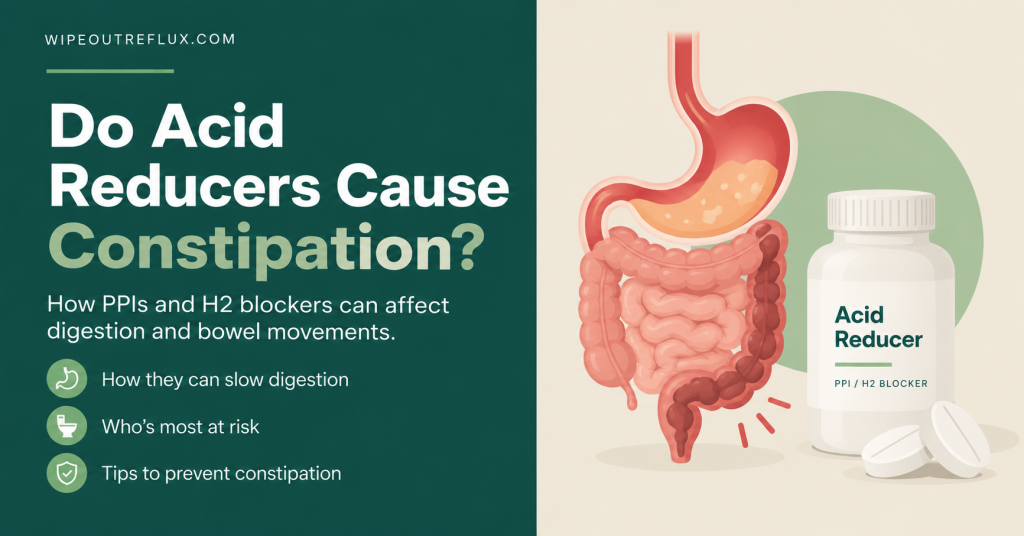
Yes, acid reducers can cause constipation, but in most people it’s uncommon and mild. In clinical trials, constipation was reported by about 1.5% of people taking omeprazole and 1.2% taking famotidine, and pantoprazole lists it as a less common side effect. Acid reducers are actually more likely to cause diarrhea than constipation.
The biggest constipation culprits in the reflux world aren’t PPIs or H2 blockers at all. They’re the calcium- and aluminum-based antacids people take alongside them, such as Tums and some Gaviscon and Maalox products. Changes to your diet when you’re managing reflux, like cutting out coffee, fruit and fiber-rich foods, can also slow things down.
If you’ve started omeprazole, pantoprazole or famotidine and you’re constipated, it’s usually manageable with fiber, fluids, movement and a look at any other products you’re taking. If it’s severe, persistent or comes with red flags like blood or weight loss, speak to your doctor.
Key Takeaways
- PPIs (omeprazole, pantoprazole, esomeprazole) and H2 blockers (famotidine) can cause constipation, but only in a small minority of people.
- Omeprazole’s prescribing information lists constipation at 1.5%, versus 3.7% for diarrhea. Famotidine lists constipation at 1.2% and diarrhea at 1.7%.
- Pantoprazole lists diarrhea among its most common side effects, while constipation appears in the less common list.
- Antacids containing calcium carbonate or aluminum hydroxide are far more constipating than PPIs or H2 blockers. Magnesium-based antacids tend to do the opposite.
- PPIs change the gut microbiome, slow stomach emptying and raise the risk of small intestinal bacterial overgrowth (SIBO), all of which can alter bowel habits in either direction.
- PPIs can make magnesium oxide laxatives less effective, because magnesium oxide needs stomach acid to work properly.
- Reflux diets often cut fiber, coffee and fruit, which can cause constipation on their own.
- Constipation itself can worsen reflux by raising pressure in the abdomen, so it’s worth fixing.
Do Acid Reducers Cause Constipation?
“Acid reducers” covers two main groups of drugs, and they work in different ways:
- Proton pump inhibitors (PPIs): omeprazole (Prilosec), esomeprazole (Nexium), pantoprazole (Protonix), lansoprazole (Prevacid) and others. These switch off the acid pumps in your stomach lining.
- H2 blockers: famotidine (Pepcid) and cimetidine. These block the histamine signal that tells your stomach to make acid.
Antacids like Tums, Rolaids and Maalox are often lumped in with these, but they don’t reduce acid production. They neutralize acid that’s already there, and as you’ll see below, they’re a much bigger constipation risk.
Both PPIs and H2 blockers can cause constipation, but it’s not one of their most common side effects. When I hear from readers who’ve become constipated after starting reflux medication, the drug itself is often only part of the story.
Does Omeprazole Cause Constipation?
It can, but it’s uncommon. In the clinical trials listed in omeprazole’s US prescribing information, constipation was reported by 1.5% of people. The most common side effects were headache (6.9%), abdominal pain (5.2%), nausea (4%), diarrhea (3.7%), vomiting (3.2%) and gas (2.7%).
So if omeprazole is going to change your bowel habits, it’s actually more than twice as likely to loosen them as to slow them down. That fits with a small study of patients treated with a PPI for ulcers, which found it significantly increased bacteria in the small intestine and sped up intestinal transit [Lewis et al., Alimentary Pharmacology & Therapeutics, 1996].
That said, everyone’s gut responds differently, and some people do notice they’re more sluggish on omeprazole. I’ve covered the full list of effects in my guide to omeprazole side effects.
Does Pantoprazole Cause Constipation?
Pantoprazole follows the same pattern. In GERD trials, the most common side effects reported above 2% were headache (12.2%), diarrhea (8.8%), nausea, abdominal pain, vomiting, gas, dizziness and joint pain. Constipation appears in the list of side effects reported at 2% or less.
Esomeprazole, lansoprazole and the other PPIs have broadly similar profiles. Constipation is possible with any of them, but diarrhea is more often reported.
Does Famotidine Cause Constipation?
Again, it can, but it’s not common. Famotidine’s prescribing information lists the side effects reported in more than 1% of people in controlled trials as headache (4.7%), dizziness (1.3%), constipation (1.2%) and diarrhea (1.7%).
Famotidine suppresses acid less completely than a PPI, so it tends to have a smaller knock-on effect on digestion and gut bacteria. If you’re weighing the two up, my comparison of famotidine vs omeprazole covers the trade-offs.
Why Acid Reducers Can Cause Constipation
Stomach acid isn’t just there to cause heartburn. It does several jobs further down the line, and lowering it can affect your bowels in a few ways.
1. Slower stomach emptying
Acid and pepsin start breaking down solid food in your stomach. When acid is suppressed, that process is less efficient, and food sits in the stomach longer. A systematic review found PPIs consistently delay the emptying of solid meals from the stomach, likely because they impair acid-dependent pepsin digestion [Sanaka et al., Digestive Diseases and Sciences, 2010].
The same effect has been seen with H2 blockers. In healthy volunteers, ranitidine, famotidine and omeprazole all slowed gastric emptying after a meal [Parkman et al., Gut, 1998]. Slower emptying is more often linked to bloating and fullness than to constipation, but in some people it can contribute to an overall slower gut.
2. Changes to your gut bacteria
Stomach acid acts as a barrier that kills off many of the bacteria you swallow. Take that barrier down and more of them survive the trip into your intestines.
In a study of over 1,800 twins, PPI users had lower gut microbial diversity, fewer of the usual gut bacteria and more bacteria normally found in the mouth and throat. The researchers concluded that PPIs remove the low-pH barrier between the upper digestive tract and the lower gut [Jackson et al., Gut, 2016]. A separate Dutch study of 1,815 people across three cohorts found similar changes, and concluded that the effect of PPIs on the gut microbiome was greater than that of antibiotics or other commonly used drugs [Imhann et al., Gut, 2016].
Your gut bacteria help regulate bowel movements, so shifting their balance can change your bowel habits, sometimes towards constipation and sometimes towards diarrhea. If this side of things interests you, I’ve written about gut health and acid reflux in more depth.
3. SIBO
When more bacteria reach the small intestine, some people develop small intestinal bacterial overgrowth (SIBO). A meta-analysis of 19 studies covering more than 7,000 people found PPI use moderately increases SIBO risk [Su et al., Journal of Gastroenterology, 2018].
SIBO usually causes bloating and gas, and it can go either way with bowel habits. The methane-producing type is particularly linked with constipation. A population study also found PPI users were more likely to meet the criteria for IBS, even after accounting for reflux and indigestion [Choung et al., Neurogastroenterology & Motility, 2013]. My articles on SIBO and acid reflux and IBS and acid reflux cover how these conditions overlap.
4. PPIs can stop magnesium laxatives working
This is one most people don’t know about. Magnesium oxide, a common laxative and supplement, needs stomach acid to convert it into a form that draws water into the bowel. With your acid suppressed, it doesn’t work as well.
In an analysis of the FDA’s adverse event reporting database, people taking magnesium preparations for opioid-related constipation had significantly more constipation when they were also taking acid suppressants, especially PPIs [Maezawa et al., Die Pharmazie, 2023]. So if you take magnesium oxide to stay regular and then start a PPI, you might suddenly find it’s stopped working.
Long-term PPI use can also lower your blood magnesium levels by reducing how much you absorb, which I cover in omeprazole and low magnesium.
The Bigger Culprit: Antacids
If you’re constipated and you’re taking antacids for breakthrough heartburn, look at those first. The active ingredient makes a big difference:
- Calcium carbonate (Tums, Rolaids, some Gaviscon products): commonly causes constipation, especially with regular use.
- Aluminum hydroxide (in some Maalox, Mylanta and Gaviscon products): very constipating. It’s often combined with magnesium to balance this out.
- Magnesium hydroxide or carbonate (Milk of Magnesia, some Maalox and Mylanta products): tends to cause looser stools, as magnesium draws water into the bowel.
- Sodium bicarbonate (baking soda, Alka-Seltzer): not usually constipating, but very high in sodium.
Many people take several Tums a day on top of their PPI and never connect the two. If you use calcium carbonate regularly, my guide to whether Tums are safe for acid reflux is worth a read.
Alginates are a good alternative for breakthrough symptoms, but check the label. Gaviscon Advance in the UK uses sodium alginate with potassium bicarbonate, while some other Gaviscon formulas contain calcium carbonate or aluminum hydroxide. I explain the differences in Tums vs Gaviscon and my guide to alginates for acid reflux.
Is It the Medication or Your Reflux Diet?
Here’s something I see all the time. Someone gets diagnosed with reflux, starts a PPI and overhauls their diet in the same week. A few weeks later, they’re constipated and blame the medication.
But a typical reflux diet often removes several things that keep you regular:
- Coffee. Caffeinated coffee is a genuine bowel stimulant. In one study, it triggered colon activity similar to a full meal, 60% stronger than water [Rao et al., European Journal of Gastroenterology & Hepatology, 1998]. Quit coffee for your reflux and your bowels may notice. If you want to keep it, see my picks for low-acid coffee brands.
- Fruit. Citrus, berries and many other high-fiber fruits are often the first things cut on a low-acid diet.
- Vegetables and beans. Onions, garlic, tomatoes and beans are common trigger lists, and they’re good fiber sources too.
- Fluids. Some people drink less to avoid filling their stomach, or cut out drinks they’d normally have.
- Food volume. Smaller meals and earlier cut-offs are great for reflux but can mean less food moving through.
A well-planned reflux diet doesn’t have to be low in fiber. Oats, bananas, melon, pears, sweet potato, root vegetables, leafy greens, whole grains and many beans and lentils (if they suit you) are reflux-friendly and keep things moving. The trick is replacing what you remove rather than just cutting. That’s a big part of how I set up the Wipeout Diet Plan, so you’re not left with a bland, low-fiber diet that fixes one problem and causes another.
Why Constipation Matters for Reflux
Constipation isn’t just uncomfortable. Straining and a backed-up bowel raise pressure inside your abdomen, which pushes up on your stomach and can make reflux worse. Bloating and slow transit also make people feel full and uncomfortable after meals.
So fixing constipation isn’t a side quest. It’s part of getting your reflux under control.
What to Do If an Acid Reducer Is Making You Constipated
Here’s how I’d approach it, roughly in this order:
- Check your antacids. If you’re taking calcium carbonate or aluminum-based antacids regularly, cut back or switch to a calcium-free alginate.
- Increase fiber gradually. Add reflux-friendly sources like oats, pears, bananas, chia or ground flaxseed, root vegetables and whole grains. Go slowly to avoid extra gas and bloating.
- Drink enough water. Fiber needs fluid to work. Plain water is ideal, and my guide to the best water for acid reflux covers your options.
- Move after meals. A 10 to 15 minute walk helps both digestion and bowel movement, and it’s good for reflux too.
- Think about laxative choice. If you need one and you’re on a PPI, magnesium oxide may be less effective. Osmotic laxatives like polyethylene glycol (Miralax, Movicol) don’t rely on stomach acid. Ask your pharmacist what suits you.
- Consider probiotics. Evidence is mixed, but some people find them helpful when their microbiome has shifted. I’ve reviewed the best probiotics for acid reflux.
- Review whether you still need the drug. Many people stay on PPIs for longer than they need to. If you and your doctor decide to come off, taper slowly to avoid rebound acid. My guide to getting off PPIs walks you through it.
- Ask about switching. If one drug seems to be the problem, switching to a different PPI or to an H2 blocker may help. My guide to alternatives to famotidine covers other options too.
Don’t stop prescribed medication suddenly without talking to your doctor, especially if you have erosive esophagitis, Barrett’s esophagus or an ulcer.
When to get checked
See your doctor promptly if constipation comes with blood in your stool, black or tarry stools, unexplained weight loss, severe abdominal pain, vomiting, or a lasting change in bowel habits, particularly if you’re over 50. These aren’t typical medication side effects and need proper assessment.
Conclusion
Acid reducers can cause constipation, but it’s not common. Omeprazole, pantoprazole and famotidine all list constipation as a possible side effect, yet each is more likely to loosen your stools than to slow them down. Where they do cause constipation, it’s usually through slower stomach emptying, changes to your gut bacteria, SIBO, or by making magnesium laxatives less effective.
Often, though, the real cause is something sitting alongside the medication: calcium- or aluminum-based antacids, a reflux diet that’s cut out coffee, fruit and fiber, or not drinking enough. Sorting those out usually fixes the problem without changing your prescription.
This is exactly why I built the Wipeout Diet Plan the way I did. It was designed first and foremost for LPR, the stubborn throat-based form of reflux, but because it works on the same underlying mechanisms, it’s just as effective for GERD and everyday heartburn. Crucially, it’s not just a list of foods to cut. It shows you what to eat instead, so you keep fiber and variety in your diet, protect your gut and can rely less on medication over time.
If you’d rather start with something lighter, the Wipeout Food Reference Guide is the essential companion, listing the foods and drinks that are safe for acid reflux and LPR along with their pH values, so you can find reflux-friendly, fiber-rich swaps at a glance.
Frequently Asked Questions
Can omeprazole cause constipation?
Yes, but it’s uncommon. Around 1.5% of people in omeprazole’s clinical trials reported constipation, compared with 3.7% who reported diarrhea. If you’re constipated on omeprazole, also check whether you’re taking calcium-based antacids or have changed your diet.
Which acid reducer is least likely to cause constipation?
PPIs and H2 blockers all have low constipation rates, typically around 1 to 2%. Famotidine suppresses acid less completely and may have less effect on gut bacteria. The products most likely to cause constipation are calcium carbonate and aluminum hydroxide antacids.
How long does constipation from omeprazole last?
Medication-related constipation often settles within a few weeks as your gut adjusts. If it continues beyond that, it’s worth looking at other causes, including diet, fluids and antacids, and speaking to your doctor or pharmacist.
Do Tums cause constipation?
Yes, they can. Tums contain calcium carbonate, which is a common cause of constipation, especially if you take them regularly. A calcium-free alginate may be a better option for breakthrough reflux.
Can acid reducers cause bloating and gas?
Yes. Gas and abdominal pain are among the more common side effects of PPIs. Slower stomach emptying, changes to gut bacteria and SIBO can all contribute to bloating.
What laxative is best if I’m taking a PPI?
Osmotic laxatives like polyethylene glycol (Miralax, Movicol) work independently of stomach acid. Magnesium oxide may be less effective, because it needs acid to work properly. Check with your pharmacist before starting any laxative.
Can constipation make acid reflux worse?
It can. Straining and a full bowel increase pressure in your abdomen, which pushes up on your stomach and can encourage reflux. Keeping your bowels regular is part of managing reflux well.
Research & References
- [Lewis et al., Alimentary Pharmacology & Therapeutics, 1996] — In 20 patients treated with a PPI for peptic ulcers, duodenal bacterial counts rose significantly and intestinal transit sped up.
- [Sanaka et al., Digestive Diseases and Sciences, 2010] — Systematic review finding PPIs consistently delay gastric emptying of solid meals, likely by impairing acid-dependent pepsin digestion, while effects on liquids are inconsistent.
- [Parkman et al., Gut, 1998] — In healthy volunteers, therapeutic doses of ranitidine, famotidine and omeprazole all slowed gastric emptying after a meal while increasing antral contractions.
- [Jackson et al., Gut, 2016] — Study of 1,827 twins finding PPI users had lower gut microbial diversity, fewer gut commensals and more oral and upper-gut bacteria.
- [Imhann et al., Gut, 2016] — Population study of 1,815 people showing PPI use was linked to significant changes in the gut microbiome, with a larger effect than antibiotics or other common drugs.
- [Su et al., Journal of Gastroenterology, 2018] — Meta-analysis of 19 studies (7,055 people) concluding PPI use moderately increases the risk of small intestinal bacterial overgrowth.
- [Choung et al., Neurogastroenterology & Motility, 2013] — Population-based study finding PPI use was associated with IBS (odds ratio 1.4), independent of coexisting GERD or dyspepsia.
- [Maezawa et al., Die Pharmazie, 2023] — FDA adverse event database analysis showing constipation was significantly more common when magnesium laxatives were combined with acid suppressants, especially PPIs.
- [Rao et al., European Journal of Gastroenterology & Hepatology, 1998] — Colonic manometry study showing caffeinated coffee stimulates colon motor activity similar to a meal, 60% more than water and 23% more than decaf.

David Gray
12 years living with LPR · Consultant & researcher
I've lived with LPR for twelve years — the misdiagnoses, the PPI courses that did nothing, the slow work of figuring out what actually helps. Wipeout Reflux is where I translate the research into plain terms for people stuck in the same place. Every claim here is sourced to peer-reviewed work, and I consult one-to-one with LPR sufferers.