
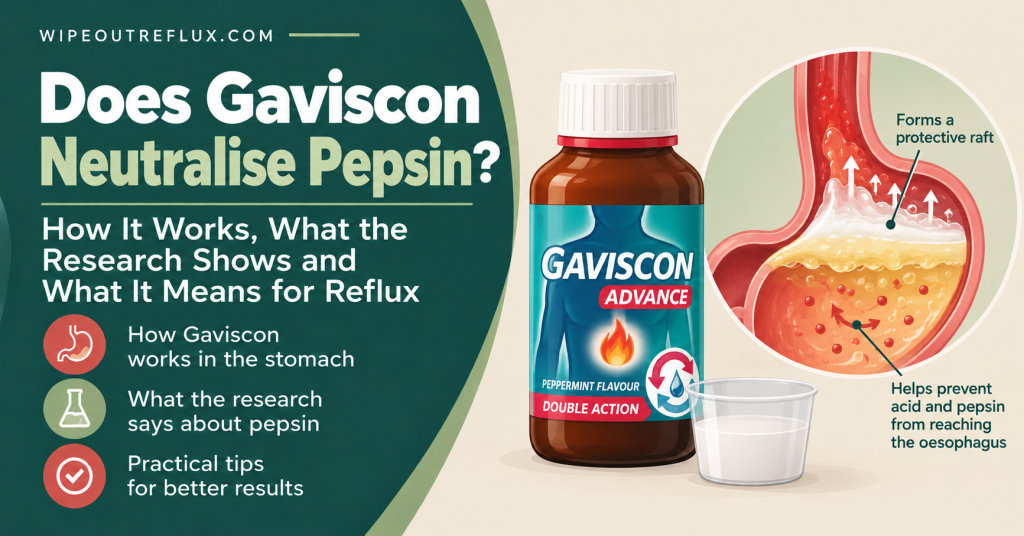
Not exactly. Gaviscon Advance doesn’t destroy pepsin the way you might hope, but it does fight it in three ways. It forms a raft that blocks a lot of reflux from reaching your throat in the first place. It traps pepsin inside that raft and partly reduces its activity in lab testing. And it briefly coats the lining of your esophagus.
What it can’t do is switch off pepsin that’s already stuck to the tissue in your throat. That pepsin stays dormant and can reactivate later when something acidic comes along. So Gaviscon Advance is one of the best tools for LPR, but it works by stopping new pepsin arriving, not by cleaning up what’s already there.
One important catch: this applies to Gaviscon Advance, the UK alginate formula. The regular Gaviscon sold in US pharmacies is mainly an antacid and hasn’t been shown to do any of this.
Key Takeaways
- Gaviscon Advance doesn’t permanently neutralize pepsin. Pepsin is only inactivated at a neutral pH, and it stays stable until about pH 8.
- Its main benefit is blocking reflux, so less pepsin reaches your throat.
- In lab studies, the Gaviscon Advance raft trapped pepsin and bile acids and reduced pepsin activity beyond what neutralizing acid alone would do.
- Alginate sticks to the esophageal lining for around 10 minutes after swallowing, giving short-lived topical protection.
- It can’t reach pepsin already embedded in throat tissue. Diet is what stops that pepsin being reactivated.
- For LPR, the studied dose is 10 ml after each meal and at bedtime.
- Don’t eat or drink for at least 30 minutes after a dose, and the bedtime dose matters most.
- US Gaviscon Extra Strength is an aluminum-magnesium antacid, not a high-dose alginate.
Why Pepsin Is the Real Problem in Silent Reflux
When I first got LPR, I assumed acid was the thing burning my throat. It took me a long time to understand that pepsin, the digestive enzyme your stomach makes to break down protein, is the bigger troublemaker. If you want the full background, I cover it in what is pepsin.
Here’s why it matters. Pepsin works hardest at around pH 2 and goes inactive at pH 6.5 or higher. But inactive doesn’t mean dead. It stays stable up to about pH 8, and when the pH drops again it switches back on. In one lab study, pepsin left at pH 7 for 24 hours still kept 79% of its activity once it was re-acidified [Johnston et al., The Laryngoscope, 2007].
Your throat sits at around pH 6.8. So pepsin that lands there during a reflux event sits quietly in the tissue, then wakes up when the next acidic reflux, drink or meal comes along. That’s the cycle behind the throat clearing, hoarseness and lump-in-the-throat feeling. I explain this in more depth in how pepsin reactivates in the throat.
That’s also why acid-suppressing drugs often disappoint in LPR. They make the reflux less acidic, but the reflux still happens and still carries pepsin. See why PPIs don’t work for LPR.
How Gaviscon Advance Fights Pepsin
1. It blocks the reflux that carries pepsin
This is the big one. When Gaviscon Advance meets stomach acid, it forms a thick alginate gel that floats on top of your stomach contents, right where reflux starts. Imaging studies show the raft sitting over the “acid pocket” at the top of the stomach. In one study, an alginate-antacid moved this acid pocket below the diaphragm in 71% of patients, compared with 21% on an antacid alone, and cut acid reflux episodes [Rohof et al., Clinical Gastroenterology and Hepatology, 2013].
Less reflux reaching your throat means less fresh pepsin landing there. Everything else is a bonus on top of this.
2. It traps pepsin and reduces its activity
The raft doesn’t just sit there as a lid. In a series of lab models, Gaviscon Advance reduced pepsin activity in a dose-dependent way, over and above its acid-neutralizing effect. It also slowed the spread of pepsin and bile acids, and the raft was able to pull both out of a simulated reflux event [Strugala et al., Journal of Pharmacy and Pharmacology, 2009].
Alginates themselves seem to inhibit pepsin directly. Earlier lab work showed alginates reduce pepsin activity in proportion to their concentration [Strugala et al., International Journal of Pharmaceutics, 2005], and a later study measured reductions of up to about 54% [Chater et al., Carbohydrate Polymers, 2015].
So “fight” is a fair word. “Neutralize” in the sense of permanently disabling pepsin is not. These are test-tube findings, and a partial reduction in activity isn’t the same as deactivation.
3. It coats the lining for a short time
Alginate is sticky. When researchers measured how long a 10 ml dose of Gaviscon Advance clung to the lower esophagus, it lasted around 10 minutes in healthy volunteers and 9 minutes in heartburn patients, much longer than a placebo liquid [Sonmez et al., Alimentary Pharmacology and Therapeutics, 2020]. That’s a brief protective layer, not all-day armor, but it’s one more reason to take it slowly and not wash it down.
What Gaviscon Can’t Do
Gaviscon Advance can’t reach pepsin that’s already bound inside your throat tissue. It works in your stomach and on the way down. It doesn’t sit on your vocal cords.
That’s where the other half of an LPR plan comes in. To stop dormant pepsin waking up, you need to stop feeding it acid. That means cutting acidic foods and drinks, especially the ones you sip throughout the day. I go through the practical options, including alkaline water, in how to neutralize pepsin in the throat and gargling and throat rinses for pepsin.
Researchers are also working on drugs that block pepsin directly. The most advanced is fosamprenavir, which I cover in fosamprenavir for LPR. Until that’s available, alginate plus a low-acid diet is the best combination we have.
How to Take Gaviscon Advance for LPR
Most people take Gaviscon wrong for silent reflux. They take it when their throat feels bad, which is too late. Here’s the routine that matches the clinical trials and what I’ve found works.
The dose
In the main LPR trial, people took 10 ml of Gaviscon Advance liquid four times a day: after each meal and at bedtime [McGlashan et al., European Archives of Oto-Rhino-Laryngology, 2009]. That also fits the product’s licensed adult dose of 5 to 10 ml after meals and at bedtime, up to four times a day [Gaviscon Advance Peppermint Oral Suspension, Summary of Product Characteristics, Reckitt Benckiser Healthcare (UK)].
Step by step
- Take it after you eat, not before. The raft needs food in your stomach to float on. Aim for straight after your meal, or within about 30 minutes.
- Shake the bottle well. The alginate settles, and a weak first pour means a weak raft.
- Swallow it slowly. Let it coat on the way down rather than gulping it.
- Don’t drink anything for at least 30 minutes. A big drink can break the raft up and wash the coating away. If you must, take a small sip.
- Never skip the bedtime dose. Lying flat is when reflux reaches the throat most easily. Take it as the very last thing before bed, after brushing your teeth.
- Space it from other medicines. Leave about 2 hours between Gaviscon Advance and other tablets, especially thyroid medication, iron and some antibiotics.
Liquid or tablets?
For LPR, I’d use the liquid at home, especially at bedtime. It forms a raft quickly and coats as it goes down. Tablets are fine when you’re out, as long as you chew them thoroughly. Two tablets give the same alginate as 10 ml of liquid. I compare the options in Gaviscon Advance vs Extra Strength.
How long before it helps?
In the trial, symptom scores had dropped significantly by the 2-month check and stayed lower at 6 months. Throat examination findings had improved by 6 months [McGlashan et al., European Archives of Oto-Rhino-Laryngology, 2009]. So give it at least 8 weeks of consistent use before you judge it.
Do you need a PPI as well?
Not necessarily. A study of LPR patients at a UK voice clinic found that Gaviscon Advance alone reduced symptom scores just as much as Gaviscon Advance plus a twice-daily PPI, after 3 months [Wilkie et al., European Archives of Oto-Rhino-Laryngology, 2018]. If you’re already on a PPI, don’t stop it suddenly. Talk to your doctor and read my guide to getting off PPIs and acid rebound.
Common mistakes
- Taking it only when symptoms flare, instead of on a schedule
- Taking it on an empty stomach, when there’s nothing for the raft to sit on
- Following it with a big glass of water, coffee or juice
- Buying US Gaviscon and expecting the same effect
- Relying on it while still eating and drinking acidic foods that reactivate pepsin
That last one is the mistake I see most in my consults. Gaviscon cuts the amount of pepsin arriving. Your diet decides whether the pepsin already there keeps getting switched back on. The Wipeout Diet Plan is built around exactly that problem, so it pairs naturally with an alginate routine.
Does US Gaviscon Neutralize Pepsin?
US Gaviscon Extra Strength is a different product. Its active ingredients are aluminum hydroxide and magnesium carbonate, which neutralize stomach acid. Alginate is only listed as an inactive ingredient, in an amount that isn’t stated. There’s no evidence it traps pepsin or helps LPR.
Neutralizing stomach acid can lower pepsin activity while the antacid is working, but it doesn’t stop reflux happening and doesn’t deactivate the pepsin that comes up. If you’re in the US, see how to get Gaviscon Advance in the US, or the closest home-grown alternative in Reflux Gourmet vs Gaviscon. For the wider category, see alginates for acid reflux.
Side Effects and Who Should Be Careful
- Sodium: Gaviscon Advance is high in sodium, so take care if you’re on a low-salt diet or have heart failure or high blood pressure.
- Potassium: it contains potassium bicarbonate, so check with your doctor if you have kidney disease.
- Medicines: keep a 2-hour gap from other tablets.
- Long-term use: if you need it every day for more than a few weeks, it’s worth getting your symptoms properly assessed.
My full guide to dosing, side effects and buying it is in Gaviscon Advance for LPR.
Conclusion
Gaviscon Advance won’t permanently neutralize pepsin, and nothing you swallow can reach the pepsin already sitting in your throat tissue. What it does very well is cut down how much pepsin reaches your throat in the first place. It blocks reflux with a raft, traps pepsin and partly dampens its activity, and briefly coats your esophagus. Taken properly, 10 ml after meals and at bedtime with nothing to drink afterwards, it has real trial evidence behind it in LPR.
But it’s only half the job. The pepsin that’s already there gets reactivated by acidic food and drink, and that’s where most people stall. The Wipeout Diet Plan is my complete plan for stopping that cycle. It was built first for silent reflux, where pepsin is the main problem, though the same approach works just as well for GERD and everyday heartburn. It’s what I recommend alongside Gaviscon Advance in my consults.
If you want something lighter to start with, the Wipeout Food Reference Guide lists the foods and drinks that are safe for acid reflux and LPR, along with their pH values, so you know exactly what won’t wake pepsin back up.
Frequently Asked Questions
Will Gaviscon fight pepsin?
Gaviscon Advance does. Its raft blocks reflux so less pepsin reaches your throat, and in lab studies it trapped pepsin and reduced its activity. It doesn’t permanently deactivate pepsin, though, and it can’t reach pepsin already in your throat tissue.
Does Gaviscon Advance remove pepsin from the throat?
No. It works in your stomach and esophagus. Pepsin already bound to throat tissue stays there until it’s cleared naturally, which is why avoiding acidic foods and drinks that reactivate it is so important.
What is the best time to take Gaviscon Advance for LPR?
After each meal and at bedtime. The bedtime dose is the most important because reflux reaches the throat most easily when you’re lying down. Don’t eat or drink for at least 30 minutes afterwards.
How much Gaviscon Advance should I take for silent reflux?
The main LPR trial used 10 ml four times a day: after meals and at bedtime. That’s within the licensed adult dose of 5 to 10 ml up to four times daily. Check with your doctor or pharmacist if you have kidney or heart problems.
Can I drink water after taking Gaviscon?
Try to wait at least 30 minutes. A large drink can break up the raft and wash off the coating. A small sip is fine if you really need it.
Does alkaline water neutralize pepsin better than Gaviscon?
They do different jobs. Alkaline water around pH 8.8 can help deactivate pepsin it comes into contact with, while Gaviscon Advance stops more pepsin arriving. Many people with LPR use both, alongside a low-acid diet.
Does regular Gaviscon work for pepsin?
UK regular Gaviscon contains half the alginate of Advance, so it forms a weaker raft. US Gaviscon is mainly an antacid with very little alginate. For pepsin and LPR, Gaviscon Advance is the version with the evidence.
Research & References
- [Johnston et al., The Laryngoscope, 2007] — Pepsin is most active at pH 2, inactive at pH 6.5 and above, but stable until pH 8 and can be reactivated; it kept 79% of its activity after 24 hours at pH 7 and re-acidification.
- [Rohof et al., Clinical Gastroenterology and Hepatology, 2013] — An alginate-antacid raft displaced the post-meal acid pocket below the diaphragm in 71% of GERD patients versus 21% on antacid alone, and reduced acid reflux episodes.
- [Strugala et al., Journal of Pharmacy and Pharmacology, 2009] — In lab models, Gaviscon Advance inhibited pepsin activity beyond its neutralizing effect, slowed diffusion of pepsin and bile acids, and removed both from a simulated reflux event.
- [Strugala et al., International Journal of Pharmaceutics, 2005] — Alginates reduced pepsin activity in a concentration-dependent, non-competitive way in vitro, with the effect varying by alginate structure.
- [Chater et al., Carbohydrate Polymers, 2015] — Alginates reduced pepsin activity by up to about 54% in vitro, with little effect on trypsin.
- [Sonmez et al., Alimentary Pharmacology and Therapeutics, 2020] — Swallowed Gaviscon Advance adhered to the distal esophageal lining for about 10 minutes in healthy volunteers and 9 minutes in heartburn patients, far longer than placebo.
- [McGlashan et al., European Archives of Oto-Rhino-Laryngology, 2009] — In 49 LPR patients, 10 ml Gaviscon Advance after meals and at bedtime significantly improved symptom scores at 2 and 6 months and throat examination scores at 6 months versus no treatment.
- [Wilkie et al., European Archives of Oto-Rhino-Laryngology, 2018] — In LPR patients followed for 3 months, Gaviscon Advance alone reduced symptom scores as much as Gaviscon Advance plus a high-dose PPI.
- [Gaviscon Advance Peppermint Oral Suspension, Summary of Product Characteristics, Reckitt Benckiser Healthcare (UK)] — Licensed adult dose of 5 to 10 ml after meals and at bedtime, notes in-vitro trapping of bile and pepsin, and cautions on sodium, potassium and drug interactions.

David Gray
12 years living with LPR · Consultant & researcher
I've lived with LPR for twelve years — the misdiagnoses, the PPI courses that did nothing, the slow work of figuring out what actually helps. Wipeout Reflux is where I translate the research into plain terms for people stuck in the same place. Every claim here is sourced to peer-reviewed work, and I consult one-to-one with LPR sufferers.