
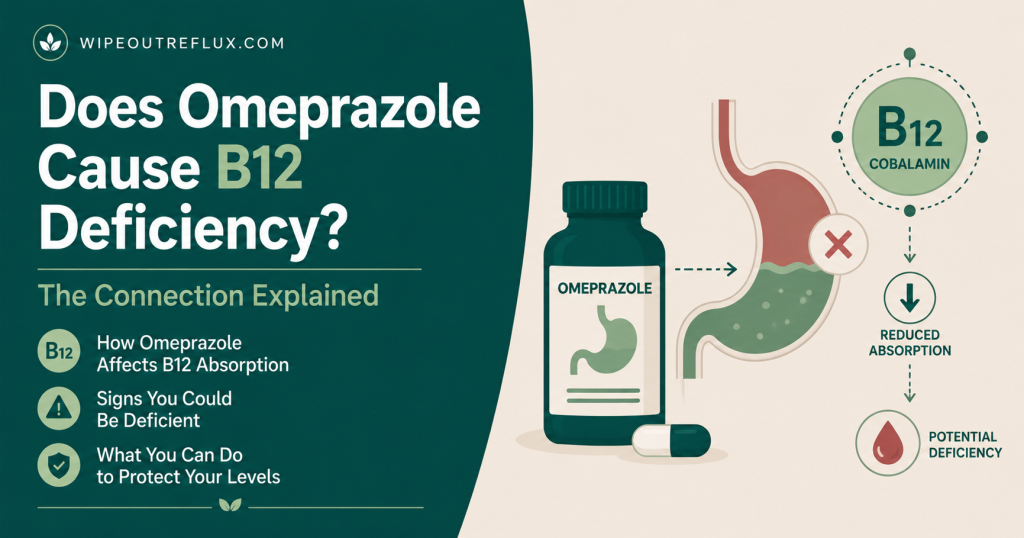
Yes — omeprazole can lower your vitamin B12, but only in a specific way and only over a long time. It reduces how much B12 you absorb from food, because stomach acid and pepsin are needed to prise B12 off the protein it’s attached to. It does not block B12 from supplements or fortified foods, because that form is already free. So the deficiency is real, it’s slow, and it’s trivially easy to prevent.
How slow? Your liver holds a reserve measured in years, so a small daily shortfall takes a long time to surface. The strongest population data found that two or more years of PPI use was associated with a 65% increase in the odds of B12 deficiency, with a dose relationship Lam et al., JAMA, 2013. Two years is the threshold worth remembering.
It matters most if you’re over 60, vegetarian or vegan, taking metformin, on a double dose, or already sitting at the bottom of the normal range. If that’s you, this is about getting a blood test and taking a cheap tablet — not about stopping your medication. For the wider picture on the drug, I’ve covered every long-term concern in omeprazole side effects. This piece goes properly deep on B12 alone.
Key Takeaways
- Omeprazole reduces absorption of protein-bound B12 from food, because acid and pepsin are needed to release it. Free B12 in supplements and fortified foods absorbs normally.
- Two weeks of omeprazole 20 mg cut protein-bound B12 absorption from 3.2% to 0.9% in healthy volunteers — the mechanism isn’t in doubt.
- The clinical evidence is mixed: one meta-analysis found a pooled odds ratio of 1.42, another found no difference at all. Almost all of it is observational.
- Your liver holds roughly two to five years of B12 — which is exactly why this risk gets missed.
- Neurological damage can appear before anaemia. In one classic series, 28% of patients with nerve damage from B12 deficiency had no anaemia and normal red cell size — and that damage doesn’t always fully reverse.
- Folic acid can correct the anaemia while nerve damage quietly progresses, so B12 must be checked before folate is replaced.
- Serum B12 alone is unreliable — methylmalonic acid, homocysteine and active B12 (holotranscobalamin) tell you more.
- Oral B12 works fine here, because supplemental B12 doesn’t need stomach acid.
The Mechanism: Why Acid Matters for Food B12 but Not for Supplements
This is the part almost every article gets wrong, and it’s the difference between sensible caution and needless worry. Absorbing B12 from food is a relay race with several handovers, and omeprazole interferes with exactly one of them — the first.
Step one: acid and pepsin cut B12 loose from food protein
B12 in meat, fish, eggs and dairy doesn’t float about freely. It arrives chemically bound to animal protein, and that bond has to be broken before your body can use it. Two things do that job, and both need an acidic stomach. Hydrochloric acid denatures the protein, unfolding it so it can be attacked. Pepsin then chops the protein up and releases the B12 — and pepsin only exists in active form when the stomach is acidic, since it’s secreted as inactive pepsinogen and needs a pH below about 4 to convert. (It’s the same enzyme that causes so much trouble in silent reflux, explained in what is pepsin.)
Omeprazole raises gastric pH from around 1.5–2 to somewhere between 4 and 6 for most of the day. So you lose the acid and most of the enzyme — a double hit on this one step.
Step two: intrinsic factor, which omeprazole leaves alone
Once freed, B12 is carried into the small intestine, handed to intrinsic factor, and absorbed by dedicated receptors at the far end of the ileum. The important point is that omeprazole doesn’t meaningfully impair intrinsic factor. It’s secreted in huge excess relative to need, and PPIs don’t destroy the cells making it. That’s why PPI-related depletion looks nothing like pernicious anaemia, where intrinsic factor is destroyed outright and absorption collapses.
Why supplements and fortified foods absorb fine
Now the payoff. The B12 in a tablet, a fortified cereal or a spray is crystalline — already free, bound to nothing. It has no step one to fail; it joins the relay at the intrinsic factor stage, which is working normally. There’s a second route too: roughly 1% of any oral dose is absorbed by simple passive diffusion, needing neither acid nor intrinsic factor. That’s a trickle from a normal meal, but from a 1,000 microgram tablet it comfortably covers daily requirements — which is why oral B12 works even in pernicious anaemia Wang et al., Cochrane Database of Systematic Reviews, 2018.
So the honest framing: omeprazole makes food a less efficient source of B12. It does not make you unable to absorb B12. Only the first of those applies here.
What the Evidence Actually Shows
The mechanism is settled. The clinical consequence is messier, and I’d rather show you the disagreement than pretend it away.
The absorption studies are unambiguous. In healthy volunteers given omeprazole for two weeks, absorption of protein-bound cyanocobalamin fell from 3.2% to 0.9% on 20 mg daily — a drop of over 70%, and it happened fast Marcuard et al., Annals of Internal Medicine, 1994.
The long-duration cohorts agree. The cleanest evidence comes from patients with Zollinger-Ellison syndrome, who take very high PPI doses for years on end. In a cohort of 131 such patients followed at the NIH — 111 of them on omeprazole for a mean of 4.5 years — serum B12 fell significantly while folate didn’t, and the authors recommended routine monitoring. Worth noting the detail: only 8 patients (6%) actually dropped below the normal range, and the clearest longitudinal decline was in those rendered fully achlorhydric Termanini et al., The American Journal of Medicine, 1998. High dose, long duration, measurable effect. The largest ordinary-population study is the one I opened with: 25,956 people with newly diagnosed B12 deficiency versus 184,199 without, where two or more years of PPI use carried an odds ratio of 1.65 Lam et al., JAMA, 2013. H2 blockers such as famotidine showed a smaller effect — around 1.25 — which makes mechanistic sense, since they suppress acid less completely (I’ve compared the classes in famotidine vs omeprazole).
But the contradictory findings are real. A Dutch study compared 125 elderly people who’d used PPIs for over three years with 125 non-users and found no significant difference in serum B12, homocysteine or red cell size den Elzen et al., Alimentary Pharmacology & Therapeutics, 2008 — in exactly the group you’d expect to be most vulnerable.
Pooling doesn’t resolve it. A systematic review of 25 studies covering 2,852 PPI users and 28,070 non-users found a pooled odds ratio of 1.42 (95% CI 1.16–1.73) Choudhury et al., Expert Review of Gastroenterology & Hepatology, 2023. A 2025 meta-analysis restricted to chronic use with biomarker outcomes found no significant difference in serum B12 or homocysteine at all Parnham & Patient, Cureus, 2025, while a separate 2025 review of older adults on polypharmacy reported serum B12 falling 12–18% over twelve months Shahid et al., Cureus, 2025.
Three things explain most of that inconsistency. Duration and dose vary wildly between studies, so effects that need years to accumulate look like noise in short ones. Confounding runs both ways — long-term users are older and sicker, which inflates the association, but they also get more blood tests and take more multivitamins, which hides it. And most of these studies used serum B12 as the outcome, which is a poor measure of what’s happening inside cells.
There’s no large, long, randomised trial answering this, and there probably never will be. My honest read: the effect is real and mechanistically certain, but modest, heavily duration-dependent, and only clinically important in people who were close to the line anyway. That’s not a reason to stop omeprazole. It’s a reason to have a blood test.
The Timeline: Why This Is a Years Problem, Not a Months One
People often start worrying three weeks into a prescription. You genuinely don’t need to. Your daily requirement is tiny — around 2.4 micrograms — and your stores are not. Most sit in the liver, conventionally quoted at two to five years’ worth of normal turnover Green et al., Nature Reviews Disease Primers, 2017. B12 is also secreted in bile and largely reabsorbed further down, so daily losses are small.
Now put that together with the mechanism. Omeprazole doesn’t stop absorption — it reduces it. You’re not running on empty; you’re running at a slight daily deficit against a very large tank. And a small shortfall over five years empties a big reserve just as surely as a large shortfall over five months.
That’s why the two-year mark keeps appearing in the data, and why the risk keeps climbing past it. It’s also why this gets missed: nobody connects fatigue in 2026 with a prescription started in 2021. By then the drug is background furniture, nobody’s reviewing it, and the symptoms don’t announce themselves as drug-related. Practically — under a year in, B12 is an unlikely culprit for exhaustion unless your stores were already low. Four years in, it belongs firmly on the list.
Who’s Actually at Risk — the Effects Stack
- Older adults. The big one. Atrophic gastritis becomes common with age, independently reducing acid and pepsin, and food-cobalamin malabsorption is a well-described syndrome in the elderly for exactly that reason Carmel, The American Journal of Clinical Nutrition, 1997. Add omeprazole and you’re suppressing what little acid remains — more on this group in acid reflux in older adults.
- Vegetarians and vegans. B12 occurs naturally only in animal foods, so vegans without supplementation are at risk regardless of medication. Vegetarians relying on dairy and eggs are affected too, since that’s protein-bound B12 — precisely the form omeprazole hits.
- Metformin users. Metformin impairs B12 absorption by a separate, calcium-dependent mechanism in the ileum, so the two drugs hit different steps and compound. In 614 patients with type 2 diabetes, B12 was about 34% lower in those taking both than either alone Long et al., Diabetes Care, 2012, and a 2025 analysis confirmed the combination raises deficiency risk beyond either drug individually Jung et al., Journal of Diabetes Investigation, 2025. Treat annual testing as non-negotiable here.
- Anyone on a double or high dose, since the dose-response relationship was clear — and twice-daily dosing is still commonly prescribed for throat symptoms.
- People with already-marginal stores. A B12 of 210 pg/mL is technically normal and functionally precarious. Start from there and you have almost no buffer.
- Gut conditions or previous gut surgery. Crohn’s affecting the terminal ileum, coeliac disease, bariatric surgery and small intestinal bacterial overgrowth all reduce absorption downstream — and SIBO is more common in PPI users, covered in gut health and acid reflux.
One of these alone is usually manageable. Two or three together is where I’d want a test on the calendar rather than a vague resolution to keep an eye on it.
Symptoms — And Why They’re So Easy to Miss
The early symptoms are so unremarkable that almost nobody attributes them to a vitamin, let alone to a reflux drug: fatigue that sleep doesn’t fix, brain fog, poor concentration, low mood or unusual irritability, breathlessness on stairs you used to manage, a sore or unusually smooth red tongue, mouth ulcers, pale skin. Every one of those gets blamed on stress, age, poor sleep, work, or the reflux itself. That’s the trap.
The neurological signs — the ones that matter
B12 maintains myelin, the insulating sheath around nerves. Run short long enough and it degrades, classically in the spinal cord. Watch for:
- Pins and needles, usually starting symmetrically in the feet and hands
- Numbness, or a “walking on cotton wool” sensation
- Loss of balance, especially in the dark or with eyes closed — that’s position sense failing
- Unsteady, wide-based walking, or leg weakness
- Memory problems, confusion or personality change — in older adults this can look like early dementia
- Depression, and less commonly other psychiatric disturbance
Two things about these are genuinely important. First, they can appear without any anaemia at all. The classic teaching is that B12 deficiency causes megaloblastic anaemia with large red cells, so a normal full blood count rules it out. That’s wrong. In a landmark series of 141 patients with neuropsychiatric abnormalities caused by cobalamin deficiency, 40 of them — 28% — had neither anaemia nor macrocytosis. Presenting features were paraesthesia, sensory loss, ataxia, dementia and psychiatric disorders, and diagnosis rested on markedly raised methylmalonic acid and homocysteine Lindenbaum et al., New England Journal of Medicine, 1988.
Second, neurological damage can become permanent. Caught early it usually reverses. Left for a year or two, recovery becomes partial and some deficit can persist. Anaemia corrects; demyelinated nerves don’t always. That asymmetry is the whole reason this article exists.
The Folic Acid Trap
If you take one thing from this page beyond the mechanism, make it this. It’s the most consequential mistake in this area, and it’s made routinely with good intentions.
B12 and folate work together in the same metabolic pathway, and deficiency of either produces an identical megaloblastic anaemia — you cannot tell them apart on a blood film. Folic acid given on its own will partially or fully correct the anaemia of B12 deficiency. What it will not do is fix the nerve damage, which runs through a different arm of B12’s function. So the visible warning sign disappears while the invisible damage carries on.
UK haematology guidelines are blunt: patients with B12 deficiency should not be treated with folic acid unless they’re also receiving adequate B12, because it can mask the deficiency while subacute, irreversible damage to the nervous system continues Devalia et al., British Journal of Haematology, 2014. The interdependence of the two vitamins in the nervous system is reviewed in detail elsewhere Reynolds, The Lancet Neurology, 2006.
Where does it bite? Folate-heavy multivitamins and B-complex supplements (most contain B12 too, which protects you — check yours does, and that the amount isn’t token); pregnancy supplements, folate-heavy by design; and fortified flour and cereals, mandatory in many countries, which push population folate intake up while B12 intake stays put. The rule is simple: if you’re supplementing folate, supplement B12 alongside it, and get B12 checked before starting folate replacement rather than after.
Why Serum B12 Alone Is an Unreliable Test
A standard serum B12 test measures total B12 in blood. Most of that is bound to haptocorrin and metabolically inert — unavailable to your cells. Only the fraction bound to transcobalamin (holotranscobalamin, or “active B12”) actually gets delivered. You can therefore have a perfectly acceptable total B12 while your cells are short. Guidelines say so directly: there’s no gold-standard test, serum B12 is first-line, and second-line methylmalonic acid is needed to clarify uncertainty Devalia et al., British Journal of Haematology, 2014.
- Methylmalonic acid (MMA). Accumulates when B12 runs short inside cells, because the enzyme clearing it needs B12. Raised MMA means functional deficiency at tissue level regardless of what serum B12 says. Kidney impairment also raises it — the main caveat.
- Homocysteine. Rises in B12 deficiency, but also in folate and B6 deficiency, kidney disease and hypothyroidism. Sensitive, not specific; best read alongside MMA.
- Holotranscobalamin (active B12). Measures the usable fraction and falls earlier than total B12, so it’s the first marker to move.
In 11,833 samples with all four markers measured together, the area under the curve for detecting subclinical deficiency was highest for holotranscobalamin (0.92), then MMA (0.91), then total B12 (0.90), with homocysteine trailing at 0.78 Jarquin Campos et al., Disease Markers, 2020.
Translation: if your B12 comes back low-normal — roughly 150–300 pg/mL, or 200–350 pmol/L depending on your lab’s units — and you have symptoms, “normal” is not an answer. Ask for MMA, or active B12 if your lab offers it.
Who Should Get Tested, and What to Ask For
No official body mandates B12 screening for PPI users, which means it won’t happen unless you ask.
Get a baseline if you’ve been on omeprazole two years or more; you’re over 60 and on it at all; you’re vegetarian or vegan; you take metformin; you’re on a double dose; or you have any neurological symptom above, at any duration. Then repeat annually if you’re continuing long term with a risk factor stacked on top, or every two to three years if you’re younger, eat meat and are on a standard dose.
Ask specifically for:
- Serum B12 — the starting point, interpreted cautiously.
- Full blood count including mean cell volume. A raised MCV supports the diagnosis; a normal one doesn’t exclude it.
- Serum folate, so it’s interpreted alongside B12 rather than treated first.
- Ferritin, because iron absorption also depends on gastric acid, the two deficiencies often travel together, and a mixed deficiency can produce a deceptively normal MCV.
- MMA or active B12 if serum B12 is borderline and you have symptoms.
- Magnesium while you’re there — it isn’t on standard panels and won’t be run unless requested. Full story in omeprazole and low magnesium.
One timing note: if you’ve already started supplementing, say so. Supplementation normalises serum B12 quickly and can mask a genuine underlying deficiency — MMA is far more informative there.
What to Actually Do About It
This is one of the easiest problems in medicine to solve, which is genuinely why I’d put B12 near the bottom of the list of reasons to worry about omeprazole. Not because the effect isn’t real — because prevention costs pennies.
Food helps, but only partly. The richest sources are liver, shellfish, oily fish, red meat, eggs and dairy, plus nutritional yeast and fortified plant milks and cereals for anyone avoiding animal foods. The catch is that natural sources are exactly the protein-bound form your medication makes harder to liberate. Eating more helps — a smaller fraction of a bigger amount — but it doesn’t bypass the problem. Fortified foods are the exception, because the B12 added to them is already free.
Oral supplements are the right answer for almost everyone. This follows straight from the mechanism: supplemental B12 needs no acid, and passive diffusion needs no intrinsic factor. A daily 500–1,000 micrograms comfortably covers a PPI-related shortfall. A Cochrane review found oral and intramuscular B12 had similar effects on normalising serum levels, with oral costing considerably less — though the authors rated the evidence low quality, and a single trial within it suggested 2,000 micrograms orally might do better still Wang et al., Cochrane Database of Systematic Reviews, 2018. Cyanocobalamin and methylcobalamin both work; the first is cheaper and more stable.
Sublingual is fine, but not magic. Sprays and melts are sold on the logic that they bypass the gut entirely; in practice much is swallowed and absorbed conventionally. A 2025 systematic review found sublingual and oral routes comparable to injection for raising serum cobalamin and lowering homocysteine Mazur et al., Frontiers in Pharmacology, 2025. Use it if you prefer it, just don’t pay a premium expecting more.
Injections are for specific situations — pernicious anaemia, severe deficiency, and anyone with neurological involvement, where loading doses are given more intensively. PPI-related depletion alone rarely warrants them, but neurological symptoms are a prompt conversation rather than one for your next routine appointment. For how B12 fits alongside everything else worth taking with reflux, see supplements for LPR, and check vitamin D at the same time — see vitamin D and silent reflux.
The Reflux Angle: Risk Without the Benefit
Everything above is about managing a small, preventable risk. But the risk only makes sense if you’re getting something in return. If omeprazole is healing erosive oesophagitis or protecting a Barrett’s segment, a slow drift in B12 is a trivial price. If you’ve been on it four years for throat clearing, hoarseness and a lump-in-the-throat sensation that haven’t shifted, you’re accumulating the cost side of the ledger with nothing on the other.
And in laryngopharyngeal reflux, PPIs frequently underperform for mechanical reasons rather than mysterious ones: they change how acidic the refluxate is, not whether reflux happens, and the main agent injuring the larynx is pepsin, which stays active well above the pH a PPI achieves. I’ve laid out the trial evidence in full, including the positive studies, in why PPIs don’t work for LPR and proton pump inhibitors for LPR. There’s a real irony in it: the same drop in pepsin activity that fails to protect your throat is part of what’s reducing your B12 absorption. Worth adding that some people’s reflux involves too little stomach acid rather than too much — see does low stomach acid cause acid reflux.
If that describes you, the answer isn’t to panic-stop the drug. Stopping abruptly triggers rebound acid hypersecretion, and the resulting flare feels like proof you needed it. The order that works: get the diet and timing changes in place, add a physical barrier such as an alginate, then taper slowly with your doctor — full process in getting off PPIs and acid rebound. If you’re weighing alternatives, the best medication for LPR covers the landscape; if you’re just starting out, how long omeprazole takes to work and the best time to take omeprazole are worth getting right first.
The Bottom Line
Omeprazole does reduce B12 absorption, and the mechanism is beyond dispute: acid and pepsin release B12 from food protein, and the drug switches off both. But it only breaks that one step — supplements, sprays and fortified foods contain free B12 that absorbs perfectly well, which is why this is a manageable inconvenience rather than a serious hazard. Give it two-plus years, stack on age, a vegetarian diet, metformin or a double dose, and it becomes worth actively monitoring. The parts to take seriously are that early symptoms are vague enough to be dismissed, that nerve damage can arrive before any anaemia and doesn’t always fully reverse, that folic acid can hide the blood picture while the nerves deteriorate, and that a “normal” serum B12 isn’t the reassurance it looks like. A test and a cheap tablet close off all of it.
The bigger question sits underneath. Nutrient risks are only worth carrying when the drug is buying you something. If you’re on long-term omeprazole for throat symptoms that haven’t improved, the sensible move isn’t to accept the trade — it’s to work on how often reflux happens rather than only how acidic it is. That means dietary acidity above all, and it’s harder than it sounds, because acid hides where you’d never look: citric acid in packaged food, vinegar in sauces, carbonation, nearly all fruit. The Wipeout Food Reference Guide is the essential companion for exactly that — the allowed and avoid lists for acid reflux and LPR with their real pH values, so you’re working from numbers instead of guesswork.
If you’d rather have the whole thing sequenced properly — what to change, in what order, and how to reintroduce foods once things calm down — the Wipeout Diet Plan goes considerably deeper. I built it around LPR and silent reflux first, since that’s the form that most often defeats medication, but because it targets the same underlying mechanisms it works just as well for GERD, heartburn and everyday acid reflux. Whatever you decide about the drug, decide it with your doctor — and never stop a PPI abruptly on the strength of an article.
Frequently Asked Questions
How long does it take for omeprazole to affect B12 levels?
Absorption drops within weeks, but blood levels take far longer to follow because the liver holds around two to five years of reserve. Clinically meaningful deficiency generally needs at least two years of continuous use, and the risk keeps climbing beyond that.
Will a B12 supplement still work while I’m taking omeprazole?
Yes — this is the key point. Supplemental B12 is crystalline and already free, so it never needs the acid-and-pepsin step omeprazole disrupts, and around 1% is absorbed by passive diffusion without intrinsic factor. A daily 500–1,000 microgram tablet is enough for most people.
Can B12 deficiency cause permanent damage?
The neurological damage can, if untreated for long enough. B12 maintains the myelin sheath around nerves, and prolonged deficiency causes demyelination that may only partially reverse. Caught early, recovery is usually complete. That’s why the neurological symptoms — pins and needles, numbness, balance problems in the dark, memory changes — matter more than the anaemia, and why they can appear first.
Why is a normal B12 blood test not always reassuring?
Serum B12 measures total circulating B12, most of which is bound to a carrier protein that can’t deliver it to cells. You can look normal on paper while your tissues are short. Methylmalonic acid, homocysteine and active B12 (holotranscobalamin) reflect what’s actually reaching your cells, so ask for those if your result is low-normal and you have symptoms.
Should I take folic acid too?
Only alongside B12, never instead of it, and not before B12 has been checked. Folic acid corrects the anaemia of B12 deficiency without touching the nerve damage, so it removes the visible warning sign while the underlying problem progresses.
Should I stop omeprazole because of the B12 risk?
No — not on this basis, and not on your own. B12 depletion is preventable with a supplement costing a few pounds a year, so it’s a poor reason to stop a drug that’s doing a job. It’s a much better reason to ask whether the drug is still doing a job at all. Any taper should be gradual and supervised, because stopping abruptly causes rebound acid hypersecretion.
Research & References
- Marcuard et al., Annals of Internal Medicine, 1994 — Absorption of protein-bound cyanocobalamin in healthy volunteers fell from 3.2% to 0.9% after two weeks of omeprazole 20 mg daily, directly demonstrating that acid suppression impairs release of B12 from food protein.
- Termanini et al., The American Journal of Medicine, 1998 — In a cohort of 131 patients with Zollinger-Ellison syndrome on long-term acid suppression, of whom 111 took omeprazole for a mean of 4.5 years, serum vitamin B12 fell significantly while folate did not; 8 patients (6%) developed subnormal levels, and the authors recommended routine B12 monitoring.
- Lam et al., JAMA, 2013 — Case-control study of 25,956 patients with incident vitamin B12 deficiency versus 184,199 controls; two or more years of PPI use was associated with a 65% increase in the odds of deficiency (OR 1.65), with a smaller effect for H2 blockers and a dose relationship.
- den Elzen et al., Alimentary Pharmacology & Therapeutics, 2008 — Comparison of 125 elderly people using PPIs for more than three years with 125 non-users, finding no significant difference in serum vitamin B12, homocysteine or mean corpuscular volume.
- Choudhury et al., Expert Review of Gastroenterology & Hepatology, 2023 — Systematic review and meta-analysis of 25 studies covering 2,852 PPI users and 28,070 non-users, finding a pooled odds ratio for vitamin B12 deficiency of 1.42 (95% CI 1.16–1.73) with moderate heterogeneity.
- Parnham & Patient, Cureus, 2025 — Systematic review and meta-analysis of six studies (1,587 cases, 2,272 controls) of chronic PPI use, finding no significant difference in serum vitamin B12 or total homocysteine between users and controls.
- Shahid et al., Cureus, 2025 — Systematic review of long-term PPI use in older adults on polypharmacy (five studies, 693 participants), reporting a 12–18% reduction in serum vitamin B12 over twelve months alongside inconsistent findings for magnesium.
- Green et al., Nature Reviews Disease Primers, 2017 — Comprehensive review of vitamin B12 deficiency covering absorption physiology, clinical presentation and the staged use of biomarkers in diagnosis.
- Carmel, The American Journal of Clinical Nutrition, 1997 — Review of cobalamin, the stomach and ageing, describing food-cobalamin malabsorption arising from atrophic gastritis and hypochlorhydria in older adults.
- Long et al., Diabetes Care, 2012 — Retrospective review of 614 patients with type 2 diabetes, finding vitamin B12 levels approximately 34% lower in those taking metformin and a PPI together than in those taking either drug alone.
- Jung et al., Journal of Diabetes Investigation, 2025 — Analysis finding that concomitant use of metformin and proton pump inhibitors increases the risk of vitamin B12 deficiency in type 2 diabetes beyond that of either drug alone.
- Lindenbaum et al., New England Journal of Medicine, 1988 — Series of 141 patients with neuropsychiatric abnormalities caused by cobalamin deficiency, of whom 40 (28%) had neither anaemia nor macrocytosis; presentations included paraesthesia, sensory loss, ataxia, dementia and psychiatric disorders, with markedly raised methylmalonic acid and homocysteine.
- Devalia et al., British Journal of Haematology, 2014 — British Committee for Standards in Haematology guidelines on the diagnosis and treatment of cobalamin and folate disorders, noting there is no gold-standard test for B12 status, recommending methylmalonic acid as a second-line test, and warning that folic acid given without adequate B12 can mask deficiency while irreversible neurological damage continues.
- Reynolds, The Lancet Neurology, 2006 — Review of vitamin B12, folic acid and the nervous system, covering their shared metabolic pathway, indistinguishable megaloblastic anaemias and overlapping neuropsychiatric syndromes.
- Jarquin Campos et al., Disease Markers, 2020 — Analysis of 11,833 samples with concurrent B12, holotranscobalamin, methylmalonic acid and homocysteine measurements; for detecting subclinical deficiency the area under the curve was 0.92 for holotranscobalamin, 0.91 for methylmalonic acid, 0.90 for total B12 and 0.78 for homocysteine.
- Wang et al., Cochrane Database of Systematic Reviews, 2018 — Cochrane review of oral versus intramuscular vitamin B12, concluding on low-quality evidence that the two routes have similar effects on normalising serum B12 while oral treatment costs less; roughly 1.2% of an oral dose is absorbed passively without intrinsic factor, which is why oral dosing works in pernicious anaemia.
- Mazur et al., Frontiers in Pharmacology, 2025 — Systematic review and meta-analysis finding sublingual and oral vitamin B12 administration comparable to intramuscular injection for raising serum cobalamin and reducing hyperhomocysteinaemia.

David Gray
12 years living with LPR · Consultant & researcher
I've lived with LPR for twelve years — the misdiagnoses, the PPI courses that did nothing, the slow work of figuring out what actually helps. Wipeout Reflux is where I translate the research into plain terms for people stuck in the same place. Every claim here is sourced to peer-reviewed work, and I consult one-to-one with LPR sufferers.