
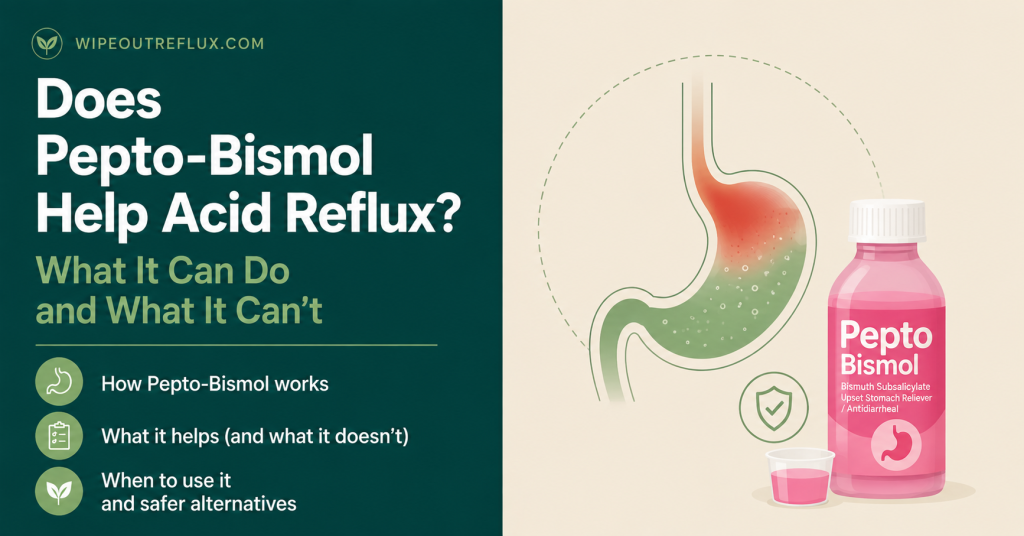
Probably not — at least not for the reflux you’re actually dealing with. Pepto-Bismol can take the edge off a one-off bout of overindulgence heartburn, and there are two old randomised trials showing exactly that. But it isn’t an antacid, it doesn’t meaningfully neutralise stomach acid, it doesn’t coat the oesophagus, and there has never been a study of it in GERD, erosive oesophagitis or silent reflux.
What it is, is an antidiarrhoeal with mild antimicrobial and mucosal effects — genuinely useful for traveller’s diarrhoea and a real component of H. pylori eradication therapy. Reaching for it for chronic reflux is using a tool designed for a different job.
And there’s a catch most people never think about: the “subsalicylate” half of the molecule is aspirin’s cousin, and over 90% of it gets absorbed. You’re taking an NSAID-class compound to treat a condition that NSAIDs are known to aggravate. Here’s the full picture.
Key Takeaways
- Pepto-Bismol’s active ingredient is bismuth subsalicylate, which splits in the stomach into poorly absorbed bismuth salts and readily absorbed salicylic acid.
- Over 90% of the salicylate is absorbed — a full 60 ml dose delivers roughly 500 mg of salicylate, comparable to a couple of standard aspirin tablets.
- It is not an antacid. It has minimal acid-neutralising capacity and does not raise stomach pH the way calcium carbonate does.
- Two randomised trials from the 1980s did show it relieved heartburn faster than placebo — but in acute indigestion and post-overindulgence settings, not chronic reflux disease.
- There are no trials of bismuth subsalicylate in GERD, reflux oesophagitis, or LPR/silent reflux.
- Bismuth quadruple therapy is recommended first-line for H. pylori by the 2024 ACG guideline — that’s the one context where it’s genuinely evidence-based.
- Harmless-looking side effects include black tongue and black stools; the real cautions are salicylate load, Reye’s syndrome risk in children, and interactions with anticoagulants.
- Alginates, antacids and dietary change all have far better claim on your reflux than this does.
What Pepto-Bismol Actually Does
Bismuth subsalicylate is an insoluble salt of trivalent bismuth and salicylic acid. In the acidic environment of the stomach it hydrolyses into two separate things, and they behave completely differently.
The bismuth portion barely gets absorbed — less than 0.005% enters the bloodstream. It stays in the gut lumen, where it does several useful things: it binds to bacterial membranes and disrupts them, inactivates bacterial enterotoxins, and appears to stimulate prostaglandin, mucus and bicarbonate secretion in the gastric mucosa Budisak et al., StatPearls, National Center for Biotechnology Information, 2024. It also reacts with hydrogen sulphide in the colon to form bismuth sulphide, which is why your stool and sometimes your tongue turn black.
The salicylate portion is a different story entirely, and I’ll come back to it.
Notice what’s absent from that list: acid neutralisation. Pepto-Bismol is not formulated as an antacid. It has some very mild buffering, but nothing like the acid-neutralising capacity of calcium carbonate in Tums. If your goal is raising stomach pH, this is the wrong bottle.
The Trials That Do Exist — And What They Actually Measured
I want to be fair here, because “Pepto does nothing for heartburn” would be too strong. Two randomised trials say otherwise.
The first was a randomised, placebo-controlled, double-blind crossover study in 48 adults, each treated for six separate episodes of indigestion — three on bismuth subsalicylate, three on placebo, dosed at symptom onset and repeated every half hour as needed. Bismuth subsalicylate gave greater and faster relief than placebo for nausea, sense of fullness, heartburn, abdominal distension and flatulence. Notably, it did not beat placebo for upper abdominal pain Hailey and Newsom, Archives of Internal Medicine, 1984.
The second recruited 132 volunteers to deliberately overindulge at a simulated cocktail and dinner party. Of the 91 who developed gastric distress, those given bismuth subsalicylate had significantly better relief of nausea, fullness, heartburn, belching, stomach pain and flatulence, and got there faster Berkowitz, Journal of International Medical Research, 1990.
So yes — there’s real randomised evidence that it helps something people call heartburn. But read what those studies were: acute, self-limiting episodes of dietary indiscretion in otherwise healthy people, measured over minutes to hours, in the 1980s. “Heartburn” there is one item on an indigestion symptom checklist, not a diagnosis of reflux disease. That’s the difference between indigestion and acid reflux, and it’s the whole crux of this article.
Nobody has ever run a trial of bismuth subsalicylate in patients with diagnosed GERD, in erosive oesophagitis healing, or in LPR. No pH-impedance study. No endoscopic outcome. Nothing. Forty years of the product being on shelves and the reflux question has simply never been asked properly.
The Salicylate Problem
This is the part that should give you pause, and it’s rarely mentioned.
The salicylate half of bismuth subsalicylate is not trapped in the gut. It’s extensively absorbed — more than 90%, excreted in urine. In a pharmacokinetic study in six men, a 60 ml dose of Pepto-Bismol produced around 500 mg of salicylate recovered in urine, representing 95% of the salicylic acid equivalents in the dose, with peak plasma levels averaging 40 µg/ml within half an hour to three hours Feldman et al., Clinical Pharmacology and Therapeutics, 1981.
Five hundred milligrams of salicylate is roughly what you’d get from a couple of regular aspirin. And salicylates sit squarely on the list of medications that make acid reflux worse — the same class as ibuprofen, capable of direct mucosal irritation and of suppressing the protective prostaglandins that maintain the gastric lining.
To be proportionate: at maximum daily dosing, plasma salicylate stays well below toxic levels, and the manufacturer’s own safety review found extended dosing for up to six weeks produced blood bismuth concentrations far below neurotoxic thresholds Bierer, Reviews of Infectious Diseases, 1990. This isn’t a dangerous product used as directed. But taking a meaningful salicylate load to treat reflux is working against yourself, particularly if you’re using it repeatedly rather than once.
It also matters if you’re already on aspirin, an anticoagulant, methotrexate, or if you have a salicylate sensitivity, a bleeding disorder or kidney impairment.
Where Bismuth Genuinely Earns Its Place
Two situations, neither of them chronic reflux.
Traveller’s diarrhoea and acute infectious diarrhoea
This is the licensed indication and it works. The antimicrobial and toxin-binding actions are real, and the evidence base is decades deep. If that’s why you have a bottle, keep it.
Helicobacter pylori eradication
This is where bismuth is genuinely front-line medicine. The 2024 ACG clinical guideline recommends 14-day bismuth quadruple therapy — a bismuth salt, tetracycline, metronidazole and a PPI — as the preferred initial regimen when antibiotic susceptibility is unknown, and dropped clarithromycin triple therapy from first-line recommendations entirely Chey et al., American Journal of Gastroenterology, 2024.
Bismuth subsalicylate is one of the accepted bismuth salts in that regimen. If you have H. pylori alongside reflux symptoms, and you’re prescribed it as part of quadruple therapy, that’s an entirely different proposition from self-medicating with it. The dose, duration and combination are what make it work.
Side Effects and Who Should Avoid It
The famous ones are cosmetic. Black tongue and black stools are caused by bismuth sulphide and are completely harmless — but they can mask the black, tarry stool of a genuine gastrointestinal bleed, which is a real clinical problem if you’re the one trying to work out what’s going on.
The ones that matter:
- Children and teenagers — the salicylate content means a Reye’s syndrome risk with viral illness, chickenpox or flu. Paediatric guidance is generally to avoid it. This applies to reflux in children too.
- Pregnancy — salicylates aren’t recommended, particularly in the third trimester. If you’re managing reflux in pregnancy, this isn’t the option.
- Anticoagulants and antiplatelets — additive bleeding risk from the salicylate.
- Kidney impairment — salicylate clearance is renal.
- Prolonged use — bismuth encephalopathy is rare and associated with heavy, sustained use, but it exists. Don’t take it daily for months.
It also binds tetracyclines and can interfere with the absorption of some other drugs, so spacing doses matters.
What to Reach For Instead
If reflux is the actual problem, almost everything else on the shelf has a better claim.
Alginates form a physical gel raft that floats on the stomach contents and physically blocks reflux — the only over-the-counter option with a mechanism specifically aimed at reflux rather than acid. Alginates for acid reflux and Gaviscon Advance in particular have proper trial data, including in throat symptoms.
Antacids genuinely neutralise acid for fast, short-lived relief — that’s what Pepto isn’t doing.
Sucralfate forms a protective barrier over damaged mucosa, which is closer to what people imagine Pepto is doing. Sucralfate for LPR covers where that fits.
For a broader comparison, the best over-the-counter options for acid reflux lays out what each category actually does.
All of them share the same limitation, though: they manage an episode after it starts. None reduces how often reflux happens in the first place — which is what the Wipeout Diet Plan is designed around, and why it tends to be the thing that finally changes the pattern rather than the symptom.
Conclusion
Pepto-Bismol is a good product being asked to do something it was never designed for. Its real strengths — antimicrobial action, toxin binding, a role in H. pylori eradication — are genuine and well supported. Its evidence for heartburn amounts to two acute indigestion trials from the 1980s in healthy people who’d overeaten, and nothing at all in reflux disease. It doesn’t neutralise acid, doesn’t coat the oesophagus, doesn’t touch the sphincter, and delivers a real salicylate dose from a drug class known to aggravate the very thing you’re treating. As a one-off after a heavy meal, it’s unlikely to hurt. As a reflux strategy, it’s a dead end.
The uncomfortable truth is that the reason people end up rummaging in the medicine cabinet is that nothing in there addresses why reflux keeps happening. That’s what the Wipeout Diet Plan is built for — a structured, mechanism-first approach to meal size, fat load, trigger foods and timing, so you reduce the number and force of reflux events instead of chasing each episode with something after the fact. I originally designed it around LPR and silent reflux, the stubborn throat-based form where people burn through every over-the-counter product going, but because it works on the same underlying mechanisms it does the job just as well for GERD and ordinary heartburn. And if you want something practical to start with today, the Wipeout Food Reference Guide is the essential companion — every food and drink that’s safe for acid reflux and LPR with its real pH value, so you’re deciding from numbers rather than guesswork.
Keep the Pepto for the trip abroad. It’s excellent at that.
Frequently Asked Questions
Does Pepto-Bismol neutralise stomach acid?
Not to any meaningful degree. It isn’t formulated as an antacid and has minimal acid-neutralising capacity compared with calcium carbonate or magnesium/aluminium antacids. Its effects come from bismuth’s antimicrobial and mucosal actions in the gut lumen, not from raising pH.
Can Pepto-Bismol make reflux worse?
It can, in two ways. The salicylate released is absorbed almost completely and belongs to the NSAID family, which is associated with mucosal irritation and worse reflux. And regular use masks symptoms without addressing the cause, which delays proper treatment.
Is it safe to take Pepto-Bismol every day?
It isn’t intended for daily long-term use. Safety data supports acute use and extended dosing of up to about three to four weeks. Beyond that you’re accumulating a daily salicylate load and, with heavy prolonged use, a small risk of bismuth toxicity. If you need something every day, you need a diagnosis rather than a bottle.
Why does Pepto-Bismol turn your tongue and stool black?
Bismuth reacts with trace hydrogen sulphide in the mouth and gut to form bismuth sulphide, a black compound. It’s harmless and resolves within a few days of stopping. The catch is that it can disguise melaena — the black tarry stool of upper gastrointestinal bleeding — so mention it if you’re being investigated.
Does Pepto-Bismol help silent reflux or LPR?
There’s no evidence for it at all. No LPR study has been done, and LPR symptoms are driven largely by pepsin reaching the throat, which nothing in bismuth subsalicylate addresses. Alginates have far better evidence for throat symptoms.
Can children take Pepto-Bismol for reflux?
Generally no. The salicylate content raises the risk of Reye’s syndrome in children and teenagers, particularly during viral illness, chickenpox or flu. Paediatric formulations that avoid salicylate exist, but reflux in a child should be assessed rather than self-treated.
Is bismuth subsalicylate the same as Gaviscon?
No, and they’re not remotely comparable for reflux. Gaviscon uses alginate to form a physical raft over the stomach contents that blocks reflux mechanically, plus an antacid component. Bismuth subsalicylate does neither. For reflux specifically, alginates are the better-evidenced choice.
Research & References
- Pharmacology review describing how bismuth subsalicylate hydrolyses in the gastrointestinal tract into minimally absorbed bismuth salts and readily absorbed salicylic acid, and outlining its antimicrobial, antitoxin and mucosal-protective actions Budisak et al., StatPearls, National Center for Biotechnology Information, 2024.
- Randomised, placebo-controlled, double-blind crossover trial in 48 adults treated for six episodes of indigestion each, finding bismuth subsalicylate gave greater and faster relief than placebo for nausea, fullness, heartburn, distension and flatulence, but not for upper abdominal pain Hailey and Newsom, Archives of Internal Medicine, 1984.
- Randomised, double-blind, placebo-controlled parallel-group study in volunteers who overindulged at a simulated dinner party, in which bismuth subsalicylate produced significantly better and faster relief of nausea, fullness, heartburn, belching, stomach pain and flatulence than placebo Berkowitz, Journal of International Medical Research, 1990.
- Pharmacokinetic study in six fasted men showing that a 60 ml dose of Pepto-Bismol delivered around 500 mg of salicylate recovered in urine — 95% of the salicylic acid equivalents in the dose — with peak plasma salicylate levels averaging 40 µg/ml Feldman et al., Clinical Pharmacology and Therapeutics, 1981.
- Review of the history, chemistry and safety of bismuth subsalicylate, reporting that over 90% of the salicylate portion is absorbed while less than 0.005% of bismuth is, and that extended dosing for up to six weeks produced blood bismuth concentrations well below neurotoxic levels Bierer, Reviews of Infectious Diseases, 1990.
- American College of Gastroenterology clinical practice guideline recommending 14-day bismuth quadruple therapy as the preferred initial treatment for treatment-naive Helicobacter pylori infection when antibiotic susceptibility is unknown, and removing clarithromycin triple therapy from first-line recommendations Chey et al., American Journal of Gastroenterology, 2024.

David Gray
12 years living with LPR · Consultant & researcher
I've lived with LPR for twelve years — the misdiagnoses, the PPI courses that did nothing, the slow work of figuring out what actually helps. Wipeout Reflux is where I translate the research into plain terms for people stuck in the same place. Every claim here is sourced to peer-reviewed work, and I consult one-to-one with LPR sufferers.