
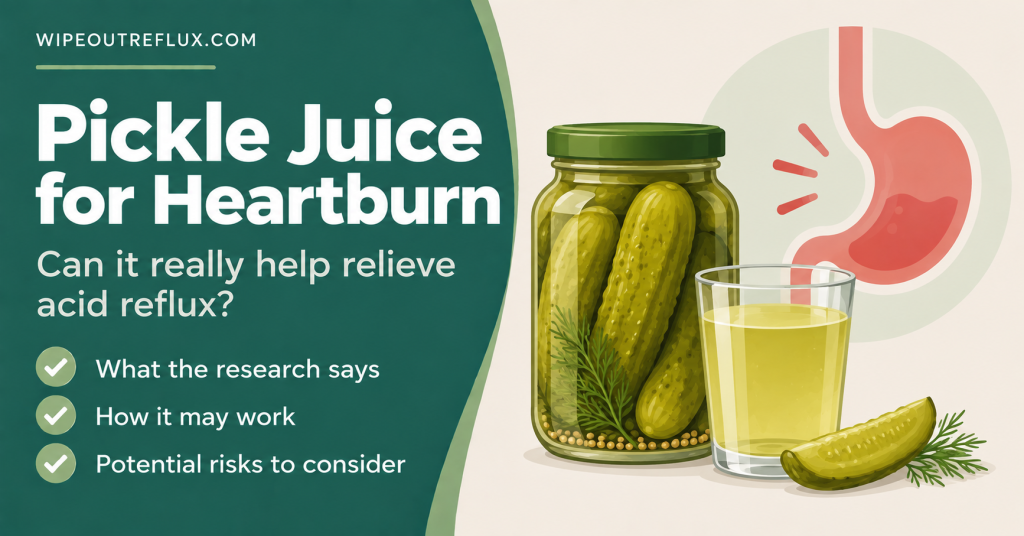
Drinking pickle juice for heartburn is a remedy that keeps circulating online, usually backed by one of two ideas: that the acid in the brine somehow signals your stomach to stop making its own acid, or that pickle juice is a gut-friendly tonic that sorts out digestion. Neither holds up. Pickle brine sits at around pH 3 — firmly acidic — which puts it in the same acid range as reflux itself, and the “acid tells your stomach to make less acid” theory has no evidence behind it.
So while a swig of brine won’t hurt most people as an occasional experiment, it’s not a treatment, and for anyone with silent reflux it can actually make things worse. Here’s why the logic fails, what the acidity means for your throat, and where to put your effort instead.
Key Takeaways
- Pickle brine is acidic — roughly pH 3 — whether it’s vinegar-based or fermented, so it isn’t neutralizing your stomach acid.
- The popular theory that swallowing acid tells your stomach to produce less acid has no scientific support.
- Reflux is driven by a weak valve and reflux events, not by too little stomach acid, so “topping up acid” doesn’t address the cause.
- For silent reflux (LPR), pH-3 brine sits squarely in the range that keeps pepsin active in the throat — a reason it can backfire.
- Pickle juice is also very high in sodium, which is worth bearing in mind if you drink it regularly.
- It rests on the same flawed logic as apple cider vinegar and mustard — adding acid to fix reflux.
- The reliable fix is reducing how often you reflux, not chasing symptoms with brine.
The Pickle Juice Claim
The remedy is to drink a small amount of pickle juice — often specified as dill pickle juice — when heartburn strikes. Two justifications usually come with it. The first is a stomach-acid theory: that introducing acid tricks your stomach into dialing down its own acid production. The second is a gut-health angle: that fermented pickle juice is full of probiotics and beneficial acids that improve digestion and therefore reflux.
Both sound reasonable on the surface. Both fall apart on closer look.
How Acidic Is Pickle Juice?
Pickle brine is acidic, and meaningfully so — typically around pH 3. There are two ways pickles get made, and both land in acidic territory. Vinegar-brined pickles (the most common supermarket type) get their acidity directly from acetic acid. Traditionally fermented pickles develop lactic acid as bacteria work on the brine. Either way, the juice you’d be drinking is sour for a reason: it’s an acid solution.
That’s the first problem with the remedy. You’re not swallowing something that neutralizes acid — you’re swallowing more acid, at a pH low enough to matter. If you want the background on why vinegar-based liquids behave this way, see is vinegar acid or alkaline.
Does Acid Really Tell Your Stomach to Make Less Acid?
This is the theory that props up nearly every “drink acid for reflux” remedy, and it’s worth taking apart directly because it’s so widespread.
The claim goes that heartburn is often caused by too little stomach acid, and that adding acid (from brine, vinegar, or lemon) signals the stomach to stop overproducing. There’s no good evidence for it. Reflux happens when the valve between the stomach and esophagus — the lower esophageal sphincter — relaxes or weakens and lets contents escape upward. The problem is a barrier problem and a reflux-event problem, not a shortage of acid. Whatever acid is in your stomach, if the valve lets it up, you feel it. Adding acid from a jar does nothing to strengthen that valve; if anything, it just gives any reflux that does occur a lower pH.
So the mechanism the remedy depends on isn’t real. That’s why the results people report are best explained by timing (heartburn often settles on its own) and the placebo effect of taking action.
Why Pickle Juice Can Backfire for Silent Reflux
For classic heartburn, a small amount of acidic brine is unlikely to do lasting harm. For silent reflux (LPR), it’s a different story, and this is where “it can backfire” becomes concrete.
Throat symptoms in LPR are driven largely by pepsin — a stomach enzyme that gets carried up and deposited on the throat lining, where it stays and waits. Pepsin is activated by acid, and research into how it behaves shows it remains stable and can be reactivated by acid exposure across a range of low pH values [Johnston et al., The Laryngoscope, 2007]. Brine at pH 3 is right in that zone. So drinking pickle juice for a throat that’s already irritated by reflux risks doing exactly the opposite of what you want — delivering acid that can wake dormant pepsin back up. For LPR, this is a remedy to skip, not to try.
How Much Pickle Juice — and What About Pregnancy?
People ask how much to drink, and the honest answer is that there’s no established dose because there’s no reliable effect to dose. A shot of brine is unlikely to harm most people as a one-off, but bear in mind pickle juice is very high in sodium, which adds up if you’re drinking it regularly or watching your salt.
In pregnancy — when cravings for pickles and brine are famously common — a small amount as a food is fine, but it’s a poor choice as a heartburn remedy: it’s acidic, unproven, and salty. Simple antacids are generally recommended first for pregnancy heartburn, and any product is worth checking with your midwife, doctor or pharmacist.
What About the Probiotic Angle?
Fermented pickle juice does contain beneficial bacteria, and gut health genuinely matters for digestion overall. But there are two catches. First, most supermarket pickles are vinegar-brined and pasteurized, so they contain little to no live culture — the probiotic claim doesn’t even apply to them. Second, even with genuinely fermented brine, sipping it for acute heartburn is not a probiotic strategy; it’s an acid hit at the moment your esophagus least needs one. If gut health is your interest, that’s a longer-term project best approached through diet rather than shots of brine.
If You’re Trying Brine, You’re Treating the Wrong Thing
Here’s the turn. If you’re searching for pickle juice for heartburn, you’re getting heartburn often enough to want relief — and the real takeaway is that this folk fix is unreliable and, for LPR, potentially counterproductive. The thing that actually works is reducing how often you reflux, so you’re not reaching for brine at all.
That’s what the Wipeout Diet Plan is built to do — a mechanism-first approach to meal size, timing, fat load and trigger foods that reduces the number and force of reflux events. I designed it first around LPR and silent reflux, where acidic remedies do the most damage, but because it targets the same underlying mechanisms it works just as well for classic GERD and everyday heartburn. That’s a real fix, rather than a sour gamble.
And if brine appeals because of the “acid cures acid” idea, know that the same reasoning powers a whole family of remedies that share the same flaw — apple cider vinegar and mustard for heartburn both rest on it, and both run into the same wall.
Conclusion
Pickle juice for heartburn is built on a theory that doesn’t stand up. The brine is acidic, at around pH 3, so it isn’t neutralizing anything; and the idea that swallowing acid makes your stomach produce less has no evidence behind it. If it seems to help, that’s timing and expectation, not chemistry. For silent reflux especially, drinking pH-3 brine over an already-irritated throat can reactivate pepsin and make symptoms worse — which is why this one genuinely can backfire.
Any remedy taken mid-flare only ever addresses the moment. If heartburn is frequent enough to have you drinking brine, the better use of your effort is reducing how often it happens in the first place. That’s what the Wipeout Diet Plan is designed for, and it comes with a full two-week meal plan with recipes so you know exactly what to eat instead of guessing. Alongside it, the Wipeout Food Reference Guide lists every food and drink that’s safe for acid reflux and LPR with its actual pH value — so instead of wondering whether something like pickle juice is too acidic, you can just check.
Leave the brine in the jar. Deal with the reflux.
Frequently Asked Questions
Does pickle juice help heartburn?
There’s no good evidence that it does. Pickle brine is acidic (around pH 3), so it doesn’t neutralize stomach acid, and the theory that swallowing acid reduces acid production isn’t supported. Any relief is most likely down to timing and placebo.
Why do people say pickle juice works for acid reflux?
Mostly because of the idea that adding acid signals the stomach to make less — a claim without scientific backing — and because heartburn often eases on its own around the time someone tries a remedy, making it look effective.
Is pickle juice bad for silent reflux or LPR?
It can be. At around pH 3, brine sits in the range that keeps pepsin — the enzyme behind LPR throat symptoms — active and able to reactivate. For silent reflux, drinking pickle juice risks worsening symptoms rather than easing them.
How much pickle juice should I drink for heartburn?
There’s no established dose, because there’s no reliable effect. A small amount is unlikely to harm most people as a one-off, but pickle juice is high in sodium, so it’s not something to drink regularly for reflux.
Is pickle juice safe for heartburn during pregnancy?
A small amount as a food is fine in pregnancy, but it’s a poor heartburn remedy — it’s acidic, unproven, and salty. Simple antacids are usually recommended first; check any product with your doctor, midwife or pharmacist.
Research & References
- Study of the activity and stability of human pepsin, showing it remains stable and can be reactivated by acid across a range of low pH values — relevant to why acidic drinks like brine can worsen throat-based reflux [Johnston et al., The Laryngoscope, 2007].

David Gray
12 years living with LPR · Consultant & researcher
I've lived with LPR for twelve years — the misdiagnoses, the PPI courses that did nothing, the slow work of figuring out what actually helps. Wipeout Reflux is where I translate the research into plain terms for people stuck in the same place. Every claim here is sourced to peer-reviewed work, and I consult one-to-one with LPR sufferers.