
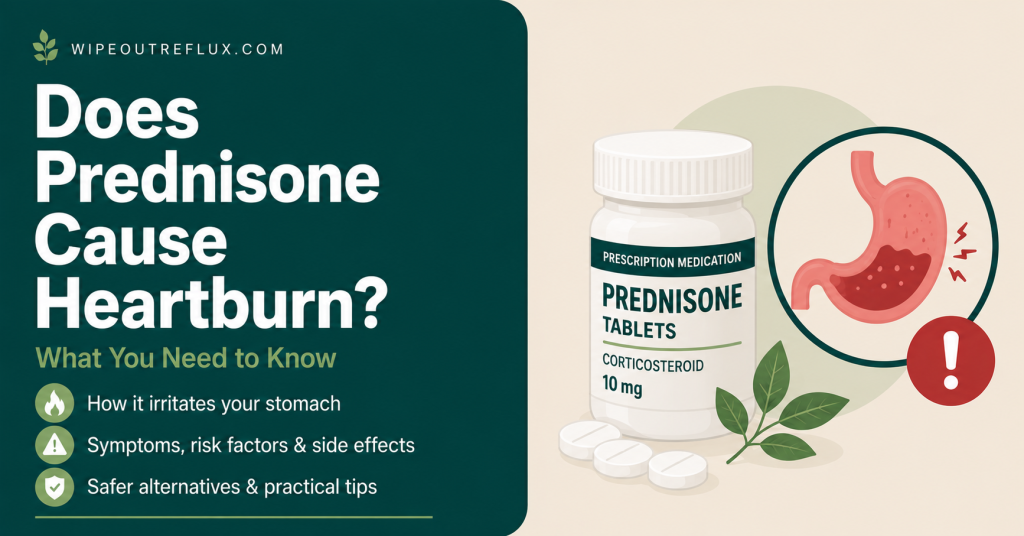
Yes — heartburn and indigestion are among the most commonly reported complaints on prednisone. But the risk is more nuanced than the warnings suggest, and knowing the actual numbers changes what you should worry about.
In a meta-analysis of 159 randomised double-blind trials covering 33,253 participants, corticosteroids raised the odds of gastrointestinal bleeding or perforation by 40% (OR 1.43). That sounds alarming until you look at where those events happened. Among 8,651 outpatients, there were 11 bleeds or perforations in total — 0.13% — and the increased risk in that group wasn’t statistically significant. The serious risk sits overwhelmingly with hospitalised, already-unwell patients.
So the honest framing is: prednisone frequently causes heartburn and indigestion, and rarely causes anything worse if you’re otherwise reasonably well and not taking NSAIDs alongside it.
The mechanisms are also not what most people assume. Prednisone doesn’t meaningfully increase stomach acid. It weakens your stomach’s ability to defend and repair itself, and — on longer courses — it drives appetite and abdominal weight gain, which is probably the bigger reflux driver of the two.
Key Takeaways
- Heartburn and indigestion are frequently reported on prednisone; serious complications are rare in outpatients.
- Across 159 trials and 33,253 participants, corticosteroids raised odds of GI bleeding or perforation by 40% (OR 1.43, 95% CI 1.22–1.66).
- Among 8,651 ambulatory patients there were only 11 such events — 0.13% — and the risk was not statistically significant in that group.
- The risk persisted when trials involving NSAIDs were excluded (OR 1.44), so steroids carry some risk independently.
- Prednisone doesn’t raise stomach acid. It suppresses the prostaglandin response that maintains and repairs the gut lining.
- Blocking COX-2 induction with a glucocorticoid worsened experimental gastric damage several-fold — a defence problem, not an acid problem.
- Weight gain is likely the bigger reflux driver on courses beyond a few weeks; each 10 kg/m² rise in BMI raises GERD risk by 68%.
- Prednisone drives central, abdominal fat specifically, which is the pattern that most raises intra-abdominal pressure.
- Combining prednisone with ibuprofen or another NSAID is the genuinely risky pairing — avoid it unless your doctor has planned for it.
- Taking the full dose in the morning with food handles both the gut irritation and the insomnia that leads to late-night eating.
How Prednisone Causes Heartburn
Four routes, and they matter at different points in a course. Short course? The first one dominates. Long course? The second and third do.
1. It disables your stomach’s repair crew
This is the mechanism people get wrong most often. Prednisone doesn’t make you produce more acid. It reduces your ability to cope with the acid you already produce.
Prostaglandins maintain the mucus layer, drive bicarbonate secretion, sustain mucosal blood flow and stimulate cell turnover in the stomach and oesophagus. Glucocorticoids suppress their production — and specifically, they suppress the induction of COX-2, the enzyme the gut upregulates when tissue is injured and needs repairing.
That distinction matters. In experimental work, inhibiting COX-2 upregulation by giving a glucocorticoid beforehand significantly worsened gastric damage — damage that was abolished by giving prostaglandin back Wallace, British Journal of Pharmacology, 2005.
So prednisone is best understood as a second hit rather than a primary cause. On its own, with a healthy stomach, it often causes nothing worse than indigestion. Add a first hit — an NSAID, existing reflux, an ulcer history, a critical illness — and the impaired repair response is what turns a minor injury into a significant one.
That’s also the cleanest explanation for the pattern in the trial data: modest risk overall, concentrated almost entirely in hospitalised patients who have other things going wrong at the same time.
2. Weight gain — probably the bigger driver
On any course lasting more than a couple of weeks, this is what I’d actually watch.
Prednisone increases appetite, promotes fluid retention, and redistributes fat centrally — to the abdomen, face and neck. The abdominal part is the problem. Excess weight around the middle raises intra-abdominal pressure, which mechanically pushes stomach contents up against the lower oesophageal sphincter, and contributes to separation at the oesophagogastric junction.
The relationship is strong and dose-dependent. A meta-analysis of 43 studies covering 484,219 participants found BMI associated with the risk of GERD (RR 1.374, 95% CI 1.260–1.499), with a dose-response analysis showing that for every 10 kg/m² increase in BMI, GERD risk rose by 68% (RR 1.681, 95% CI 1.326–2.131). Overweight — a BMI of 25 or above — emerged as the inflection point where risk climbs Tang et al., Frontiers in Physiology, 2025. Guidelines specifically recommend weight loss for reflux patients who are overweight Katz et al., The American Journal of Gastroenterology, 2022.
Here’s the practically useful point. If your reflux started within days of beginning prednisone, it’s mechanism one — mucosal irritation. If it crept in after several weeks and has got steadily worse, it’s very likely weight, and the fix is different. That timing distinction tells you which lever to pull.
3. Increased appetite means bigger, later meals
Related to the above but worth separating, because it’s actionable on its own.
Steroid-driven hunger is not subtle — people describe it as constant and hard to ignore. The consequence is larger meals, more frequent snacking and, crucially, eating later into the evening. Meal volume is an independent reflux trigger regardless of what you weigh, as covered in does overeating cause acid reflux. A large plate at 10pm will cause reflux in someone whose weight hasn’t changed at all.
4. Insomnia pushes eating later still
Prednisone commonly disrupts sleep, particularly when taken later in the day. Being awake at midnight while ravenously hungry produces exactly the behaviour you don’t want — a substantial late snack followed by lying down. It’s a behavioural mechanism rather than a pharmacological one, but it’s a real contributor and one of the easiest to fix.
What the Evidence Actually Shows
The definitive study here is worth going through properly, because it’s more reassuring than the leaflet.
Researchers pooled 159 randomised, double-blind, placebo-controlled trials of corticosteroids for any medical condition, totalling 33,253 participants. In all, 804 participants (2.4%) had a gastrointestinal bleed or perforation — 2.9% on corticosteroids against 2.0% on placebo. Corticosteroids increased the odds by 40% (OR 1.43, 95% CI 1.22–1.66) Narum et al., BMJ Open, 2014.
Three findings within that deserve attention.
The risk is concentrated in hospitalised patients. For inpatients, the association was clear (OR 1.42, 95% CI 1.22–1.66). For ambulatory patients — people taking steroids at home, which is most readers of this article — there were 11 events among 8,651 patients, a rate of 0.13%, and the increased risk was not statistically significant (OR 1.63, 95% CI 0.42 to 6.34; note how wide that interval is).
It isn’t just NSAIDs. When the researchers excluded trials involving NSAID use, the association persisted (OR 1.44, 95% CI 1.20–1.71). It also held when trials excluding peptic ulcer patients were removed, and when trials using gastroprotective drugs were removed. So corticosteroids carry some independent risk — a claim that had been genuinely disputed for years.
These are serious events, not heartburn. The study measured bleeding and perforation, not symptoms. It tells you very little about how likely you are to get indigestion, which is far more common and far less serious. Nobody has produced an equivalent high-quality figure for reflux symptoms specifically on prednisone, which is why I’m not giving you one.
My read: if you’re at home on a course of prednisone, not taking NSAIDs, without an ulcer history, your risk of something serious is genuinely low. Your risk of uncomfortable heartburn is meaningfully higher, and most of this article is about that.
The Combination That Actually Matters
If you take one practical thing from this article, make it this.
Prednisone impairs your stomach’s ability to defend and repair itself. NSAIDs — ibuprofen, naproxen, diclofenac, aspirin — actively damage the lining through prostaglandin suppression and direct contact injury. Put them together and you have a drug causing injury alongside a drug preventing repair. The risk of peptic ulcer bleeding with NSAIDs, with or without steroids, is markedly higher than with steroids alone.
This combination is disturbingly easy to stumble into. You’re on prednisone for an inflammatory condition, you have a headache or joint pain, and ibuprofen is the obvious over-the-counter answer. It’s also in a lot of cold and flu remedies, migraine products and period-pain medications, often without being prominent on the front of the box.
Use paracetamol instead for everyday pain and fever — it doesn’t share the mechanism. For localised joint or muscle pain, a topical NSAID gel delivers a small fraction of the systemic exposure of a tablet. And if you genuinely need an oral NSAID while on steroids, that’s a conversation with your doctor about gastroprotection, not a self-prescription. The wider picture is in medications that make acid reflux worse.
How to Prevent It
In rough order of impact.
Take the whole dose in the morning, with food
Two benefits from one change. Food buffers the direct contact irritation, and morning dosing matches your body’s natural cortisol rhythm and substantially reduces the insomnia that drives late-night eating. Unless your doctor has specifically told you to split the dose, a single morning dose with breakfast is the standard approach.
Take it with a full glass of water and stay upright afterwards — the same discipline that prevents any tablet from lodging in the oesophagus. Detail on why in can acid reflux make it hard to swallow.
Avoid NSAIDs
Covered above, and it’s the highest-value single precaution. Read labels on anything you buy over the counter.
Get ahead of the appetite
Steroid hunger is real and willpower alone tends to lose. What works better is structure: plan meals rather than grazing, front-load protein and fibre which are more satiating, keep low-calorie options within reach for when the hunger hits, and drink water regularly.
The reflux-specific version of this advice is to keep individual meals smaller and more frequent rather than large, and to protect the evening. A hard stop on eating two to three hours before bed does more for reflux than almost anything else you can control — see how long before bed you should stop eating and acid reflux at night.
Watching your weight during a longer course isn’t vanity — given the 68% risk increase per 10 kg/m², it’s directly reflux-relevant. Staying as active as your condition allows helps, and exercise and acid reflux covers which forms are reflux-friendly.
Ask whether you need gastroprotection
Routine PPI cover for everyone on short-course prednisone isn’t standard practice, and given the 0.13% event rate in outpatients that’s a defensible position. But it’s worth asking if any of these apply: you’re also taking an NSAID or aspirin, you have a history of peptic ulcer or GI bleeding, you’re on anticoagulants or an SSRI, you’re older, or you’re on a high dose or a long course.
If a PPI is started, timing matters — see the best time to take omeprazole — and it’s worth understanding the trade-offs of longer-term use in omeprazole side effects. Sucralfate is an alternative your doctor might consider, since it coats damaged tissue rather than suppressing acid.
Use an alginate for symptom relief
For day-to-day heartburn while you’re on the course, a raft-forming alginate is a sensible choice — it creates a physical barrier on top of the stomach contents rather than just buffering. See alginates for acid reflux and Gaviscon Advance. It’s compatible with prednisone and doesn’t interfere with it.
Raise the head of your bed
Simple, free, and effective for night-time symptoms — which is when prednisone-related reflux tends to be worst, given the late-eating and insomnia combination.
Why You Must Not Stop Suddenly
This deserves its own section because the consequence is serious and the temptation is real when a drug is making you uncomfortable.
Prednisone taken for more than about three weeks suppresses your adrenal glands’ own cortisol production. Your body stops making it because the drug is supplying it. If you stop abruptly, you have neither — and cortisol is not optional. Adrenal insufficiency can cause profound fatigue, weakness, nausea, vomiting, low blood pressure and, in severe cases, an adrenal crisis, which is a medical emergency.
Beyond that, stopping suddenly means the condition being treated flares, which is usually why you were prescribed steroids in the first place.
So: heartburn is not a reason to stop prednisone. It’s a reason to phone your doctor’s surgery and ask about managing the heartburn, or about whether your taper can be brought forward. Both are reasonable requests. Stopping unilaterally is not.
Related Conditions Worth Knowing About
Prednisone is frequently prescribed for asthma and COPD exacerbations, which creates a specific complication: reflux can itself cause or worsen respiratory symptoms.
That means a course of steroids for a chest problem can improve the airway inflammation while worsening the reflux that may be contributing to it. If you find your breathing symptoms improve on steroids then return quickly afterwards, and you also have heartburn or throat symptoms, reflux is worth investigating as a driver rather than a coincidence. See asthma misdiagnosis and acid reflux, acid reflux and COPD and acid reflux and bronchitis.
When to See a Doctor
Seek medical advice promptly if you have:
- Black, tarry or sticky stools
- Vomiting blood, or vomit resembling coffee grounds
- Severe or sudden abdominal pain
- Difficulty or pain on swallowing
- Feeling faint, dizzy or breathless
- Persistent vomiting
The first three are the ones to treat as urgent. Perforation is rare but it’s the complication steroids are specifically implicated in, and steroids can also blunt the usual pain signals — so symptoms may be less dramatic than the underlying problem. Err on the side of getting checked. More in endoscopy for acid reflux and when to see a doctor for LPR.
Conclusion
Prednisone causes heartburn often enough that you shouldn’t be surprised by it, but the serious risk is smaller than the warnings imply — 11 bleeds or perforations among 8,651 outpatients across 159 trials, a rate of 0.13%, with the increase not even statistically significant in that group. The genuine danger sits with hospitalised patients and, above all, with anyone combining steroids with NSAIDs.
Understanding the mechanism tells you what to do. Prednisone doesn’t raise your acid; it suppresses the prostaglandin response your gut uses to protect and repair itself, which makes it a second hit rather than a primary cause. That’s why avoiding the first hit — ibuprofen and its relatives — is the single most valuable precaution available to you.
On longer courses, though, I’d argue the bigger reflux driver isn’t the mucosal effect at all. It’s appetite and abdominal weight gain, with each 10 kg/m² of BMI carrying a 68% higher GERD risk. If your heartburn appeared in week one, treat the lining. If it crept in around week six alongside your waistband, treat the weight and the meal pattern — and the evening in particular, because steroid insomnia plus steroid hunger is a reliable recipe for a large meal shortly before lying down.
What none of this justifies is stopping the drug. Prednisone is usually treating something that needs treating, and after three weeks or so, stopping abruptly is genuinely dangerous. Heartburn is a reason to call your doctor, not to open the bin.
Meanwhile, the parts you can control are the ordinary ones — meal size, meal timing, what’s on the plate. Working out which foods genuinely need to go, which just need timing differently, and in what order to test them is most of the real work of managing reflux through diet, and it’s what the Wipeout Diet Plan is structured around, as a way of reducing reflux episodes rather than a list of prohibitions. I built it first and foremost for LPR and silent reflux, the stubborn throat-based form that responds worst to medication, though because it targets the same underlying mechanisms it works just as well for GERD and everyday heartburn. Alongside it, the Wipeout Food Reference Guide is the practical companion — the full list of foods and drinks that are safe for acid reflux and LPR with their actual pH values, which is particularly useful when steroid appetite is making every food decision harder than usual.
Frequently Asked Questions
Does prednisone cause heartburn?
Commonly, yes. It suppresses the prostaglandins that maintain and repair your stomach and oesophageal lining, and on longer courses it drives appetite and abdominal weight gain, both of which promote reflux. It does not increase stomach acid, which is why acid-focused explanations are misleading.
How likely is prednisone to cause a stomach ulcer or bleed?
Low if you’re taking it at home and not on NSAIDs. Across 159 trials, only 11 bleeds or perforations occurred among 8,651 ambulatory patients — 0.13% — and the increased risk in that group wasn’t statistically significant. The clear risk was in hospitalised patients.
Should I take a PPI with prednisone?
Not routinely for a short course in an otherwise healthy person. It’s worth asking about if you’re also taking an NSAID or aspirin, have a history of ulcer or GI bleeding, take anticoagulants or an SSRI, are older, or are on a high dose or long course. That’s a decision for your prescriber.
Can I take ibuprofen with prednisone?
Avoid it unless your doctor has specifically approved it. NSAIDs damage the gut lining while prednisone impairs repair, and NSAID use with or without steroids carries markedly higher peptic ulcer bleeding risk than steroids alone. Use paracetamol, or a topical NSAID gel for localised pain.
Should I take prednisone with food?
Yes, and ideally the whole dose with breakfast. Food reduces direct contact irritation, and morning dosing matches your natural cortisol rhythm and cuts the insomnia that leads to late-night eating. Take it with a full glass of water and stay upright afterwards.
Why does prednisone make me so hungry?
Glucocorticoids increase appetite directly and alter how the body handles glucose and fat. It’s one of the most consistently reported effects and it’s not a lack of willpower. For reflux purposes the issue is that it produces larger and later meals, so structure and a firm evening cut-off help more than trying to resist it.
Will the heartburn stop when I finish the course?
Usually. The mucosal effects reverse once prostaglandin production recovers, generally within days to a couple of weeks. If the reflux was driven by weight gained during the course, it will persist until that weight comes off — which is worth knowing so you don’t assume the drug is still at fault.
Can I stop prednisone if it’s causing bad heartburn?
Not on your own, and this genuinely matters. Courses beyond about three weeks suppress your own cortisol production, and stopping suddenly risks adrenal crisis as well as a flare of whatever is being treated. Call your doctor to discuss managing the heartburn or adjusting the taper.
Does prednisone increase stomach acid?
Not meaningfully, despite the common assumption. It weakens the mucus, bicarbonate and blood-flow defences that protect the lining from the acid that’s already there, and it blunts the tissue’s repair response. That’s why treating it purely as an acid problem often disappoints.
Is a short course safer than a long one?
Yes, on both counts. Short courses carry less cumulative mucosal exposure and don’t run long enough for meaningful weight gain, which is the dominant reflux mechanism on extended treatment. Risk rises with both dose and duration.
Research & References
- Narum et al., BMJ Open, 2014 — Systematic review and meta-analysis of 159 randomised, double-blind, placebo-controlled trials of corticosteroids for any medical condition, totalling 33,253 participants. In all, 804 patients (2.4%) had a gastrointestinal bleed or perforation (2.9% on corticosteroids, 2.0% on placebo). Corticosteroids increased the risk by 40% (OR 1.43, 95% CI 1.22–1.66); the risk was significant for hospitalised patients (OR 1.42, 95% CI 1.22–1.66) but not for ambulatory patients (OR 1.63, 95% CI 0.42–6.34), among whom only 11 events occurred in 8,651 patients (0.13%). The increased risk persisted when studies involving NSAID use were excluded (OR 1.44, 95% CI 1.20–1.71).
- Wallace, British Journal of Pharmacology, 2005 — Review of the role of cyclo-oxygenase-2 in gastrointestinal mucosal defence, describing how COX-2 is upregulated in response to mucosal injury and contributes to tissue repair. Inhibiting COX-2 upregulation by prior administration of a glucocorticoid significantly exacerbated ischaemia-reperfusion-induced gastric damage, an effect abolished by concurrent administration of prostaglandin.
- Tang et al., Frontiers in Physiology, 2025 — Systematic review with dose-response meta-analysis of 43 studies covering 484,219 participants examining body mass index and gastro-oesophageal reflux. BMI was associated with risk of symptomatic reflux (RR 2.041, 95% CI 1.507–2.763) and of GERD (RR 1.374, 95% CI 1.260–1.499), with overweight (BMI ≥25 kg/m²) identified as an inflection point. Dose-response analysis showed that for every 10 kg/m² increase in BMI, GERD risk rose by 68% (RR 1.681, 95% CI 1.326–2.131).
- Katz et al., The American Journal of Gastroenterology, 2022 — ACG clinical guideline for the diagnosis and management of gastro-oesophageal reflux disease, which recommends weight loss for patients who are overweight, suggests avoiding meals within 2 to 3 hours of bedtime, and suggests avoiding individual trigger foods as a conditional recommendation on low-quality evidence.

David Gray
12 years living with LPR · Consultant & researcher
I've lived with LPR for twelve years — the misdiagnoses, the PPI courses that did nothing, the slow work of figuring out what actually helps. Wipeout Reflux is where I translate the research into plain terms for people stuck in the same place. Every claim here is sourced to peer-reviewed work, and I consult one-to-one with LPR sufferers.