
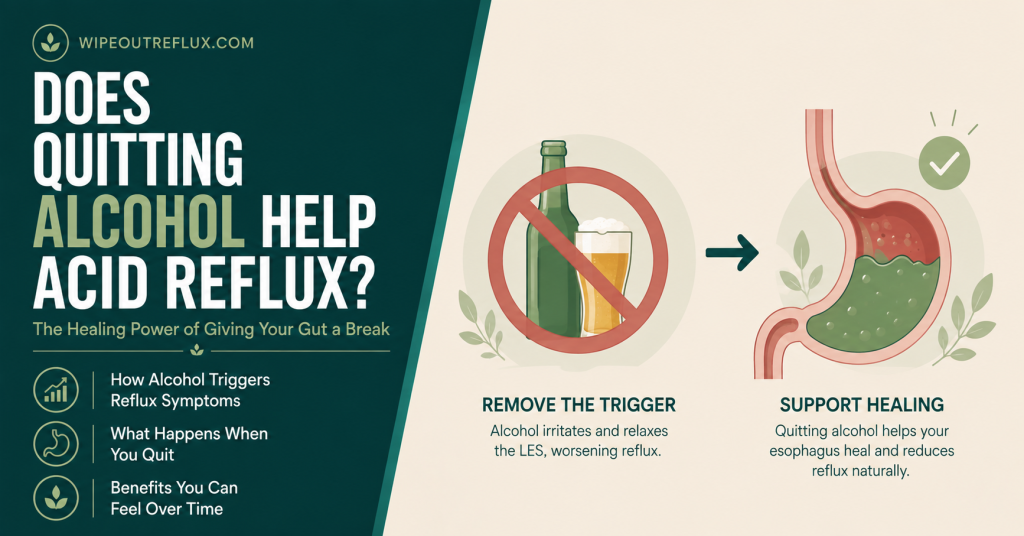
Usually, yes — but not in the way most people expect, and the honest version of this answer is more interesting than the usual one.
Here’s the tension. Give someone with reflux a glass of wine or a beer with dinner and you can measure the damage within three hours: acid exposure in the oesophagus roughly doubles. That’s a randomised trial, not a theory. But when researchers have gone looking for evidence that stopping drinking improves GERD, they’ve largely come up empty. And a large genetic study found no sign that alcohol causes reflux disease in the first place.
Both things are true, and the way they fit together is the whole point of this article: alcohol is a trigger, not a cause. Quitting removes a reliable trigger — which for a lot of people means noticeably fewer symptoms, better nights and a calmer throat. What it won’t do is fix the underlying reason you reflux in the first place. If you stop drinking and expect the problem to disappear, you’ll be disappointed. If you stop drinking as one part of a wider approach, it’s one of the more useful things you can do.
Key Takeaways
- In a randomised trial, 300 ml of white wine or 500 ml of beer with a meal roughly doubled postprandial acid exposure in reflux patients compared with water (23–25% of the time below pH 4 versus 11–12%).
- A single evening drink measurably wrecks night-time reflux: 120 ml of scotch impaired supine acid clearance, and 7 of 17 volunteers had reflux episodes averaging 47 minutes that never happened on control nights.
- Drinkers have 48% higher odds of GERD than non- or occasional drinkers, rising to more than double in frequent drinkers, with a linear dose-response — so cutting down genuinely helps even if you don’t stop.
- A Mendelian randomisation study found no causal link between alcohol consumption and developing gastro-oesophageal reflux (OR 0.99). Alcohol triggers episodes; it doesn’t appear to create the disease.
- An evidence review found no published evidence that alcohol cessation improves oesophageal pH profiles or symptoms — but that reflects a near-total absence of trials, not a demonstrated failure.
- Most people notice the change within the first week, mainly at night. Throat-based symptoms take four to eight weeks because throat tissue heals slowly.
- What you were drinking matters. Fermented drinks like beer and wine stimulate stomach acid in a way that distilled spirits at the same strength don’t.
- If you drink heavily or daily, stopping abruptly can be medically dangerous. Talk to your GP about doing it safely rather than going cold turkey alone.
What the evidence actually says
This topic has a strange evidence base, and I think being straight about it is more useful than pretending it’s simple.
Alcohol clearly causes reflux episodes
The best single study here is a small randomised trial from Munich. Twenty-five reflux patients — 15 with visible oesophagitis, 10 with non-erosive reflux disease — drank either 300 ml of white wine, 500 ml of beer, or the same volume of tap water alongside a standard meal, then had their oesophageal pH measured for the next three hours.
The results weren’t subtle. With water, the oesophagus spent 11–12% of that time below pH 4. With wine it was 23%; with beer, 25%. It happened in patients with and without oesophagitis, and in both men and women Pehl et al., Alimentary Pharmacology and Therapeutics, 2006.
So a normal-sized drink with dinner roughly doubles how long acid sits in your oesophagus that evening. That is about as direct as evidence gets.
But alcohol doesn’t appear to cause reflux disease
Here’s the part that surprises people. A large Mendelian randomisation study — a method that uses inherited genetic variants to sidestep the confounding that plagues ordinary observational research — looked at smoking and alcohol against 24 gastrointestinal diseases. Genetically predicted alcohol consumption showed no association at all with gastro-oesophageal reflux: odds ratio 0.99, confidence interval 0.81 to 1.21. Flatly null.
Smoking, in the same analysis, was clearly associated with reflux (OR 1.28) Yuan et al., eLife, 2023. Which is worth knowing if you’re weighing up which habit to tackle first — I’ve written separately about smoking and acid reflux.
That doesn’t contradict the trial above. It means something specific: alcohol provokes reflux in people whose anti-reflux barrier is already compromised, but it isn’t what compromised it. The usual culprits there are weight, a hiatal hernia, and a weak or over-relaxing lower oesophageal sphincter.
And nobody has properly tested quitting
An evidence-based review from Stanford screened 2,039 studies on lifestyle measures for GERD and found only 16 clinical trials worth analysing. Its conclusion on this point was blunt: neither tobacco nor alcohol cessation was associated with improvement in oesophageal pH profiles or symptoms. Weight loss and head-of-bed elevation were the two measures that held up Kaltenbach et al., Archives of Internal Medicine, 2006.
Read that carefully, though. “No published evidence of efficacy” is not the same as “shown not to work.” It reflects the fact that almost nobody has run the study — and a randomised trial where you assign one group to keep drinking is never going to get past an ethics committee. So we’re left inferring backwards from the trigger studies, which is reasonable but not the same as proof.
My practical read: if a drink measurably doubles your acid exposure, removing the drink removes that. The absence of a trial doesn’t undo the physiology.
What actually changes when you stop drinking
Your nights change first, and most
This is the effect I’d most want people to know about, and it comes from a study that’s nearly forty years old but has never really been bettered.
Seventeen healthy volunteers — healthy, note, not reflux patients — were monitored with ambulatory pH probes on two nights. On one, they had 120 ml of scotch whisky three hours after their evening meal. On the other, nothing.
Normal supine acid clearance was impaired after that fairly modest amount. Seven of the seventeen had prolonged reflux episodes on the alcohol night, averaging 47 minutes each, typically kicking in around three and a half hours after the drink and well over an hour after lying down. None of them had a single such episode on the control night Vitale et al., Journal of the American Medical Association, 1987.
Forty-seven minutes of acid sitting against your oesophagus, in people with no reflux problem at all. Now imagine the same night in someone whose sphincter already leaks.
Two mechanisms are stacking here. Alcohol lowers resting sphincter tone, and it blunts the peristaltic contractions that are supposed to sweep refluxate back down. Lying flat removes gravity from the equation. That’s why the nightcap is such a reliably bad idea, and why night-time reflux is usually the first thing to improve when people stop.
Sleep quality improves, which helps on its own
Alcohol is a sedative that fragments the second half of the night. That matters here because oesophageal peristalsis and swallowing both slow down during sleep, and the more disturbed your sleep, the longer acid lingers. Better sleep architecture means faster clearance. It’s an indirect benefit, but a real one — and it compounds with things like sleeping on your left side.
What doesn’t change
Being honest about this saves a lot of disappointment:
- A hiatal hernia stays a hiatal hernia. No amount of abstinence closes it.
- A weak sphincter is still weak. Alcohol makes it worse temporarily; removing alcohol returns it to its baseline, which may not be good.
- Weight doesn’t drop automatically. It often does, since alcohol is calorie-dense — but plenty of people replace it with sugar. Given that excess weight is the single biggest modifiable driver of reflux, this one is worth watching.
- Existing tissue damage takes time. Erosive oesophagitis heals over weeks to months, not days.
- Everything else you eat and drink still counts. If you swap wine for fizzy drinks and coffee, you may have gained very little.
Why the first fortnight can feel worse, not better
A lot of people quit, feel rough, and conclude alcohol wasn’t the problem. Usually it’s one of these:
Appetite comes back. Alcohol suppresses appetite in the short term. Stop, and many people eat more, later, and sweeter. Bigger and later meals are two of the most reliable reflux triggers there are — so this can easily cancel out the gain.
Sleep gets worse before it gets better. Rebound insomnia in the first week or two is common. Broken sleep means slower oesophageal clearance overnight.
Stress goes up. If drinking was how you decompressed, removing it without replacing it raises baseline tension, and stress genuinely amplifies reflux symptoms through oesophageal hypersensitivity — particularly relevant if anxiety is already part of your picture.
Substitutions backfire. Alcohol-free beer is still fermented, carbonated and acidic. Sparkling water distends the stomach. Tonic water is acidic and fizzy. It’s worth thinking about what you actually replace it with.
One important caveat before you start. If you drink heavily or every day, stopping abruptly on your own can be medically dangerous — alcohol withdrawal is one of the few withdrawal syndromes that can be life-threatening. Please talk to your GP about tapering safely rather than going cold turkey. That’s a genuine medical issue, not a formality.
A realistic timeline
Individual variation is enormous, but this is roughly the pattern I see and would expect from the mechanisms:
- Night one to three. Night-time symptoms often improve immediately. If you were having a drink within four hours of bed, this can be dramatic.
- Week one. Fewer breakthrough episodes. Sleep may still be poor. Don’t judge anything yet.
- Weeks two to four. The clearest signal for heartburn and regurgitation. If two full weeks of abstinence changes nothing at all for classic heartburn, alcohol probably wasn’t your main driver.
- Weeks four to eight. Throat symptoms — hoarseness, throat clearing, the lump sensation — start to settle. This is the realistic window for LPR symptoms, and it lines up with the general LPR recovery timeline.
- Three months and beyond. Mucosal healing, if there was visible damage. Also long enough for weight change to make its own contribution.
Two weeks is the minimum honest test for heartburn. Six weeks is the minimum honest test if your symptoms are throat-based.
Does it matter what you were drinking?
Yes — and this is where quitting gets more interesting than “alcohol bad.”
Researchers compared what different drinks do to gastric acid output and gastrin release. Fermented drinks — beer and wine — turned out to be powerful stimulants of both. Distilled spirits at equal or higher ethanol content did not Teyssen et al., Gut, 1997. The team later isolated the culprits as maleic acid and succinic acid, small metabolites produced by fermentation itself Teyssen et al., Journal of Clinical Investigation, 1999.
The practical implication: if beer and wine were your drinks, quitting removes an acid-stimulating effect on top of the ethanol effect. You’ve removed two problems, not one. Someone quitting neat spirits removes fewer mechanisms — though spirits bring their own, and red wine has a well-earned reputation of its own.
Volume matters too, and it’s the thing nobody counts. Two pints is over a litre of liquid delivered to your stomach in an evening. That’s a pressure problem before you get to what’s dissolved in it.
If you don’t want to stop completely
Plenty of people don’t want to give up drinking entirely, and I’d rather give useful advice than moralise.
The good news is that the relationship is dose-dependent, and linear. A meta-analysis of 29 studies found drinkers had 48% higher odds of GERD than non- or occasional drinkers (OR 1.48). For people drinking more frequently it rose to 2.12 — more than double — and the association was strongest for erosive oesophagitis at OR 1.78 Pan et al., Alcohol and Alcoholism, 2019.
Linear dose-response is genuinely encouraging. It means every reduction buys you something; you aren’t stuck choosing between total abstinence and no benefit.
If you’re cutting down rather than stopping:
- Protect the last four hours before bed. This single change does more than any other, for the reasons in the Vitale study above — and it pairs with the general rule about how long before bed to stop eating.
- Reduce frequency before you agonise over type. Three drinking days a week beats seven, regardless of what’s in the glass.
- Cap the volume. The trial that doubled acid exposure used 300 ml of wine or 500 ml of beer. Stay meaningfully under that.
- Drink with food, not on an empty stomach.
- Prefer still to fizzy. Carbonation distends the stomach and triggers the sphincter relaxations that let reflux through.
- Sit up afterwards. Don’t go horizontal on an evening you’ve drunk. If you’re out, the usual advice for eating out with reflux applies double.
Quitting alcohol and silent reflux
If your symptoms are throat-based rather than heartburn — hoarseness, chronic throat clearing, a lump sensation, post-nasal drip — the calculation shifts, and I’d argue quitting matters more, not less.
The reason is pepsin. Pepsin is the stomach enzyme that travels up with refluxate and lodges in throat tissue, where it can sit dormant for hours. It reactivates whenever acid arrives from any source — including something you drink. That’s the reasoning behind low-acid dietary approaches for stubborn LPR rather than GERD, which use a pH 5 cut-off Koufman, Annals of Otology, Rhinology and Laryngology, 2011.
Nearly every alcoholic drink sits below pH 5. Wine is typically pH 3 to 4; beer around 4 to 4.5. So each mouthful passes acidic liquid directly over the exact tissue where pepsin is waiting. That’s a mechanism that simply doesn’t apply to heartburn in the same way, and it’s why people with LPR often report that alcohol hits their throat harder than it ever hit their chest. It’s also worth knowing how to neutralise pepsin in the throat while you’re healing.
Population data backs the association up. In a survey of 340 Greek adults using the Reflux Symptom Index, LPR prevalence was 18.8%, and both tobacco smoking and alcohol consumption were related to it Spantideas et al., BMC Ear, Nose and Throat Disorders, 2015.
Expect a slower response. Throat tissue heals more slowly than oesophageal mucosa, so give it four to eight weeks before you judge.
The longer-term reason it’s worth doing
Beyond symptoms, there’s a tissue argument. In 463 Japanese men who underwent upper endoscopy, heavy drinkers — more than 50 g of ethanol a day — had roughly double the odds of erosive oesophagitis (OR 1.99) and of Barrett’s epithelium (OR 1.91) compared with never drinkers, with a clear dose-response per gram consumed Akiyama et al., BMC Gastroenterology, 2008.
Barrett’s is the tissue change that matters for long-term risk, which I’ve covered in more detail in whether acid reflux can cause cancer. I’m not raising this to frighten anyone — the absolute risks are small and this was heavy, sustained drinking. But it’s a legitimate reason the answer to “does quitting help” is yes even in the years where you don’t feel much difference day to day.
Quitting alone probably isn’t enough
Here’s a detail that puts alcohol in proportion.
A large cohort study followed nearly 43,000 women and scored them on five antireflux lifestyle factors: normal weight, never smoking, at least 30 minutes of moderate-to-vigorous activity daily, no more than two cups of coffee, tea or soda a day, and a prudent diet. Women meeting all five had half the risk of reflux symptoms compared with those meeting none (hazard ratio 0.50). The population-attributable risk was 37% — more than a third of cases potentially avoidable. Body weight alone accounted for 19% Mehta et al., JAMA Internal Medicine, 2021.
Notice what isn’t on that list. Alcohol wasn’t one of the five factors. That’s not because it’s irrelevant — it’s because, at a population level, weight, smoking, activity and overall diet pattern do more of the work.
So quitting alcohol is worth doing. It’s just not the lever you want to pull in isolation. And if you’re on acid suppression, don’t stop that at the same time — changing two variables at once tells you nothing, and there’s a separate issue with acid rebound when coming off PPIs.
Conclusion
Quitting alcohol helps acid reflux, but it helps in a specific and limited way that’s worth understanding before you set your expectations. It removes a trigger that measurably doubles your acid exposure on the evenings you drink, and it removes it most decisively at night, when your oesophagus is least able to defend itself. For a lot of people that’s the difference between waking up burning and sleeping through. What it doesn’t do is repair a hernia, strengthen a sphincter, or undo the weight and dietary pattern that made you refluxy in the first place.
Which is why I’d frame it as a foundation rather than a fix. Take alcohol out, then build on the space it creates — that means looking honestly at portion sizes, meal timing, weight, and the acidity of everything else passing through. If you want a straightforward starting point, the Wipeout Food Reference Guide is the essential reference for exactly that: which foods and drinks are safe for acid reflux and LPR, and the pH value of each one, so you can see at a glance where your replacements actually sit. It’s the fastest way to avoid the classic mistake of swapping wine for something equally acidic.
If you want the full approach rather than a reference, the Wipeout Diet Plan goes considerably deeper — it’s the structured protocol I built after working through this myself, originally designed around LPR and silent reflux because that’s the stubborn throat-based form that resists everything, though since it targets the same underlying mechanisms it works just as well for GERD, heartburn and everyday acid reflux. It covers the sequencing, the timing and the healing phase in a way a food list can’t.
Give any change a fair test. Two weeks for heartburn, six for throat symptoms. And if you drink daily or heavily, please involve your doctor in stopping — that’s a safety issue, not a suggestion.
Frequently Asked Questions
How long after quitting alcohol will my acid reflux improve?
Night-time symptoms often improve within the first few nights, because alcohol’s biggest effect is on supine acid clearance. Daytime heartburn typically settles over two to four weeks. Throat symptoms like hoarseness and throat clearing take four to eight weeks, since throat tissue heals more slowly than the oesophagus.
Will quitting alcohol cure my acid reflux?
Unlikely on its own. Alcohol triggers reflux episodes but doesn’t appear to cause reflux disease — a Mendelian randomisation study found no causal association between alcohol consumption and GERD. Quitting removes a trigger; it doesn’t fix a hiatal hernia, a weak sphincter, or excess weight.
Why is my acid reflux worse after quitting alcohol?
Usually appetite rebound, disrupted sleep in the first week or two, higher baseline stress, or substitute drinks that are themselves acidic or carbonated. Eating more and later is the most common culprit. Give it a full two weeks before drawing conclusions.
Which alcohol is worst for acid reflux?
Fermented drinks — beer and wine — stimulate gastric acid and gastrin release in a way distilled spirits at the same alcohol content don’t, because of fermentation by-products. Beer also adds carbonation and far larger volumes. That said, spirits still relax the sphincter and impair acid clearance.
Does cutting down help, or do I have to stop completely?
Cutting down helps. The relationship is linear and dose-dependent: 48% higher odds of GERD in drinkers overall, rising to more than double in frequent drinkers. Every reduction in frequency and volume buys something. Reducing frequency and protecting the four hours before bed gives you the most benefit per unit of effort.
Is alcohol-free beer better for reflux?
Somewhat, but less than people hope. Alcohol-free beer is still fermented, still carbonated and still acidic — typically well below pH 5. Removing the alcohol eliminates one mechanism out of several. It’s an improvement, not a solution.
Does quitting alcohol help silent reflux and LPR?
It tends to help more, not less. Almost all alcoholic drinks sit below pH 5, and dietary acid can reactivate pepsin lodged in throat tissue. Since pepsin is the main agent of throat damage in LPR, removing a regular acid source directly reduces that. Expect four to eight weeks before judging.
Is it safe to stop drinking suddenly?
Not always. If you drink heavily or daily, abrupt cessation can cause serious withdrawal symptoms, including seizures. Speak to your GP about tapering safely. For occasional or moderate drinkers, simply stopping is fine.
Research & References
- Randomised trial in 25 reflux patients showing that 300 ml of white wine or 500 ml of beer taken with a standardised meal increased postprandial oesophageal acid exposure compared with water (wine 23% of time below pH 4 versus water 12%; beer 25% versus water 11%), in patients with and without erosive oesophagitis Pehl et al., Alimentary Pharmacology and Therapeutics, 2006.
- Ambulatory pH monitoring study in 17 healthy volunteers finding that 120 ml of scotch whisky taken after the evening meal impaired normal supine oesophageal acid clearance, with 7 of 17 subjects experiencing prolonged reflux episodes averaging 47 minutes that did not occur on control nights Vitale et al., Journal of the American Medical Association, 1987.
- Evidence-based review screening 2,039 studies of lifestyle measures for GERD, concluding that weight loss and head-of-bed elevation improved pH profiles and symptoms, while no published evidence supported improvement in GERD measures after cessation of alcohol or tobacco Kaltenbach et al., Archives of Internal Medicine, 2006.
- Mendelian randomisation analysis of smoking and alcohol against 24 gastrointestinal diseases, finding genetically predicted alcohol consumption unassociated with gastro-oesophageal reflux (OR 0.99, 95% CI 0.81–1.21) while genetic liability to smoking initiation was associated with increased risk (OR 1.28, 95% CI 1.20–1.37) Yuan et al., eLife, 2023.
- Systematic review and meta-analysis of 29 studies reporting a pooled odds ratio for GERD of 1.48 (95% CI 1.31–1.67) in drinkers versus non- or occasional drinkers, rising to 2.12 in more frequent drinkers, with an odds ratio of 1.78 for reflux oesophagitis and a linear dose-response relationship Pan et al., Alcohol and Alcoholism, 2019.
- Human study comparing alcoholic beverages, finding that drinks produced by fermentation such as beer and wine are powerful stimulants of gastric acid output and gastrin release, whereas beverages produced by distillation at equal or higher ethanol content are not Teyssen et al., Gut, 1997.
- Study identifying the gastric acid stimulatory constituents of fermented alcoholic beverages using yeast-fermented glucose as a model, isolating maleic acid and succinic acid as the responsible compounds Teyssen et al., Journal of Clinical Investigation, 1999.
- Endoscopic study of 463 Japanese men finding heavy drinkers (over 50 g ethanol per day) had increased odds of erosive oesophagitis (OR 1.99, 95% CI 1.12–3.53) and Barrett’s epithelium (OR 1.91, 95% CI 1.19–3.09) compared with never drinkers, with a dose-response relationship per gram consumed Akiyama et al., BMC Gastroenterology, 2008.
- Cohort study of 42,955 women over 392,215 person-years, finding that women adhering to five antireflux lifestyle factors had a hazard ratio of 0.50 (95% CI 0.42–0.59) for reflux symptoms versus those adhering to none, with a population-attributable risk of 37% Mehta et al., JAMA Internal Medicine, 2021.
- Population survey of 340 Greek adults using the Reflux Symptom Index, finding a laryngopharyngeal reflux prevalence of 18.8% and identifying tobacco smoking and alcohol consumption as factors related to LPR Spantideas et al., BMC Ear, Nose and Throat Disorders, 2015.
- Study of a low-acid diet in recalcitrant laryngopharyngeal reflux, using a pH 5 threshold on the basis that pepsin deposited in laryngeal tissue can be reactivated by hydrogen ions from ingested acid Koufman, Annals of Otology, Rhinology and Laryngology, 2011.

David Gray
12 years living with LPR · Consultant & researcher
I've lived with LPR for twelve years — the misdiagnoses, the PPI courses that did nothing, the slow work of figuring out what actually helps. Wipeout Reflux is where I translate the research into plain terms for people stuck in the same place. Every claim here is sourced to peer-reviewed work, and I consult one-to-one with LPR sufferers.