
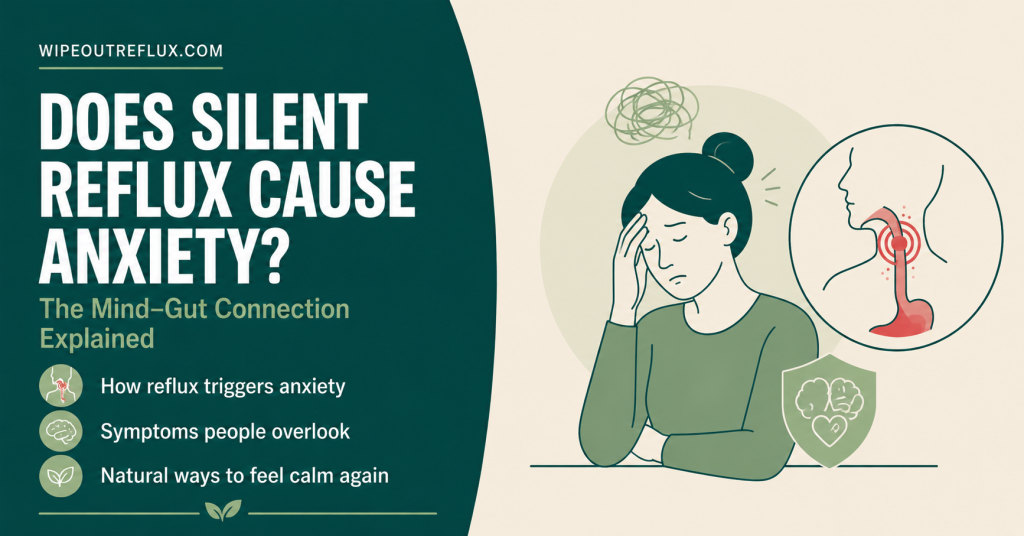
Yes — silent reflux can cause and worsen anxiety, and it does it in two distinct ways. Physically, reflux and the brain are wired together through the gut-brain axis, and the evidence points to reflux genuinely raising the risk of anxiety. Experientially, silent reflux (LPR) produces a set of frightening body sensations — a tight throat, a lump that won’t clear, breathlessness, chest tightness, a racing heart — that feel exactly like anxiety and can set off the alarm on their own.
What traps people is that it runs both ways. Reflux fuels anxiety, and anxiety fuels reflux, so the two lock into a self-reinforcing loop. Many people are told their throat symptoms are “just anxiety” when in fact reflux is driving the anxiety in the first place — and until the reflux is addressed, the worry keeps coming back.
Here’s how silent reflux causes anxiety, why the physical symptoms are so alarming, and how to break the cycle from both ends.
Key Takeaways
- Silent reflux can cause and amplify anxiety — the relationship is real and, importantly, bidirectional: reflux feeds anxiety and anxiety feeds reflux.
- Anxiety is markedly more common in people with reflux than in those without, and genetic evidence suggests reflux causally increases the risk of anxiety disorders.
- LPR’s physical symptoms — throat tightness, a lump sensation, breathlessness, chest tightness and heart palpitations — closely mimic anxiety and can trigger it directly.
- The gut and brain are connected via the gut-brain axis and vagus nerve, so reflux and mood genuinely influence each other at a physiological level.
- Hypervigilance is a big part of it: once you’ve had scary throat episodes, your brain stays on alert, which worsens both symptoms and anxiety.
- Being told your symptoms are “just anxiety” when reflux is the real driver is common — and unhelpful, because it leaves the reflux untreated.
- Calming the reflux at its source usually eases the anxiety that rides on it, especially when combined with addressing the stress side directly.
Does silent reflux really cause anxiety?
It’s a fair question, because it’s easy to assume the arrow only points the other way — that anxious people just notice their bodies more. But the research shows a genuine, two-way connection. Anxiety is far more common in people with reflux than in those without it: a large systematic review and meta-analysis found anxiety symptoms in around a third of people with reflux, and roughly four-and-a-half times the odds of anxiety compared with healthy controls, concluding the relationship is likely bidirectional and causal Zamani et al., American Journal of Gastroenterology, 2023.
More striking, a Mendelian randomization study — which uses genetics to test cause and effect rather than mere correlation — found that reflux causally increases the risk of anxiety disorders, not just the reverse Zeng et al., Frontiers in Psychiatry, 2023. And for the silent, throat-based form specifically, people with LPR score significantly higher on anxiety and distress measures than healthy volunteers, which is why researchers describe LPR and psychological distress as a “vicious cycle” Barillari et al., European Archives of Oto-Rhino-Laryngology, 2025. So no, it isn’t in your head — or rather, it is, but reflux is helping put it there.
Why LPR symptoms feel exactly like anxiety
Here’s the part that catches people off guard. Silent reflux doesn’t usually cause classic heartburn — the symptoms of LPR are in the throat, chest and airway, and they happen to be the exact same sensations the body produces during anxiety and panic. When you can’t feel the reflux itself, all that’s left is the alarming symptom — so your brain reasonably concludes something is very wrong.
Consider how closely they overlap:
- A lump or tightness in the throat. The globus sensation of reflux feels identical to the “throat closing” feeling of anxiety.
- Breathlessness. Shortness of breath from silent reflux mirrors the air-hunger of a panic attack.
- Chest tightness. Reflux-related chest tightness is easily read by the brain as danger.
- A racing or pounding heart. Palpitations linked to reflux are a hallmark of anxiety too.
When a physical symptom is indistinguishable from anxiety, the body can’t tell the difference — and it responds by ramping up the stress response, which is anxiety. The reflux, in effect, borrows anxiety’s alarm system.
The gut-brain connection behind it
This overlap isn’t a coincidence. The gut and brain are in constant two-way communication through what’s called the gut-brain axis, with the vagus nerve as the main cable between them. That’s why digestive problems and mood are so tightly linked at a physiological level, not just a psychological one.
The vagus nerve’s role in reflux means irritation and reflux signals travel straight to the brain, and stress signals travel straight back to the gut — each capable of provoking the other. Broader gut health feeds into the same loop. So when reflux stirs up anxiety, or anxiety stirs up reflux, it’s using a real, hard-wired pathway.
The hypervigilance trap
There’s a learned layer on top of all this, and it’s often what keeps the anxiety going. Once you’ve had a few frightening episodes — waking up choking, a sudden throat-closing spasm, a night of pounding heart — your brain starts scanning for the next one. That’s hypervigilance, and it makes you notice every tiny throat sensation and interpret it as a threat.
Hypervigilance is a double problem: it directly generates anxiety, and by keeping your nervous system revved up it worsens reflux too. It’s also why simply being reassured “it’s just reflux” rarely settles things — the alarm has already been installed. Breaking it usually means both quietening the reflux and consciously calming the stress response, which is where understanding how stress drives reflux becomes practical rather than abstract.
“It’s just anxiety” — when it isn’t
A lot of people with silent reflux have been told their throat symptoms are purely anxiety, especially when scopes and standard tests look unremarkable. Sometimes anxiety is genuinely part of it. But being handed that explanation when reflux is the real driver is both common and counterproductive, because it leaves the actual cause untreated while you try to relax your way out of a physical problem.
This is the mirror image of a question worth knowing about — whether LPR can be caused by anxiety — and the honest answer is that causation flows both ways. If your anxiety is tightly bound to physical throat and chest sensations, that’s a strong hint reflux is involved, and treating the reflux is part of treating the anxiety.
How to break the reflux-anxiety cycle
Because the loop runs both ways, the fix does too: calm the reflux and calm the nervous system together. When you reduce the physical reflux that’s setting off the alarms, the anxiety that rides on it usually eases.
- Reduce reflux at the source. Fewer reflux events means fewer alarming symptoms to react to. Meal size, trigger foods and drinks, and overall reflux burden are where a structured silent reflux treatment approach does the heavy lifting.
- Protect your nights. Night-time episodes are the scariest and the most anxiety-generating, so controlling reflux at night pays double.
- Address the pepsin. It’s the enzyme pepsin, not just acid, that keeps your throat irritated and symptomatic — understanding what pepsin is helps you target the real irritant.
- Calm the stress response directly. Slow breathing, downregulating the nervous system, and not catastrophising each sensation all reduce both the anxiety and the reflux it drives.
- Get properly assessed if symptoms are severe. Chest tightness and palpitations deserve a medical check to rule out other causes, and unexplained anxiety with physical symptoms is always worth discussing with a professional — reflux may be one piece, not the whole picture.
Conclusion
Does silent reflux cause anxiety? Yes — both by genuinely raising your risk of anxiety through the gut-brain connection, and by producing throat, chest and breathing sensations so like anxiety that your body sounds the alarm on its own. And because reflux and anxiety feed each other, it becomes a cycle: the symptoms create worry, the worry worsens the reflux, and round it goes. Being told it’s “just anxiety” misses half the story, because for many people the reflux is what’s generating the anxiety in the first place.
The reassuring part is that the cycle breaks from either side, and calming the reflux tends to calm the anxiety that sits on top of it. When there are fewer reflux events irritating your throat and fewer frightening night-time episodes, there’s less for your nervous system to react to — and paired with directly settling the stress response, most people find the whole loop quietens down. If severe anxiety or physical symptoms persist, that’s worth a proper conversation with your doctor, since these things deserve real support rather than dismissal.
Since the physical reflux is the engine, that’s where to start, and it comes down to what you eat and drink. The Wipeout Food Reference Guide is the essential reference for which foods and drinks are safe with acid reflux and LPR, along with their pH values, so you can remove what’s provoking the symptoms that trigger your anxiety. And for the complete, step-by-step method, the Wipeout Diet Plan goes much deeper — it was built first and foremost around LPR, the throat-based reflux behind so many of these anxiety-mimicking symptoms, but because it works on the same underlying mechanisms it’s just as effective for classic GERD and heartburn. Settle the reflux, and the anxiety that feeds on it usually loosens its grip.
Frequently Asked Questions
Does silent reflux cause anxiety?
Yes. Silent reflux can cause and worsen anxiety, and the relationship is bidirectional. Reflux raises anxiety risk through the gut-brain connection, and its physical symptoms — throat tightness, breathlessness, chest tightness and palpitations — mimic anxiety so closely that they can trigger it directly. Anxiety then worsens reflux, creating a self-reinforcing cycle.
Why does silent reflux make me feel panicky?
Because LPR produces the exact sensations of a panic attack — a closing throat, air hunger, chest tightness and a racing heart — without the obvious heartburn that would explain them. When your body can’t identify the cause, it interprets the sensations as danger and triggers the stress response, which feels like panic.
Is my throat tightness reflux or anxiety?
It can be either, and often it’s both, because they produce the same feeling and feed each other. A strong clue that reflux is involved is if the tightness comes with other reflux symptoms like throat clearing, a cough, hoarseness or worse symptoms after eating or lying down. Treating the reflux often eases the tightness and the anxiety together.
Can treating silent reflux reduce anxiety?
Often, yes. When you reduce reflux at its source, there are fewer alarming physical symptoms setting off your stress response, so the anxiety that rides on them tends to ease. It usually works best combined with directly calming the nervous system, since hypervigilance can keep the cycle going even as the reflux improves.
Why was I told my reflux symptoms are “just anxiety”?
Because silent reflux often looks unremarkable on standard tests and its symptoms overlap heavily with anxiety, it’s frequently misattributed to stress alone. Sometimes anxiety is part of it, but reflux may be the real driver of that anxiety — and if so, treating the reflux is an essential part of resolving the symptoms rather than relaxation alone.
Research & References
- Systematic review and meta-analysis reporting that anxiety symptoms affect roughly a third of people with gastroesophageal reflux and that anxiety is markedly more common in reflux patients than healthy controls, concluding the relationship is likely bidirectional and causal Zamani et al., American Journal of Gastroenterology, 2023.
- Bidirectional Mendelian randomization study using genetic data to show that gastroesophageal reflux disease causally increases the risk of anxiety disorders, supporting a genuine cause-and-effect relationship rather than mere correlation Zeng et al., Frontiers in Psychiatry, 2023.
- Case-control study finding that patients with laryngopharyngeal reflux scored significantly higher on anxiety, depression and distress measures than healthy volunteers, leading the authors to describe LPR and psychological distress as a vicious cycle Barillari et al., European Archives of Oto-Rhino-Laryngology, 2025.

David Gray
12 years living with LPR · Consultant & researcher
I've lived with LPR for twelve years — the misdiagnoses, the PPI courses that did nothing, the slow work of figuring out what actually helps. Wipeout Reflux is where I translate the research into plain terms for people stuck in the same place. Every claim here is sourced to peer-reviewed work, and I consult one-to-one with LPR sufferers.