
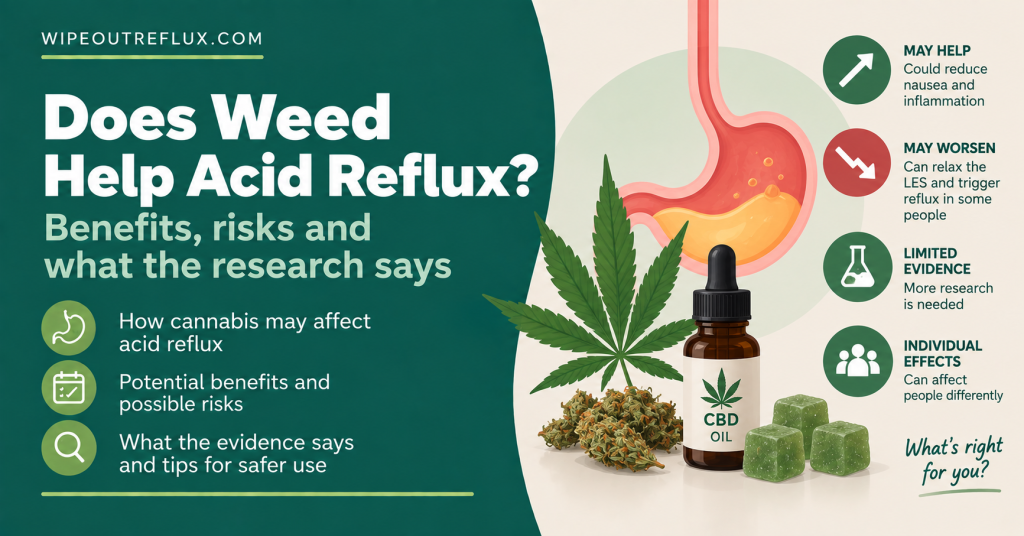
There’s a real mechanism behind the idea that cannabis helps reflux, and it’s more interesting than most people assume. THC acts on CB1 receptors in the brainstem circuit that triggers transient relaxations of the lower esophageal sphincter — the specific event that lets stomach contents escape upward. In a controlled human study, oral THC cut those relaxations by around half at the higher dose.
And then the same study found the catch. THC also lowered resting sphincter pressure, actual reflux episodes and acid exposure didn’t improve meaningfully, and half the volunteers on the higher dose were nauseated and vomiting — which is why that arm of the study was stopped early [Beaumont et al., British Journal of Pharmacology, 2009].
So the short answer: cannabis does something measurable to the mechanism that causes reflux, but that hasn’t translated into less reflux, and the route most people use it by — smoking — brings its own problems for the throat and esophagus. Below I’ll go through both sides properly, along with the thing almost nobody writes about: cannabinoid hyperemesis syndrome, which mimics severe reflux closely enough that people get treated for the wrong condition for years.
Key Takeaways
- THC reduces transient lower esophageal sphincter relaxations by roughly 28% at 10 mg and 52% at 20 mg — a genuine, dose-dependent effect on the core reflux mechanism.
- In the same study, THC also lowered resting sphincter pressure, and reflux episodes and acid exposure did not significantly improve.
- Half the volunteers given 20 mg experienced nausea and vomiting, along with dizziness, low blood pressure and a racing heart.
- In a US inpatient database of 27.2 million admissions, cannabis users with GERD had 34% higher odds of esophagitis than non-users.
- CBD doesn’t bind CB1 with any meaningful affinity, so there’s no basis for expecting the sphincter effect from CBD products.
- Cannabinoids slow gastric emptying, which is why they’re stopped for 48 hours before a gastric emptying study — and slow emptying tends to work against reflux control.
- Cannabinoid hyperemesis syndrome causes cyclic vomiting that resists standard anti-sickness drugs and is relieved by hot showers. It’s routinely mistaken for reflux or cyclic vomiting syndrome.
- For LPR specifically, the smoke itself is the bigger issue — inhaled irritants hit the same laryngeal tissue that reflux is already inflaming.
The case that it helps: CB1 receptors and transient relaxations
To follow the argument you need one piece of background. Most reflux isn’t acid forcing its way past a permanently weak valve. It happens during transient lower esophageal sphincter relaxations — brief, involuntary openings of the lower esophageal sphincter that are triggered by stomach distension after eating and coordinated through the vagus nerve and brainstem. They’re a normal mechanism, designed for belching. In reflux disease they happen too often and let too much through.
CB1 cannabinoid receptors sit right in that reflex pathway. Activate them and the reflex should fire less often. That’s the theory, and it held up in animals first: a cannabinoid receptor agonist inhibited both transient relaxations and reflux in dogs [Lehmann et al., Gastroenterology, 2002].
The human test came in 2009. Eighteen healthy male volunteers were given oral THC at 10 mg or 20 mg, or placebo, in a randomized double-blind design. THC reduced the meal-induced rise in transient relaxations during the first hour after eating in a dose-dependent way — about 28.5% at 10 mg and 52.5% at 20 mg [Beaumont et al., British Journal of Pharmacology, 2009].
That’s a substantial effect on the exact mechanism that matters. Pharmaceutical companies took it seriously enough to pursue CB1 agonists as a reflux drug class. If the story ended there, cannabis would be a plausible reflux treatment.
The case that it doesn’t: what the same study found next
Three findings in that paper undercut the headline, and they’re rarely quoted alongside it.
THC also lowered resting sphincter pressure. Both doses significantly decreased basal LES pressure after the meal, starting around an hour in [Beaumont et al., British Journal of Pharmacology, 2009]. So THC closes one door and opens another: fewer triggered relaxations, but a slacker sphincter the rest of the time. Those effects work against each other.
Reflux itself didn’t significantly improve. There was a trend toward fewer reflux episodes in the first hour after eating at the 20 mg dose, but it didn’t reach significance, and overall postprandial reflux and acid exposure showed no meaningful reduction. Reducing a mechanism on a manometry trace is not the same as reducing reflux, and here it didn’t translate.
The dose that worked best made people sick. Half the subjects on 20 mg had nausea and vomiting, which forced that arm to be terminated early. Hypotension, tachycardia, dizziness and confusion were also reported. These were healthy young men in a controlled setting.
Then there’s what happens outside the lab. A US National Inpatient Sample analysis covering 27.2 million admissions, including 507,190 cannabis users, found that among patients with GERD, cannabis users had 34% higher adjusted odds of esophagitis (aOR 1.34). Interestingly, they had lower odds of esophageal stricture (0.88) and esophageal cancer (0.48) [Kaur et al., Cannabis and Cannabinoid Research, 2024].
Be careful with that last part. Cannabis users in hospital databases skew considerably younger, and stricture and cancer are diseases of decades of exposure — so those protective-looking numbers are more likely an artifact of age than a benefit. The esophagitis signal is the one that fits the mechanism: more erosive esophagitis in people using a substance that relaxes the sphincter.
One more piece worth connecting: cannabinoids slow gastric emptying. That’s established enough that guidelines instruct patients to stop cannabinoids for 48 hours before a gastric emptying study, or the result measures the drug rather than the stomach [Camilleri et al., American Journal of Gastroenterology, 2022]. Food sitting longer in a distended stomach is not a helpful direction if you reflux — it’s the same dynamic I’ve covered in gastroparesis and acid reflux.
THC vs CBD
This distinction matters more than the marketing suggests, because the sphincter effect above is a CB1 effect and only one of these compounds meaningfully activates CB1.
THC is the CB1 agonist. It’s what produced the reduction in transient relaxations, and it’s also what produced the drop in resting sphincter pressure, the nausea, the dizziness and the slowed gastric emptying. The effects come as a package.
CBD has very low affinity for CB1 and works through other targets entirely. There’s no mechanistic basis for expecting it to reduce transient relaxations, and no human reflux trial of it. CBD oils are frequently marketed for digestive complaints, and I’d treat those claims as unevidenced for reflux specifically. Worth noting separately that CBD is metabolized by the same liver enzymes as many medications, including some PPIs, so interactions are a real consideration if you take prescription drugs.
The practical upshot: buying a CBD product hoping for the reflux mechanism described in the research is a category error. The research used THC.
Smoking vs edibles vs vaping
The delivery route changes the risk profile substantially, and this is where most reflux-specific harm sits.
Smoking. The evidence on tobacco is clear — it lowers sphincter pressure, reduces the saliva that neutralizes and clears acid, and provokes coughing that drives pressure spikes in the abdomen. Combusted cannabis shares most of those properties, minus the nicotine, and cannabis smokers typically inhale more deeply and hold longer. If you have reflux, smoking anything is working against you; the detail is in can smoking cause acid reflux.
Vaping. Often assumed to be the safe middle ground. Propylene glycol and vegetable glycerin aerosols dry the throat, and the throat-clearing and coughing that follow are exactly what an already-irritated larynx doesn’t need. I’ve gone through what’s known in vaping and acid reflux. Less combustion damage, not harm-free.
Edibles. These avoid the smoke entirely, which is a genuine advantage for the throat. But they bring their own reflux problems: they’re usually high in fat and sugar (fat slows gastric emptying and lowers sphincter pressure), the dose is harder to control, onset is delayed by one to two hours so it’s easy to take more than you intended, and they arrive alongside a meal-sized volume in the stomach. Being high also tends to mean eating more, later, and lying down soon afterwards — which is the classic recipe for a bad night of reflux regardless of the cannabis.
If you’re going to use cannabis and you have reflux, edibles taken well before bed rather than late at night are the least bad configuration. That’s harm reduction, not a recommendation.
Cannabinoid hyperemesis syndrome
This is the section that matters most, and it’s the one you won’t find on the reflux pages competing for this search.
Cannabinoid hyperemesis syndrome (CHS) is a pattern of severe cyclic nausea and vomiting that develops after prolonged, heavy cannabis use — typically after years of it. The Rome IV criteria describe episodic vomiting resembling cyclic vomiting syndrome, occurring on a background of prolonged excessive cannabis use, resolving with sustained cessation, and frequently accompanied by compulsive hot bathing [Cue et al., StatPearls, 2023].
Several features make it recognizable once you know to look:
- Hot showers or baths relieve it. This is close to pathognomonic — in one survey, 67% of people with CHS reported relief from hot showers. People often bathe compulsively, several times a day, and can’t explain why it works.
- Standard anti-sickness drugs don’t work. Classic resistance to ondansetron and metoclopramide is characteristic, and it’s often what finally prompts someone to question the diagnosis.
- Topical capsaicin cream helps. Applied to the abdomen, it’s produced significant relief of both pain and vomiting in published cases. Benzodiazepines are used short-term, and antipsychotics such as haloperidol are another option.
- Only stopping cannabis resolves it. That’s built into the diagnostic criteria. Cutting down usually doesn’t.
Here’s why it belongs in an article about reflux. The presentation — recurrent vomiting, upper abdominal pain, nausea, an acid-burned throat and esophagus from repeated vomiting — reads as severe reflux disease, and the vomiting genuinely does cause secondary esophagitis. So the investigations often confirm “reflux”, and the person is treated with escalating acid suppression for years while the actual driver goes unaddressed. The cruel twist is that people often increase cannabis use to control the nausea, because cannabis is a known antiemetic, which makes everything worse.
If you have cyclic vomiting, hot showers that help more than any medication, and you use cannabis regularly, raise CHS with your doctor by name. It’s the same category of diagnostic problem as rumination syndrome, another condition that gets misfiled as reflux for years before someone recognizes the pattern.
What any of it means for LPR specifically
Silent reflux changes the calculation, and not in cannabis’s favor.
LPR is driven by refluxate reaching the larynx and throat, where the tissue has almost none of the esophagus’s defenses. The damage there is largely done by pepsin, which binds to laryngeal tissue and stays there, reactivating whenever the local pH drops. Three things follow:
- Inhaled irritants hit the target tissue directly. Smoke and vapor pass over the exact tissue that reflux is already inflaming. There’s no equivalent insult for someone with heartburn alone. If your symptoms are throat-based — constant throat clearing, hoarseness, a lump sensation — this is the single most relevant consideration.
- Coughing and throat clearing amplify the cycle. Both traumatize the vocal folds mechanically, on top of the chemical injury.
- Nothing in the CB1 research was measured in the throat. The human study looked at esophageal reflux with manometry and pH monitoring, in healthy volunteers. Extrapolating a modest, non-significant esophageal finding to laryngeal reflux isn’t justified.
There’s one genuinely mixed consideration. Reflux symptoms are amplified by stress and hypervigilance — that’s well established, and I’ve written about it in can LPR be caused by anxiety. Some people find cannabis reduces that loop, and less anxiety may genuinely mean fewer perceived symptoms. Whether that outweighs a relaxed sphincter, slower gastric emptying and inhaled irritants is an individual calculation — but it should be made with the full picture rather than the half of the research that gets quoted. It’s also worth weighing against the things that do reliably reduce what reaches your larynx in the first place — the meal composition, timing and pepsin-load work set out in the Wipeout Diet Plan.
Conclusion
The fair summary is that cannabis has a real, measurable effect on the reflux mechanism that has never been shown to produce less reflux. THC cuts transient sphincter relaxations substantially, but also lowers resting sphincter pressure, slows gastric emptying, and in the one proper human study didn’t significantly reduce reflux episodes or acid exposure — while making half the higher-dose group vomit. Add smoke or vapor over an already-inflamed larynx, and the case for using it as a reflux remedy doesn’t hold together. If you have cyclic vomiting relieved by hot showers, the question isn’t whether cannabis is helping your reflux; it’s whether you have cannabinoid hyperemesis syndrome.
None of that is an argument about cannabis generally — it’s an argument about using it for this. And it leaves the actual problem untouched: acid and pepsin reaching tissue that can’t defend against them.
That’s the problem the Wipeout Diet Plan is built to solve — a structured, week-by-week program covering what to eat and what to drop, how to time meals and sleep so they stop working against you, how to bring the acid and pepsin load down steadily, and how to reduce reliance on acid suppression safely when the time comes. I built it primarily around LPR, the throat-based form that’s hardest to shift, but because it works on the same underlying mechanisms it’s just as effective for GERD, heartburn and classic acid reflux.
If you’d rather start smaller, the Wipeout Food Reference Guide is the essential companion — every food and drink that matters for acid reflux and LPR, with its pH, so you can start making better choices from your next meal.
Frequently Asked Questions
Does weed help acid reflux?
Not in any way that’s been demonstrated. THC reduces the transient sphincter relaxations that cause reflux — by around half at a 20 mg oral dose — but the same study found it also lowered resting sphincter pressure, and reflux episodes and acid exposure didn’t significantly improve. Half the subjects at that dose became nauseated and vomited.
Can smoking weed cause acid reflux?
It plausibly contributes. THC lowers resting sphincter pressure and slows gastric emptying, and smoke reduces saliva and irritates the throat, all of which work against reflux control. In a large inpatient database, cannabis users with GERD had 34% higher adjusted odds of esophagitis than non-users.
Is CBD good for acid reflux?
There’s no evidence for it. CBD has very low affinity for the CB1 receptor that mediates the sphincter effect seen with THC, and no human reflux trial has tested it. CBD also interacts with the liver enzymes that metabolize many medications, which is worth checking if you take prescription drugs.
Are edibles better than smoking for reflux?
For your throat and larynx, yes — no smoke or vapor over inflamed tissue. But edibles are typically high in fat and sugar, harder to dose, slow to take effect, and tend to lead to eating more, later, and lying down soon afterwards. Well before bedtime rather than late at night is the less damaging option.
What is cannabinoid hyperemesis syndrome?
A syndrome of recurrent severe nausea and vomiting that develops after prolonged heavy cannabis use. It’s distinguished by relief from hot showers or baths, resistance to standard anti-sickness drugs like ondansetron, and resolution only when cannabis is stopped completely. It’s frequently misdiagnosed as cyclic vomiting syndrome or severe reflux, partly because repeated vomiting causes genuine esophagitis.
Why do hot showers help cannabinoid hyperemesis?
The mechanism isn’t fully settled, with theories involving the TRPV1 receptor and the brain’s temperature regulation centre. The clinical point is more important than the explanation: relief from hot bathing is one of the most distinctive features of the syndrome, and topical capsaicin cream — which acts on the same receptor — has helped in published cases.
Will quitting cannabis improve my reflux?
If you smoke or vape it, quitting removes a direct irritant from an already-inflamed throat and larynx, so improvement is likely for LPR-type symptoms. For heartburn, the effect is less predictable. If your symptoms are cyclic vomiting relieved by hot showers, cessation isn’t just likely to help — it’s the only thing that resolves the condition.
Research & References
- [Beaumont et al., British Journal of Pharmacology, 2009] — Randomized, double-blind, placebo-controlled study of oral Δ9-THC at 10 mg and 20 mg in 18 healthy volunteers: transient lower esophageal sphincter relaxations reduced by 28.5% and 52.5% respectively in the first postprandial hour, basal LES pressure also significantly decreased, no significant reduction in reflux episodes or acid exposure, and nausea and vomiting in half of subjects at 20 mg alongside hypotension, tachycardia and central effects.
- [Lehmann et al., Gastroenterology, 2002] — Animal study showing that cannabinoid receptor agonism inhibits transient lower esophageal sphincter relaxations and reflux in dogs, the preclinical basis for the later human work.
- [Kaur et al., Cannabis and Cannabinoid Research, 2024] — Analysis of 27.2 million US inpatient encounters including 507,190 cannabis users: among patients with GERD, cannabis use was associated with higher adjusted odds of esophagitis (aOR 1.34) and lower adjusted odds of esophageal stricture (0.88) and esophageal cancer (0.48).
- [Cue et al., StatPearls, 2023] — Review of cannabinoid hyperemesis syndrome: Rome IV diagnostic criteria, the requirement for prolonged excessive cannabis use and resolution with sustained cessation, relief from hot bathing reported by 67% of respondents in one survey, characteristic resistance to ondansetron and metoclopramide, and symptom relief from topical capsaicin cream, benzodiazepines and antipsychotics.
- [Camilleri et al., American Journal of Gastroenterology, 2022] — ACG clinical guideline on gastroparesis, which lists cannabinoids among the medications customarily stopped for 48 hours before gastric emptying testing because of their effect on gastric emptying.

David Gray
12 years living with LPR · Consultant & researcher
I've lived with LPR for twelve years — the misdiagnoses, the PPI courses that did nothing, the slow work of figuring out what actually helps. Wipeout Reflux is where I translate the research into plain terms for people stuck in the same place. Every claim here is sourced to peer-reviewed work, and I consult one-to-one with LPR sufferers.