
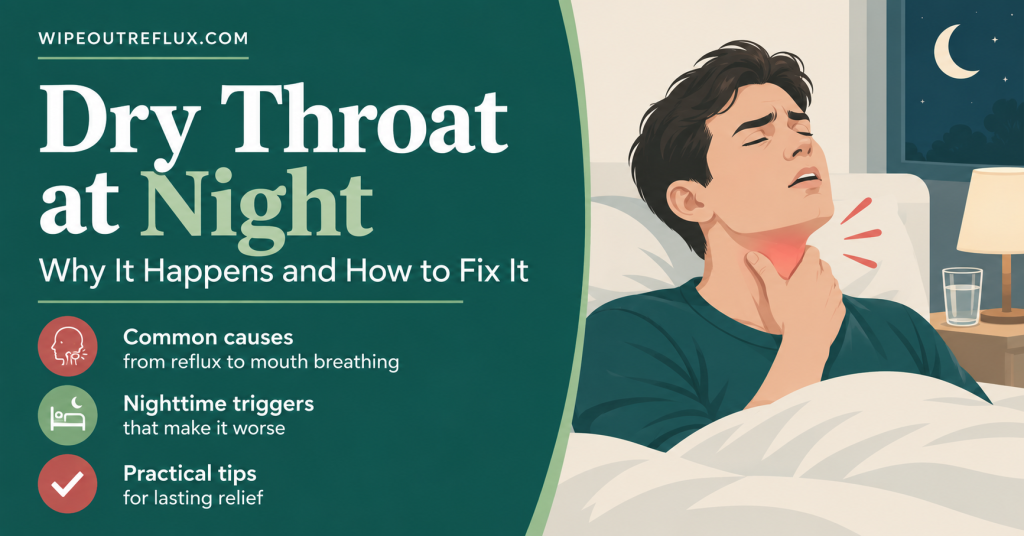
A dry throat at night is usually caused by breathing through your mouth while you sleep, dry indoor air, or both. Saliva production drops sharply during sleep, so your mouth and throat already have less moisture overnight. Mouth breathing then dries the surface out with every breath. A blocked nose, snoring, sleep apnea, a CPAP mask, heating or air conditioning, alcohol and some medications all make it worse.
Night-time reflux is the cause people tend to miss. When you lie down, stomach contents reach the throat more easily, and with less saliva and less swallowing to clear them, the throat ends up irritated, dry and scratchy by morning. A dry throat that comes with a cough, throat clearing or hoarseness in the morning points strongly to reflux.
To fix it: breathe through your nose (treat the congestion behind it), run a humidifier to keep bedroom humidity around 40 to 50%, stop eating 3 hours before bed, cut back on evening alcohol, and keep water by the bed.
Key Takeaways
- Saliva flow falls to a fraction of its daytime level during sleep, so your throat is at its most vulnerable overnight.
- Mouth breathing is the most common cause. Sleeping with your mouth open dries the throat and even makes the mouth more acidic.
- Dry bedroom air from heating or air conditioning pulls moisture from your airways all night.
- Night-time reflux is a commonly missed cause, especially when the dryness comes with a morning cough, throat clearing or hoarseness.
- Snoring, sleep apnea and CPAP without a heated humidifier often leave you with a parched throat in the morning.
- Antihistamines, antidepressants, blood pressure medications and alcohol can all reduce saliva.
- A humidifier set to 40 to 50% humidity, nasal breathing and a 3-hour gap between dinner and bed fix most cases.
- Constant dry mouth day and night, dry eyes, extreme thirst or frequent urination need checking by a doctor.
What Causes a Dry Throat at Night?
The reason your throat dries out at night specifically, rather than during the day, comes down to saliva. During the day you produce saliva constantly and swallow it hundreds of times, which keeps your throat coated and moist. When you fall asleep, saliva production drops to a trickle and you swallow far less often. Your throat loses its main source of moisture for 7 or 8 hours.
That’s normal, and most people wake up fine. But anything that adds extra drying on top tips the balance. These are the main causes:
- Mouth breathing: the most common cause by a long way.
- Dry bedroom air: heating in winter, air conditioning in summer.
- Night-time acid reflux and silent reflux: often missed, especially when there’s a cough too.
- A blocked nose: allergies, colds, a deviated septum or nasal polyps.
- Snoring and sleep apnea: including CPAP machines without humidification.
- Medications and alcohol: many common drugs reduce saliva.
- Dehydration and medical conditions: diabetes and Sjögren’s syndrome, among others.
Mouth Breathing: The Number One Cause
Your nose is a built-in humidifier. As air passes through it, it’s warmed and moistened before it reaches your throat. When you breathe through your mouth, that step is skipped. Dry air hits the back of your throat directly, all night long.
The effect is bigger than most people realize. In a study where healthy volunteers slept with and without their nose blocked, mouth breathing made the mouth more acidic overnight. Average pH dropped from around neutral to about 6.6, with dips as low as 3.6, because there wasn’t enough saliva to buffer it [Choi et al., Journal of Oral Rehabilitation, 2016].
The drying reaches further down too. In a voice study, just 15 minutes of forced mouth breathing made it harder to start the voice and increased vocal effort, while nose breathing didn’t. The researchers put this down to drying of the vocal fold surface [Sivasankar and Fisher, Journal of Speech, Language, and Hearing Research, 2003]. Now imagine 8 hours of it. That’s why mouth breathers often wake up with a dry throat and a croaky voice.
Signs you’re breathing through your mouth at night:
- You wake with a dry mouth, cracked lips or a sticky tongue
- Your partner says you snore or sleep with your mouth open
- There’s drool on your pillow
- You wake up with bad breath or a sore throat that eases after a drink
- Your nose often feels blocked at night
Mouth taping has become popular as a fix, but it’s only safe if you can breathe comfortably through your nose, and it isn’t suitable if you might have sleep apnea. I cover the pros and cons in is mouth taping safe for acid reflux.
Night-Time Reflux: The Cause Most Guides Miss
Why reflux reaches the throat more at night
When you’re upright, gravity helps keep stomach contents where they belong. Lie down and that help disappears. On top of that, the two things that normally protect your esophagus and throat both slow down during sleep: you swallow far less often, and you make much less saliva. Saliva is alkaline and rich in bicarbonate. It neutralizes acid that comes up and washes it back down. I explain this in saliva, bicarbonate and acid reflux.
So at night, any reflux that does happen tends to travel further and stay longer. Eating late makes this much more likely. In a case-control study, people who went to bed within 3 hours of dinner had much higher odds of reflux than those who waited 4 hours or more [Fujiwara et al., American Journal of Gastroenterology, 2005]. More in acid reflux at night.
Why reflux makes your throat feel dry
With silent reflux (LPR), small amounts of stomach contents reach the voice box and throat. The main troublemaker isn’t acid alone but pepsin, the stomach’s protein-digesting enzyme. Pepsin can be taken up into throat tissue and become active again later when more acid arrives [Johnston et al., The Laryngoscope, 2007]. The irritated lining feels raw and scratchy, and thick mucus builds up instead of the thin, watery coating a healthy throat has. People often describe this as dryness, even though the throat isn’t technically short of moisture.
Reflux and dry mouth also feed each other. Less saliva means acid is cleared more slowly, and reflux can change how your mouth and throat feel. See acid reflux and dry mouth.
For me, this was one of the most recognizable LPR patterns. I’d wake up with a dry, tight throat, clear it a dozen times, and sound rough for the first hour of the day. Water helped for a minute, then the dryness came straight back. That doesn’t happen with plain dry air, where a drink fixes it.
Signs your dry throat at night is reflux
- It’s worse after late, large, fatty or spicy dinners, or after alcohol
- You wake with a hoarse voice, a sour or bitter taste, or a lump-in-the-throat feeling
- You clear your throat a lot in the morning, or cough up thick mucus
- Drinking water only helps for a short while
- It improves when you raise the head of your bed or eat earlier
- You sometimes wake up coughing or choking. See waking up choking from acid reflux.
For the full set of throat signs, see LPR symptoms, and for why mornings are often the worst, why your acid reflux is worse in the morning.
Cough and Dry Throat at Night
A dry throat and a night-time cough often go together, and figuring out which came first points you to the cause.
- Reflux: a dry, tickly cough after lying down or in the early hours, with throat clearing and hoarseness in the morning. Reflux can trigger coughing through a nerve reflex from the esophagus even when it doesn’t reach the throat. See reflux cough.
- Post-nasal drip: mucus dripping down the back of the throat when you lie down, often with a blocked or runny nose. Reflux can mimic this closely. See silent reflux and post-nasal drip.
- Dry air: a tickly cough that eases with a drink and is worse in winter or with air conditioning.
- Medication: ACE inhibitor blood pressure drugs (names ending in “-pril”) commonly cause a dry, tickly cough. See ACE inhibitor cough.
- Asthma: coughing or wheezing at night, especially in the early hours, can be asthma. Reflux can also make asthma worse at night.
Coughing itself dries and irritates the throat further, so the two can keep each other going. Breaking the cycle usually means treating the cause and sipping water rather than giving in to every cough. More in how to stop constant throat clearing.
Dry Mouth and Dry Throat at Night
When your mouth is as dry as your throat, the cause is usually something that cuts saliva across the board.
Medications
Hundreds of medications reduce saliva. The most common culprits are:
- Antihistamines, including sleep aids that contain diphenhydramine or doxylamine
- Antidepressants, especially older tricyclics like amitriptyline
- Blood pressure medications and diuretics
- Bladder medications for overactive bladder
- Decongestants
- Some pain medications and muscle relaxants
Never stop a prescribed medication on your own, but if your dry throat started around the time you began a new drug, ask your doctor or pharmacist whether there’s an alternative or a better time of day to take it. See antihistamines and acid reflux.
Alcohol, caffeine and smoking
Alcohol in the evening is a triple hit. It dehydrates you, it relaxes your throat muscles so you’re more likely to snore and mouth-breathe, and it relaxes the valve at the top of your stomach so reflux is more likely. Smoking and vaping dry and irritate the throat lining directly. See is alcohol acid or alkaline and vaping and acid reflux.
Medical conditions
- Diabetes: high blood sugar causes thirst, a dry mouth and frequent urination, including at night.
- Sjögren’s syndrome: an autoimmune condition that attacks the glands that make saliva and tears. Dry eyes plus a dry mouth day and night is the classic combination.
- Thyroid problems: can affect the throat and saliva. See thyroid problems and acid reflux.
- Burning mouth syndrome: causes dryness and burning that’s often worse later in the day. See burning mouth syndrome.
Snoring, Sleep Apnea and CPAP
Snoring almost always means some mouth breathing, and the vibration itself dries and irritates the throat. Obstructive sleep apnea makes it worse. People with apnea often sleep with their mouth open, and the effort of breathing against a blocked airway can also increase night-time reflux. If you snore loudly, wake up unrefreshed, or someone has noticed you stop breathing in your sleep, a sleep study is worth asking about. See sleep apnea and acid reflux.
CPAP is very effective for apnea, but the constant airflow is drying. Heated humidification makes a real difference. In a trial of people starting CPAP, a heated humidifier significantly reduced dry mouth, dry throat and dry nose compared with no humidification, and people used their CPAP for longer each night. A cold, unheated humidifier didn’t give the same benefit [Massie et al., Chest, 1999]. If you use CPAP and wake up parched, talk to your provider about turning up the heated humidifier, using heated tubing, or switching to a full face mask if you breathe through your mouth.
Really Dry Throat at Night: When It’s Something Else
If your throat is extremely dry, like sandpaper, and water doesn’t touch it, think beyond dry air:
- Constant dryness day and night, with dry eyes, points toward Sjögren’s syndrome or a medication.
- Extreme thirst, frequent urination and weight loss point toward diabetes. Get your blood sugar checked.
- Dryness with a hoarse voice, throat clearing and mucus points toward reflux.
- Dryness with a fever, swollen glands or white patches on the tonsils is likely an infection.
How to Get Rid of a Dry Throat at Night
Fix the airflow
- Breathe through your nose. If your nose is blocked at night, treat that first. Saline rinses before bed, treating allergies, and keeping pets out of the bedroom all help. A stuffy nose that never clears may need an ENT assessment. See LPR vs allergies.
- Humidify your bedroom. Aim for 40 to 50% humidity. More on this below.
- Sleep on your side or slightly raised. Lying flat on your back makes snoring and mouth breathing more likely.
Fix the reflux
- Stop eating 3 hours before bed. This gives your stomach time to empty before you lie down. See how long before bed you should stop eating.
- Raise the head of your bed. Use bed risers or a wedge pillow so your whole upper body is raised, not just your head. See best wedge pillows for silent reflux and the best sleeping position for silent reflux.
- Make your evening meal low in acid and fat. In people with stubborn silent reflux, a strict low-acid diet improved symptoms in most cases [Koufman, Annals of Otology, Rhinology & Laryngology, 2011]. Taking away pepsin’s fuel is the central idea of the Wipeout Diet Plan.
- Consider an alginate before bed. Products like Gaviscon Advance form a protective raft on top of your stomach contents that helps block night-time reflux. See alginates for acid reflux.
Keep your throat moist
- Drink enough during the day. Front-load your fluids so you’re well hydrated by evening without needing to drink a lot right before bed.
- Keep water by the bed. Small sips when you wake up help. Room-temperature water is gentler than iced.
- Cut back on evening alcohol and caffeine. Both dry you out and make reflux more likely.
- Try a soothing pre-bed drink. A warm (not hot) cup of chamomile tea with a little manuka honey coats the throat. See is chamomile tea good for acid reflux and is manuka honey good for acid reflux.
- Use saliva-friendly lozenges carefully. Sugar-free lozenges or xylitol gum during the evening can boost saliva. Avoid mint and menthol, which can worsen reflux. See throat lozenges and hard candy for acid reflux.
Humidifier for Dry Throat at Night: What to Buy
A humidifier is the simplest fix for a dry throat caused by dry air, and it helps a mouth-breathing throat too. But the type matters, and so does keeping it clean.
How much humidity you need
Aim for 40 to 50% relative humidity in your bedroom. Below about 30%, the air pulls moisture from your airways and you’ll notice it in your throat, nose and eyes. Above 60%, you start encouraging dust mites and mold, which can trigger allergies and a blocked nose, the very thing that makes you mouth-breathe. A cheap digital hygrometer tells you where you are, so you’re not guessing.
Cool mist, warm mist or evaporative?
- Evaporative (cool): a fan blows air through a wet wick. These naturally stop adding moisture as the room gets more humid, so they’re hard to overdo, and they don’t spray minerals into the air. The trade-off is a wick that needs replacing and some fan noise.
- Ultrasonic (cool mist): a vibrating plate turns water into a fine mist. Quiet and efficient, which makes them good for bedrooms. With tap water, they can spread a fine white mineral dust, so use distilled or demineralized water.
- Warm mist: boils the water before releasing it as steam, so the mist is cleaner. They use more electricity, and the hot water is a burn risk around children and pets.
Whatever you choose, clean it as the manufacturer recommends, change the water daily rather than topping it up, and let it dry out when you’re not using it. A dirty humidifier can grow bacteria and mold and spray them straight into the air you’re breathing all night.
My picks
Prices and models change, so check the current listing on Amazon before you buy.
- Best evaporative: Honeywell HCM-350 Cool Moisture Humidifier. A long-standing evaporative model with a UV feature to help keep the water clean. It’s self-regulating, so it won’t over-humidify a bedroom, and there’s no white dust. Budget for replacement wicks.
- Best for the bedroom: LEVOIT LV600HH Hybrid Humidifier. Offers both warm and cool mist, has a large 6-liter tank that lasts through the night, and a built-in humidity sensor so you can set it to hold your target level. Use distilled water in cool mode.
- Best budget pick: Pure Enrichment MistAire Ultrasonic Humidifier. A compact, quiet cool-mist humidifier for a bedside table or a smaller bedroom. Good value if you just want to take the edge off dry winter air.
- Don’t skip this: ThermoPro TP50 Hygrometer. An inexpensive digital humidity monitor. It’s the easiest way to know whether your bedroom is actually dry and whether your humidifier is overdoing it.
One honest caveat: a humidifier won’t fix a dry throat caused by reflux, medication or a blocked nose on its own. If you’ve got the humidity right and still wake up dry and hoarse, look at the other causes in this article.
When to See a Doctor
A dry throat at night is usually harmless and fixable at home. See a doctor if you have:
- Dry mouth and throat all day as well as at night, especially with dry eyes
- Extreme thirst, frequent urination or unexplained weight loss
- A hoarse voice lasting more than 3 to 4 weeks
- Difficulty or pain when swallowing, or food sticking
- Loud snoring with pauses in breathing, choking awake or daytime sleepiness
- A cough lasting more than 3 weeks, or coughing up blood
- A lump in your neck
If reflux seems likely and home changes haven’t helped, my guide on when to see a doctor for LPR explains what to ask for.
Conclusion
A dry throat at night happens because your throat loses most of its saliva while you sleep, and then something adds extra drying on top. Mouth breathing and dry bedroom air are the most common culprits, and a humidifier plus clear nasal breathing fixes many cases. But if you wake up hoarse, clearing your throat, coughing or with thick mucus, and water only helps for a minute, night-time reflux is the more likely cause. With less saliva and less swallowing overnight, any reflux reaches further and lingers longer, leaving pepsin to irritate your throat until morning.
That’s where food and timing come in. For a complete, structured way to calm night-time reflux, the Wipeout Diet Plan is the first thing I’d recommend. It takes you step by step through low-acid meals, evening eating habits and the triggers that keep your throat inflamed. It was designed first and foremost for silent reflux, the throat-based kind behind most of these dry, hoarse mornings, but because it works on the same root causes, it helps just as much with GERD and classic heartburn.
If you’d like a simpler starting point, the Wipeout Food Reference Guide is the essential companion. It lists the foods and drinks that are safe for acid reflux and LPR, with their pH values, so you can choose an evening meal that won’t leave your throat raw by morning.
Frequently Asked Questions
Why does my throat get so dry at night?
Saliva production drops sharply during sleep and you swallow much less, so your throat has less moisture overnight. Mouth breathing, dry indoor air, a blocked nose, snoring, alcohol, some medications and night-time reflux all add to the drying.
How do I get rid of a dry throat at night fast?
Sip room-temperature water, breathe through your nose if you can, and sit up for a few minutes. For lasting relief, run a humidifier set to 40 to 50%, treat nasal congestion, and stop eating 3 hours before bed if reflux could be involved.
Can acid reflux cause a dry throat at night?
Yes. Lying down lets reflux reach the throat more easily, and with less saliva and swallowing during sleep, it’s cleared more slowly. Pepsin irritates the throat lining, which feels dry, scratchy and raw, often with hoarseness and throat clearing in the morning.
Why do I have a cough and dry throat at night?
The most common causes are night-time reflux, post-nasal drip and dry air. ACE inhibitor blood pressure medications and asthma can also cause it. A cough that starts after lying down and comes with morning hoarseness points toward reflux.
Does a humidifier help a dry throat at night?
Yes, if dry air is part of the problem. Keep bedroom humidity at 40 to 50%, use distilled water in ultrasonic models, and clean the humidifier regularly. It won’t fix dryness caused by reflux or medication on its own.
Is a dry throat at night a sign of sleep apnea?
It can be. People with sleep apnea often sleep with their mouth open and wake with a dry mouth and throat. If you also snore loudly, wake up unrefreshed, or someone has noticed pauses in your breathing, ask your doctor about a sleep study.
Why do I wake up with a dry mouth and throat every morning?
Most often it’s mouth breathing during sleep, made worse by dry air, a blocked nose or snoring. If it lasts all day too, consider medications, diabetes or Sjögren’s syndrome, and get checked by a doctor.
Research & References
- [Choi et al., Journal of Oral Rehabilitation, 2016] — In healthy volunteers, mouth breathing during sleep lowered intraoral pH compared with nasal breathing, with prolonged drops into the acidic range.
- [Sivasankar and Fisher, Journal of Speech, Language, and Hearing Research, 2003] — 15 minutes of mouth breathing, but not nasal breathing, increased phonation threshold pressure and vocal effort, attributed to surface drying of the vocal folds.
- [Fujiwara et al., American Journal of Gastroenterology, 2005] — Going to bed within 3 hours of dinner was associated with markedly higher odds of reflux than waiting 4 hours or more.
- [Johnston et al., The Laryngoscope, 2007] — Pepsin remains stable at throat pH and can be reactivated by acid, explaining ongoing throat irritation from reflux.
- [Massie et al., Chest, 1999] — In people starting CPAP, heated humidification reduced dry mouth, throat and nose and increased nightly CPAP use, while cold passover humidification did not improve use.
- [Koufman, Annals of Otology, Rhinology & Laryngology, 2011] — A strict low-acid diet improved symptoms in most people with silent reflux that hadn’t responded to medication alone.

David Gray
12 years living with LPR · Consultant & researcher
I've lived with LPR for twelve years — the misdiagnoses, the PPI courses that did nothing, the slow work of figuring out what actually helps. Wipeout Reflux is where I translate the research into plain terms for people stuck in the same place. Every claim here is sourced to peer-reviewed work, and I consult one-to-one with LPR sufferers.