
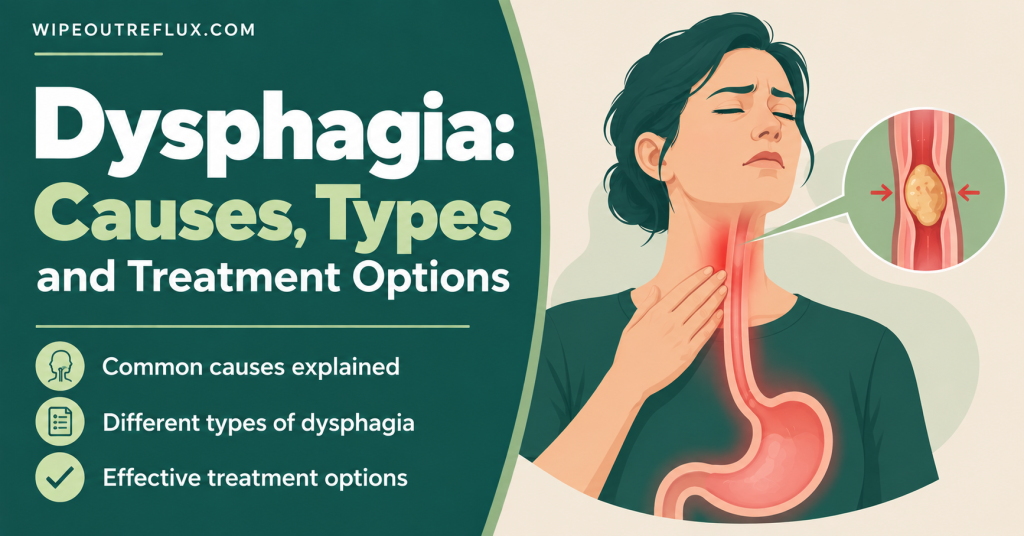
Dysphagia is the medical term for difficulty swallowing. It means food, drink or pills don’t pass smoothly from your mouth to your stomach. You might cough or choke as you swallow, feel something sticking in your throat or chest, or need several swallows to get one mouthful down.
It’s a symptom, not a diagnosis. The cause might be in the throat (usually a nerve or muscle problem) or in the esophagus (usually inflammation, narrowing or a motility problem). Treatment depends entirely on which one you have. That’s why the most useful thing you can do is work out where and how swallowing goes wrong, then get the right test.
Dysphagia is also far more common than most people realize. In a US survey of more than 31,000 adults, about 1 in 6 reported it, and only about half had ever sought care [Adkins et al., Clinical Gastroenterology and Hepatology, 2019].
Key Takeaways
- Dysphagia = difficulty swallowing. It’s a symptom with many possible causes, not a disease in itself.
- There are two main types: oropharyngeal (trouble starting a swallow, coughing or choking) and esophageal (food feels stuck a few seconds after swallowing).
- Acid reflux is the most common esophageal cause, followed by eosinophilic esophagitis, strictures and motility disorders.
- Stroke, Parkinson’s disease and aging muscles are the leading causes of the oropharyngeal type.
- Where you feel the blockage isn’t reliable. A problem low in the esophagus is often felt in the throat.
- Treatment targets the cause: reflux control, dilation, allergy-focused treatment, swallowing therapy, or surgery.
- Food stuck that won’t move, being unable to swallow saliva, or weight loss with worsening swallowing all need prompt medical care.
What Is Dysphagia? A Plain-English Definition
Swallowing looks simple, but it’s one of the most coordinated things your body does. Around 30 pairs of muscles and several cranial nerves have to fire in the right order in less than a second. Your tongue pushes food back, your airway seals shut, the upper esophageal sphincter opens, and then a wave of muscle contraction (peristalsis) carries food down to the stomach while the lower sphincter relaxes to let it in.
Dysphagia is what happens when any link in that chain fails. The word comes from Greek: dys (difficulty) and phagia (eating).
Three things often get confused with it:
- Odynophagia is painful swallowing. Food goes down, but it hurts. It usually points to inflammation or infection. You can have both at once.
- Globus is a constant lump-in-the-throat feeling that’s there between swallows and often eases when you eat. True dysphagia gets worse when you eat. I cover globus in detail in lump in throat from reflux (globus sensation).
- Trouble swallowing pills only is usually a technique and anxiety issue rather than a structural problem, unless solid food is also affected.
The Two Main Types of Dysphagia
Doctors split dysphagia by where the problem lives, because the causes and tests are completely different. A clinical review in American Family Physician recommends starting with the specific symptoms rather than where the patient thinks the blockage is [Wilkinson et al., American Family Physician, 2021].
Oropharyngeal dysphagia (the “transfer” problem)
This is trouble getting food out of the mouth and into the esophagus. It happens in the first second of the swallow.
- Difficulty starting a swallow
- Coughing, choking or throat clearing during or right after swallowing
- Food or liquid coming back through the nose
- A wet or gurgly voice after drinking
- Needing to swallow several times per mouthful
- Drooling, or food pocketing in the cheeks
- Repeated chest infections (a sign of silent aspiration)
It’s usually caused by nerve or muscle problems, and it’s the type with the highest risk of food or drink going into the lungs.
Esophageal dysphagia (the “transit” problem)
Here the swallow starts normally, but food then feels like it sticks on the way down, usually within a few seconds.
- A feeling of food catching behind the breastbone or at the base of the throat
- Needing to drink to wash food down
- Regurgitating undigested food
- Chest pressure or pain while eating
- Slowing down, cutting food smaller, or avoiding bread and meat
Two patterns tell doctors a lot:
- Solids only, getting steadily worse: suggests a mechanical narrowing, such as a stricture, ring or tumor.
- Solids and liquids from the start, coming and going: suggests a motility (muscle) problem, such as achalasia or esophageal spasm.
Why where you feel it can mislead you
This one surprises people. Most assume that if food feels stuck in the throat, the problem is in the throat. But when researchers compared where 100 patients felt their dysphagia with what endoscopy and manometry actually found, localization was not accurate. Feeling it low in the chest usually matched a low problem, but feeling it high in the throat or mid-chest rarely matched an actual problem at that level [Roeder et al., Digestive Diseases and Sciences, 2004].
In practice, a narrowing just above the stomach can make you feel like food is lodged at the base of your neck. So a “throat” sensation still warrants a look at the whole esophagus.
What Causes Dysphagia?
Esophageal causes
- Acid reflux (GERD): the most common cause overall. Reflux inflames the esophageal lining, disrupts normal muscle contractions and makes the nerves hypersensitive. In the large US survey, GERD was the most common condition among people with dysphagia, at 30.9% [Adkins et al., Clinical Gastroenterology and Hepatology, 2019]. I’ve written a full, reflux-specific breakdown of the five mechanisms in can acid reflux make it hard to swallow?
- Erosive esophagitis: more severe acid damage with visible erosions. See erosive esophagitis.
- Peptic stricture: scarring from long-term reflux that narrows the esophagus. See esophageal stricture.
- Schatzki ring: a thin ring of tissue at the bottom of the esophagus, classically causing intermittent “steakhouse” episodes. See Schatzki ring.
- Eosinophilic esophagitis (EoE): an allergic inflammation of the esophagus that is increasingly common, especially in younger men with food sticking episodes. It accounted for 8% of dysphagia in the US survey. See eosinophilic esophagitis vs acid reflux.
- Achalasia: the lower sphincter fails to relax and the esophagus loses its pushing wave. Often misdiagnosed as reflux for years. See achalasia vs acid reflux.
- Esophageal spasm and other motility disorders: uncoordinated or overly strong contractions. See esophageal spasm vs acid reflux.
- Pill esophagitis: certain tablets (doxycycline, NSAIDs, potassium, bisphosphonates, iron) can burn the lining if they lodge. See pill stuck in throat.
- Tumors: esophageal or stomach cancer, much less common, but the reason progressive dysphagia always needs investigating (more below).
- Other: scleroderma, external pressure from an enlarged thyroid or blood vessel, and radiation damage.
Oropharyngeal causes
- Stroke: the single biggest cause. A systematic review found dysphagia affects 37% to 78% of people after stroke depending on how it’s measured, and those with dysphagia had around three times the risk of pneumonia, rising to about eleven times with confirmed aspiration [Martino et al., Stroke, 2005].
- Parkinson’s disease: a meta-analysis found about a third of people with Parkinson’s report swallowing problems, but more than 80% show dysphagia when it’s measured objectively. Many don’t notice it [Kalf et al., Parkinsonism and Related Disorders, 2012].
- Other neurological conditions: multiple sclerosis, motor neurone disease (ALS), myasthenia gravis, dementia and head injury.
- Aging (presbyphagia): swallowing muscles lose strength and speed with age. A European white paper puts oropharyngeal dysphagia at 30% to 40% of independently living older people, 44% of those admitted to geriatric acute care and 60% of those in care homes [Baijens et al., Clinical Interventions in Aging, 2016].
- Zenker’s diverticulum: a pouch above the esophagus that traps food, causing regurgitation hours later. See Zenker’s diverticulum.
- Upper sphincter dysfunction: a cricopharyngeal muscle that doesn’t open fully. See upper esophageal sphincter and acid reflux.
- Head and neck cancer and its treatment: surgery and radiotherapy can stiffen swallowing structures.
- Medications: sedatives, some antipsychotics, and anything that causes a very dry mouth.
What about LPR and silent reflux?
This is the angle most general guides skip. Laryngopharyngeal reflux (LPR) sends small amounts of acid and pepsin up to the throat, where the tissue is far more delicate than in the esophagus. The result is swelling around the larynx and upper esophageal sphincter, extra mucus, and a throat that feels tight or obstructed.
For most people with LPR, the swallowing symptom is globus rather than true dysphagia. Food actually goes down fine, but the throat feels full or narrow. It’s still worth taking seriously, and it’s one of the reasons I push people to work out whether they’re dealing with GERD or LPR, because the treatment approach differs.
Is Dysphagia Serious? The Red Flags
Most dysphagia turns out to have a treatable, benign cause. But it’s also the single most important warning symptom for esophageal and stomach cancer. In a large UK primary care study, no other isolated upper-GI symptom carried as high a cancer risk. In people 55 and over it approached 5%, and under 55 it was below 1% [Stapley et al., British Journal of Cancer, 2013]. That’s why guidelines treat new dysphagia as a reason for prompt endoscopy rather than a watch-and-wait symptom. I explain the wider risk picture in can acid reflux cause cancer?
Go to the emergency room now if:
- Food is stuck and won’t go up or down
- You can’t swallow your own saliva, or you’re drooling
- You’re struggling to breathe, or your voice has suddenly changed
- You have chest pain that could be cardiac
See a doctor promptly (within days to a couple of weeks) if:
- Dysphagia is new and persistent, especially if you’re over 55
- It’s getting steadily worse, particularly from solids toward soft foods
- You’ve lost weight without trying
- You’re vomiting, vomiting blood, or passing black stools
- You’re coughing or choking when you eat or drink, or getting repeated chest infections
- You have a new lump in the neck or a hoarse voice lasting more than three weeks
If a pill or food has lodged and you’re unsure whether it’s passed, my guide to food that feels stuck in your chest walks through what to do in the moment.
How Dysphagia Is Diagnosed
The test depends on which type your symptoms point to.
For esophageal dysphagia
- Upper endoscopy (EGD): the first-line test. It shows inflammation, strictures, rings and tumors, allows biopsies (essential to diagnose EoE), and a stricture can often be stretched in the same session. See endoscopy for acid reflux.
- Barium swallow: an X-ray of you swallowing contrast. Good for subtle narrowing, rings, pouches and achalasia. See barium swallow for acid reflux.
- High-resolution manometry: measures the pressure and coordination of each swallow. It’s the key test for achalasia and spasm. See esophageal manometry.
- pH or pH-impedance monitoring: used when reflux is suspected but endoscopy looks normal. See the Bravo pH test.
For oropharyngeal dysphagia
- Bedside swallow screen by a nurse or speech-language pathologist (SLP)
- Videofluoroscopic swallow study (modified barium swallow): an X-ray video of you eating and drinking different textures, which shows whether anything enters the airway
- FEES (fiberoptic endoscopic evaluation of swallowing): a thin camera through the nose watches the throat as you swallow
A normal endoscopy doesn’t mean nothing is wrong. Many people with dysphagia have normal structure and turn out to have a motility problem or esophageal hypersensitivity, which is why manometry and pH testing matter when the first test is clear.
Difficulty Swallowing Treatments: Matched to the Cause
There’s no single dysphagia treatment. What works depends on the underlying cause, which is why diagnosis comes first.
Reflux-related dysphagia
- Acid suppression (usually a PPI) to let inflammation heal. This also reduces how often a stricture comes back after dilation.
- Diet and meal changes: smaller meals, stopping food 3 hours before bed, and reducing high-fat and acidic trigger foods.
- Alginates to form a barrier over stomach contents. See Gaviscon Advance.
- Raising the head of the bed if symptoms are worse at night.
For the throat-based, LPR side of this, diet does a lot of the heavy lifting because pepsin in the throat is reactivated by acidic food and drink. That’s the core of the Wipeout Diet Plan, which walks through it step by step.
Strictures and rings
Esophageal dilation stretches the narrowed section with a balloon or tapered dilator during endoscopy. Relief is usually immediate. See esophageal dilation for what to expect.
Eosinophilic esophagitis
High-dose PPIs, swallowed topical steroids (such as budesonide), elimination diets that remove common trigger foods like dairy and wheat, and biologic injections (dupilumab) for more stubborn cases. Dilation is added if the esophagus has already narrowed.
Achalasia
Pneumatic balloon dilation, laparoscopic Heller myotomy (cutting the tight sphincter muscle), or POEM (the same cut done endoscopically). Botox injection is a short-term option for people who aren’t fit for surgery.
Oropharyngeal dysphagia
This is the domain of speech-language pathologists (SLPs, or speech and language therapists in the UK). Treatment usually combines:
- Swallowing exercises to strengthen the tongue, throat and the muscles that open the upper sphincter, such as the head-lift (Shaker) exercise, effortful swallow and tongue-strengthening drills
- Compensatory techniques, such as a chin tuck while swallowing, turning the head to one side, or taking smaller sips
- Texture changes to food and drink (see below)
- Treating the underlying condition, such as Parkinson’s medication optimization or cricopharyngeal myotomy when the upper sphincter won’t open
For people with severe, unsafe swallowing, a feeding tube may be needed short-term (after a stroke, for example) or long-term.
Dysphagia Diet Levels (IDDSI) Explained
If you or a family member has been told to follow a “level 5” or “level 2” diet, this is what it means. The International Dysphagia Diet Standardisation Initiative (IDDSI) created one global framework so that hospitals, care homes and families all describe textures the same way. It runs on a continuous scale from 0 to 7 [Cichero et al., Dysphagia, 2017].
Drinks (levels 0–4):
- Level 0 – Thin: normal water, tea, coffee
- Level 1 – Slightly thick: thicker than water, flows through a straw
- Level 2 – Mildly thick: pours quickly from a spoon, like nectar
- Level 3 – Moderately thick / Liquidised: can be drunk from a cup, but takes effort through a straw
- Level 4 – Extremely thick / Puréed: eaten with a spoon, holds its shape
Foods (levels 3–7):
- Level 3 – Liquidised and Level 4 – Puréed (shared with drinks)
- Level 5 – Minced and moist: small soft lumps (about 4mm for adults), easily mashed with the tongue
- Level 6 – Soft and bite-sized: tender pieces about 1.5cm, needs some chewing
- Level 7 – Regular / Easy to chew: normal everyday textures, or soft versions of them
Thickened drinks slow the flow so the airway has time to close. That makes them useful for oropharyngeal dysphagia, but they’re not needed for most esophageal causes. Your level should always be set by an SLP after a swallow assessment, not guessed at home.
How to Make Swallowing Easier at Home
While you’re waiting for tests, or alongside treatment, these steps help most people:
- Sit fully upright to eat and stay upright for 30 minutes afterward.
- Take small bites and sips, and finish one before starting the next.
- Chew thoroughly. Most food impactions involve poorly chewed meat or bread. See does chewing your food help acid reflux?
- Keep food moist with sauces and gravies. Dry, crumbly and stringy foods are the hardest.
- Be wary of the classic culprits: steak, dry chicken, fresh white bread, rice that clumps, and raw vegetables.
- Eat without distraction. Talking and scrolling while eating throws off swallow timing.
- Take pills one at a time, upright, with a full glass of water, and never right before lying down.
- Keep reflux under control, because ongoing inflammation and swelling make every other cause worse.
Conclusion
Dysphagia is common, often underreported, and almost always worth investigating. The key is to separate the two types. If the problem is starting the swallow (coughing, choking, food going the wrong way), you’re looking at an oropharyngeal cause that needs a swallow assessment and speech therapy. If food sticks on the way down, it’s esophageal, and endoscopy is the first step. Red flags such as weight loss, worsening dysphagia or food that won’t move should always be seen quickly.
For a large share of people, the root cause is reflux. It may be inflaming the esophagus, narrowing it over time, or, in LPR, swelling the throat so swallowing feels tight. If that’s you, the Wipeout Diet Plan is the most complete place to start. It’s my step-by-step plan for calming reflux through food choice, meal timing and pepsin control, so the tissue has a chance to heal. I designed it first for LPR, the tougher throat-based kind, but because it tackles the same underlying mechanisms, it works equally well for GERD and classic heartburn.
If you want something lighter to keep on hand, the Wipeout Food Reference Guide is the essential companion. It lists the foods and drinks that are safe for acid reflux and LPR, along with their pH values, so you can choose soft, easy-to-swallow meals that won’t set off more inflammation.
Frequently Asked Questions
What is dysphagia in simple terms?
Dysphagia means difficulty swallowing. Food, drink or pills don’t move smoothly from your mouth to your stomach, so you might cough, choke, or feel something sticking in your throat or chest.
What is the most common cause of dysphagia?
For esophageal dysphagia, acid reflux (GERD) is the most common cause. For oropharyngeal dysphagia, stroke and other neurological conditions, along with age-related muscle weakening, are the leading causes.
Can dysphagia go away on its own?
Sometimes. Dysphagia from a short-lived cause, such as a sore throat, pill irritation or a reflux flare, often settles once that cause heals. Dysphagia that lasts more than a couple of weeks or keeps coming back should be checked, because the cause usually needs specific treatment.
How do you treat difficulty swallowing?
Treatment depends on the cause. It might mean reflux treatment, stretching a narrowed esophagus (dilation), medication or diet changes for eosinophilic esophagitis, surgery for achalasia, or swallowing exercises and texture-modified diets with a speech-language pathologist.
Is difficulty swallowing a sign of cancer?
It can be, which is why new or worsening dysphagia should always be investigated. But most cases have a benign cause. The risk is higher if you’re over 55 and if the dysphagia is progressive or comes with weight loss.
Can anxiety cause difficulty swallowing?
Anxiety can cause a tight throat, globus and a fear of swallowing, and it can make a real swallowing problem feel worse. But anxiety shouldn’t be assumed as the cause until physical causes have been ruled out, especially if food actually sticks.
What are the dysphagia diet levels?
The IDDSI framework runs from level 0 (thin drinks) to level 7 (regular food). Drinks are levels 0–4, and foods are levels 3–7, including puréed (4), minced and moist (5) and soft and bite-sized (6). A speech-language pathologist sets your level after assessing your swallow.
Research & References
- [Adkins et al., Clinical Gastroenterology and Hepatology, 2019] — Survey of 31,129 US adults finding 16.1% reported dysphagia, only 51.1% had sought care, and GERD (30.9%), eosinophilic esophagitis (8.0%) and esophageal stricture (4.5%) were the most common associated conditions.
- [Wilkinson et al., American Family Physician, 2021] — Clinical review of dysphagia evaluation, distinguishing oropharyngeal from esophageal types, recommending endoscopy as the initial test for esophageal dysphagia and speech-language pathology input for oropharyngeal cases.
- [Roeder et al., Digestive Diseases and Sciences, 2004] — Study of 100 patients comparing where they felt dysphagia with endoscopy and manometry findings, concluding that patient localization of esophageal dysphagia is not accurate, particularly for sensations felt high in the throat.
- [Martino et al., Stroke, 2005] — Systematic review finding dysphagia in 37–78% of stroke patients depending on the assessment method, with a roughly threefold increase in pneumonia risk and an elevenfold increase with confirmed aspiration.
- [Kalf et al., Parkinsonism and Related Disorders, 2012] — Meta-analysis finding about 35% of people with Parkinson’s disease report swallowing problems, while objective testing detects oropharyngeal dysphagia in around 82%.
- [Baijens et al., Clinical Interventions in Aging, 2016] — European white paper classifying oropharyngeal dysphagia as a geriatric syndrome, affecting 30–40% of independently living older people, 44% of geriatric acute admissions and 60% of institutionalized older adults.
- [Stapley et al., British Journal of Cancer, 2013] — UK primary care case-control study identifying dysphagia as the highest-risk single symptom for esophago-gastric cancer, with a positive predictive value near 5% at age 55 and over and 0.8% under 55.
- [Cichero et al., Dysphagia, 2017] — Development of the IDDSI framework, an international 0–7 scale of standardized terms and testing methods for texture-modified foods and thickened drinks.

David Gray
12 years living with LPR · Consultant & researcher
I've lived with LPR for twelve years — the misdiagnoses, the PPI courses that did nothing, the slow work of figuring out what actually helps. Wipeout Reflux is where I translate the research into plain terms for people stuck in the same place. Every claim here is sourced to peer-reviewed work, and I consult one-to-one with LPR sufferers.