
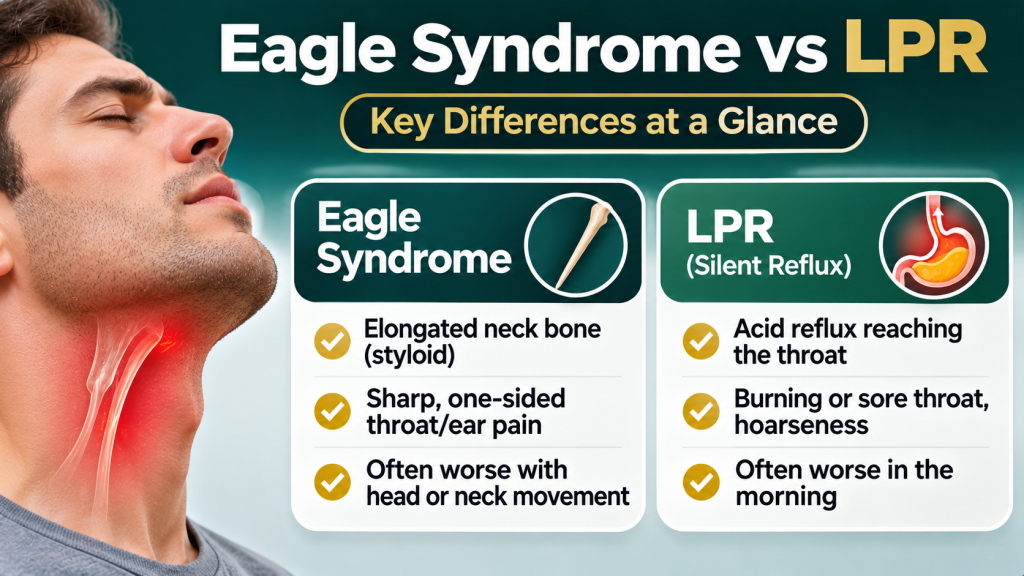
Eagle syndrome and LPR can both cause throat pain, a feeling of something stuck in the throat, trouble swallowing and ear pain, so they’re easily confused. The key difference is the cause. Eagle syndrome is structural: an elongated styloid process (a thin spike of bone below the ear) or a calcified ligament presses on nerves and blood vessels in the neck. LPR is chemical: stomach contents reaching the throat cause inflammation.
That difference shows up in the symptoms. Eagle syndrome pain is usually one-sided, often sharp or stabbing, and triggered by turning your head, swallowing, yawning or pressing behind the jaw. It doesn’t change with what you eat. LPR is more often felt centrally or on both sides, comes with throat clearing, mucus and hoarseness, and flares after meals or at night. Eagle syndrome is rare, while LPR is very common. But if you have stubborn one-sided throat pain that doesn’t respond to reflux treatment, it’s worth knowing about.
Key Takeaways
- Eagle syndrome is caused by an elongated styloid process or a calcified stylohyoid ligament pressing on nerves or arteries in the neck.
- An elongated styloid is found in roughly 4% of people, but only a small minority ever develop symptoms.
- Eagle syndrome symptoms include one-sided throat pain, a foreign-body sensation, painful or difficult swallowing, ear pain and neck pain, often triggered by turning the head.
- LPR symptoms are usually less one-sided and come with throat clearing, mucus, hoarseness and flare-ups after meals or at night.
- Eagle syndrome is confirmed with a CT scan. LPR is diagnosed from symptoms, a throat exam and sometimes pH testing.
- Surgery to shorten the styloid process relieves symptoms in the large majority of people with confirmed Eagle syndrome.
- Sudden dizziness, fainting, vision changes or weakness when turning your head can signal the vascular type of Eagle syndrome and need urgent medical attention.
What Is Eagle Syndrome?
The styloid process is a thin, pointed piece of bone that projects down and forward from the base of the skull, just below and in front of each ear. It anchors a ligament (the stylohyoid ligament) that runs to the hyoid bone in the neck, along with several muscles used in swallowing and moving the tongue.
In some people, the styloid process is longer than normal (usually defined as more than 3 cm), or the ligament attached to it has calcified. An elongated styloid process is found in around 4% of the general population, and most of these people never notice it [Bokhari et al., StatPearls, NIH Bookshelf]. When it does cause symptoms, that’s called Eagle syndrome, named after Dr. Watt Eagle, who described it in 1937.
There are two main types:
- Classic Eagle syndrome: the long styloid irritates nerves in the throat and neck, most commonly the glossopharyngeal nerve, which supplies the back of the throat, the tonsil area and part of the ear. This causes throat, neck and ear pain. It’s often seen after a tonsillectomy, possibly because scar tissue changes how the area moves.
- Vascular Eagle syndrome: the styloid presses on the carotid arteries or internal jugular vein. This can cause headaches, dizziness or, rarely, stroke-like symptoms, often when the head is turned.
In a large review of nearly 500 published cases, about three-quarters had the classic form and about a quarter the vascular form [Hassani et al., PeerJ, 2024].
Symptoms of Eagle Syndrome
The most common symptoms in that review were neck pain, throat pain, a foreign-body sensation in the throat and difficulty swallowing [Hassani et al., PeerJ, 2024]. Typical features include:
- Persistent, one-sided throat pain, often in the tonsil area
- A feeling of something stuck in the throat on one side
- Pain when swallowing, or difficulty swallowing
- Ear pain on the same side, often with a normal ear exam
- Pain in the neck, jaw or face, sometimes shooting or stabbing
- Pain triggered or worsened by turning the head, swallowing, yawning or opening the mouth wide
- Tenderness when pressing behind the angle of the jaw or in the tonsil area
- Ringing in the ear or a change in voice in some cases
Vascular-type symptoms can include headaches, dizziness or blackouts when turning the head, visual disturbances, and in rare cases signs of a stroke or carotid artery tear. These need urgent assessment.
How LPR Causes Similar Symptoms
In LPR, acid and pepsin from the stomach reach the throat and larynx. The tissue there has little protection, so even small amounts of reflux can cause inflammation and heightened sensitivity. That can produce:
- A lump-in-the-throat (globus) sensation
- Throat pain, burning or rawness
- A feeling that food or pills are sticking
- Referred ear pain through the vagus and glossopharyngeal nerves, the same nerve network involved in Eagle syndrome
- Constant throat clearing, mucus, hoarseness and a chronic cough
The overlap with Eagle syndrome is real, which is why both conditions can be misdiagnosed for a long time. The trick is looking at the pattern, not just the list of symptoms.
Eagle Syndrome vs LPR: How to Tell the Difference
Side and location
- Eagle syndrome: usually one-sided, often pinpointed to the tonsil area, the angle of the jaw or just below the ear.
- LPR: more often central (around the Adam’s apple or the top of the breastbone) or felt on both sides, though it can favor one side.
What triggers it
- Eagle syndrome: movement. Turning or tilting the head, swallowing, yawning, chewing, opening wide, or pressing on the area.
- LPR: reflux. Meals (especially large, late, fatty or acidic ones), lying down, alcohol, coffee and other trigger foods. Moving your head doesn’t make it worse.
The kind of pain
- Eagle syndrome: often sharp, stabbing or electric, sometimes a deep ache, and can shoot to the ear or face.
- LPR: more often raw, burning, scratchy or a tight, lumpy feeling.
Other symptoms
- Eagle syndrome: neck pain, facial pain, pain on head turning, and sometimes headaches or dizziness (vascular type). Throat clearing and mucus aren’t typical.
- LPR: throat clearing, excess mucus or postnasal drip, hoarseness, cough, a sour or bitter taste, and sometimes heartburn.
Response to reflux treatment
- Eagle syndrome: no real change with diet, alginates or acid suppression.
- LPR: usually improves gradually over weeks to months with a consistent reflux plan.
History
- Eagle syndrome: often after a tonsillectomy or neck trauma, and more common from middle age.
- LPR: often comes with reflux triggers, weight gain, late eating, stress or a hiatal hernia.
A useful rule of thumb: if your one-sided throat pain hasn’t budged after two to three months of properly done reflux treatment, and it’s worse when you turn your head or swallow, ask your ENT about Eagle syndrome.
How Eagle Syndrome Is Diagnosed
- Physical exam: an ENT may feel the tip of the styloid through the tonsil area with a gloved finger. Reproducing your usual pain this way is a strong clue.
- CT scan: a CT of the neck, ideally with 3D reconstruction, measures the length and angle of the styloid and confirms the diagnosis. A dental panoramic X-ray sometimes picks it up incidentally.
- CT angiography: used if the vascular type is suspected.
- Local anesthetic injection: numbing the tonsil area can temporarily relieve pain if the styloid is responsible.
Just having a long styloid on a scan doesn’t mean it’s the cause of your symptoms. Lots of people have one with no symptoms at all. The diagnosis depends on the scan, the exam and your symptoms fitting together.
How LPR Is Diagnosed
LPR is usually diagnosed from your symptoms (often scored with the Reflux Symptom Index) and a scope examination of the throat to look for reflux-related swelling and redness. Where it’s unclear, pH or pH-impedance monitoring can measure reflux reaching the throat directly. My guide to how acid reflux is diagnosed walks through the options.
Treatment for Eagle Syndrome
Mild cases may be managed with pain relief, anti-inflammatory medication, nerve-calming medication or local injections. For persistent symptoms, the main treatment is surgery to shorten the styloid process (styloidectomy). This is done either through the mouth (via the tonsil area) or through a small incision in the neck.
Surgery has good results. In the large review, 97.8% of surgically treated patients improved or had complete resolution, compared with 65.9% of those treated without surgery [Hassani et al., PeerJ, 2024]. A review of robotic transoral styloidectomy found that 16 of 17 patients had complete or near-complete symptom resolution [Campisi et al., Clinical Otolaryngology, 2024]. These are mostly small case series, so results in individual clinics will vary.
Treatment for LPR
LPR responds to reducing how much reflux reaches your throat:
- Stop eating at least three hours before bed.
- Raise the head of your bed with blocks or a wedge.
- Cut down on acidic, fatty and trigger foods and drinks.
- Use an alginate like Gaviscon Advance after meals and at bedtime to block reflux reaching the throat.
- Follow a structured low-acid diet. The Wipeout Diet Plan takes you through it step by step.
Can You Have Both?
Yes. LPR is common, and an elongated styloid is far from rare, so some people will have both. That’s one reason partial improvement can be confusing. If your throat clearing, mucus and hoarseness improve with reflux treatment but one sharp, one-sided pain triggered by head movement stays the same, the two may be overlapping.
Other Causes of One-Sided Throat Pain
Eagle syndrome and LPR aren’t the only possibilities. One-sided throat pain can also come from tonsil problems, an inflamed lingual tonsil, dental issues, TMJ disorders, nerve pain such as glossopharyngeal neuralgia, laryngeal sensory neuropathy, neck problems and, rarely, tumors.
See an ENT promptly if one-sided throat or ear pain lasts more than three weeks, especially with a lump in the neck, worsening difficulty swallowing, hoarseness lasting more than three to four weeks, coughing up blood, or unexplained weight loss. If you smoke or drink heavily, don’t wait. Most causes are benign, but these signs need ruling out. I go through the warning signs in sore throat on one side and LPR or throat cancer.
Get emergency help straight away if you develop sudden weakness, numbness, slurred speech, vision loss, severe dizziness or fainting, especially when turning your head.
Conclusion
Eagle syndrome and LPR share a surprising number of symptoms, including throat pain, a lump-in-the-throat feeling, swallowing trouble and ear pain, partly because they involve the same nerve network. But they come from completely different places. Eagle syndrome is a structural problem caused by an overlong styloid bone or a calcified ligament, and its pain is typically one-sided, sharp and triggered by head movement and swallowing. LPR is caused by reflux reaching the throat, and it comes with throat clearing, mucus and hoarseness that flare after meals and at night.
Because LPR is far more common, it makes sense to start there, as long as you do it properly and give it time. If a sharp, one-sided pain still hasn’t shifted after a few months, ask your ENT about a CT scan to check your styloid processes. It’s a simple way to rule Eagle syndrome in or out.
For the reflux side, diet is the most powerful lever you have. The Wipeout Diet Plan is my complete, step-by-step guide to calming throat reflux. It was built first and foremost for LPR, the kind that causes globus and throat pain, but because it targets the same underlying triggers, it works just as well for GERD and everyday heartburn. If your symptoms are reflux-driven, a structured plan like this is the fastest way to find out.
Frequently Asked Questions
What are the symptoms of Eagle syndrome?
The most common symptoms are one-sided throat pain, a feeling of something stuck in the throat, painful or difficult swallowing, ear pain and neck pain. Symptoms are often triggered by turning the head, swallowing or yawning. The vascular type can cause headaches, dizziness or stroke-like symptoms.
Can Eagle syndrome be mistaken for acid reflux?
Yes. Both can cause globus, throat pain, swallowing trouble and ear pain, so Eagle syndrome is sometimes treated as LPR for a long time. Pain triggered by head movement, a clear one-sided pattern and no response to reflux treatment are clues pointing to Eagle syndrome.
How common is Eagle syndrome?
An elongated styloid process is found in around 4% of people, but only a small minority develop symptoms, so Eagle syndrome itself is rare. LPR is far more common.
How is Eagle syndrome diagnosed?
By combining a physical exam, which may include feeling the styloid tip through the tonsil area, with a CT scan of the neck to measure the styloid process. CT angiography is used if the vascular type is suspected.
Can LPR cause one-sided throat pain?
It can, although LPR symptoms are more often central or on both sides. If one-sided pain persists, especially with a lump in the neck or worsening swallowing, see an ENT to rule out other causes.
Is Eagle syndrome dangerous?
The classic form is painful but not dangerous. The vascular form can rarely compress or damage the carotid arteries, which may cause a stroke. Sudden neurological symptoms, especially with head turning, need emergency care.
Does Eagle syndrome go away without surgery?
Some people manage mild symptoms with medication or injections, but the bone itself doesn’t shrink. In published cases, surgery gave much better results than non-surgical treatment.
Research & References
- [Bokhari et al., StatPearls, NIH Bookshelf] — Clinical overview of Eagle syndrome, covering its definition, its link with compression of the glossopharyngeal nerve, and the prevalence of an elongated styloid process.
- [Hassani et al., PeerJ, 2024] — Systematic review of 497 Eagle syndrome patients. 74.5% had the classic form and 23.5% the vascular form. Neck pain, pharyngeal pain, foreign-body sensation and dysphagia were most common, and 97.8% of surgical patients improved versus 65.9% treated medically.
- [Campisi et al., Clinical Otolaryngology, 2024] — Systematic review of transoral robotic styloidectomy. 16 of 17 patients (94.1%) had complete or near-complete symptom resolution, with one minor complication.

David Gray
12 years living with LPR · Consultant & researcher
I've lived with LPR for twelve years — the misdiagnoses, the PPI courses that did nothing, the slow work of figuring out what actually helps. Wipeout Reflux is where I translate the research into plain terms for people stuck in the same place. Every claim here is sourced to peer-reviewed work, and I consult one-to-one with LPR sufferers.