
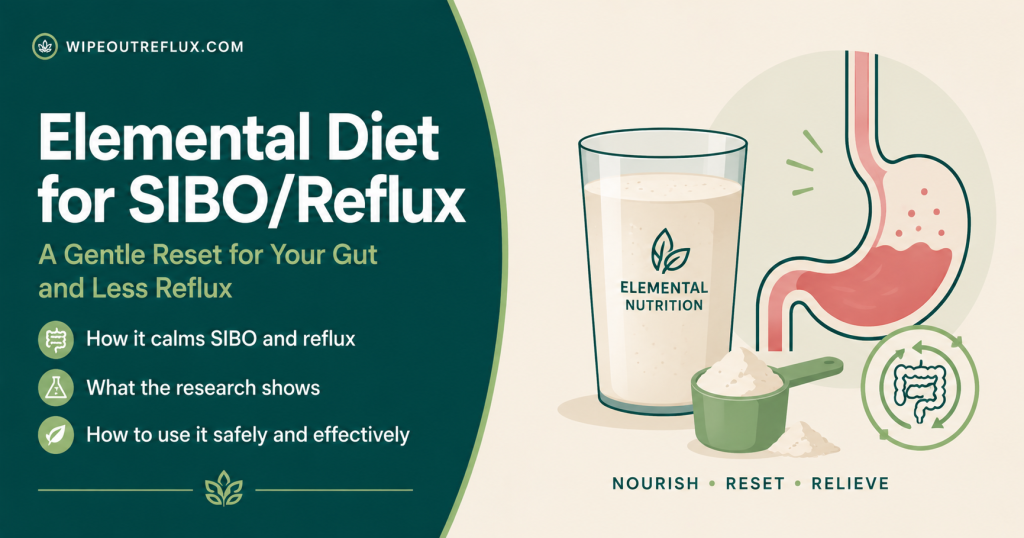
An elemental diet is a short-term liquid formula of pre-digested nutrients — free amino acids instead of whole protein, simple sugars instead of complex carbs, and very little fat — designed to be absorbed high up in the small intestine before it can reach the bacteria lower down. For SIBO (small intestinal bacterial overgrowth), that’s the whole idea: it feeds you while effectively starving the overgrown bacteria, and the main study behind it normalised the SIBO breath test in around 80% of people after two weeks.
Its connection to reflux is real but mostly indirect. SIBO produces gas and bloating that push up on the stomach and can worsen reflux, and the acid-suppressing drugs used for reflux can themselves encourage SIBO — so for some people, breaking the overgrowth quietens the reflux too. But an elemental diet is demanding, unpleasant to drink, and genuinely restrictive, it isn’t a first-line treatment, and it isn’t something to attempt long-term without medical guidance.
Below is what an elemental diet actually is, how it works against SIBO, what the evidence does and doesn’t show, where it fits into the reflux picture, and the honest downsides — so you can judge whether it’s worth discussing with your doctor or whether a more sustainable route makes more sense.
Key Takeaways
- An elemental diet is an exclusive liquid formula of pre-digested nutrients absorbed high in the small intestine, leaving little to feed bacteria further down.
- For SIBO, it works by starving the overgrown bacteria while still nourishing you; an open-label study normalised the SIBO breath test in about 80% of people at two weeks and 85% at three.
- The reflux link is mostly indirect: SIBO gas and bloating raise abdominal pressure and can aggravate reflux, and PPIs modestly raise the risk of SIBO in the first place.
- Amino-acid (elemental) formulas have strong evidence in eosinophilic oesophagitis, an oesophageal condition — but that’s a different disease from GERD or silent reflux.
- Guidelines still put antibiotics first for SIBO; the elemental diet is an option with limited data and major practical drawbacks.
- The downsides are significant: poor taste, high cost, no real food for weeks, blood-sugar swings, and difficulty sticking with it.
- It should be medically supervised, especially if you have diabetes or other health conditions.
- It’s a reset, not a cure — without addressing the underlying cause, both SIBO and reflux tend to return.
What an Elemental Diet Actually Is
An elemental diet replaces all your food, for a set period (usually two to three weeks), with a nutritionally complete liquid formula. The trick is in the form the nutrients take. Instead of intact protein, you get free amino acids — protein already broken down to its building blocks. Instead of complex carbohydrates, you get simple sugars like glucose or maltodextrin. Fat is kept very low. Vitamins, minerals and electrolytes are all included, so it’s designed to keep you fully nourished.
Because everything is already “pre-digested,” your body barely has to do any work to absorb it, and crucially, it gets absorbed in the first stretch of the small intestine. The original clinical formula was a product called Vivonex, and several elemental and “semi-elemental” formulas now exist, some flavoured to be more drinkable than the notoriously grim originals. Semi-elemental versions use short peptides rather than single amino acids and are a little more palatable, at the cost of being marginally less “elemental.”
The key point is that this is a medical-style intervention, not a wellness cleanse. It’s a specific tool for a specific problem, and it’s most established for exactly one gut issue: SIBO.
How an Elemental Diet Treats SIBO
SIBO is what it sounds like — too many bacteria colonising the small intestine, where there should be relatively few. Those bacteria ferment the food you eat, especially carbohydrates, producing the hydrogen and methane gas that drive the bloating, distension and discomfort people with SIBO know well. More on the condition itself in SIBO and acid reflux.
The logic of the elemental diet is elegant: if the nutrients are absorbed high in the small intestine, almost nothing reaches the overgrown bacteria further down. You keep getting fed; they don’t. Starved of the substrate they ferment, the overgrowth is meant to shrink back over the two to three weeks of the diet. It’s essentially a way to reset the bacterial population without antibiotics — a scorched-earth approach to their food supply rather than a direct attack on the bacteria.
That’s the theory, and there’s a real study behind it. In an open-label trial, people with an abnormal SIBO breath test went on an exclusive two-week elemental diet; 80% had a normal breath test by day 15, rising to 85% in those who continued to day 21, with symptoms improving alongside Pimentel et al., Digestive Diseases and Sciences, 2004. That’s a striking result, and it’s the reason the elemental diet has a reputation as a powerful SIBO tool.
What the Evidence Does — and Doesn’t — Show
It’s worth being honest about the limits here, because the internet tends to oversell this. That headline study was open-label, without a control group, and it measured a breath test rather than long-term symptom cure. It’s genuinely promising, but it’s largely one body of work, and the evidence base is thin compared with the decades of data behind antibiotics.
That’s why formal guidance still places antibiotics such as rifaximin as the first-line treatment for SIBO, with dietary and elemental approaches sitting further down the list as options when antibiotics fail, aren’t tolerated, or aren’t wanted — and with an explicit acknowledgement that the elemental diet is hard to adhere to Pimentel et al., The American Journal of Gastroenterology, 2020. None of that means it doesn’t work; it means it’s a considered second- or third-line option, not a proven front-line cure.
The SIBO–Reflux Connection: Why This Matters
If you’re here because of reflux rather than a formal SIBO diagnosis, here’s why the two topics keep colliding.
Gas pushes acid upward. The gas SIBO bacteria produce increases pressure inside the abdomen and stomach. That extra pressure pushes up against the valve at the top of the stomach, making it easier for stomach contents to escape into the oesophagus. It’s the same mechanical story behind why gas and bloating so often travel with reflux — more pressure below, more reflux above.
Reflux treatment can feed SIBO. There’s a genuine loop here. Stomach acid is one of the body’s defences against bacteria colonising the small intestine, so suppressing it long-term can tilt the odds toward overgrowth. A meta-analysis found that PPI use moderately raises the risk of SIBO Su et al., Journal of Gastroenterology, 2018. So someone on long-term acid suppression for reflux may be nudging themselves toward the very overgrowth that then worsens their reflux — part of why it’s worth understanding the trade-offs of long-term PPIs.
Put those together and you can see the appeal of an elemental diet for someone stuck in this cycle: clear the overgrowth, drop the gas and pressure, and the reflux may ease as a knock-on effect. It’s a reasonable idea — but it treats a contributor to reflux, not reflux itself, and only helps if SIBO was genuinely part of your picture. That’s a question worth settling with proper testing and diagnosis rather than assumption.
Elemental Formulas and the Oesophagus Directly
There’s one place where an elemental formula has strong, direct evidence in an oesophageal disease — and it’s worth understanding precisely because it’s often confused with reflux. In eosinophilic oesophagitis (EoE), an allergic condition that inflames the oesophagus and mimics reflux, an exclusive amino-acid elemental diet induces remission in around 90% of patients, more than any other dietary approach Arias et al., Gastroenterology, 2014.
That sounds like a ringing endorsement for reflux — but EoE is a different disease, driven by food allergens rather than acid, and the elemental diet works there by removing the allergens, not by fixing a reflux mechanism. If your “reflux” has never responded to normal treatment, it’s worth making sure EoE has been excluded, which I cover in eosinophilic esophagitis vs acid reflux. But don’t read the EoE data as proof that an elemental diet cures GERD or silent reflux; the mechanisms are simply different.
The Real Downsides
This is the part the enthusiastic write-ups skip, and it matters, because adherence is where elemental diets live or die.
It’s hard to drink. Traditional elemental formulas taste medicinal and monotonous, and having nothing else for two to three weeks is a real psychological grind. Many people simply can’t finish the course.
It’s expensive. Weeks of formula, particularly the more palatable branded versions, add up quickly, and it’s often not covered unless prescribed for a recognised indication.
Blood-sugar swings. Because the carbohydrate is simple sugar, an elemental diet can spike blood glucose. Anyone with diabetes or blood-sugar issues needs medical oversight, not a DIY attempt.
No real food, no fibre, and social fallout. Chewing nothing for weeks affects more than your gut — it hits your energy, your routines and your social life. The lack of fibre also changes the wider gut environment, and some people report a rocky reintroduction when they return to solid food.
It doesn’t fix the cause. This is the big one. An elemental diet can clear an overgrowth, but if the reason you developed SIBO in the first place — slow gut motility, low stomach acid, a structural issue — is still there, the bacteria tend to creep back. Recurrence is common, which is why it’s best seen as a reset that buys you a window, not a permanent solution.
Who Might Consider It, and How
An elemental diet is worth discussing with a knowledgeable clinician if you have confirmed, symptomatic SIBO that hasn’t responded to or tolerated antibiotics, and you understand what the two to three weeks involve. It should be supervised, especially if you have any other medical condition, and it works best as one step in a wider plan that also tackles why the overgrowth happened — addressing motility, overall gut health, and the reflux mechanics behind the whole thing.
Some people use a “hybrid” or partial approach — part elemental formula, part carefully chosen food — to improve tolerability, though this dilutes the starve-the-bacteria effect. Whatever the format, the reintroduction phase matters as much as the diet itself: going straight back to the eating pattern that fed the problem tends to undo the work. That’s where a sustainable everyday framework earns its keep, and it’s exactly what the Wipeout Diet Plan is built to provide — a liveable way of eating that keeps reflux (and the pressure that drives it) down for the long run, rather than a two-week sprint you can’t repeat.
Conclusion
An elemental diet is a genuinely useful tool in the right hands — a way to reset an overgrowth of bacteria that can, in turn, take some of the gas and pressure off your reflux. But it’s a short-term reset, not a cure, and it’s a hard one: unpleasant to drink, expensive, restrictive, and prone to recurrence if the underlying cause is left unaddressed. It sits well down the list of options, behind antibiotics for SIBO and behind sensible everyday changes for reflux, and it isn’t something to improvise alone. If you’re drawn to it because ordinary reflux treatment hasn’t worked, the more important step is often to confirm what’s actually driving your symptoms in the first place.
And whatever you find, the durable fix is the same: reduce how often and how hard you reflux, day in and day out. That’s what the Wipeout Diet Plan is designed to do — a structured, mechanism-first way to calm reflux at its source and keep the pressure down, so you’re not relying on drastic resets that undo themselves the moment you eat normally again. I built it primarily around LPR and silent reflux, the stubborn throat-based form that so often overlaps with gut issues like SIBO and bloating, but because it works on the same underlying reflux mechanisms it helps GERD and everyday heartburn just as well. And if you want a concrete starting point today, the Wipeout Food Reference Guide is the essential companion — the full list of which foods and drinks are safe for acid reflux and LPR, with their actual pH values, so you’re working from numbers instead of guesswork.
Frequently Asked Questions
Does an elemental diet help acid reflux?
Only indirectly. It doesn’t fix the reflux valve or acid production. But if SIBO is contributing to your reflux — through gas and bloating that push acid upward — clearing that overgrowth with an elemental diet may ease reflux as a side effect. It helps a contributor, not reflux itself, and only if SIBO was genuinely part of the problem.
How long do you stay on an elemental diet for SIBO?
Typically two to three weeks. In the main study, most people normalised their SIBO breath test by day 15, and a further group by day 21. It’s meant to be a short, defined course under guidance — not something to extend indefinitely on your own.
Is an elemental diet better than antibiotics for SIBO?
Not according to current guidelines, which still put antibiotics like rifaximin first. The elemental diet is an option when antibiotics fail, aren’t tolerated, or aren’t wanted, but its evidence base is thinner and adherence is difficult. Many clinicians reserve it for harder cases.
Can I make an elemental diet at home?
Homemade recipes exist, but they’re hard to balance nutritionally and easy to get wrong, and an exclusive liquid diet for weeks carries real risks — particularly for blood sugar. This is a diet best done with a commercial formula and medical supervision, not improvised.
Will SIBO and reflux come back after an elemental diet?
They can, and often do, if the underlying cause isn’t addressed. The diet clears the overgrowth but doesn’t fix why it developed — slow motility, low stomach acid, or the reflux mechanics themselves. Pairing it with a sustainable long-term approach is what makes the results last.
Is an elemental diet safe?
For most people it’s safe as a short, supervised course, but it isn’t risk-free. Blood-sugar swings, difficulty maintaining nutrition, and a tricky reintroduction are the main concerns, and anyone with diabetes or other conditions needs medical oversight. It’s a clinical tool, not a casual cleanse.
Research & References
- Pimentel et al., Digestive Diseases and Sciences, 2004 — Open-label study in which subjects with an abnormal lactulose breath test underwent a two-week exclusive elemental diet; 80% had a normal breath test by day 15 and 85% by day 21, with concomitant symptom improvement.
- Pimentel et al., The American Journal of Gastroenterology, 2020 — ACG clinical guideline on small intestinal bacterial overgrowth, recommending antibiotics as first-line treatment and discussing dietary and elemental approaches as options limited by adherence and evidence.
- Su et al., Journal of Gastroenterology, 2018 — Meta-analysis of 19 studies (7,055 subjects) finding that proton pump inhibitor use moderately increases the risk of SIBO (pooled odds ratio 1.71), consistent with reduced gastric acid predisposing to small-bowel overgrowth.
- Arias et al., Gastroenterology, 2014 — Systematic review and meta-analysis of dietary interventions for eosinophilic oesophagitis, finding exclusive amino-acid elemental formulas the most effective option at roughly 90% histologic remission, albeit with significant practical limitations.

David Gray
12 years living with LPR · Consultant & researcher
I've lived with LPR for twelve years — the misdiagnoses, the PPI courses that did nothing, the slow work of figuring out what actually helps. Wipeout Reflux is where I translate the research into plain terms for people stuck in the same place. Every claim here is sourced to peer-reviewed work, and I consult one-to-one with LPR sufferers.