
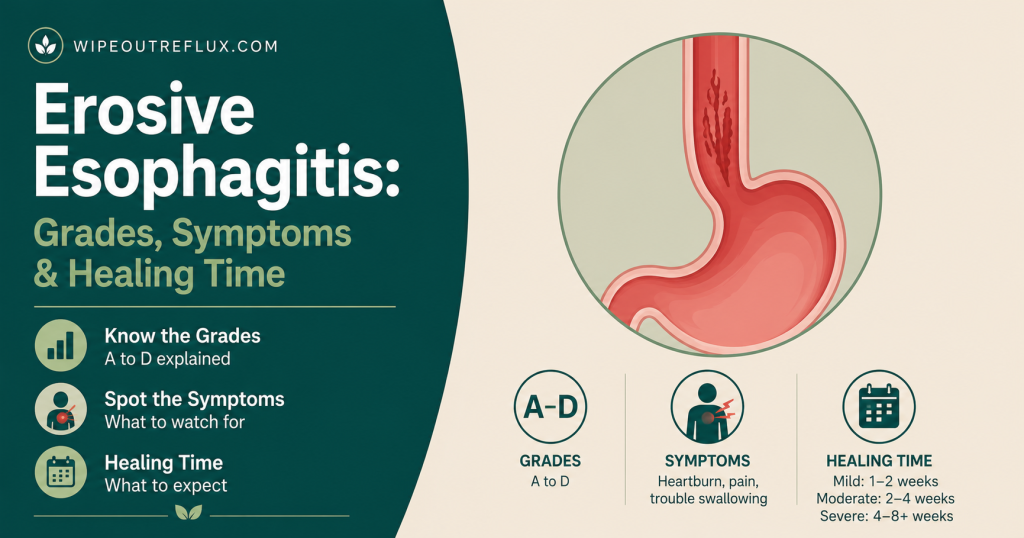
Erosive esophagitis means acid reflux has caused visible breaks in the lining of your oesophagus — damage a gastroenterologist can actually see through a scope, rather than symptoms alone. It’s graded A to D on the Los Angeles classification, from a single break under 5mm up to damage circling three-quarters or more of the oesophagus.
The healing news is good, and it’s the first thing worth saying. With a standard proton pump inhibitor, most people heal within eight weeks — comfortably over 80% in most trials. Grades A and B often heal in four. Grades C and D are slower and less certain, with around a quarter to a third failing to heal fully on a PPI in eight weeks, which is exactly where newer drugs have changed the picture.
Two things surprise people. First, symptoms are a poor guide to grade — you can have severe erosions and barely notice, or grade A and feel wretched. Second, healing is not the end of it: without ongoing treatment, most people relapse within six to twelve months. Below is the full grading system, what each grade actually means for you, realistic healing timelines, and what to do when eight weeks of a PPI hasn’t been enough.
Key Takeaways
- Erosive esophagitis is visible damage — mucosal breaks — not just reflux symptoms.
- The Los Angeles classification grades it A to D by the size and extent of those breaks.
- Most cases are grade A or B, which are mild and heal readily.
- Grade A alone doesn’t confirm GERD; grade C or D is considered conclusive evidence of reflux disease.
- Overall healing on a PPI is comfortably above 80% at eight weeks, but drops substantially for grades C and D.
- Symptom severity correlates poorly with grade — a meaningful minority with severe erosions have no symptoms at all.
- Vonoprazan heals severe erosive esophagitis considerably better than a PPI: 92% versus 72% for grade C/D in a head-to-head trial.
- Without maintenance therapy, the large majority relapse within six to twelve months of stopping.
- Erosive esophagitis is a GERD diagnosis. If you have silent reflux (LPR), your scope is usually clean — that’s expected, not reassuring.
What Erosive Esophagitis Actually Is
Your oesophagus is lined with squamous epithelium, which is tough but has no real defence against acid — unlike the stomach, which produces a protective mucus layer. When refluxed acid and pepsin sit against that lining often enough and long enough, the surface cells die off faster than they can be replaced and the lining breaks open. Those breaks are erosions, and seeing them is what separates erosive esophagitis from the much more common non-erosive kind.
The distinction matters clinically. Erosive esophagitis is objective evidence of reflux disease — there’s no ambiguity about whether reflux is happening. It also carries a small but real risk of complications if left untreated: strictures, bleeding, and the cellular change to Barrett’s oesophagus. And it responds well to acid suppression, which is not always true of reflux symptoms in general.
It’s worth saying plainly: most people with reflux symptoms don’t have this. The majority have non-erosive reflux disease, where the scope looks normal. If you’ve been diagnosed with erosive esophagitis you’re in the minority who have visible, treatable, trackable damage — which is frustrating to hear but genuinely more straightforward to manage.
The Los Angeles Classification: Grades A to D
The LA classification was developed to fix a real problem — earlier systems were inconsistent between endoscopists. It grades severity purely on the size and extent of mucosal breaks, which turns out to be far more reproducible than trying to judge redness or inflammation Lundell et al., Gut, 1999. Here’s what each grade means.
Grade A. One or more mucosal breaks no longer than 5mm, which do not extend between the tops of two mucosal folds. This is the mildest category and the most common. It’s worth knowing that grade A findings turn up in people without reflux disease too, which is why guidelines don’t treat grade A on its own as proof of GERD.
Grade B. One or more mucosal breaks longer than 5mm, still not extending between the tops of two mucosal folds. Longer breaks, but still discrete and separate. Grade B alongside typical symptoms and a response to PPI treatment is generally accepted as diagnostic.
Grade C. One or more mucosal breaks that are continuous between the tops of two or more mucosal folds, but involving less than 75% of the circumference. This is where damage stops being patchy and starts joining up. Grade C is considered conclusive evidence of GERD.
Grade D. One or more mucosal breaks involving at least 75% of the oesophageal circumference. The most severe grade, carrying the highest risk of stricture and the lowest healing rate on standard treatment. Also conclusive for GERD.
Two points people consistently misread. The grades describe extent, not depth — grade D isn’t a deeper ulcer than grade A, it’s more surface area affected. And the folds criterion in grades A and B does real work: a 4mm break confined to one fold is a different finding from a 4mm break bridging two, which is why the report wording is more specific than it looks.
Symptoms — and Why They Don’t Track the Grade
The typical symptoms are the ones you’d expect from reflux generally:
- Heartburn — burning behind the breastbone, often worse lying down or after meals.
- Regurgitation — acid or food coming back up into the throat or mouth.
- Odynophagia — pain on swallowing, which is more specific to erosive disease than to reflux generally and is worth mentioning to your doctor.
- Dysphagia — food sticking, which can signal a stricture forming and always warrants review.
- Chest pain — sometimes severe enough to mimic cardiac pain, which should always be assessed properly first.
- Nausea and early fullness.
Here’s the part that catches people out. How bad you feel tells you remarkably little about how bad the damage is. Studies looking at endoscopy in people undergoing routine health screening consistently find erosive esophagitis in people reporting no symptoms at all — in one series of erosive patients, around 11% had no reflux symptoms whatsoever Kasyap et al., PLOS ONE, 2018. The mismatch runs both ways: plenty of people with grade A erosions feel dreadful, while some people with grade C sail through with mild indigestion.
The likely explanation is oesophageal sensitivity. How much you feel depends on how sensitised the nerves in your oesophageal wall have become, which is a separate variable from how much tissue damage there is. Two people with identical scopes can have entirely different experiences.
The practical consequence is important: don’t use symptom relief as your only measure of healing. Feeling better after two weeks on a PPI doesn’t mean the erosions have closed. This is precisely why grade C and D usually get a repeat endoscopy to confirm healing rather than being signed off on symptoms alone.
Healing Time: What to Realistically Expect
Acid suppression works here, and works well, because you’re removing the thing preventing repair. The standard first-line approach is a PPI taken once daily 30 to 60 minutes before a meal — timing that matters more than most people are told, and which I’ve covered in the best time to take omeprazole.
Grades A and B. These heal readily. Four weeks of PPI therapy heals a large majority, and eight weeks heals most of the rest. Healing rates in this range typically exceed 90%. Many people won’t need a repeat scope to confirm it.
Grades C and D. Slower and less certain. Eight weeks is the standard course rather than four, and even then a meaningful proportion won’t be fully healed — failure rates of roughly 25–30% on a standard PPI are reported for more severe disease. A confirmatory endoscopy after treatment is standard practice here, both to check healing and to look for Barrett’s, which can be hidden underneath inflamed tissue and only becomes visible once the inflammation settles. That repeat scope is recommended for grade B as well, not just C and D.
A few things that genuinely change the timeline:
- Dosing timing. PPIs work best taken 30 to 60 minutes before a meal, because they only shut down proton pumps that food has activated. Guidelines specify pre-meal dosing for exactly this reason, and taking the tablet at bedtime on an empty stomach is a common and easily fixed mistake.
- Adherence. Stopping when symptoms improve at week two is common and leaves the erosions unhealed.
- Twice-daily dosing. For grade C and D, or for failure to heal on once daily, splitting the dose morning and evening is a standard escalation.
- Night-time acid. Nocturnal acid breakthrough can undermine healing; positioning and meal timing matter, not just the drug.
If you’re wondering how quickly you should notice anything at all, symptom improvement typically starts within days but full effect takes longer — more detail in how long omeprazole takes to work.
When a PPI Isn’t Enough: Vonoprazan
If you have grade C or D erosive esophagitis, this section is the most useful thing on this page, because the standard-of-care answer has genuinely shifted.
Vonoprazan is a potassium-competitive acid blocker — a different class from PPIs. It works faster, doesn’t require an acidic environment to be activated, isn’t dependent on meal timing in the same way, and produces more consistent, longer-lasting acid suppression, including overnight. Those pharmacological differences translate into better healing where healing is hardest.
The head-to-head trial is worth knowing in detail. Just over a thousand patients with erosive esophagitis were randomised to vonoprazan 20mg or lansoprazole 30mg daily for up to eight weeks. Overall healing was 92.9% with vonoprazan against 84.6% with lansoprazole. But the gap widened sharply in severe disease: among patients with grade C or D, healing was around 92% with vonoprazan versus roughly 72% with lansoprazole. Vonoprazan was also ahead at just two weeks in this group. Patients who healed were then re-randomised for 24 weeks of maintenance, where vonoprazan again outperformed lansoprazole at keeping them healed Laine et al., Gastroenterology, 2023.
That difference — 92% against 72% — is large by the standards of this field, and it’s concentrated exactly where the clinical need is. For grade A and B disease the advantage is much smaller, because PPIs already heal those well; there’s little room to improve on 90-plus percent.
So the sensible reading is: if you have mild erosive esophagitis, a PPI is a perfectly good first choice. If you have grade C or D, or you’ve already failed an adequate eight-week PPI course taken correctly, vonoprazan is a conversation worth having with your gastroenterologist. I’ve written about it in more depth in Voquezna (vonoprazan) for acid reflux.
Before escalating, though, it’s worth ruling out the boring explanations for non-healing: taking the PPI at the wrong time relative to meals, poor adherence, or a different diagnosis altogether — eosinophilic oesophagitis in particular can look and feel like refractory reflux.
After Healing: The Relapse Problem
Healing erosive esophagitis is comparatively easy. Keeping it healed is the harder half, and it’s where expectations often go wrong.
Acid suppression doesn’t fix the reason you reflux. It changes what the reflux is made of. The sphincter is still weak, the hiatal hernia is still there if you have one, the anatomy hasn’t changed — so when the drug stops, the acid comes back and the damage tends to return. In the classic maintenance trial, patients whose esophagitis had been healed with omeprazole were followed for a year on various maintenance regimens; continued omeprazole kept 80% in remission, against 49% on ranitidine and 54% on cisapride — the acid suppression was doing the work Vigneri et al., The New England Journal of Medicine, 1995. Broader data has consistently shown the large majority of people with healed erosive esophagitis relapsing within six to twelve months without maintenance therapy, and relapse is more likely the more severe the original grade.
For grade C and D, guidelines generally support indefinite maintenance PPI therapy, because the risk of complications from recurrent severe esophagitis outweighs the risks of long-term acid suppression Katz et al., The American Journal of Gastroenterology, 2022. For grade A and B, stepping down to the lowest effective dose, or to on-demand use, is often reasonable.
This is where the non-pharmacological side stops being an optional extra. If long-term acid suppression is the plan, anything that reduces how often you reflux in the first place reduces how much drug you need — and long-term PPI use isn’t consequence-free, as covered in omeprazole side effects. Don’t stop a PPI abruptly after healing severe esophagitis, though; rebound acid secretion is real and can be brutal, so any reduction should be tapered and planned — see getting off PPIs and acid rebound.
Complications Worth Knowing About
These are uncommon, and much less likely if the esophagitis is treated, but they’re the reason this diagnosis is taken seriously.
Stricture. Repeated damage and repair lays down scar tissue, which can narrow the oesophagus. The symptom is food sticking, usually solids first. It’s treatable by endoscopic dilatation, but preventing it is much better than treating it, and progressive difficulty swallowing should never be sat on.
Barrett’s oesophagus. Chronic acid exposure can drive the lining to change into an intestine-like tissue that tolerates acid better but carries a small increased cancer risk. This is why a follow-up scope after healing matters, and it applies more widely than most people assume: guidelines recommend repeat endoscopy after 8 to 12 weeks of PPI therapy for LA grade B, C and D — not just the severe grades. The reason is straightforward. Barrett’s hidden underneath active inflammation was found at repeat endoscopy in 9.4% of grade A/B cases and 17.4% of grade C/D cases, so the yield in moderate disease is far from negligible Shaheen et al., The American Journal of Gastroenterology, 2022.
Bleeding and ulceration. Deeper erosions can bleed, occasionally enough to cause iron-deficiency anaemia rather than visible bleeding. Black tarry stools or vomiting blood need urgent attention.
Why This Diagnosis Is Rare in Silent Reflux
If your symptoms are throat-based — chronic throat clearing, hoarseness, a lump sensation, a persistent cough — and your scope came back clean, that’s the expected result rather than a contradiction.
Erosive esophagitis requires sustained liquid acid contact with the oesophageal lining. LPR works differently: small volumes, often gaseous, travelling the full length of the oesophagus quickly and reaching the larynx, where the tissue is far more delicate and has none of the oesophagus’s clearance mechanisms. The oesophagus gets brief exposure and stays intact; the throat gets damaged by amounts that wouldn’t mark the oesophagus at all. Pepsin does much of that work — not because it behaves differently in the throat, but because laryngeal tissue has none of the oesophagus’s defences or clearance, and pepsin is taken up into laryngeal cells where it can go on causing damage even after the acid has gone.
So a normal endoscopy doesn’t exclude LPR, and the absence of erosive esophagitis says almost nothing about whether your throat symptoms are reflux-driven. It’s also why acid-suppression trials often disappoint in LPR while working well here — discussed in why PPIs don’t work for LPR. If that’s your situation, the endoscopy guide explains what the test can and can’t tell you.
Conclusion
Erosive esophagitis is one of the more encouraging reflux diagnoses to receive, even though it doesn’t feel that way at the time. The damage is visible, which means it can be graded, treated and confirmed healed — a clarity most people with reflux symptoms never get. Grades A and B heal reliably in four to eight weeks. Grades C and D take longer, warrant a follow-up scope, and now have a genuinely better drug option if a PPI doesn’t finish the job.
The part to take seriously is what happens after healing. Acid suppression heals the lining but changes nothing about why you reflux, and most people relapse within months of stopping. That leaves two options: stay on medication indefinitely, or reduce the reflux itself so that less suppression is needed. Realistically most people end up doing some of both, and the second half is the part you have direct control over — meal timing, meal size, trigger foods, weight, sleeping position and what you drink all change how often acid reaches your oesophagus at all.
That’s the ground the Wipeout Diet Plan covers — a structured way to cut down the reflux events themselves rather than only neutralising what’s in them, which is what makes stepping down a dose realistic rather than wishful. I built it primarily around LPR and silent reflux, the throat-based form where scopes come back clear and medication disappoints most, but since it targets the same underlying mechanisms it works just as well for GERD, heartburn and healed erosive disease. Alongside it, the Wipeout Food Reference Guide is the practical companion — the full list of foods and drinks that are safe for acid reflux and LPR with their actual pH values, which matters more than usual while a damaged lining is still healing and unusually sensitive to anything acidic.
Whatever else you do, finish the full course, take it before food, and don’t judge healing by how you feel.
Frequently Asked Questions
How long does erosive esophagitis take to heal?
Grades A and B usually heal within four to eight weeks on a PPI, with healing rates above 90%. Grades C and D typically need the full eight weeks and heal less reliably — roughly a quarter to a third aren’t fully healed on a standard PPI in that time.
Is grade B erosive esophagitis serious?
Grade B is mild-to-moderate and heals well with standard treatment. It’s more significant than grade A in that it’s accepted as diagnostic of reflux disease alongside typical symptoms, but it doesn’t carry the stricture and complication risk associated with grades C and D.
Can erosive esophagitis heal without medication?
It can in principle, but it’s not the sensible plan, particularly for grades C and D. Acid suppression dramatically improves healing rates and reduces complication risk. Diet and lifestyle changes are valuable alongside treatment and become the main tool for preventing relapse after healing — not usually a substitute during it.
Will my erosive esophagitis come back?
Without maintenance treatment, most people relapse within six to twelve months, and more so with higher grades. That’s why grade C and D are usually kept on long-term therapy, while milder grades may step down to the lowest effective dose.
Do I need a repeat endoscopy after treatment?
Guidelines recommend a repeat endoscopy after 8 to 12 weeks of treatment for grades B, C and D — not only the severe grades. It confirms healing and, importantly, checks for Barrett’s oesophagus, which active inflammation can conceal. Barrett’s is picked up at that repeat scope in around 9% of grade A/B cases and 17% of grade C/D cases. Grade A alone generally doesn’t require one.
Why do I feel fine if I have erosions?
Symptom severity correlates poorly with endoscopic grade. Some people with visible erosions have no symptoms at all. How much you feel depends on how sensitised your oesophageal nerves are, which is independent of how much damage is present. It’s a good reason not to gauge healing by symptoms.
Is vonoprazan better than omeprazole for this?
For severe disease, the evidence favours it clearly — around 92% healing versus 72% for lansoprazole in grade C/D in a head-to-head trial. For grades A and B the advantage is small, because PPIs already work well. It’s most worth discussing if you have severe disease or have failed a properly taken eight-week PPI course.
Can erosive esophagitis turn into cancer?
Not directly. The pathway of concern runs through Barrett’s oesophagus, where chronic acid exposure changes the lining, and only a small fraction of Barrett’s ever progresses further. Treating the esophagitis and following screening advice is precisely how that risk gets managed.
I have silent reflux but my endoscopy was normal — does that mean no damage?
It means no oesophageal damage, which is the expected finding in LPR. Throat-based reflux typically leaves the oesophagus intact while irritating far more sensitive laryngeal tissue. A clean scope doesn’t rule out LPR and doesn’t mean your symptoms lack a physical cause.
Research & References
- Lundell et al., Gut, 1999 — Validation study establishing the Los Angeles classification of oesophagitis, grading severity by mucosal break length and whether breaks extend between the tops of mucosal folds (grade A: breaks ≤5mm not extending between fold tops; grade B: breaks >5mm not extending between fold tops; grade C: continuous breaks between fold tops involving less than 75% of the circumference; grade D: breaks involving at least 75% of the circumference), and demonstrating improved inter-observer reproducibility over earlier systems.
- Laine et al., Gastroenterology, 2023 — Randomised trial of vonoprazan 20mg versus lansoprazole 30mg in patients with erosive oesophagitis. Vonoprazan was non-inferior and, on exploratory analysis, superior for healing at 8 weeks (92.9% versus 84.6%; difference 8.3%, 95% CI 4.5–12.2), with the benefit concentrated in more severe disease, and superior for maintenance of healing over 24 weeks.
- Katz et al., The American Journal of Gastroenterology, 2022 — ACG clinical guideline for the diagnosis and management of gastro-oesophageal reflux disease, covering PPI dosing before meals, the diagnostic weight of Los Angeles grades, and maintenance therapy for patients with severe erosive oesophagitis.
- Vigneri et al., The New England Journal of Medicine, 1995 — Randomised comparison of five maintenance regimens over 12 months in patients whose reflux oesophagitis had been healed with omeprazole. Remission rates were 80% on omeprazole, 89% on omeprazole plus cisapride, 66% on ranitidine plus cisapride, 54% on cisapride and 49% on ranitidine — establishing continued acid suppression as the key to maintaining healing.
- Kasyap et al., PLOS ONE, 2018 — Cross-sectional study of 142 patients with endoscopically confirmed erosive oesophagitis graded by the Los Angeles classification, in which 11.3% reported no reflux symptoms at all, illustrating the imperfect relationship between symptoms and visible mucosal damage.
- Shaheen et al., The American Journal of Gastroenterology, 2022 — Updated ACG guideline on Barrett’s oesophagus, recommending repeat endoscopy after 8 to 12 weeks of PPI therapy for patients with Los Angeles grade B, C or D oesophagitis, since active inflammation can obscure underlying Barrett’s; the guideline reports Barrett’s identified at that repeat examination in 9.4% of grade A/B cases and 17.4% of grade C/D cases.

David Gray
Content Researcher & Author
David Gray founded Wipeout Reflux to address a critical gap in reflux management. His research synthesizes over 100 peer-reviewed studies on laryngopharyngeal reflux (LPR), pepsin biology, and GERD pathophysiology. For LPR specifically—a condition most physicians misdiagnose—his work focuses on pepsin reactivation and why standard PPI therapy fails most patients. He develops evidence-based protocols targeting root causes of both LPR and GERD, integrating emerging research on sphincter dysfunction, dietary interventions, and newer clinical approaches. Wipeout Reflux represents practical application of clinical science for patients seeking real solutions.