
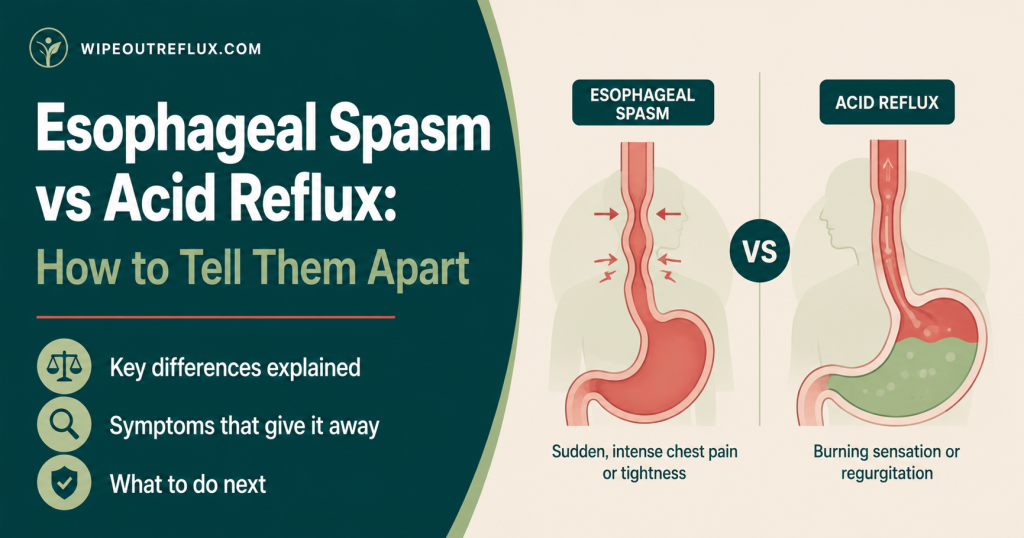
The quickest way to tell them apart is the character of the pain. Reflux burns — a rising heat behind the breastbone, usually after eating or when lying down, often with a sour taste. Oesophageal spasm grips — a sudden, intense squeezing or crushing in the chest that can arrive out of nowhere, sometimes while swallowing, sometimes at rest, and it’s frightening enough that most people think they’re having a heart attack.
The complication is that they’re not independent. Reflux is the most common cause of non-cardiac chest pain, and acid in the oesophagus can itself provoke abnormal contractions — so plenty of people have both, with the reflux driving the spasm.
Before anything else: new, severe or crushing chest pain needs to be assessed as a cardiac event until proven otherwise. Nothing in this article is a substitute for that. Once your heart has been cleared, this is how to work out which of the two you’re dealing with.
Key Takeaways
- Reflux pain burns and rises; spasm pain squeezes, grips or crushes and often arrives suddenly.
- Spasm pain can last seconds to minutes and may be triggered by swallowing — especially very hot or very cold drinks.
- GERD is the most common cause of non-cardiac chest pain, with prevalence estimates of roughly 40–60% in Western countries.
- Acid exposure can trigger abnormal oesophageal contractions, so reflux is often the underlying cause of the spasm rather than a separate problem.
- Distal oesophageal spasm is formally diagnosed on high-resolution manometry — premature contractions with a distal latency under 4.5 seconds in at least 20% of swallows.
- An empirical PPI trial performs reasonably well as a first test in non-cardiac chest pain, with pooled sensitivity around 80%.
- Peppermint oil eliminated simultaneous contractions in all eight patients in a small manometry study — but peppermint also relaxes the lower sphincter and can worsen reflux.
- Chest pain that comes with sweating, breathlessness, jaw or arm pain, or exertion needs emergency assessment, not a reflux plan.
What oesophageal spasm actually is
Normally, swallowing produces an orderly wave of contraction that travels down the oesophagus at a set pace, pushing food ahead of it. In spasm, that coordination breaks down. Contractions fire too early, all at once, or with far too much force.
There are two main patterns, and they’re distinct on testing:
Distal oesophageal spasm (DES) — contractions arrive prematurely, so segments of the oesophagus squeeze simultaneously instead of in sequence. On high-resolution manometry it’s defined as premature contractions with a distal latency below 4.5 seconds in at least 20% of swallows, with normal junction relaxation, in a patient with chest pain or difficulty swallowing Roman et al., Neurogastroenterology & Motility, 2021.
Hypercontractile oesophagus (jackhammer oesophagus) — the timing is normal but the force is extreme, defined as a distal contractile integral above 8,000 mmHg·s·cm in at least 20% of swallows.
You don’t need to remember the numbers. The useful point is that spasm is a defined, measurable motility abnormality — not a vague term for “chest pain I can’t explain” — and that manometry is what distinguishes it.
How the pain differs
Side by side, the two symptom patterns are more distinguishable than most people expect.
Reflux chest pain
- Character: burning, hot, rising
- Location: behind the breastbone, often moving upward toward the throat
- Onset: gradual, building over minutes
- Timing: after meals, on lying down, on bending forward
- Duration: often prolonged — 20 minutes to hours
- Company: sour taste, regurgitation, hoarseness, throat clearing
- Relief: antacids or alginates often help within minutes; standing up helps
Spasm chest pain
- Character: squeezing, gripping, crushing, vice-like — not burning
- Location: deep in the centre of the chest, sometimes radiating to the back, jaw or arms
- Onset: abrupt, often peaking within seconds
- Timing: frequently while swallowing, particularly very hot or very cold drinks; sometimes entirely at rest, including waking you at night
- Duration: seconds to a few minutes, occasionally longer
- Company: a sensation of food sticking, or of the swallow not going down properly
- Relief: antacids do little; it tends to pass on its own
The two most discriminating questions are: does it burn or does it squeeze? and did swallowing set it off? Burning after a meal points to reflux. Sudden gripping triggered by an ice-cold drink points to spasm.
A third useful clue is difficulty swallowing. Intermittent trouble getting food or liquid down — often worse with liquids than solids, which is counterintuitive — is far more suggestive of a motility problem. If you have that, read whether acid reflux can make swallowing difficult as well, because the two causes need different investigation.
Why they overlap so much
Here’s where the tidy comparison breaks down, and it’s the part most articles skip.
GERD is the single most common cause of non-cardiac chest pain, with prevalence estimates in the region of 40–60% in Western populations Li et al., Gastroenterology & Hepatology, 2024. In a study of low-risk acute chest pain patients presenting to hospital, GERD of at least moderate severity was present in 44% Al-Ani and Winchester, Critical Pathways in Cardiology, 2015.
Beyond frequency, there’s a direct mechanistic link. Acid in the oesophagus doesn’t just cause burning; it alters how the muscle behaves, and repeated acid exposure is associated with abnormal contraction patterns. That means a substantial number of people diagnosed with spasm have reflux underneath it, driving the motor abnormality.
The practical implication is important: treating the reflux often reduces the spasm. It’s usually not a case of picking one diagnosis and ignoring the other.
There’s also a sensitisation angle. Chronic acid exposure can make the oesophagus hypersensitive, so normal contractions start being perceived as painful. That’s part of why reflux, spasm and general chest tightness blur together, and why stress makes both worse — stress lowers the threshold at which the nervous system registers oesophageal sensation as pain.
How doctors actually work it out
Step 1 — Rule out the heart
This is non-negotiable and comes first every time. Oesophageal spasm mimics cardiac pain closely enough that even experienced clinicians won’t distinguish them on symptoms alone. ECG, troponin and often a stress test come before any gastrointestinal work-up. I’ve written more on the overlap in heartburn or heart attack.
Step 2 — The PPI trial
Because reflux is the most likely cause, a course of acid suppression is often used both as treatment and as a diagnostic test. It performs reasonably: a meta-analysis of PPI testing in non-cardiac chest pain found pooled sensitivity around 80% and specificity around 74% against pH monitoring and endoscopy Wang et al., Archives of Internal Medicine, 2005.
If the pain resolves, reflux was probably the driver. If it doesn’t, that’s genuinely informative — it pushes motility disorders and hypersensitivity up the list. Just be aware that a failed PPI trial doesn’t rule reflux out entirely, particularly for non-acid or weakly acidic reflux.
Step 3 — Endoscopy
Endoscopy looks for erosive oesophagitis, strictures, and eosinophilic oesophagitis — which is a common and frequently missed cause of chest pain and food sticking, and needs biopsies rather than just a look.
Step 4 — High-resolution manometry
This is the test that actually diagnoses spasm. A thin catheter measures pressure along the length of the oesophagus while you swallow, producing the distal latency and contractile integral values used in the classification above. It’s the only way to confirm distal oesophageal spasm or jackhammer oesophagus — more on what’s involved in oesophageal manometry.
Step 5 — pH monitoring
If manometry is normal and PPIs didn’t help, ambulatory pH or pH-impedance testing quantifies actual acid exposure and, crucially, whether your pain episodes correlate with reflux events. See how reflux is diagnosed and the Bravo pH test.
Treatment differs — and one remedy pulls both ways
If reflux is the driver, treatment is the usual reflux approach: acid suppression, alginate barriers, smaller meals, timing, bed elevation, weight management.
If genuine spasm persists after reflux is controlled, treatment aims at the muscle instead — smooth muscle relaxants such as calcium channel blockers, nitrates, PDE5 inhibitors, and low-dose neuromodulators like amitriptyline that reduce oesophageal pain perception rather than the contractions themselves. Those same neuromodulators show up in reflux cough management for the same reason.
The peppermint problem
This is the most interesting practical tension in the whole topic, and it explains a lot of contradictory advice.
Peppermint oil is a smooth muscle relaxant. In eight patients with diffuse oesophageal spasm undergoing manometry, peppermint oil completely eliminated simultaneous oesophageal contractions in every patient, and also reduced multiphasic, spontaneous and missed contractions Pimentel et al., Journal of Clinical Gastroenterology, 2001.
That’s a striking result for spasm. But peppermint relaxes the lower oesophageal sphincter too — which is precisely why it’s on every reflux avoid-list, as I’ve covered in is peppermint tea good for acid reflux.
So the same substance helps one condition and worsens the other. If your problem is pure spasm with no reflux, peppermint may genuinely help. If you have both — which is common — it can trade a gripping pain for a burning one. It’s worth discussing with your doctor rather than self-experimenting, especially since the study used peppermint oil drops rather than tea.
Self-management that helps either way
- Avoid extremes of temperature in drinks — very cold and very hot are both classic spasm triggers.
- Eat slowly and chew thoroughly; large boluses provoke both problems.
- Sip warm (not hot) water during an episode — many people find it helps the muscle settle.
- Smaller meals reduce both distension-driven reflux and the load the oesophagus has to move.
- Practise slow diaphragmatic breathing during an attack. It won’t stop the contraction, but it reduces the panic response that amplifies the pain — see breathing exercises for acid reflux.
When to seek urgent help
Treat chest pain as cardiac and seek emergency care if it comes with sweating, nausea, breathlessness, light-headedness, pain radiating to the jaw, neck or left arm, pain brought on by exertion, or a sense that something is seriously wrong. Also see a doctor promptly for progressive difficulty swallowing, food genuinely sticking, unintentional weight loss, or vomiting blood.
Oesophageal spasm is unpleasant but not dangerous. The risk lies in assuming that’s what it is.
Conclusion
Reflux burns and builds; spasm grips and strikes. Swallowing — especially something very hot or very cold — triggering sudden crushing chest pain points to spasm, while a rising burn after a meal or on lying down points to reflux. But the more useful insight is that these aren’t rival diagnoses. Reflux is the commonest cause of non-cardiac chest pain, acid exposure can provoke the abnormal contractions themselves, and treating the reflux frequently settles the spasm along with it.
That’s why the sensible order of business is: get your heart cleared, treat the reflux properly, and only then investigate motility if the pain persists. Manometry is what confirms spasm, and it’s worth asking for if a genuine PPI trial has failed and you have difficulty swallowing alongside the pain.
On the reflux side, getting food right does a lot of the work, and it’s the part people find hardest to pin down. The Wipeout Food Reference Guide is the essential reference for that — which foods and drinks are actually safe with acid reflux and LPR, and their pH values, so you can stop guessing meal by meal. If you’d rather follow a complete system, the Wipeout Diet Plan goes considerably deeper. It was built first around LPR, the stubborn throat-based form of reflux, but because it works on the same underlying mechanisms it’s just as effective for GERD and classic heartburn — and reducing acid exposure is exactly what takes the pressure off an oesophagus that’s contracting abnormally in response to it.
Frequently Asked Questions
How do I know if my chest pain is spasm or reflux?
The character of the pain is the best guide. Burning that rises and builds after eating or lying down suggests reflux. Sudden squeezing or crushing, especially triggered by swallowing something very hot or very cold, suggests spasm. Difficulty swallowing alongside the pain also points towards spasm.
Can acid reflux cause oesophageal spasm?
Yes. Acid exposure alters oesophageal motor function and is associated with abnormal contraction patterns, and reflux is the most common cause of non-cardiac chest pain overall. In many people the spasm is a consequence of the reflux, which is why treating the reflux often improves both.
How long does oesophageal spasm last?
Usually seconds to a few minutes, though it can occasionally persist longer. Reflux pain more typically lasts twenty minutes to a few hours. Pain lasting longer than about twenty minutes with cardiac features needs emergency assessment regardless.
Does peppermint help oesophageal spasm?
In a small manometry study, peppermint oil eliminated simultaneous contractions in all eight patients with diffuse spasm. The catch is that peppermint also relaxes the lower oesophageal sphincter and can worsen reflux, so it’s only sensible if reflux genuinely isn’t part of your picture — worth checking with your doctor first.
What test diagnoses oesophageal spasm?
High-resolution oesophageal manometry. It measures the timing and force of contractions along the oesophagus and is the only way to confirm distal oesophageal spasm or jackhammer oesophagus using the standard criteria.
Will PPIs help oesophageal spasm?
They often help, because reflux is frequently the underlying trigger. A PPI trial has around 80% pooled sensitivity for identifying reflux-related non-cardiac chest pain. If a proper trial doesn’t help, that’s a useful signal to investigate motility rather than escalating acid suppression indefinitely.
Is oesophageal spasm dangerous?
The spasm itself isn’t dangerous, though it’s painful and alarming. The danger is misattributing cardiac pain to it. Any new, severe or exertional chest pain should be assessed as a possible heart problem first.
Research & References
- Chicago Classification version 4.0 technical review defining distal oesophageal spasm as premature contractions with a distal latency below 4.5 seconds in at least 20% of swallows with normal oesophago-gastric junction relaxation, in patients with dysphagia or non-cardiac chest pain Roman et al., Neurogastroenterology & Motility, 2021.
- Review of non-cardiac chest pain identifying gastro-oesophageal reflux disease as the most common oesophageal cause, with estimated prevalence of roughly 40–60% in Western countries and 30–50% in Asia Li et al., Gastroenterology & Hepatology, 2024.
- In low-risk acute chest pain patients undergoing evaluation, GERD of at least moderate severity was present in 44%, with substantial overlap between non-cardiac conditions Al-Ani and Winchester, Critical Pathways in Cardiology, 2015.
- Meta-analysis of empirical proton pump inhibitor testing in non-cardiac chest pain reporting pooled sensitivity of 80% and specificity of 74% against 24-hour pH monitoring and endoscopy Wang et al., Archives of Internal Medicine, 2005.
- In eight patients with diffuse oesophageal spasm assessed by manometry, peppermint oil completely eliminated simultaneous oesophageal contractions and improved multiphasic, spontaneous and missed contractions Pimentel et al., Journal of Clinical Gastroenterology, 2001.

David Gray
12 years living with LPR · Consultant & researcher
I've lived with LPR for twelve years — the misdiagnoses, the PPI courses that did nothing, the slow work of figuring out what actually helps. Wipeout Reflux is where I translate the research into plain terms for people stuck in the same place. Every claim here is sourced to peer-reviewed work, and I consult one-to-one with LPR sufferers.