
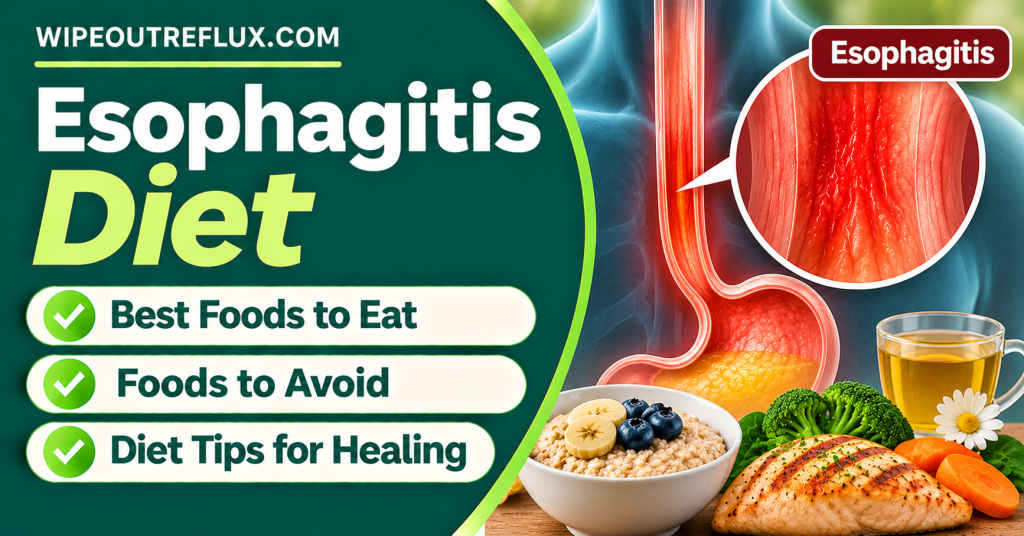
An esophagitis diet does two things while your esophagus heals. It avoids food that physically scrapes or stings the inflamed lining, so think soft, moist, lukewarm and low-acid. And it cuts down the reflux that caused the damage in the first place, which means smaller meals, less fat, and nothing in the three hours before bed.
Diet supports healing but rarely does the job alone. For reflux esophagitis, acid-suppressing medication is what actually heals the lining, and if your esophagitis has another cause, such as a pill or an allergy, that cause needs dealing with too. Below I’ll explain the different types, what to eat and avoid while you heal, a sample day, and how long to stick with it.
Key Takeaways
- Esophagitis means inflammation of the esophagus. The most common cause is acid reflux, but pills, food allergy (eosinophilic esophagitis) and infections can cause it too.
- While you heal, choose soft, moist foods at a lukewarm temperature. Avoid hard, dry, crunchy, spicy, acidic and very hot foods.
- To reduce the reflux driving the damage, eat smaller meals, keep fat moderate and stop eating three hours before bed.
- Acidic drinks such as citrus juice and soda are linked to more heartburn, in proportion to how acidic they are.
- Eating right before bed and drinking 40 to 60 g of alcohol a day are both linked to erosive esophagitis.
- For reflux esophagitis, PPIs are the main treatment. Diet works alongside them, not instead of them.
- Pill esophagitis is mostly caused by antibiotics like doxycycline. Taking pills upright with a full glass of water helps prevent it.
- Eosinophilic esophagitis needs a completely different diet: elimination of trigger foods, not a reflux diet.
What Kind of Esophagitis Do You Have?
This matters, because the right diet depends on the cause.
Reflux (erosive) esophagitis
The most common type. Repeated acid and pepsin exposure wears small breaks in the lining of the lower esophagus. It’s graded A to D on endoscopy, with D being the most severe. I explain the grades in erosive esophagitis. Most of this article is about this type.
Pill-induced esophagitis
A tablet or capsule sticks in the esophagus and burns the lining directly. More than 70 drugs have been reported to cause it, and antibiotics such as doxycycline, tetracycline and clindamycin account for over half of cases. Aspirin, potassium chloride, iron and anti-inflammatory painkillers are other common culprits [Jaspersen, Drug Safety, 2000]. If this sounds like you, see doxycycline heartburn and Fosamax and heartburn.
Eosinophilic esophagitis (EoE)
An allergic-type condition where white blood cells called eosinophils build up in the esophagus. It’s driven by food triggers rather than acid, so the dietary approach is completely different. I cover it at the end of this article and in eosinophilic esophagitis vs acid reflux.
Infectious esophagitis
Caused by yeast (candida) or viruses, usually in people with weakened immune systems or on inhaled steroids. It needs antifungal or antiviral treatment. A gentle diet helps with comfort, but treating the infection is what matters.
Why Diet Matters When Your Esophagus Is Inflamed
An inflamed esophagus is a bit like a graze inside your chest. Two kinds of food make it worse.
Foods that irritate on the way down. Rough textures scrape. Acids and spices sting exposed tissue. Very hot drinks add a thermal injury on top. This is why swallowing can hurt with esophagitis, which doctors call odynophagia. If that’s your main symptom, I go deeper in throat pain when swallowing.
Foods and habits that cause more reflux. Large, fatty or late meals push more acid and pepsin back up, keeping the injury going. In one study, calorie load drove how much acid reached the esophagus after a meal, while fat content increased reflux symptoms [Fox et al., Clinical Gastroenterology and Hepatology, 2007].
A good esophagitis diet tackles both.
Foods to Eat While Your Esophagus Heals
Aim for foods that are soft, moist, mild, low in acid and served lukewarm rather than piping hot.
Soft proteins
- Scrambled or poached eggs
- Flaked white fish such as cod or haddock, baked or poached
- Shredded or minced chicken and turkey in a little broth
- Soft tofu
- Low-fat cottage cheese or plain yogurt, if dairy agrees with you
- Smooth nut butters, thinly spread
Soft starches
- Oatmeal or cream of rice
- Mashed potato or mashed sweet potato
- Well-cooked rice and soft pasta
- Soft bread without crusts, rather than toast
Fruit and vegetables
- Bananas, ripe pears and melon
- Applesauce
- Well-cooked carrots, squash, zucchini and green beans
- Pureed vegetable soups
Drinks
- Water, at room temperature
- Lukewarm caffeine-free herbal teas such as chamomile
- Oat, almond or low-fat milk
- Smoothies made with banana, melon and oats, no citrus or berries
For ideas, my acid reflux soups and acid reflux smoothie recipes work well in the early healing phase. If you want the full picture of what’s safe to eat, the Wipeout Diet Plan includes complete meal plans built around low-acid, easy-to-tolerate foods.
Foods to Avoid With Esophagitis
Rough and dry textures
- Toast, crackers, chips, pretzels and crusty bread
- Raw vegetables and salads
- Nuts, seeds and granola
- Dry, tough meat such as steak or overcooked chicken
Acidic foods and drinks
- Citrus fruit and juice: orange, grapefruit, lemon, lime
- Tomatoes, tomato sauce and ketchup
- Vinegar and pickles
- Soda and other carbonated drinks
Acid content really does matter here. In a study of 38 beverages and 394 people with heartburn, the acidity of citrus drinks and juices correlated with how much heartburn they caused [Feldman and Barnett, Gastroenterology, 1995]. Soft drinks had the lowest pH of anything tested.
Spicy and strongly flavored foods
- Chili, hot sauce, curry and black pepper
- Raw garlic and onion
Spice doesn’t usually cause reflux, but it stings an inflamed lining. See spicy food and acid reflux.
Fatty and fried foods
- Fried food, fast food, pastries, creamy sauces and fatty cuts of meat
Alcohol
Alcohol irritates the lining directly and relaxes the valve that keeps acid down. In a study of 5,240 health-checkup participants in Japan, drinking 40 to 60 g of alcohol a day was linked to higher odds of erosive esophagitis in non-obese men [Shiota et al., Journal of Primary Care and Community Health, 2023]. Avoid it completely while you heal.
Coffee?
Coffee is less clear-cut than you might think. A meta-analysis found no significant overall link between coffee and GERD [Kim et al., Diseases of the Esophagus, 2014]. But hot, acidic coffee can still sting an inflamed esophagus. I’d pause it while you heal, then reintroduce a lukewarm, low-acid cup. More in is coffee bad for acid reflux?
How to Eat, Not Just What to Eat
- Eat smaller meals. Four or five small meals instead of three large ones.
- Take small bites and chew well. Smaller, well-chewed pieces pass more gently.
- Sip water between bites to help food move down.
- Let hot food cool to warm rather than hot.
- Stay upright for at least 30 minutes after eating, ideally longer.
- Stop eating three hours before bed. In the Japanese study above, eating just before bedtime was also linked to erosive esophagitis in obese men [Shiota et al., Journal of Primary Care and Community Health, 2023]. A separate study found going to bed within three hours of dinner was linked to 7.45 times the odds of GERD [Fujiwara et al., American Journal of Gastroenterology, 2005]. See how long before bed you should stop eating.
- Take pills upright, with a full glass of water, and don’t lie down for at least 30 minutes afterwards. That’s the single best way to prevent pill esophagitis. My guide on trouble swallowing pills has more tips.
A Sample Day on an Esophagitis Diet
- Breakfast: Oatmeal made with oat milk, with a mashed banana stirred through. Lukewarm chamomile tea.
- Mid-morning: A ripe pear or a pot of applesauce.
- Lunch: Pureed carrot and sweet potato soup with soft white bread, crusts removed.
- Afternoon: Plain low-fat yogurt with soft melon.
- Dinner (3+ hours before bed): Poached cod with mashed potato and well-cooked green beans.
How Long Should You Follow an Esophagitis Diet?
The strict soft-food phase usually only needs to last until swallowing is comfortable again, often a couple of weeks once treatment starts. After that, start reintroducing textures and foods one at a time, every few days, so you can tell which ones cause problems.
For reflux esophagitis, proton pump inhibitors are the mainstay of healing, while alginates, sucralfate and H2 blockers have more limited healing power on their own [Shibli et al., Translational Gastroenterology and Hepatology, 2025]. Doctors often repeat an endoscopy after a course of treatment for more severe grades to confirm healing. If you’re on sucralfate, check foods to avoid while taking sucralfate.
The reflux-reducing habits (meal size, fat, timing and alcohol) are worth keeping for the long term. Untreated esophagitis can lead to complications such as an esophageal ulcer or esophageal stricture, so it’s not something to leave alone once the pain settles.
If You Have Eosinophilic Esophagitis
EoE is different. It’s driven by an immune reaction to certain foods, so a reflux diet won’t fix it. The best-studied dietary treatment is an elimination diet, guided by a doctor and ideally a dietitian. In one study of adults, the six-food elimination diet, which removes milk, wheat, soy, eggs, nuts and seafood, brought eosinophil counts down to 5 per high-power field or fewer in 64% of patients. Reintroducing foods one at a time then identified the triggers [Gonsalves et al., Gastroenterology, 2012].
Please don’t attempt this on your own. Elimination diets need repeat endoscopies to confirm what’s working, and cutting out major food groups without support can leave gaps in your nutrition.
Conclusion
Eating with esophagitis comes down to two goals: don’t irritate the inflamed lining, and don’t add to the reflux that’s causing it. In the early healing phase, that means soft, moist, mild, low-acid food served lukewarm, in small portions, well before bed. Avoid rough textures, citrus, tomatoes, spice, alcohol, soda and fried food until swallowing feels normal again.
Then the focus shifts from healing to keeping it healed. That’s where the long-term reflux habits come in: moderate portions, moderate fat, an early finish to eating and figuring out your personal trigger foods. Your medication heals the lining, but your diet is what stops the damage coming back.
If you’d like a step-by-step plan for that long-term phase, the Wipeout Diet Plan is my complete guide. It walks you through what to eat, how to structure meals and how to reintroduce foods without setting yourself back. It was designed first for LPR, the hard-to-shift throat-based form of reflux, but because it works on the same reflux mechanisms, it suits anyone recovering from esophagitis and wanting to keep acid where it belongs.
Frequently Asked Questions
What can I eat for breakfast with esophagitis?
Oatmeal with banana, scrambled eggs, plain yogurt with soft melon, or a banana and oat smoothie are all gentle options. Avoid toast, citrus juice and hot coffee while you heal.
Is milk good for esophagitis?
Milk can feel soothing briefly, but full-fat milk may increase reflux afterwards. Low-fat or plant milks are a better choice. I explain more in does milk help acid reflux?
Can I eat bread with esophagitis?
Soft bread without crusts is usually fine. Toast, crusty bread and crackers can scrape an inflamed esophagus, so save them for after you’ve healed.
Are bananas good for esophagitis?
Yes. Bananas are soft, low in acid and easy to swallow, which makes them one of the best fruits while healing.
How long does it take for esophagitis to heal?
It depends on the cause and severity. Mild reflux esophagitis often improves within a few weeks of starting treatment, while more severe grades take longer and may need a follow-up endoscopy.
Should I avoid hot drinks with esophagitis?
Yes, while you’re healing. Let tea and other drinks cool to warm. Very hot liquids add extra irritation to an already inflamed lining.
Is the diet different for eosinophilic esophagitis?
Yes. EoE is managed with medication or a supervised elimination diet that removes common allergenic foods. A standard reflux diet won’t treat it.
Research & References
- [Jaspersen, Drug Safety, 2000] — Review of drug-induced esophageal injury: more than 70 drugs implicated, with antibiotics such as doxycycline, tetracycline and clindamycin responsible for over half of cases.
- [Fox et al., Clinical Gastroenterology and Hepatology, 2007] — Study of reflux patients showing calorie density determined esophageal acid exposure after a meal, while fat content increased reflux symptoms.
- [Feldman and Barnett, Gastroenterology, 1995] — Measurement of 38 beverages and heartburn reports from 394 people, finding titratable acidity of citrus drinks correlated with heartburn and soft drinks had the lowest pH.
- [Shiota et al., Journal of Primary Care and Community Health, 2023] — Cross-sectional study of 5,240 Japanese adults linking erosive esophagitis to eating just before bedtime in obese men and to smoking, 40 to 60 g/day alcohol and hiatal hernia in non-obese men.
- [Kim et al., Diseases of the Esophagus, 2014] — Meta-analysis finding no significant association between coffee intake and GERD.
- [Fujiwara et al., American Journal of Gastroenterology, 2005] — Case-control study finding a dinner-to-bed time under three hours was associated with 7.45 times the odds of GERD.
- [Shibli et al., Translational Gastroenterology and Hepatology, 2025] — Narrative review of erosive esophagitis treatment, concluding PPIs are the mainstay of healing while alginates, sucralfate and H2 blockers have limited healing efficacy.
- [Gonsalves et al., Gastroenterology, 2012] — Study of adults with eosinophilic esophagitis: after the six-food elimination diet, 64% reached peak counts of 5 eosinophils per high-power field or fewer, and food reintroduction identified causative foods.

David Gray
12 years living with LPR · Consultant & researcher
I've lived with LPR for twelve years — the misdiagnoses, the PPI courses that did nothing, the slow work of figuring out what actually helps. Wipeout Reflux is where I translate the research into plain terms for people stuck in the same place. Every claim here is sourced to peer-reviewed work, and I consult one-to-one with LPR sufferers.