
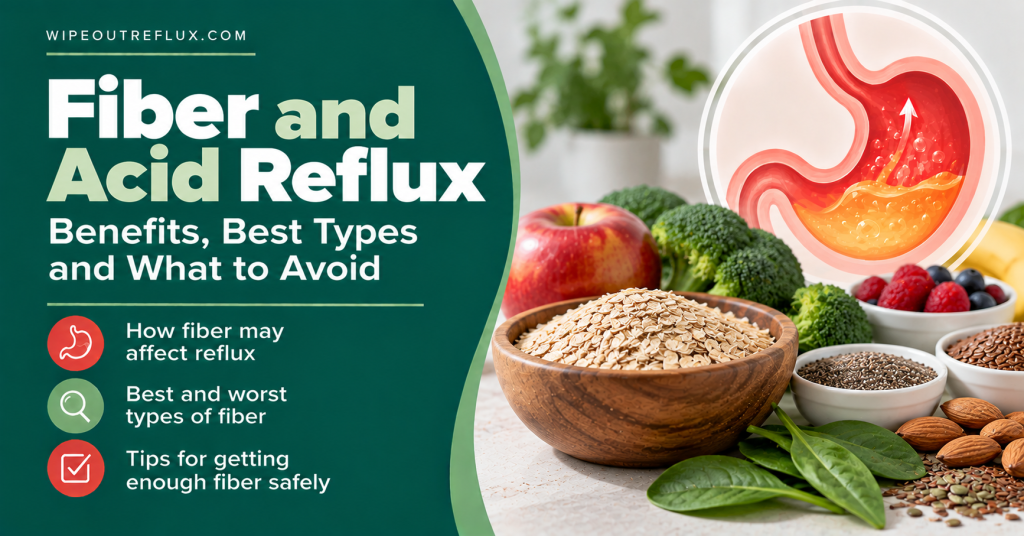
Eating more fiber is linked to less acid reflux. Large population studies consistently find that people who eat more fiber have fewer reflux symptoms and a lower risk of GERD. The biggest, a UK Biobank study following more than 500,000 people for over 12 years, found higher fiber intake was associated with an 8% lower risk of developing GERD [Zhang et al., Food & Function, 2025].
But there’s a catch that most “eat more fiber” advice skips over. Some of the highest-fiber foods are also classic reflux triggers. Beans and lentils can cause gas and bloating, onions are a well-documented trigger, and citrus fruit and tomatoes are acidic. So the goal isn’t simply more fiber. It’s more fiber from the right foods: oats, root vegetables, bananas, brown rice and other gentle sources.
Key Takeaways
- Observational studies, including one of more than 500,000 people, link higher fiber intake with fewer reflux symptoms and a lower risk of GERD.
- These studies show an association, not proof that fiber prevents reflux. People who eat more fiber also tend to be leaner and eat less fat.
- In a small study, adding psyllium fiber raised LES pressure and cut reflux episodes in people who ate very little fiber.
- Fiber may help by relieving constipation and straining, keeping you full on smaller meals, and supporting a healthy weight.
- Highly fermentable fiber can make reflux worse. In one study, it increased LES relaxations and reflux episodes.
- High-fiber foods that often trigger reflux include beans, onions, garlic, citrus fruit, tomatoes and, for some people, raw cruciferous vegetables.
- Reflux-friendly fiber sources include oats, sweet potatoes, carrots, bananas, pears, brown rice, quinoa, barley, chia and flaxseed.
- Increase fiber slowly and drink more water to avoid bloating, which can push reflux up.
What the Research Says About Fiber and Reflux
Population studies: more fiber, less reflux
Three studies stand out.
- UK Biobank (2025). Among 502,412 adults followed for an average of 12.5 years, higher dietary fiber was linked to an 8% lower risk of GERD, a 22% lower risk of Barrett’s esophagus and a 19% lower risk of esophageal adenocarcinoma [Zhang et al., Food & Function, 2025].
- Norway’s HUNT study (2004). In a comparison of 3,153 people with severe reflux and 40,210 without, eating bread high in fiber was associated with a lower risk of reflux symptoms [Nilsson et al., Gut, 2004].
- Houston volunteers (2005). In 371 people who completed detailed food questionnaires, higher fiber intake remained linked to a lower risk of GERD symptoms even after adjusting for body weight and calorie intake. High fat intake went the other way [El-Serag et al., Gut, 2005].
There’s also a longer-term angle. A meta-analysis led by Queen’s University Belfast found that the highest fiber intakes were associated with a 34% lower risk of esophageal adenocarcinoma, and the authors suggested less reflux as one possible reason [Coleman et al., Nutrition Reviews, 2013].
The honest caveat
All of these are observational studies. They show that people who eat more fiber get less reflux, but not that the fiber itself is the reason. High-fiber eaters tend to weigh less, eat less fat, smoke less and exercise more, and each of those affects reflux on its own. The effects are also fairly modest. Fiber is a good habit, not a cure.
The one intervention study
The closest thing to a direct test is a small study of people with non-erosive reflux who ate very little fiber, about 6 g a day on average. Adding 5 g of psyllium three times a day for 10 days roughly doubled minimum LES pressure, cut reflux episodes from about 68 to 42 a day and reduced how many people had heartburn [Morozov et al., World Journal of Gastroenterology, 2018]. It had no placebo group and only 30 participants, so it’s promising rather than conclusive. I go through it in detail in my article on psyllium husk for acid reflux.
How Fiber Might Reduce Reflux
Nobody has proven exactly how fiber helps, but there are three main explanations. A fourth point is often stated as fact but turns out to be more complicated.
1. Less constipation, less abdominal pressure
When you’re constipated, your gut is full and you strain on the toilet. Both raise pressure in the abdomen, which pushes up against the stomach and the lower esophageal sphincter. Constipation and reflux often occur together. In one clinic study, people with GERD were twice as likely as other patients to have chronic constipation (14% vs 7%) and more likely to have chronic bloating [Jiang et al., Zhonghua Nei Ke Za Zhi, 2013]. In children with both conditions, treating the constipation improved reflux on pH testing [Baran et al., European Journal of Gastroenterology & Hepatology, 2017].
Of all the mechanisms, this is the one I think matters most day to day. If you’re regularly constipated and have reflux, fixing your bowels is a reasonable first step.
2. Fullness on smaller meals
Fiber, especially the soluble kind found in oats and psyllium, makes meals more filling. In a controlled trial, psyllium increased feelings of fullness hours after a meal [Bergmann et al., Gut, 1992]. Feeling full sooner makes it easier to eat smaller meals, and big meals are one of the most reliable reflux triggers. See does overeating cause acid reflux.
3. Weight
Excess weight is one of the strongest risk factors for reflux. A meta-analysis found that the odds of GERD symptoms were 43% higher with a BMI of 25 to 30 and 94% higher with a BMI over 30 [Hampel et al., Annals of Internal Medicine, 2005]. Fiber helps with weight control, which is probably part of why fiber eaters get less reflux.
4. Gastric emptying: more complicated than it sounds
You’ll often read that fiber “speeds up digestion” and so helps reflux. That’s not quite right for the stomach. Soluble fiber forms a gel that tends to slow stomach emptying: in the same psyllium trial, gastric emptying was delayed from the third hour after a meal [Bergmann et al., Gut, 1992]. Fiber speeds things up mainly further down, in the bowel. Slower emptying isn’t necessarily a problem, since the reflux studies still show benefit, but if you have gastroparesis, large amounts of fiber can make you feel worse.
The Catch: Not All Fiber Is Reflux-Friendly
This is where generic advice can backfire for people with reflux. “Eat more fiber” often means more beans, onions, citrus and tomato-based dishes, and several of those cause problems.
Fermentable fiber can increase reflux
Some fibers are rapidly fermented by gut bacteria, producing gas. In a crossover study of people with GERD, a fermentable fiber (fructo-oligosaccharides) increased transient LES relaxations, reflux episodes, acid exposure and symptoms compared with placebo [Piche et al., Gastroenterology, 2003]. Fermentation in the colon seems to trigger signals that make the LES relax more often.
Fermentable fiber is concentrated in beans, lentils, chickpeas, onions, garlic, wheat-heavy foods and added “prebiotic” fibers like inulin and chicory root. That’s a big reason acid reflux and gas so often go together, and why some people do better on a low-FODMAP diet for acid reflux.
Acidic fiber sources
Oranges, grapefruit and tomatoes all contain decent amounts of fiber, but they’re acidic. In a survey of nearly 400 people with heartburn, the more acidic a citrus drink was, the more heartburn people reported from it [Feldman and Barnett, Gastroenterology, 1995]. With silent reflux, acidity matters even more, because acidic food can reactivate pepsin in the throat. In a small study of people whose LPR hadn’t responded to medication, a strict low-acid diet improved symptoms in 19 of 20 [Koufman, Annals of Otology, Rhinology & Laryngology, 2011].
Onions
Onions are worth singling out. In a pH-monitoring study, adding a slice of raw onion to a hamburger had no effect on people without reflux, but significantly increased reflux episodes, acid exposure, heartburn and belching in people who already had heartburn [Allen et al., American Journal of Gastroenterology, 1990].
High-Fiber Foods That Commonly Trigger Reflux
These aren’t banned for everyone, and tolerance varies. But if you’re adding fiber and your reflux gets worse, look here first:
- Beans and lentils. They’re very high in fiber but also highly fermentable. Lentils are usually better tolerated than beans, especially well-cooked red lentils in small portions. See are lentils good for acid reflux and is hummus good for acid reflux.
- Onions. One of the best-documented triggers, especially raw. See is onion good for acid reflux.
- Garlic. Fermentable and a common trigger. See is garlic acidic or alkaline.
- Citrus fruit. Oranges, grapefruit, lemons and limes all bring acid along with their fiber. See is grapefruit acid or alkaline and is orange juice bad for acid reflux.
- Tomatoes. They’re acidic in any form, and sauces and paste are the most concentrated. See are tomatoes bad for acid reflux.
- Raw cruciferous vegetables in large portions. Cabbage, cauliflower and Brussels sprouts can cause gas in some people. Cooked broccoli is usually fine. See is cabbage good for acid reflux.
- Bran-heavy cereals and “prebiotic” bars. These often contain inulin or chicory root, the fermentable fibers that can increase reflux.
Reflux-Friendly High-Fiber Foods
These are the fiber sources I lean on. Most are low in acid, gentle on the stomach and less likely to cause gas.
Grains
- Oats. Probably the best single fiber food for reflux, rich in soluble beta-glucan and low in acid. Plain rolled or steel-cut oats are better than flavored sachets. See are Quaker oats good for acid reflux, and if oats bother you, why oatmeal can give you heartburn.
- Brown rice. Mild, filling and easy to digest. See is rice acidic or alkaline.
- Quinoa. A high-fiber, high-protein alternative to rice. See is quinoa acid or alkaline.
- Barley. Rich in soluble fiber and great in soups. See is barley good for acid reflux.
- Wholegrain bread. This is the fiber source linked to less reflux in the Norwegian study. See is bread good for acid reflux.
Root vegetables and other vegetables
- Sweet potatoes. High in fiber and naturally low in acid. See are sweet potatoes good for acid reflux.
- Potatoes with the skin on. Baked or boiled, not fried. See are potatoes acidic.
- Carrots. Cooked or raw. See are carrots good for acid reflux.
- Broccoli, steamed. See is broccoli good for acid reflux.
- Spinach and other leafy greens. See is spinach good for acid reflux.
Fruit
- Bananas. Low in acid and easy on the stomach. See are bananas acidic or alkaline.
- Pears. One of the highest-fiber, least acidic fruits. See are pears good for acid reflux.
- Sweet apples, such as Gala, Fuji and Red Delicious, rather than tart varieties. See are apples good for acid reflux.
- Avocado in modest portions, because of its fat. See avocado for acid reflux.
- Prunes, which are particularly useful for constipation. See are prunes good for acid reflux.
Seeds
- Chia seeds. Soak them first. See are chia seeds good for acid reflux.
- Ground flaxseed. See is flaxseed good for acid reflux.
If you want to check a food quickly, the Wipeout Food Reference Guide lists reflux- and LPR-friendly foods with their pH values, so you can see at a glance which high-fiber foods are safe.
How to Add Fiber Without Making Reflux Worse
- Go slowly. Add one new fiber food every few days. A sudden jump in fiber is the fastest way to get bloated, and bloating pushes up on the stomach.
- Drink more water. Fiber needs water to work. Without it, constipation can get worse.
- Cook your vegetables. Cooked vegetables are usually easier to tolerate than raw ones in large salads.
- Spread fiber through the day rather than eating one huge, high-fiber meal.
- Favor soluble fiber from oats, barley, psyllium, bananas and root vegetables over large amounts of bran.
- Watch out for added “prebiotic” fibers. Inulin, chicory root and FOS appear in many protein bars, cereals and fiber drinks.
- Keep a simple diary for a couple of weeks. Tolerance varies, and you might find lentils are fine for you but beans aren’t.
- Consider a supplement if your diet falls short. Psyllium is the best-studied option for reflux.
As a target, US guidance suggests about 25 g of fiber a day for women and 38 g for men, and most adults fall well short [Daley and Vadakekut, StatPearls, 2026]. UK guidance is 30 g a day. If you’re currently well below that, don’t try to close the gap in a week. Aim to get there over a month or two.
Building a full day of eating that is high in fiber and still reflux-safe is exactly what the Wipeout Diet Plan does, with meals, portions and timing already worked out.
Conclusion
Fiber and reflux have a real, if modest, connection. Large studies link higher fiber intake with less reflux and a lower risk of GERD, and a small trial suggests fiber can strengthen the LES barrier in people who eat very little of it. The likely reasons are less constipation and straining, more fullness on smaller meals, and better weight control. But the source matters as much as the amount. Beans, onions, garlic, citrus and tomatoes are all high in fiber and also among the most common reflux triggers. Oats, root vegetables, bananas, pears, brown rice and barley give you the benefit without the problem.
If you want a complete plan rather than a list of foods, the Wipeout Diet Plan is my in-depth, step-by-step guide to eating for reflux. It shows you which foods to build meals around, which to avoid, and how to time and size meals so your symptoms settle. I originally designed it around silent reflux, but because it targets the same root causes, it works equally well if your symptoms are classic heartburn or GERD.
For a quick reference, the Wipeout Food Reference Guide is the essential companion. It covers the foods and drinks that are safe for acid reflux and LPR, along with their pH values, so you always know what you’re eating.
Frequently Asked Questions
Does fiber help acid reflux?
It seems to. People who eat more fiber have fewer reflux symptoms and a lower risk of GERD, and a small trial found psyllium fiber reduced reflux episodes. The evidence is mostly observational, so think of fiber as one helpful habit rather than a treatment.
Can fiber make acid reflux worse?
Yes, if it comes from the wrong sources or you add it too quickly. Fermentable fibers in beans, onions and prebiotic supplements can increase gas, bloating and LES relaxations. Citrus and tomatoes add acid. Increase fiber gradually and choose gentle sources.
What is the best high-fiber food for GERD?
Oatmeal is my top pick. It’s high in soluble fiber, low in acid, filling and easy to digest. Sweet potatoes, bananas, pears, brown rice and barley are also excellent.
Are beans bad for acid reflux?
Not for everyone, but they’re one of the most common problems. They’re highly fermentable and produce a lot of gas. If you eat them, start with small, well-cooked portions and see how you feel. Red lentils are often better tolerated.
Is soluble or insoluble fiber better for reflux?
Soluble fiber, from oats, barley, psyllium, bananas and root vegetables, is generally easier on reflux. It’s gentler on the gut, and soluble fiber has the stronger evidence for digestive symptoms. Large amounts of bran are more likely to cause bloating.
Should I take a fiber supplement for acid reflux?
If you can’t get enough fiber from food, psyllium is the best-studied option for reflux. Choose plain psyllium without citric acid or inulin, and take it with a full glass of water, away from your medications.
Is fiber good for silent reflux (LPR)?
Yes, as long as you choose low-acid sources. With LPR, avoid acidic fiber foods like citrus and tomatoes, and build meals around oats, root vegetables, bananas, pears and grains instead.
Research & References
- Zhang et al., Food & Function, 2025. In 502,412 UK Biobank participants followed for 12.5 years, higher dietary fiber was associated with a lower risk of GERD (HR 0.92), Barrett’s esophagus (HR 0.78) and esophageal adenocarcinoma (HR 0.81).
- Nilsson et al., Gut, 2004. A Norwegian case-control study of more than 43,000 people found high-fiber bread was associated with a lower risk of reflux symptoms, while smoking and table salt were associated with a higher risk.
- El-Serag et al., Gut, 2005. In 371 volunteers, fiber intake was inversely associated with GERD symptoms after adjustment for BMI and calories, while high fat intake was associated with more symptoms.
- Coleman et al., Nutrition Reviews, 2013. A meta-analysis found the highest fiber intakes were associated with a 34% lower risk of esophageal adenocarcinoma, possibly through effects on reflux or weight.
- Morozov et al., World Journal of Gastroenterology, 2018. In 30 NERD patients with low fiber intake, psyllium for 10 days raised minimum LES pressure and reduced reflux episodes and heartburn. There was no placebo group.
- Piche et al., Gastroenterology, 2003. Fermentable fructo-oligosaccharides increased transient LES relaxations, reflux episodes, acid exposure and symptoms in people with GERD, compared with placebo.
- Allen et al., American Journal of Gastroenterology, 1990. Raw onion added to a meal significantly increased reflux episodes, acid exposure and heartburn in people with heartburn, but not in healthy controls.
- Feldman and Barnett, Gastroenterology, 1995. In 394 people with heartburn, the titratable acidity of citrus drinks correlated with the amount of heartburn reported.
- Koufman, Annals of Otology, Rhinology & Laryngology, 2011. A strict low-acid diet (no foods below pH 5) for at least two weeks improved symptoms in 19 of 20 patients with PPI-resistant LPR.
- Jiang et al., Zhonghua Nei Ke Za Zhi, 2013. In a gastroenterology clinic, GERD patients had higher rates of chronic constipation and bloating than other patients.
- Baran et al., European Journal of Gastroenterology & Hepatology, 2017. Treating functional constipation in children improved their reflux symptoms and acid reflux on pH monitoring.
- Bergmann et al., Gut, 1992. Psyllium delayed gastric emptying and increased satiety after a meal in a randomized, double-blind crossover trial.
- Hampel et al., Annals of Internal Medicine, 2005. A meta-analysis found obesity was associated with higher odds of GERD symptoms (OR 1.94 for BMI over 30), with risk rising as weight increased.
- Daley and Vadakekut, StatPearls, 2026. A clinical review of dietary fiber, including recommended intakes of 25 g a day for women and 38 g for men, and the finding that most adults fall short.

David Gray
12 years living with LPR · Consultant & researcher
I've lived with LPR for twelve years — the misdiagnoses, the PPI courses that did nothing, the slow work of figuring out what actually helps. Wipeout Reflux is where I translate the research into plain terms for people stuck in the same place. Every claim here is sourced to peer-reviewed work, and I consult one-to-one with LPR sufferers.