
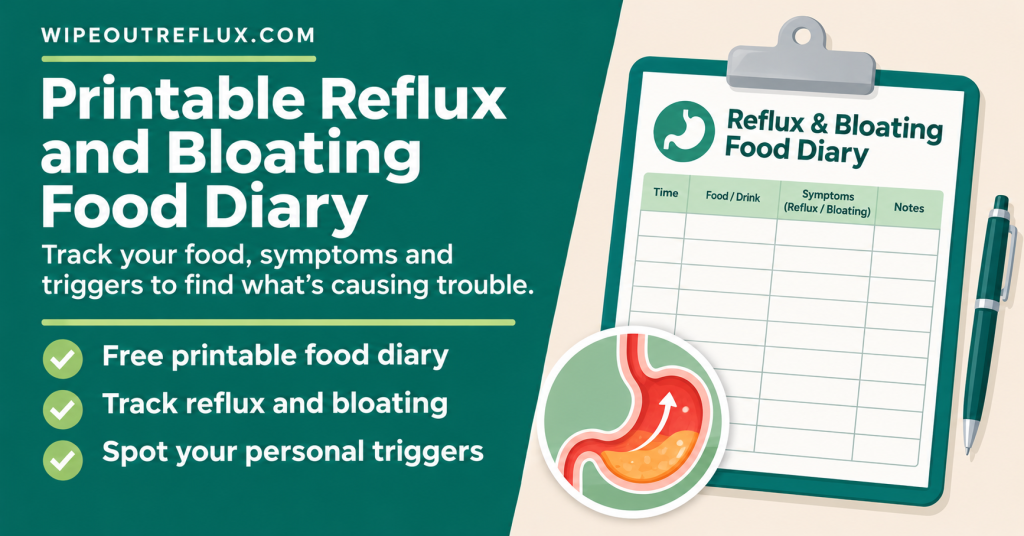
A food diary for acid reflux, bloating or IBS is a simple log of what you eat and drink, when, and what symptoms follow and when they start. Kept honestly for at least 7 days, it’s one of the most reliable ways to find your personal triggers, because they’re rarely the same as anyone else’s. Below you can download my free printable reflux food and symptom diary (a 9-page PDF), followed by how to fill it in, how to read the patterns, and the mistakes that make most diaries useless.
Ask most people with reflux what they ate before their last flare and they can’t tell you. That isn’t their fault. Reflux symptoms can start minutes after a meal or, with silent reflux, the next morning. Without writing it down, the link between cause and effect is almost impossible to see.
Key Takeaways
- Common trigger lists are a starting point, but individual triggers vary a lot. A diary shows what affects you.
- Record the time of every meal, snack and drink, plus the time each symptom starts. The timing is what links the two.
- Track more than food: lying down after eating, portion size, stress, sleep, alcohol and medications all change reflux.
- Silent reflux (LPR) symptoms such as throat clearing and hoarseness are often delayed, sometimes until the next morning, so log overnight and morning symptoms too.
- Keep the diary for at least 7 days, and only treat a food as a suspect if it’s linked to symptoms on two or three separate occasions.
- Test suspects one at a time: remove one for 1 to 2 weeks, then reintroduce it and watch for the same symptom.
- A validated food and symptom diary has been shown to reliably capture symptoms as they occur in IBS, which supports this approach.
- The free printable below has daily pages, a symptom checklist for GERD, LPR and bloating, and a weekly review page.
Download the Free Reflux Food and Symptom Diary
Download the free printable diary (PDF)
It’s 9 pages, sized for US Letter, and prints fine on A4. It includes:
- A how-to page, with a symptom checklist split into classic reflux (GERD), silent reflux (LPR), and gut and bloating symptoms
- Seven daily pages, each with rows for breakfast, lunch, dinner, snacks and bedtime, and columns for time, food and drink, what you did after eating, symptoms, time started and severity from 0 to 10
- Daily boxes for overnight and morning symptoms, medications and remedies, and other factors like stress, exercise, alcohol and caffeine
- A weekly review page to list suspected triggers, safe foods and patterns, plus how to test them
Why a Food Diary Works Better Than a Trigger List
Every reflux website has a list of foods to avoid, and mine is no exception. See LPR foods to avoid. Those lists are useful because they’re built on how foods affect the lower esophageal sphincter and acidity. But they’re generalizations.
When researchers reviewed the evidence on lifestyle advice for GERD, they found physiological evidence that things like high-fat meals, chocolate and alcohol relax the lower esophageal sphincter. But they found little direct evidence that blanket food restrictions improve symptoms across whole groups of patients [Kaltenbach et al., Archives of Internal Medicine, 2006]. One reasonable reading is that triggers are individual. Coffee wrecks one person and doesn’t bother another. Onions are fine raw for some people and a disaster cooked in a rich sauce.
A diary turns generic advice into your own list. In IBS research, a structured food and symptom diary recorded at the time of eating has been validated as an accurate way to capture symptoms and link them to diet [Wright-McNaughton et al., Clinical and Translational Gastroenterology, 2019]. The same principle works for reflux and bloating.
What to Record
Food and drink
- Everything, including drinks, sauces, dressings, snacks, gum and mints
- Roughly how much. Portion size is a trigger in its own right. See does overeating cause reflux?
- How it was cooked: fried versus baked, creamy sauce versus plain
- The time you ate it
Symptoms
- What you felt. Use the checklist on page 1 of the diary.
- When it started. This matters more than anything else you record.
- How bad it was, from 0 to 10. Be consistent rather than precise.
Everything else
- What you did after eating: sat upright, walked or lay down
- Bedtime, sleep quality, and whether the head of your bed was raised
- Medications and remedies, and when you took them (PPIs, H2 blockers, antacids, alginates)
- Stress, exercise, alcohol, caffeine and tight clothing
Timing: How Long After Eating Do Symptoms Appear?
This is why memory fails and a diary works.
- Heartburn and regurgitation usually appear within 30 minutes to 3 hours of eating. They’re often worst after the largest meal or when lying down.
- Bloating and gas can follow within an hour or build over several hours, depending on the food. See acid reflux and gas.
- Silent reflux (LPR) symptoms are often delayed. Throat clearing, mucus, hoarseness and a sore throat on waking frequently reflect what happened the evening before. That’s why the diary has an overnight and morning box on every page. Pepsin lodged in the throat can also be reactivated by acidic food and drink hours after the reflux itself, so an acidic drink can trigger throat symptoms quickly even when the real cause came earlier.
How to Read Your Diary
- Circle every symptom scored 4 or above.
- Look back 3 hours (or to the previous evening for morning throat symptoms) and note what you ate or did.
- Look for repeats. A food linked to symptoms on two or three separate days is a suspect. One bad reaction isn’t a pattern.
- Look for non-food patterns: late meals, large portions, lying down after eating, stressful days or poor sleep. These are often bigger factors than any single food. See how long before bed to stop eating.
- List your safe foods too. Knowing what you can eat is as useful as knowing what to avoid, and stops your diet shrinking unnecessarily.
Testing Your Suspects
Once you have a short list, test one suspect at a time:
- Remove your top suspect completely for 1 to 2 weeks, keeping everything else the same.
- Keep the diary going.
- Reintroduce the food in a normal portion and watch for the same symptom over the next day.
- If symptoms return, it’s a likely trigger. If not, it’s probably safe in that amount.
Changing several things at once makes it impossible to know what helped. For a more structured approach, see the elimination diet for acid reflux. If bloating and bowel symptoms dominate, the low FODMAP diet and IBS and acid reflux are worth reading.
Common Food Diary Mistakes
- Filling it in at the end of the day. Memory rewrites things. Log as you go.
- Skipping the “boring” items: drinks, condiments, the handful of crackers. These are often the answer.
- Not recording symptom times, which makes the diary almost useless for finding links.
- Stopping after two or three days. You need at least a week, ideally two.
- Cutting out foods after one bad reaction. This leads to a restrictive diet that may not be necessary.
- Ignoring the non-food factors. Late dinners and lying down after eating cause a lot of reflux on their own.
Paper or App?
Apps are convenient and some produce charts, but many are built for calorie counting and don’t make it easy to log symptom timing or throat symptoms. Paper is fast, flexible and easy to bring to a doctor’s appointment or consultation. Use whichever you’ll actually stick to. Consistency matters more than format. If you track your LPR score week to week, the Reflux Symptom Index pairs well with the diary.
When a Diary Isn’t Enough
A diary is for finding triggers, not for managing warning signs. See a doctor if you have difficulty swallowing, vomit blood, pass black stools, lose weight without trying, have chest pain with exertion or breathlessness, or if symptoms keep progressing despite changes.
Conclusion
A food diary is one of the simplest, most effective tools for reflux, silent reflux and bloating, because it replaces generic trigger lists with your own evidence. Log food, timing and symptoms as you go for at least a week, include overnight and morning symptoms if your throat is affected, look for repeats rather than one-offs, and test suspects one at a time. Download the free printable diary to get started.
Finding your triggers is step one. Knowing what to eat instead is step two, and that’s where most people get stuck, living on plain rice and chicken because they’re scared of everything else. The Wipeout Diet Plan gives you complete low-acid meal plans and recipes built around the foods that calm reflux, so your diary results turn into meals you enjoy. I built it around LPR, the hardest form of reflux to control, and it works just as well for GERD and heartburn.
Frequently Asked Questions
How long should I keep a food diary for acid reflux?
At least 7 days, ideally 2 weeks. That gives enough repeated meals to spot genuine patterns rather than one-off reactions.
What should I write in a reflux food diary?
Write down everything you eat and drink, with amounts and times, plus each symptom, when it started and how severe it was. Add what you did after eating, sleep, stress, alcohol and any medications.
How long after eating does acid reflux start?
Heartburn usually appears within 30 minutes to 3 hours. Silent reflux throat symptoms are often delayed and may show up the next morning.
Can a food diary help with bloating?
Yes. The same method works for bloating and IBS. Log foods and timing, then look for repeated links. The free diary includes a bloating and gut symptom checklist.
Should I stop eating a food after one bad reaction?
No. Wait until it’s linked to symptoms on two or three occasions, then test it properly by removing it for 1 to 2 weeks and reintroducing it.
Is there a free printable food diary for acid reflux?
Yes. You can download my free 9-page reflux food and symptom diary on this page. It’s designed for GERD, silent reflux (LPR) and bloating.
What foods most commonly trigger reflux?
Common triggers include fatty and fried foods, chocolate, coffee, alcohol, citrus, tomatoes, carbonated drinks, mint, onions and garlic. But triggers are individual, which is why a diary is so useful. See LPR foods to avoid.
Research & References
- An evidence-based review of lifestyle measures in GERD, finding physiological evidence that tobacco, alcohol, chocolate and high-fat meals lower sphincter pressure, but little evidence that blanket dietary measures are effective, with weight loss and head-of-bed elevation better supported [Kaltenbach et al., Archives of Internal Medicine, 2006].
- A validation study of the Food and Symptom Times (FAST) diary in 51 people with IBS, showing that a real-time food and symptom diary validly captures gastrointestinal symptoms as they occur and links them to dietary intake [Wright-McNaughton et al., Clinical and Translational Gastroenterology, 2019].

David Gray
12 years living with LPR · Consultant & researcher
I've lived with LPR for twelve years — the misdiagnoses, the PPI courses that did nothing, the slow work of figuring out what actually helps. Wipeout Reflux is where I translate the research into plain terms for people stuck in the same place. Every claim here is sourced to peer-reviewed work, and I consult one-to-one with LPR sufferers.