
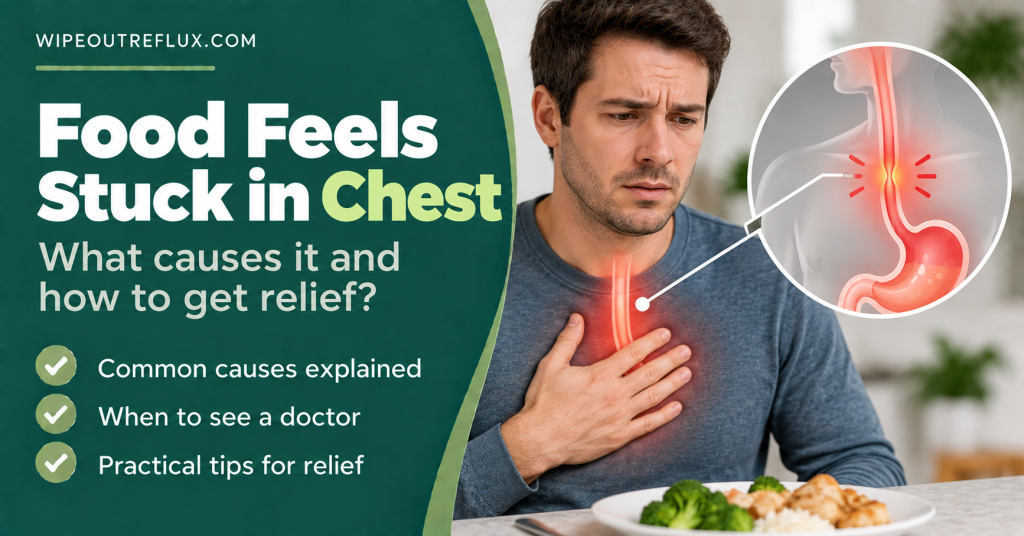
When food feels stuck in your chest, the problem is almost always in your esophagus, the muscular tube that carries food from your throat to your stomach. The most common causes are reflux-related: an inflamed esophageal lining, a narrowing from old acid damage (a peptic stricture), or a thin ring of tissue at the bottom of the esophagus called a Schatzki ring. Eosinophilic esophagitis and swallowing-muscle problems come next.
This is different from the “lump in the throat” feeling. That sensation (globus) is usually a tense muscle, and food goes down fine. When food sticks lower down, behind your breastbone, it usually means the food really is slowing down on its way to the stomach. Doctors call that esophageal dysphagia, and it deserves a proper look rather than a wait-and-see.
If food is stuck right now and you can’t swallow your own saliva, you’re drooling, or everything you drink comes straight back up, go to an emergency department. That’s a food impaction, and it needs removing within hours.
Key Takeaways
- Being unable to swallow saliva after food sticks is an emergency. An impacted food bolus should be cleared endoscopically, ideally within 24 hours.
- A stuck feeling in the chest usually reflects a real hold-up in the esophagus, unlike the throat “lump” of globus.
- People are surprisingly accurate at pointing to where food sticks, but problems low in the esophagus are sometimes felt higher up.
- Reflux is a leading cause. More than a third of people with erosive esophagitis report difficulty swallowing, and most improve once the lining heals.
- Food that sticks only now and then, especially meat or bread, points to a Schatzki ring or eosinophilic esophagitis. Food sticking more and more over weeks or months needs prompt investigation.
- Eosinophilic esophagitis causes about half of food impactions in adults who are biopsied, and it is often misdiagnosed as reflux for years.
- Trouble with liquids as well as solids from the start suggests a muscle (motility) problem such as achalasia.
- An endoscopy with biopsies is the key test. Ask for biopsies even if the esophagus looks normal.
First: When Food Stuck in Your Chest Is an Emergency
I want to cover this first, because it changes what you should do next.
A food bolus impaction is a piece of food, usually meat, that has lodged in the esophagus and won’t move. The signs are clear:
- You can’t swallow your own saliva, or you’re drooling or spitting it out
- Everything you try to drink comes back up within seconds
- You have constant pressure or pain behind the breastbone that started with a mouthful of food
- You have noisy breathing, coughing or choking
A bolus that doesn’t pass on its own risks aspiration, dehydration and, rarely, perforation. The definitive treatment is an endoscopy to push or pull the food out, which is recommended within 24 hours [Hardman et al., Cochrane Database of Systematic Reviews, 2020]. If you can’t manage your saliva, you need it sooner than that. The same Cochrane review found no good evidence that injections such as glucagon or muscle relaxants reliably clear the blockage. So don’t delay going to hospital hoping a drug or a home remedy will do the job.
Chest pain is worth a second thought too. If the pain isn’t clearly tied to a swallow, or it comes with breathlessness, sweating, or pain spreading into your arm or jaw, treat it as a possible heart problem until proven otherwise. Here’s how to tell heartburn from a heart attack.
If none of that applies to you, and the food eventually goes down or the feeling comes and goes, read on.
Chest vs Throat: Why the Location Matters
The two sensations sound similar but usually have very different causes.
Food stuck in your throat often isn’t stuck at all. It’s commonly globus, a constant lump or tightness felt at the neck. It’s usually better when you eat and worse when you swallow saliva, and it’s typically driven by a tense upper esophageal sphincter reacting to reflux. I’ve covered that separately in food stuck in throat feeling and globus sensation.
Food stuck in your chest happens during a meal. You feel a mouthful slow down or stop behind the breastbone, and it might pass after a few seconds, a sip of water, or several extra swallows. That’s true dysphagia: the food bolus really is meeting resistance.
How accurate is the spot you point to? Fairly accurate. In a study of 139 people with dysphagia and a confirmed esophageal narrowing, over half located the blockage within 2 cm of where endoscopy found it, and nearly three-quarters within 4 cm. There was one important catch: 15% of people with a blockage at the bottom of the esophagus felt it much higher up [Wilcox et al., Digestive Diseases and Sciences, 1995]. So a problem low in the chest can be felt in the throat, but a chest sensation rarely comes from the throat. If it’s in your chest, your esophagus is where to look.
The Clue Doctors Use: Solids, Liquids and Timing
Before any test, three questions narrow things down a lot:
- Solids only, and only occasionally (a chunk of steak or doughy bread every few weeks) → a ring, a web or eosinophilic esophagitis. The narrowing only catches large or poorly chewed pieces.
- Solids, getting steadily worse over weeks to months → a narrowing that is progressing: a peptic stricture or, less commonly, a tumor. This needs prompt investigation, especially with weight loss.
- Solids and liquids from the start → a muscle (motility) problem, such as achalasia or esophageal spasm. The pipe isn’t narrowed; it just isn’t pushing properly.
Also think about whether you have heartburn or regurgitation now, or used to, because the most common causes are all connected to reflux.
What Causes Food to Feel Stuck in Your Chest?
1. Reflux Inflaming the Esophagus
You don’t need scar tissue for food to stick. An inflamed esophageal lining is enough, because it disrupts the coordinated squeeze that moves food down and makes the lining more sensitive to a passing bolus.
The numbers are larger than most people expect. Across trials of nearly 12,000 people with erosive esophagitis, 37% had dysphagia at baseline. After four weeks of acid suppression it resolved in 83% of them, and people whose dysphagia didn’t improve were significantly less likely to have healed [Vakil et al., Clinical Gastroenterology and Hepatology, 2004]. In other words, sticking that settles as reflux is treated is reassuring, and sticking that persists needs another look. More on this in erosive esophagitis and whether acid reflux can make it hard to swallow.
2. Peptic Stricture
Years of acid damage can leave scar tissue that narrows the lower esophagus. This is a peptic stricture. The typical story is a long history of heartburn, then solids that stick a little more each month, often with less heartburn than before because the narrowing acts as a partial barrier.
Strictures are one of the most common findings when food gets fully stuck. In a series of adults with food bolus obstruction, peptic stricture was the cause in 15 of the 29 patients who were biopsied [Kerlin et al., Journal of Clinical Gastroenterology, 2007]. Treatment is esophageal dilation to stretch the narrowing, plus ongoing reflux control so it doesn’t re-form. See my full guide to esophageal strictures.
3. Schatzki Ring
A Schatzki ring is a thin band of tissue at the very bottom of the esophagus. It classically causes food to stick now and then, often with a large bite of meat at a restaurant, which is why it’s nicknamed “steakhouse syndrome.” Reflux has been suggested as a cause, and a single stretch with a large dilator usually fixes it [Jalil and Castell, Journal of Clinical Gastroenterology, 2002]. In the localization study above, rings accounted for about one in six esophageal narrowings [Wilcox et al., Digestive Diseases and Sciences, 1995]. My Schatzki ring guide covers what the endoscopy report wording means and what to eat.
4. Eosinophilic Esophagitis (EoE)
This is the cause I most want younger readers to know about. EoE is an allergic-type inflammation of the esophagus. It makes the wall stiff and ringed, so food sticks, especially in young and middle-aged men.
In adults who arrived at hospital with food stuck in the esophagus and were biopsied, 50% had EoE. All of them were men, with an average age of 32, and most had had previous episodes [Kerlin et al., Journal of Clinical Gastroenterology, 2007]. It’s also routinely missed. In 261 EoE patients, the median delay from first symptoms to diagnosis was three years, and about a quarter had first been told they had reflux [Lenti et al., Digestive and Liver Disease, 2021]. Two factors that lengthened the delay were repeated food impactions and a previous endoscopy done without biopsies.
Many people with EoE respond to PPIs. Across 73 studies, PPIs improved symptoms in about 65% and settled the inflammation under the microscope in about 45% [Lucendo et al., Clinical Gastroenterology and Hepatology, 2025]. Others need swallowed steroids, dietary elimination or newer biologic drugs. Here’s how to tell eosinophilic esophagitis from acid reflux.
5. Esophageal Motility Disorders
Sometimes the tube is a normal width but the muscle isn’t doing its job:
- Achalasia: the valve at the bottom won’t relax and the esophagus loses its squeeze. Food and liquid both stick, and regurgitation of undigested food is common. Achalasia can look a lot like GERD, with heartburn and chest pain, and has been mistaken for it, sometimes all the way to antireflux surgery [Kessing et al., Clinical Gastroenterology and Hepatology, 2011]. See achalasia vs acid reflux.
- Distal esophageal spasm: uncoordinated contractions that cause intermittent sticking and chest pain that can feel cardiac [Khalaf et al., American Journal of Medicine, 2018]. See esophageal spasm vs acid reflux.
- Weak or ineffective motility: common in long-standing reflux, where weak contractions let food linger. I’ve explained the link in esophageal motility and acid reflux.
These are diagnosed with esophageal manometry, which measures pressure along the esophagus during swallows.
6. Hiatal Hernia
When part of the stomach slides up through the diaphragm, the junction where food enters the stomach can kink or narrow. People with larger hernias often describe food “sitting” low in the chest, or a pressure after meals that eases with burping or standing. The hernia also makes reflux worse, which feeds causes 1 and 2. More in hiatal hernia and reflux.
7. Pill Injury
Tablets that dissolve in the esophagus instead of reaching the stomach can burn the lining and leave a painful ulcer. After that, food and drink feel as if they catch at the same spot. Nearly 100 different medications have been implicated, and taking pills upright with plenty of water reduces the risk [Kikendall, Journal of Clinical Gastroenterology, 1999]. If this started right after swallowing a tablet, see pill stuck in throat.
8. Esophageal Cancer
I’ll be direct, because vague reassurance doesn’t help anyone. Most people with food sticking don’t have cancer, but new dysphagia is a recognized alarm symptom. In a UK primary care study of nearly 6,000 people with new-onset dysphagia, esophageal cancer was diagnosed within three years in 5.7% of men and 2.4% of women. The rate rose to 9% in men aged 65–74 [Jones et al., BMJ, 2007].
The pattern to take seriously is dysphagia that’s progressive (solids, then softer foods, then liquids), especially with unexplained weight loss, vomiting, anemia, or a long reflux history over the age of 50. That combination needs an urgent referral, not a trial of home remedies. For context, read can acid reflux cause cancer.
Food Feels Stuck in Your Chest but Nothing’s There
Some people have every test come back clear and still feel food catching, or feel a lingering “something’s there” after the food has gone. This is real, and it has a name.
When endoscopy, biopsies and manometry are all normal, specialists call it functional dysphagia. The leading explanation is esophageal hypersensitivity: the nerves in the esophagus report normal food passage as if it were a problem, and paying close attention to the sensation amplifies it [Aziz et al., Gastroenterology, 2016].
Reflux often plays a role here too. An esophagus repeatedly exposed to acid and pepsin becomes more sensitive, so a bolus that would normally pass unnoticed registers as sticking. That’s also why the stuck feeling can linger for a while after a meal, and why it tends to settle as reflux control improves, even when nothing structural was ever found. If it comes with chest tightness or frequent burping, reflux is even more likely to be involved.
What to Do When Food Feels Stuck in Your Chest
If you can swallow your saliva and you’re breathing normally:
- Stop eating. Don’t try to push it down with another mouthful of bread or rice. That just adds to the blockage.
- Stand up or walk around. Gravity and gentle movement help the esophagus clear itself.
- Take small sips of water. Stop if they come straight back up.
- Give it a little time. Many boluses pass on their own within minutes to an hour as the esophagus keeps contracting.
- Skip the old home remedies. Fizzy drinks are often suggested, but the evidence is essentially lab-based: pressure changes in a flask, not trials in people [Ibrahim and Browning, European Archives of Oto-Rhino-Laryngology, 2021]. Don’t make yourself vomit, and never use meat tenderizer, which can damage the esophagus.
- Go to hospital if you can’t swallow saliva, can’t keep fluids down, or it hasn’t cleared within a few hours.
Even if it clears, book an appointment. A single episode of food getting properly stuck is a reason to have your esophagus looked at, because the cause is usually treatable and it tends to happen again.
How to Stop Food Getting Stuck Again
While you’re waiting for tests, and afterwards, these habits reduce episodes:
- Cut food small and chew thoroughly. Most impactions are meat, and most are a bite that was too big. There’s a reflux benefit too, covered in does chewing your food help acid reflux.
- Slow down and sip between bites. Don’t eat while rushed, distracted or after several drinks.
- Be wary of dry, dense and doughy foods. Steak, chicken breast, fresh white bread and dry rice are the usual culprits. Moist, tender cooking methods help.
- Stay upright for at least 30 minutes after eating, and take tablets standing with a full glass of water.
- Treat the reflux. For inflammation, strictures and rings, calming reflux lets the lining heal and reduces re-narrowing after dilation.
That last point is where most people have the most control. Reflux is behind a large share of chest sticking, either directly through inflammation or through the scarring and sensitivity it leaves. What you eat, how much, and when you eat it largely determine how much reflux your esophagus has to deal with. That’s the focus of the Wipeout Diet Plan.
Getting Diagnosed
Expect some combination of the following:
- Upper endoscopy is the key test. It shows inflammation, strictures, rings and tumors, and allows treatment (dilation) during the same procedure. Ask for biopsies even if everything looks normal. That’s how EoE is found, and skipping biopsies is a known cause of years of delay.
- Barium swallow shows the shape of the esophagus and how liquid and food move through it. It’s good for subtle rings and motility patterns.
- Esophageal manometry is used if the endoscopy is normal but sticking continues, to check for achalasia or spasm.
- pH or pH-impedance testing confirms reflux if that’s still uncertain. More on the options in how acid reflux is diagnosed.
See a Doctor Promptly If
- Food has got fully stuck even once
- Sticking is happening more often or with softer foods
- You’re losing weight without trying
- You’re vomiting, bringing up blood, or passing black stools
- You’re over 50 and this is new
- Liquids are sticking as well as solids
- It hasn’t improved after a few weeks of reflux treatment
Conclusion
Food that feels stuck in your chest is your esophagus telling you something specific. Unlike the throat lump of globus, this usually means food really is being held up. The good news is that the common causes are very treatable: reflux inflammation that heals, strictures and rings that can be stretched, and EoE that responds to targeted treatment. The key steps are knowing when it’s an emergency, getting an endoscopy with biopsies, and dealing with the reflux that sits behind so many of these causes.
That last part is where the Wipeout Diet Plan comes in. It’s the complete, step-by-step protocol I built over twelve years of managing reflux myself, designed to reduce how often reflux happens rather than just suppress the acid afterward. I originally developed it around LPR, the stubborn throat-based form, but it targets the same underlying mechanisms, so it works equally well for GERD, heartburn and the esophageal damage that makes food stick. Less reflux gives an inflamed lining the chance to heal and helps keep a dilated stricture or ring from narrowing again.
If you’d prefer a simpler starting point, the Wipeout Food Reference Guide is the essential companion. It lists the foods and drinks that are safe for acid reflux and LPR, with their pH values, so every meal stops feeding the problem.
Most importantly, if food ever sticks and you can’t swallow your saliva, go to hospital straight away.
This article is general information, not medical advice. Difficulty swallowing should always be assessed by a doctor.
Frequently Asked Questions
Why does food feel stuck in my chest?
Usually because something is slowing food down in your esophagus. The most common causes are reflux inflammation, a peptic stricture, a Schatzki ring, eosinophilic esophagitis or a swallowing-muscle problem such as achalasia. Unlike the throat lump of globus, a chest sticking sensation usually reflects a real hold-up, so it’s worth getting an endoscopy.
Can acid reflux make food feel stuck in your chest?
Yes, and often. More than a third of people with erosive esophagitis report difficulty swallowing, and most improve once the lining heals with treatment. Long-term reflux can also cause scarring (strictures), rings and weakened esophageal contractions, all of which make food stick.
What should I do if food is stuck in my chest right now?
Stop eating, stand up and walk around, and take small sips of water if you can swallow them. Many boluses pass within minutes to an hour. If you can’t swallow your own saliva, you’re drooling, or fluids come straight back up, go to an emergency department. Endoscopic removal is recommended within 24 hours, and sooner if saliva can’t pass.
Is it serious if food feels stuck in my chest but eventually goes down?
It’s usually not dangerous in the moment, but it should still be investigated. Intermittent sticking is typical of a Schatzki ring or eosinophilic esophagitis, and both are easy to treat once diagnosed. It becomes more urgent if the sticking is getting worse, you’re losing weight, or you’re over 50 with a new symptom.
What’s the difference between food stuck in your throat and food stuck in your chest?
A throat sensation that’s constant, better when eating and worse when swallowing saliva is usually globus, a muscular reaction often driven by reflux. A chest sensation that happens during a meal, as a bite goes down, is true esophageal dysphagia, where food is actually meeting resistance. Problems low in the esophagus are occasionally felt in the throat, so a throat feeling doesn’t completely rule out a chest cause.
Why does food get stuck in my chest when I eat meat or bread?
Dense, chewy meat and doughy bread form large, cohesive boluses that are the first things to catch on a narrowing. That’s why a Schatzki ring is nicknamed “steakhouse syndrome,” and why eosinophilic esophagitis often shows up as meat getting stuck. Smaller bites, thorough chewing and sips of water between mouthfuls help while you get checked.
Can anxiety make food feel stuck in my chest?
Anxiety can heighten how strongly you notice esophageal sensations, and in functional dysphagia a hypersensitive esophagus reports normal swallowing as sticking. But anxiety should be a conclusion reached after testing, not before. Chest sticking has too many treatable physical causes to assume it’s stress without an endoscopy.
Research & References
- [Hardman et al., Cochrane Database of Systematic Reviews, 2020]: Cochrane review of conservative treatments for esophageal soft food bolus impaction. Endoscopy within 24 hours is the definitive treatment, and there was inadequate evidence to recommend glucagon, muscle relaxants or other medical treatments.
- [Wilcox et al., Digestive Diseases and Sciences, 1995]: In 139 patients with dysphagia and an esophageal stricture, 52% localized the blockage within 2 cm and 74% within 4 cm. 15% of distal lesions were felt in the proximal esophagus. Causes included carcinoma (34.5%), GERD (22.3%) and Schatzki ring (15.8%).
- [Vakil et al., Clinical Gastroenterology and Hepatology, 2004]: Across 11,945 patients with erosive esophagitis, 37% had dysphagia, which resolved in 83% after four weeks of PPI therapy. Persistent dysphagia was linked to lower healing rates.
- [Kerlin et al., Journal of Clinical Gastroenterology, 2007]: In 43 adults with esophageal food bolus obstruction, 29 had biopsies. 15 had peptic stricture and 14 (50%) had eosinophilic esophagitis, all men with a mean age of 32.
- [Jalil and Castell, Journal of Clinical Gastroenterology, 2002]: Review of Schatzki’s ring. It classically causes intermittent solid-food dysphagia, reflux has been suggested as a cause, and it is usually treated by passing a large dilator.
- [Lenti et al., Digestive and Liver Disease, 2021]: In 261 patients with eosinophilic esophagitis, the median diagnostic delay was 36 months and 25.7% were first misdiagnosed with GERD. Previous endoscopy without biopsies and repeated food impactions were linked to longer delay.
- [Lucendo et al., Clinical Gastroenterology and Hepatology, 2025]: Meta-analysis of 73 studies (7,304 patients). PPIs produced clinical response in 65% and histological remission in 45.4% of eosinophilic esophagitis patients, with double doses outperforming standard doses.
- [Kessing et al., Clinical Gastroenterology and Hepatology, 2011]: Review and case series showing that achalasia can present with heartburn, chest pain and acid exposure that mimic GERD, leading to misdiagnosis. Manometry avoids the error.
- [Khalaf et al., American Journal of Medicine, 2018]: Review of distal esophageal spasm, a rare motility disorder presenting mainly with nonobstructive dysphagia and noncardiac chest pain, diagnosed with manometry and barium studies.
- [Kikendall, Journal of Clinical Gastroenterology, 1999]: Review of 979 cases of pill esophagitis from nearly 100 medications. The risk is reduced by taking pills upright with plenty of fluid.
- [Jones et al., BMJ, 2007]: UK primary care cohort. New-onset dysphagia had a three-year positive predictive value for esophageal cancer of 5.7% in men and 2.4% in women, rising to 9.0% in men aged 65–74.
- [Aziz et al., Gastroenterology, 2016]: Rome IV review of functional esophageal disorders, including functional dysphagia. Visceral hypersensitivity and hypervigilance are central to symptom generation when structure and motility are normal.
- [Ibrahim and Browning, European Archives of Oto-Rhino-Laryngology, 2021]: In vitro study of pressure changes produced by carbonated beverages on food boluses. The authors noted that clinical relevance still needs to be established.

David Gray
12 years living with LPR · Consultant & researcher
I've lived with LPR for twelve years — the misdiagnoses, the PPI courses that did nothing, the slow work of figuring out what actually helps. Wipeout Reflux is where I translate the research into plain terms for people stuck in the same place. Every claim here is sourced to peer-reviewed work, and I consult one-to-one with LPR sufferers.