
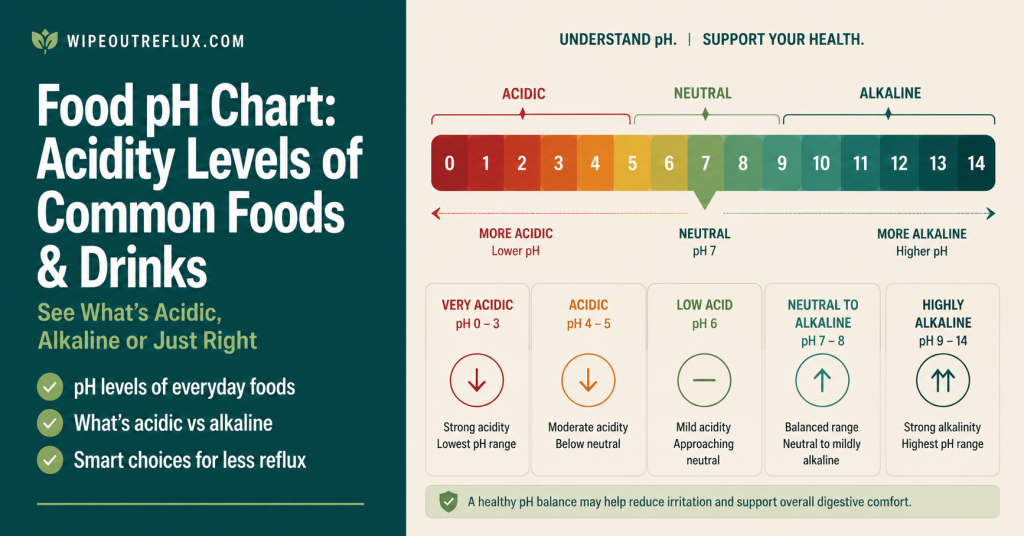
Most foods are acidic. That surprises people, but on the 0–14 pH scale, the majority of what you eat and drink sits below 7 — fruit, coffee, tomatoes, bread, even plain yogurt. What matters for reflux isn’t whether a food is “acidic” in the abstract, it’s where it falls relative to two specific numbers: pH 4, the classic threshold used to define a reflux event, and pH 5, roughly where pepsin can reactivate and start doing damage again.
Below is a practical pH chart of common foods and drinks, grouped by category, using approximate ranges rather than single numbers — pH genuinely varies by ripeness, variety and processing. This is a working reference covering what people search for most, not an exhaustive database.
Key Takeaways
- The pH scale runs 0–14; anything below 7 is acidic, 7 is neutral, above 7 is alkaline.
- Most fruit, coffee, wine, soda and tomatoes fall between pH 2 and pH 4.5 — solidly acidic.
- Most vegetables, grains, dairy, meat and fish sit closer to neutral, roughly pH 5.5 to 7.
- pH 4.0 is the standard cutoff used in ambulatory pH testing to define a reflux event.
- Pepsin, the enzyme that does most of the tissue damage in LPR, can reactivate at roughly pH 5 and stays stable up to pH 6.5.
- A food’s pH is only part of the picture — buffering capacity, fat content, portion size and meal timing all affect how it behaves in your gut.
- Some mildly acidic foods are genuinely fine for reflux; some near-neutral foods aren’t, which is why raw pH numbers alone can mislead.
- This chart covers the roughly 45–50 most commonly searched foods — the complete list with reflux-impact ratings lives in the Wipeout Food Reference Guide.
What Is the pH Scale, and Why Does Reflux Care About It?
The pH scale measures how acidic or alkaline a substance is, from 0 (extremely acidic) to 14 (extremely alkaline), with 7 as neutral — plain water. Each whole number is a tenfold jump in acidity, so a food at pH 3 is ten times more acidic than one at pH 4, and a hundred times more acidic than one at pH 5. That’s why small-looking differences on a pH chart of foods actually matter quite a bit.
For reflux specifically, two numbers matter most. Ambulatory pH monitoring defines a reflux event as pH dropping below 4.0 — the standard clinical cutoff. The second is less known but arguably more important for laryngopharyngeal reflux (LPR): pepsin, the enzyme behind most throat and airway damage, doesn’t stay switched off once it leaves the stomach. Research on human pepsin’s activity and stability found it remains stable up to around pH 6.5 and can reactivate once conditions turn acidic again, including inside cells Johnston et al., The Laryngoscope, 2007. That’s the mechanism behind a lot of “why does this still bother my throat,” covered further in what is pepsin and how pepsin reactivates in the throat.
The two numbers to remember: below pH 4.0 counts as a reflux event on clinical pH monitoring. Below roughly pH 5.0, pepsin already sitting in your throat tissue can switch back on. That second threshold is why some people react to foods a standard reflux chart would call safe.
pH Chart of Common Foods and Drinks
These are approximate pH ranges, not reflux-safety verdicts — a food’s acidity is one input, not the whole answer (more on that below). Colour bands show where each food sits relative to the two thresholds above, and where a food has its own deeper breakdown on the site, its name links through to it.
- Under pH 3 · very high acid
- pH 3–4 · high acid
- pH 4–5 · moderate
- pH 5–7 · low acid
- Above pH 7 · alkaline
Fruits
Fruit dominates the acidic end of the scale. For a deeper breakdown of individual fruits, see the acidity of fruits chart.
| Fruit | Approximate pH |
|---|---|
| Lemons | 2.0–2.6 |
| Limes | 2.0–2.8 |
| Grapefruit | 3.0–3.3 |
| Strawberries | 3.0–3.5 |
| Oranges | 3.1–4.1 |
| Pineapple | 3.2–4.0 |
| Apples | 3.3–4.0 |
| Grapes | 3.3–4.5 |
| Bananas | 4.5–5.2 |
Vegetables
Vegetables read very differently on the pH scale than fruit — most sit much closer to neutral.
| Vegetable | Approximate pH |
|---|---|
| Tomatoes | 4.3–4.9 |
| Bell peppers | 4.6–5.5 |
| Cucumbers | 5.1–5.7 |
| Onions | 5.3–5.8 |
| Cabbage | 5.4–6.0 |
| Potatoes | 5.4–6.0 |
| Lettuce | 5.8–6.1 |
| Carrots | 5.9–6.5 |
| Broccoli | 6.3–6.8 |
Dairy
| Dairy food | Approximate pH |
|---|---|
| Plain yogurt | 4.0–4.6 |
| Kefir | 4.2–4.8 |
| Sour cream | 4.4–4.8 |
| Cheddar cheese | 5.1–5.9 |
| Butter | 6.1–6.4 |
| Whole milk | 6.4–6.8 |
Meat, Fish and Eggs
| Food | Approximate pH |
|---|---|
| Beef | 5.3–6.2 |
| Chicken | 5.5–6.4 |
| Salmon | 6.1–6.6 |
| Cod / white fish | 6.6–6.8 |
| Eggs, whole | 7.0–7.9 |
Grains and Starches
| Food | Approximate pH |
|---|---|
| White bread | 5.3–5.8 |
| Pasta, cooked | 5.8–6.5 |
| Oatmeal | 6.0–6.6 |
| Rice, cooked | 6.0–6.7 |
| Cornmeal | 6.2–7.0 |
Drinks
Drinks span the widest range of anything on this chart, from soda near battery-acid territory to alkaline water above pH 8. More detail in is coffee acid or alkaline, caffeine and acid reflux and alkaline water for LPR.
| Drink | Approximate pH |
|---|---|
| Cola / soda | 2.3–3.0 |
| White wine | 3.0–3.5 |
| Red wine | 3.3–3.6 |
| Orange juice | 3.3–4.2 |
| Beer | 4.0–4.6 |
| Coffee, brewed | 4.8–5.1 |
| Black tea | 4.9–5.5 |
| Green tea | 6.0–7.1 |
| Alkaline water | 8.0–9.5 |
Condiments and Sauces
| Condiment | Approximate pH |
|---|---|
| White vinegar | 2.0–3.0 |
| Mustard | 3.5–4.6 |
| Ketchup | 3.6–3.9 |
| Mayonnaise | 3.8–4.6 |
| Salsa | 3.9–4.7 |
| Soy sauce | 4.4–5.4 |
For the sauces and dressings that catch people out most often — the vinegar- and citrus-based ones — there’s a fuller breakdown in condiments to avoid with acid reflux and BBQ sauce and acid reflux.
Every common food, its pH, and whether it’s actually reflux-safe
That’s roughly 50 of the most-searched foods and drinks — still a fraction of what’s on a plate in a week. The Wipeout Food Reference Guide covers the full list, and goes further than acidity alone: each food is rated for real reflux impact once buffering, fat and portion size are accounted for, so you’re not guessing from a number.
Get the Food Reference Guide →High-Acid vs Low-Acid Foods: What Counts as Which
On a pH chart of foods, “high acid” generally means anything below about pH 4 — squarely under the reflux threshold. “Low acid” usually means pH 5 and above, though as the next section explains, low acid doesn’t automatically mean reflux-safe.
A working list of high acid foods from the categories above: citrus (lemons, limes, grapefruit, oranges), vinegar, soda, wine, most berries, pineapple, tomatoes and tomato-based sauces, and most condiments built on vinegar or citric acid. These are the foods worth being most deliberate about, particularly close to bedtime — see LPR foods to avoid for the fuller reasoning.
Low acid foods cluster around grains, most vegetables, plain dairy, lean meat, fish and eggs — generally pH 5.5 and above. These form the backbone of a reflux-friendly plate, laid out in full in LPR foods to eat, and built into a day-by-day protocol in the Wipeout Diet Plan.
Where Vegetables and Alkaline Foods Fit
Vegetables ph values are, on the whole, reassuring: most land between 5 and 7, well clear of the pH 4 reflux threshold, which is part of why a vegetable-forward plate is such a consistent recommendation across reflux diets — including the Mediterranean and plant-based approaches. Genuinely alkaline foods — above pH 7 — are rarer than people assume. Whole eggs edge slightly alkaline, and alkaline water is the most searched-for option, sitting around pH 8–9.5 depending on brand; whether it’s worth the switch is covered in alkaline water and LPR, with the broader approach in the alkaline diet and GERD.
Why pH Alone Doesn’t Tell You Enough
Here’s the catch with any pH chart, including this one: raw pH doesn’t fully predict how a food behaves once you eat it. Buffering capacity matters — milk is mildly acidic but has enough protein and mineral content to neutralise stomach acid rather than add to it. Fat content matters too, since fatty meals slow gastric emptying and relax the valve meant to keep stomach contents down, regardless of the meal’s pH. Portion size and timing matter just as much; a large low-acid meal eaten right before lying down can trigger more reflux than a small acidic one eaten hours earlier Heidarzadeh-Esfahani et al., Preventive Nutrition and Food Science, 2021.
Then there’s the pepsin threshold covered earlier. Because pepsin can reactivate at roughly pH 5, a mildly acidic food can still matter if it arrives alongside a reflux event, while some near-neutral foods still cause problems through fat or portion size rather than acidity. A clinical low-acid diet trial found meaningful symptom improvement from reducing dietary acid intake — but the protocol went well beyond simply picking high-pH foods off a chart Koufman, Annals of Otology, Rhinology & Laryngology, 2011.
A pH value can’t tell you if a food is safe. A reflux rating can.
This is exactly the gap the Wipeout Food Reference Guide is built to close — not just pH values, but whether each food is genuinely safe for reflux once buffering, fat content and portion size are factored in. No more guessing from a number on a chart.
See the full reflux ratings →Conclusion
A pH chart is a useful starting point, but it’s still just an ingredient list, not a plan. Knowing that lemons sit at pH 2 and oatmeal sits near pH 6 doesn’t tell you what to eat for breakfast, how to structure your meals, or how long to wait before lying down.
The Wipeout Diet Plan
This is what turns acidity data into a protocol you can actually follow — what to eat, how meals should be structured and timed, and how to reintroduce foods as symptoms settle. It was built first around LPR, the throat-based form of reflux that’s hardest to pin down, but because it targets the same underlying mechanisms, it works just as well for GERD and everyday heartburn.
Explore the Wipeout Diet Plan →If you want the reference material to go alongside that plan — every common food, its pH, and whether it’s actually safe for reflux rather than just acidic on paper — that’s the Wipeout Food Reference Guide. Used together, the chart tells you where a food sits on the scale, and the guide tells you what to actually do with that information.
Frequently Asked Questions
What is the pH scale for foods?
It’s a 0–14 scale measuring acidity, where below 7 is acidic, 7 is neutral, and above 7 is alkaline. Most foods and drinks fall somewhere between pH 2 and pH 7; very few everyday foods are truly alkaline.
What foods are the most acidic?
Lemons and limes sit at the extreme end, around pH 2.0–2.8, alongside vinegar and cola. Most citrus fruit, berries, wine and tomato-based sauces fall in the pH 3–4.5 range, all below the pH 4 reflux threshold.
What foods are low acid or alkaline?
Most vegetables, grains, plain dairy, lean meat, fish and eggs sit between pH 5.5 and 8, with whole eggs and alkaline water among the few genuinely alkaline options on a typical plate.
Does a food’s pH tell you if it’s safe for acid reflux?
Not on its own. Buffering capacity, fat content, portion size, and how close to bedtime you eat all affect how a food behaves, so a mildly acidic food can be fine while a near-neutral one isn’t. That’s the gap a reflux-specific reference, rather than a raw pH chart, is designed to fill.
What pH triggers acid reflux?
Clinically, pH monitoring defines a reflux event as a drop below pH 4.0. For LPR specifically, pepsin — the enzyme responsible for most throat damage — can reactivate at roughly pH 5, which is why the throat can stay irritated even when overall acidity looks moderate. The Reflux Symptom Index is a quick way to score how much your throat symptoms are being affected.
Is coffee acidic or alkaline?
Acidic. Brewed coffee typically sits around pH 4.8–5.1, which puts it above the pH 4 reflux threshold but still low enough to bother sensitive people. More detail in is coffee acid or alkaline, or see the best low-acid coffee brands if you’d rather not give it up.
Research & References
- U.S. Food and Drug Administration, Approximate pH of Foods and Food Products, CFSAN — FDA reference compilation of pH ranges across food categories, used as the primary data source for the chart above; the agency notes pH varies by variety, ripeness and processing method.
- Johnston et al., The Laryngoscope, 2007 — Laboratory study of human pepsin activity and stability across a range of pH levels, finding pepsin remains stable up to roughly pH 6.5 and can reactivate under acidic conditions, including intracellularly.
- Koufman, Annals of Otology, Rhinology & Laryngology, 2011 — Clinical study of a low-acid diet in patients with recalcitrant laryngopharyngeal reflux, reporting significant symptom improvement with dietary acid reduction alongside standard care.
- Koufman & Johnston, Annals of Otology, Rhinology & Laryngology, 2012 — Study evaluating pH 8.8 alkaline water and its potential to inactivate pepsin as an adjunct to reflux treatment.
- Heidarzadeh-Esfahani et al., Preventive Nutrition and Food Science, 2021 — Systematic review of dietary intake and reflux disease risk, covering fat intake, meal size and eating patterns alongside acidity as independent contributors to reflux symptoms.

David Gray
12 years living with LPR · Consultant & researcher
I've lived with LPR for twelve years — the misdiagnoses, the PPI courses that did nothing, the slow work of figuring out what actually helps. Wipeout Reflux is where I translate the research into plain terms for people stuck in the same place. Every claim here is sourced to peer-reviewed work, and I consult one-to-one with LPR sufferers.