
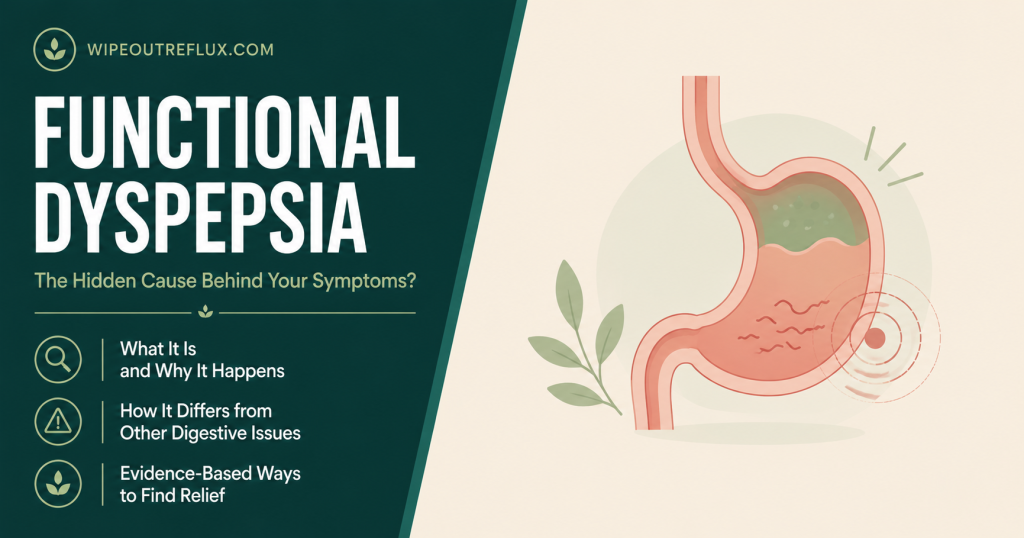
Functional dyspepsia is what you’re left with when the upper-gut symptoms are real, persistent and miserable — and the endoscopy comes back clean. It’s defined by four possible symptoms: pain in the upper abdomen, burning in the upper abdomen, uncomfortable fullness after a normal-sized meal, and early satiety, where a few mouthfuls defeat you. No structural damage, no ulcer, no explanation on the camera.
It gets confused with acid reflux constantly, because the symptoms overlap and because almost everyone ends up on the same acid-suppressing drug. But the two are different problems in different places, and the evidence on treatment is unusually clear about it: what works for functional dyspepsia depends on which subtype you have, and for a large group of people, acid suppression was never going to do anything at all.
If you’ve been told your tests are normal and left with a repeat prescription and a shrug, this article is the one I’d have wanted you to read first. Functional doesn’t mean imaginary. It means the damage isn’t structural — and the mechanisms behind it are now reasonably well understood.
Key Takeaways
- Functional dyspepsia means dyspeptic symptoms with no structural cause found on investigation. Global pooled prevalence is 8.4%, and it’s more common in women.
- There are two subtypes: postprandial distress syndrome (fullness and early satiety) and epigastric pain syndrome (pain or burning). Knowing yours predicts what will help.
- PPIs help only modestly overall, with a number needed to treat of 13 — and the benefit is confined to ulcer-like and reflux-like symptoms, with no advantage for dysmotility-type symptoms.
- Amitriptyline improved symptoms in a major randomised trial, most clearly for ulcer-like pain, while escitalopram did not — and neither helped those with delayed gastric emptying.
- Two independent lines of evidence converge on the same point: your subtype, not your acid, predicts response.
- Duodenal eosinophils and mast cells are significantly increased in functional dyspepsia, and more of them are degranulated — the site of the problem may be the duodenum rather than the stomach.
- Impaired gastric accommodation and visceral hypersensitivity matter more than emptying speed; true gastroparesis is relatively uncommon.
- Psychological therapies produce significant symptom improvement in randomised trials — not because it’s in your head, but because the gut–brain axis is part of the mechanism.
What functional dyspepsia actually is
The formal definition requires one or more of four symptoms, bothersome enough to affect your daily life, present for the last three months with onset at least six months ago, and no structural disease found that explains them:
- Bothersome postprandial fullness
- Bothersome early satiety
- Bothersome epigastric pain
- Bothersome epigastric burning
Note what’s absent. Nothing about acid. Nothing about the oesophagus. Nothing about heartburn. Heartburn is explicitly not a dyspepsia symptom — it belongs to reflux.
The condition splits into two subtypes, and this split is the most useful thing in this article:
- Postprandial distress syndrome (PDS) — meal-related. Fullness after normal portions, early satiety, often with nausea, bloating and excessive burping. This is the commoner subtype.
- Epigastric pain syndrome (EPS) — pain or burning in the upper abdomen, not necessarily tied to meals, sometimes worse when the stomach is empty.
Plenty of people meet both sets of criteria. But if you lean clearly one way, that leaning should be steering your treatment — and in my experience it almost never does.
It is not a rare or fringe diagnosis. A meta-analysis of 44 studies covering 256,915 participants across 40 countries put the global pooled prevalence at 8.4%, higher in women than men at 9.0% versus 7.0%, with postprandial distress syndrome the commonest subtype Lee et al., Scientific Reports, 2024. Roughly one person in twelve, worldwide.
How to tell it apart from reflux
Reflux is a mechanical transport failure: stomach contents moving upward past a sphincter into the oesophagus, and sometimes as far as the throat. Functional dyspepsia is a processing problem in the stomach and duodenum. Different place, different direction, different symptoms.
The distinguishing questions:
Does lying flat change it? Reflux is gravity-dependent and almost always worsens when you lie down. Functional dyspepsia is largely indifferent to posture. If elevating the head of your bed reliably helps, that’s reflux.
Can you finish a normal meal? Early satiety is the single most specific functional dyspepsia symptom. Reflux doesn’t stop you eating — it punishes you afterwards.
Is your throat involved? Hoarseness, throat clearing, a lump sensation, a nagging cough — these are LPR symptoms, caused by refluxate reaching the larynx. Functional dyspepsia cannot produce them.
Do things come back up? Regurgitation and a sour or bitter taste are reflux. They aren’t features of functional dyspepsia.
The complication is that both can be true at once. Dyspepsia is present in 43.9% of people with weekly reflux symptoms, the two overlap in 25.9% of individuals overall, and the odds of dyspepsia are almost sevenfold higher in people with weekly reflux symptoms Eusebi et al., Clinical Gastroenterology and Hepatology, 2018. So the question isn’t always “which one” — it’s “how much of each, and which is driving the misery today”.
Why “functional” doesn’t mean imaginary
This is where people get dismissed, and it’s the part I most want to correct.
Functional means no structural lesion was found. It does not mean no mechanism. In functional dyspepsia the recognised disturbances include impaired relaxation of the gastric fundus — the part of the stomach that should expand to receive a meal — visceral hypersensitivity, where ordinary amounts of stretch register as pain, low-grade mucosal immune activation, altered gut microbiota, and disrupted brain–gut signalling Wang et al., Frontiers in Medicine, 2025.
Two of those deserve unpacking, because they explain the two subtypes almost perfectly.
Impaired accommodation. Normally, when food arrives, the upper stomach relaxes to make room — a vagally-mediated reflex using nitric oxide. If that relaxation fails, the same meal generates far more pressure and stretch than it should. Result: fullness after small portions, early satiety, discomfort. That’s postprandial distress syndrome in one sentence, and it’s why the vagus nerve keeps coming up in this condition.
Visceral hypersensitivity. The nerves reporting from your gut are turned up too loud, and the central processing of those signals is altered. Normal digestion is read as pain. Nothing on a camera will ever show this, and it doesn’t make it less real.
The same review makes a point worth holding onto. Delayed gastric emptying gets blamed a lot, but the association between emptying speed and actual symptoms is weak, and true gastroparesis is relatively uncommon. If you’ve been chasing a gastric emptying result, it may be less central than you’ve been led to believe — though it’s still worth understanding where gastroparesis fits.
The duodenum: where the action probably is
Here’s the shift in thinking that hasn’t reached most patients yet, and it matters because it explains why stomach-focused and acid-focused treatment misses.
A systematic review and meta-analysis of 22 case-control studies covering 1,108 people with functional dyspepsia and 893 controls found that duodenal eosinophils and mast cells are significantly increased in functional dyspepsia, and that a higher proportion of those cells are degranulated — meaning actively releasing their inflammatory contents Shah et al., Clinical Gastroenterology and Hepatology, 2022.
That’s a low-grade immune process in the first part of the small intestine, invisible on a standard endoscopy because nobody biopsies a normal-looking duodenum for eosinophil counts. Alongside it sits evidence of impaired mucosal barrier integrity — a slightly leakier lining that lets food antigens and bacterial products reach nerve endings they shouldn’t reach.
If that’s the engine, several things suddenly make sense. Why symptoms are so tightly meal-related. Why some people respond to dietary change far more than medication. Why mast cell activity keeps surfacing — and it’s worth reading about the histamine intolerance and mast cell link if food reactions are a big part of your picture. And why suppressing stomach acid, which happens a level upstream, so often changes nothing.
The subtype question nobody asks you
Now the section I’d put on a poster.
Two completely independent lines of evidence, different drugs, different research groups, arrived at the same conclusion: response depends on your symptom subtype, not on how much acid you make.
The acid evidence. A Cochrane review of proton pump inhibitors in functional dyspepsia found them only slightly better than placebo overall — risk ratio 0.88 across 5,968 participants, number needed to treat 13. But the subgroup analysis found the benefit was confined to people with ulcer-like and reflux-like dyspepsia, with no advantage of PPI treatment in people with dysmotility-like or unspecified dyspepsia Pinto-Sanchez et al., Cochrane Database of Systematic Reviews, 2017.
The neuromodulator evidence. The Functional Dyspepsia Treatment Trial randomised 292 people to amitriptyline, escitalopram or placebo over twelve weeks. Amitriptyline improved symptoms; escitalopram did not. The benefit was most evident in those with ulcer-like epigastric pain — and there was no efficacy in people with delayed gastric emptying, suggesting genuinely different mechanisms in those with and without slow emptying Talley et al., Gastroenterology, 2015.
Look at the shape of that. Two different drug classes, and both work for the pain-predominant picture and fail for the fullness-and-slow-emptying picture. That isn’t coincidence — it’s two different diseases wearing the same name.
So the most valuable question you can answer before your next appointment is simply: is my main problem pain, or is it fullness? Almost nobody will ask you. It should be the first thing anyone asks.
What the evidence says actually works
A word before the specifics: the prescription options below are decisions for you and your doctor, and several are used off-label at doses far lower than their original purpose. I’m laying out what the trials show so you can have a better conversation, not so you can self-prescribe.
If your pattern is pain or burning (EPS)
- An acid-suppression trial is reasonable. This is the subgroup where PPIs actually earn their place. Give it a proper trial and judge it honestly — if eight weeks changes nothing, that’s an answer, not a reason to escalate. See what to do when reflux medication isn’t working.
- Low-dose tricyclics are the best-evidenced next step. In a network meta-analysis of drugs for functional dyspepsia, tricyclic antidepressants ranked near the top, and first when only low-risk-of-bias trials were included — with the authors suggesting they be considered earlier in the disease course rather than as a last resort Ford et al., Alimentary Pharmacology & Therapeutics, 2021. They’re being used at low doses as neuromodulators to turn down visceral hypersensitivity, not as antidepressants — the same logic behind amitriptyline and gabapentin for reflux cough. Side effects are commoner than with placebo, so it’s a genuine trade-off.
- Rule out H. pylori first. Non-negotiable, and cheap — see H. pylori and acid reflux.
If your pattern is fullness and early satiety (PDS)
- Change meal volume before anything else. If your stomach isn’t accommodating well, stop asking it to accommodate so much at once. Smaller, more frequent meals is the highest-yield intervention in this subtype, and it costs nothing.
- Cut fat at the problem meals. Fat slows gastric emptying and reliably worsens fullness and nausea — fried food is the usual offender.
- Ask about prokinetics rather than more acid suppression. These target motility, which is the actual mechanism here. Prokinetics and specifically domperidone are worth understanding before you discuss them.
- Slow down and chew properly. Unglamorous and genuinely effective — see whether chewing your food helps — as is not overloading the stomach in the first place.
- Ginger is the gentlest starting point for nausea and gastric motility — see ginger for acid reflux and digestion.
Worth doing whichever subtype you have
- Take the gut–brain axis seriously. A systematic review and meta-analysis of randomised trials found significant improvement in functional dyspepsia symptoms with psychological therapy compared with control treatment, most interventions being cognitive behavioural therapy or derivatives of it Rodrigues et al., Journal of Gastroenterology and Hepatology, 2021. That’s not a suggestion that you’re imagining it. It’s that the nervous system is part of the mechanism, so it’s a legitimate target. Breathing exercises are a free place to start, and stress modulates the whole system.
- Audit your medications. Anti-inflammatories especially, but iron, antibiotics and GLP-1 drugs all feature — check the list of medications that make reflux and stomach symptoms worse.
- Consider the microbiome angle. Given the duodenal picture, it’s not a leap. Probiotics, SIBO and general gut health are all reasonable threads to pull if bloating dominates.
- Don’t stop a PPI abruptly. Acid rebound after withdrawal generates symptoms in people who never had reflux, which can look convincingly like relapse. Read how to get off PPIs without acid rebound first.
Where reflux fits — because a quarter of you have both
If you have functional dyspepsia and reflux together, treating one and ignoring the other guarantees partial results. And the two are mechanically linked: a stomach that doesn’t accommodate well holds contents at higher pressure, and pressure is what forces the sphincter open.
Which means the interventions that help postprandial distress — smaller meals, less fat, eating earlier, slowing down — are also the interventions that reduce reflux. That overlap is genuinely good news. You’re not choosing between two treatment plans; you’re building one that addresses volume, timing and pressure.
What you do need to add on the reflux side is the food detail, because that’s where people get stuck and where online advice contradicts itself most. The Wipeout Food Reference Guide is the essential reference for it — which foods and drinks are actually safe with acid reflux and LPR, and their pH values, so you’re not guessing meal by meal while you’re already managing a sensitive gut.
How functional dyspepsia gets diagnosed
It’s a diagnosis of exclusion, but the exclusion doesn’t have to be exhaustive.
Guidance recommends that people under 60 with dyspepsia have a non-invasive Helicobacter pylori test — breath or stool antigen — and treatment if positive, rather than proceeding straight to endoscopy. People 60 and over are advised to have upper endoscopy to exclude organic disease, with alarm features in younger patients assessed case by case Moayyedi et al., The American Journal of Gastroenterology, 2017.
A reasonable workup usually also includes coeliac serology and basic bloods for anaemia. If you’ve had all that and it’s clear, you have your answer — and the useful next move is subtyping yourself, not repeating the same tests. For the reflux side of things, how acid reflux is diagnosed and what to expect from endoscopy for acid reflux cover the rest.
When to get re-checked
Functional dyspepsia doesn’t turn into anything sinister, but a changing picture deserves fresh eyes. Go back to your doctor for unintentional weight loss, difficulty swallowing or food sticking, persistent vomiting, black or tarry stools, vomiting blood, unexplained anaemia, or a clear change in the character of long-standing symptoms.
And if chest discomfort arrives with sweating, breathlessness, or pain spreading to the jaw or arm, treat it as cardiac until proven otherwise — telling heartburn from a heart attack is not a judgement call to make at home.
Conclusion
Functional dyspepsia is a real condition with real mechanisms: a stomach that doesn’t relax properly to receive food, nerves that report ordinary stretch as pain, and low-grade immune activity in the duodenum that a standard endoscopy will never show you. Being told your tests are normal is not the same as being told nothing is wrong.
The single most useful thing you can do with that diagnosis is subtype yourself. Two independent bodies of evidence — the Cochrane analysis of acid suppression and the Functional Dyspepsia Treatment Trial — found the same pattern: treatments work for the pain-predominant picture and fail for the fullness-and-slow-emptying picture. If your problem is early satiety and heaviness after meals, the evidence says acid suppression is unlikely to help you, and the levers that will are meal volume, fat content, eating pace and motility. If your problem is epigastric pain, acid suppression and low-dose neuromodulators are where the evidence sits. Nobody is going to ask you which you are, so decide before you go in.
And if reflux is part of your picture too — as it is for roughly a quarter of people — the food side does a great deal of the work for both. The Wipeout Food Reference Guide is the essential starting point: the allowed foods and drinks for acid reflux and LPR with their pH values, so you can stop second-guessing every meal. If you’d rather follow a complete system, the Wipeout Diet Plan goes considerably deeper. It was built first around LPR, the stubborn throat-based form of reflux, but because it works on the same underlying mechanisms it’s just as effective for GERD and everyday heartburn — and smaller, better-timed, lower-fat meals are exactly what a stomach that struggles to accommodate food needs anyway.
Frequently Asked Questions
Is functional dyspepsia the same as acid reflux?
No. Reflux is stomach contents travelling upward into the oesophagus; functional dyspepsia is a processing problem in the stomach and duodenum with no structural cause. Heartburn is explicitly not a functional dyspepsia symptom. They overlap in around a quarter of people, but they’re separate conditions needing different treatment.
Does functional dyspepsia ever go away?
It fluctuates. Many people have long quiet periods punctuated by flares, often triggered by illness, stress or dietary change. It doesn’t progress to anything dangerous, and symptom control is realistic — but it tends to be a condition you manage rather than one you cure outright.
Why don’t PPIs work for my functional dyspepsia?
Because for a large group they were never going to. A Cochrane review found PPIs only slightly better than placebo overall, with a number needed to treat of 13, and the benefit confined to ulcer-like and reflux-like symptoms. There was no advantage at all in dysmotility-type dyspepsia — the fullness, bloating and nausea pattern.
Why would a doctor prescribe an antidepressant for a stomach problem?
At low doses, tricyclics act as neuromodulators rather than antidepressants — they turn down the visceral hypersensitivity that makes ordinary digestion register as pain. In the Functional Dyspepsia Treatment Trial, amitriptyline improved symptoms while escitalopram did not, which is telling: it isn’t the mood effect doing the work. Side effects are commoner than with placebo, so it’s a discussion worth having properly.
Is functional dyspepsia caused by anxiety?
Anxiety isn’t the cause, but the gut–brain axis is genuinely part of the mechanism, and stress modulates visceral sensitivity. That’s why psychological therapies produce measurable symptom improvement in randomised trials. It’s a legitimate treatment target, not an accusation that you’re imagining things.
What should I eat with functional dyspepsia?
Start with volume rather than content. Smaller, more frequent meals are the most effective single change for postprandial fullness, because the problem is often the stomach failing to expand to receive a normal portion. Then reduce fat at the meals that trouble you most, since fat slows gastric emptying. Eating slowly and chewing thoroughly helps more than people expect.
Can functional dyspepsia cause nausea?
Yes, particularly in the postprandial distress subtype, where nausea often accompanies fullness and early satiety. It’s one of the features that distinguishes it from reflux, which more typically produces burning and regurgitation than nausea.
Do I need another endoscopy?
Usually not. If you’ve had a normal endoscopy, been tested for Helicobacter pylori and screened for coeliac disease, repeating those tests rarely adds anything. What tends to help more is identifying your subtype and matching treatment to it. Do go back if you develop alarm features or your symptoms change character.
Research & References
- Systematic review and meta-analysis of 44 studies including 256,915 participants from 40 countries reporting a global pooled prevalence of functional dyspepsia of 8.4% (95% CI 7.4–9.5), higher in women than men (9.0% versus 7.0%), with postprandial distress syndrome the commonest subtype Lee et al., Scientific Reports, 2024.
- Narrative review of functional dyspepsia mechanisms describing impaired gastric fundus relaxation, visceral hypersensitivity, mucosal immune activation, microbiota imbalance and disrupted brain–gut signalling, and noting that the association between delayed gastric emptying and clinical symptoms is weak while true gastroparesis is relatively uncommon Wang et al., Frontiers in Medicine, 2025.
- Systematic review and meta-analysis of 22 case-control studies including 1,108 patients with functional dyspepsia and 893 controls, finding duodenal eosinophils (SMD 1.29, 95% CI 0.85–1.73) and mast cells (SMD 2.11, 95% CI 1.14–3.07) significantly increased in functional dyspepsia, with a higher proportion of degranulated cells Shah et al., Clinical Gastroenterology and Hepatology, 2022.
- Cochrane review of proton pump inhibitors in functional dyspepsia finding PPIs slightly more effective than placebo (risk ratio 0.88, 95% CI 0.82–0.94; 5,968 participants; number needed to treat 13), with benefit confined to ulcer-like and reflux-like dyspepsia and no advantage in dysmotility-like or unspecified dyspepsia Pinto-Sanchez et al., Cochrane Database of Systematic Reviews, 2017.
- Multicentre randomised controlled trial of 292 participants comparing amitriptyline, escitalopram and placebo over twelve weeks in functional dyspepsia, finding symptom improvement with amitriptyline but not escitalopram, most evident in ulcer-like epigastric pain, and no efficacy in those with delayed gastric emptying Talley et al., Gastroenterology, 2015.
- Systematic review and network meta-analysis of drug therapies for functional dyspepsia ranking tricyclic antidepressants among the most efficacious classes, and first when analysis was restricted to trials at low risk of bias, with adverse events significantly commoner than placebo Ford et al., Alimentary Pharmacology & Therapeutics, 2021.
- Systematic review and meta-analysis of randomised controlled trials comparing psychological therapies with control treatment in functional dyspepsia, showing significant improvement in symptoms favouring psychological therapy, with most interventions being cognitive behavioural therapy or derivatives Rodrigues et al., Journal of Gastroenterology and Hepatology, 2021.
- Systematic review and meta-analysis of community populations finding dyspepsia in 43.9% of individuals with weekly gastro-oesophageal reflux symptoms, a pooled overlap of 25.9%, and almost sevenfold higher odds of dyspepsia in those with weekly reflux symptoms Eusebi et al., Clinical Gastroenterology and Hepatology, 2018.
- American College of Gastroenterology and Canadian Association of Gastroenterology guideline recommending non-invasive Helicobacter pylori testing and treatment for dyspeptic patients under 60, with upper gastrointestinal endoscopy advised from age 60 to exclude organic pathology Moayyedi et al., The American Journal of Gastroenterology, 2017.

David Gray
12 years living with LPR · Consultant & researcher
I've lived with LPR for twelve years — the misdiagnoses, the PPI courses that did nothing, the slow work of figuring out what actually helps. Wipeout Reflux is where I translate the research into plain terms for people stuck in the same place. Every claim here is sourced to peer-reviewed work, and I consult one-to-one with LPR sufferers.