
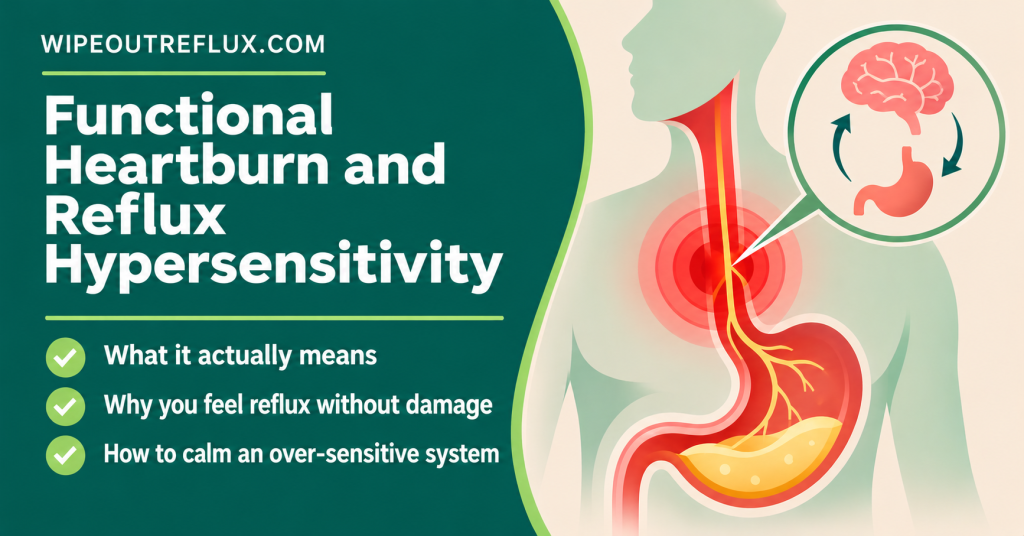
Functional heartburn and reflux hypersensitivity are what you’re left with when the burning is real, your scope is clean, and your pH study shows a normal amount of acid. They sound like the same thing, but they aren’t. In reflux hypersensitivity, your symptoms still line up with reflux events — you’re just feeling normal, everyday reflux far more intensely than most people. In functional heartburn, the burning doesn’t line up with reflux at all.
That one difference decides almost everything that follows: whether acid-reducing drugs are worth continuing, whether surgery is ever an option, and whether the main target should be the reflux or the nerves that are sending the pain signal.
I’ve spent a lot of time in consult calls with people who were told “your tests are normal” and then sent home on the same PPI that wasn’t working. This article explains what those two labels actually mean, how they’re diagnosed, and what the evidence says helps each one.
Key Takeaways
- Both conditions mean heartburn with a normal endoscopy and normal acid exposure on reflux testing. The difference is whether your symptoms match your reflux episodes.
- Reflux hypersensitivity: symptoms are triggered by reflux, but by a normal amount of it. Your esophagus is over-sensitive.
- Functional heartburn: symptoms have no consistent link to reflux. The pain signal is generated or amplified elsewhere along the gut–brain pathway.
- Functional heartburn is one of the most common reasons acid suppression “fails.” In one large trial of PPI-refractory heartburn, 99 of 366 referred patients turned out to have it.
- PPIs help many people with reflux hypersensitivity, but they don’t help functional heartburn unless true GERD overlaps with it.
- Treatments that turn down nerve sensitivity — low-dose neuromodulators and brain–gut therapies like hypnotherapy — are the mainstay for functional heartburn.
- Esophageal hypervigilance (being finely tuned in to throat and chest sensations) predicts how bad symptoms feel, regardless of how much acid you have. This applies to LPR throat symptoms too.
- Getting the right label requires reflux testing off acid-suppressing medication, ideally with impedance and symptom association, plus manometry and biopsies.
Three kinds of heartburn with a normal scope
Most people with heartburn never get to see any damage on endoscopy. Those people can fall into three groups, and they look identical from the outside:
- Non-erosive reflux disease (NERD) — normal-looking esophagus, but too much acid on pH testing. This is true GERD, just without visible erosions.
- Reflux hypersensitivity — normal esophagus, normal acid exposure, but your symptoms clearly coincide with reflux episodes.
- Functional heartburn — normal esophagus, normal acid exposure, and no meaningful link between your symptoms and reflux events.
The Rome IV criteria group functional heartburn and reflux hypersensitivity among the functional esophageal disorders. These are esophageal symptoms that aren’t explained by a structural blockage, eosinophilic esophagitis, a major motility disorder, or GERD [Aziz et al., Gastroenterology, 2016]. Both diagnoses need symptoms present for the last three months, starting at least six months ago, occurring at least twice a week [Sawada et al., Gut and Liver, 2023].
“Functional” is an unfortunate word. It doesn’t mean imaginary or “all in your head.” It means the problem is in how the signal is generated and processed, rather than in visible tissue damage. The burning is just as real.
How the two are diagnosed
You can’t tell these conditions apart by how the burning feels. You need testing, usually in this order:
- Upper endoscopy with biopsies — to rule out erosive esophagitis, Barrett’s esophagus, and eosinophilic esophagitis, which can also burn.
- Reflux monitoring — either a wireless Bravo capsule or a 24-hour pH-impedance catheter. It measures your acid exposure time (AET) and whether your symptoms line up with reflux events.
- High-resolution manometry — to rule out major motility disorders such as achalasia or esophageal spasm.
The reflux test is where the two diagnoses split. Under the Lyon Consensus, an AET below 4% is normal, above 6% is abnormal, and 4–6% is a gray zone [Gyawali et al., Gut, 2024]. Then come the symptom association scores. A symptom index of 50% or more, or a symptom association probability above 95%, counts as a positive link between your symptoms and reflux [Sawada et al., Gut and Liver, 2023].
- Normal AET + positive symptom association = reflux hypersensitivity
- Normal AET + negative symptom association = functional heartburn
One practical point that trips a lot of people up: if you’ve never had GERD proven, the first reflux test should be done off your PPI. Testing while you’re on the drug can make true GERD look like reflux hypersensitivity, because the medication has already pulled your acid numbers down. The review authors flag this exact problem in the research too — many hypersensitivity studies tested people on PPIs, which muddies the classification [Sawada et al., Gut and Liver, 2023]. Coming off the drug for testing isn’t always pleasant, so it’s worth reading up on acid rebound when stopping PPIs first.
Reflux hypersensitivity: normal reflux, oversensitive esophagus
Everyone refluxes. Dozens of small episodes a day are completely normal, and most people never feel them. In reflux hypersensitivity, you do.
Several mechanisms seem to be involved.
Nerve endings sitting closer to the surface
This is the finding I find most convincing. A study comparing esophageal biopsies found that people with non-erosive reflux had sensory nerve fibers sitting much closer to the surface of the lining than healthy controls, or than people with erosive esophagitis or Barrett’s. The authors suggested that acid hypersensitivity might partly come from those nerves simply being nearer to whatever washes up from the stomach [Woodland et al., Gastroenterology, 2017].
It also explains a paradox that confuses a lot of patients: people with no visible damage often have worse symptoms than people with obvious erosions. Pain depends on how close the nerves are to the refluxate, not how much tissue is damaged.
People with functional heartburn did not show this superficial nerve pattern, which points toward central rather than local factors in that group [Sawada et al., Gut and Liver, 2023].
How high the reflux travels
Reflux that climbs higher up the esophagus is more likely to cause symptoms, and the nerves in the upper esophagus sit closer to the surface than those lower down [Sawada et al., Gut and Liver, 2023]. This matters if you also have throat symptoms. The reflux episodes that reach high enough to irritate a sensitive esophagus are the same ones heading toward the throat.
It’s also why “normal acid” doesn’t mean “no trigger.” Impedance testing picks up weakly acidic and non-acid reflux that a pH-only test misses, and a sensitive esophagus can respond to those too.
Sleep
Poor sleep makes the esophagus more sensitive. In one study, sleep deprivation increased esophageal sensitivity to acid in GERD patients but not in healthy volunteers [Sawada et al., Gut and Liver, 2023]. If your reflux wakes you up, and the lack of sleep makes the next day’s reflux hurt more, that’s a loop worth breaking deliberately.
Functional heartburn: the signal, not the acid
Functional heartburn behaves differently. The burning shows up whether or not reflux has just happened. When researchers inflate small balloons in the gut, people with functional heartburn show heightened sensitivity in both the esophagus and the rectum, which suggests a body-wide tuning of the pain system rather than a local esophageal problem. Anxiety and mood disorders are also very common in this group [Fass et al., Gastroenterology, 2020].
The company it keeps is telling. A study using impedance-pH testing found that dyspeptic symptoms were much more common in functional heartburn than in reflux-related heartburn. The authors concluded that it has more in common with functional dyspepsia than with non-erosive reflux disease [Savarino et al., Gut, 2009]. The overlap figures are striking:
- Functional dyspepsia: present in 63% of people with functional heartburn, against 37% with reflux hypersensitivity or NERD
- IBS: 77% with functional heartburn, 48% with reflux hypersensitivity, and 17% with NERD
Those figures are pulled together in the Sawada review [Sawada et al., Gut and Liver, 2023]. Reflux hypersensitivity sits between true GERD and functional heartburn on almost every measure, which is why many experts argue it belongs on the GERD spectrum rather than with the functional disorders.
Hypervigilance: the amplifier
Esophageal hypervigilance is the habit, usually unconscious, of scanning your chest and throat for sensations and then bracing for them. It isn’t a character flaw. It’s what a nervous system learns after months or years of unpredictable pain.
In a study of patients who had 96-hour wireless pH monitoring, hypervigilance scores were similar whether people had normal or abnormal acid exposure and positive or negative symptom association. But hypervigilance significantly predicted how severe their symptoms were, even after accounting for symptom-specific anxiety [Guadagnoli et al., Neurogastroenterology & Motility, 2021]. In other words, the amplifier is on in everyone, but in functional heartburn it’s doing most of the work.
If this sounds familiar, I’ve written about how stress affects reflux and how the vagus nerve connects the gut and brain.
Why your PPI isn’t working
This is usually where people find these terms — after months on a PPI, sometimes at double dose, with the burning still there.
The numbers make the picture clear. In one series, PPIs gave more than 50% symptom relief to 68% of people with NERD and 56% of people with reflux hypersensitivity — but to 0% of people with functional heartburn [Sawada et al., Gut and Liver, 2023]. Expert guidance says PPIs have no therapeutic value in functional heartburn unless proven GERD overlaps with it. Functional heartburn has been found in 21–39% of PPI-refractory patients tested with pH-impedance [Fass et al., Gastroenterology, 2020].
The biggest study of “PPI-refractory” heartburn shows how often the label is wrong. Of 366 veterans referred for heartburn that wasn’t responding to PPIs:
- 42 got relief from a proper two-week trial of twice-daily omeprazole
- 23 turned out to have a non-GERD esophageal disorder
- 99 had functional heartburn
- Only 78 had confirmed reflux-related heartburn that went on to the randomized part of the trial
The researchers concluded that truly PPI-refractory, reflux-related heartburn was found in only a minority of patients [Spechler et al., New England Journal of Medicine, 2019]. That’s one of the reasons I wrote about why PPIs often don’t work for LPR — acid suppression only helps when acid is genuinely the driver.
The LPR angle: a hypersensitive throat
Most writing on this topic stops at the esophagus. But the same pattern shows up in the throat, and it’s something I see constantly in silent reflux.
In a study of people referred for laryngeal symptoms such as throat clearing, hoarseness, and globus, more than 80% had elevated hypervigilance and anxiety scores. That held whether or not reflux testing actually confirmed LPR [Krause et al., Clinical Gastroenterology and Hepatology, 2023].
That doesn’t mean LPR isn’t real — I lived with it for over a decade. It means a sensitized throat can keep producing symptoms after the reflux itself is under control, in the same way a sensitized esophagus can. If you’ve had the lump-in-the-throat feeling or constant throat clearing linger long after your diet and reflux improved, this is a likely reason. It’s also why neuromodulators such as amitriptyline and gabapentin are used for reflux-related cough — the target is the nerve, not the acid.
What helps reflux hypersensitivity
Because the symptoms are still triggered by reflux events, the strategy has two parts: reduce how often and how high reflux climbs, and turn down the sensitivity.
Cut down the reflux events
Normal acid exposure doesn’t mean you can’t benefit from having less reflux. If a sensitive esophagus reacts to every episode, fewer episodes mean fewer symptoms. That’s where meal size, meal timing, avoiding late eating, and lowering trigger foods earn their keep. In my experience, that’s where most people with hypersensitivity get their biggest win. The Wipeout Diet Plan is built around exactly this — reducing the number and reach of reflux events rather than just suppressing acid.
Alginates are a sensible add-on here too. They form a physical raft that limits how much refluxate gets up the esophagus, and they work whether or not the reflux is acidic. That matters if weakly acidic reflux is what’s triggering you.
Acid suppression
Unlike functional heartburn, reflux hypersensitivity often responds at least partly to PPIs — more than half of patients in the data above [Sawada et al., Gut and Liver, 2023]. So it’s reasonable to continue one if it’s clearly helping, ideally at the lowest effective dose.
Neuromodulators
In a six-month randomized trial, 75 people with hypersensitive esophagus received either citalopram 20 mg or placebo [Viazis et al., American Journal of Gastroenterology, 2012]. Symptoms resolved in 61.5% on citalopram against 33.3% on placebo [Sawada et al., Gut and Liver, 2023].
Not every neuromodulator trial has been positive, and I think you deserve the honest version. A randomized trial of low-dose imipramine (25 mg) in people with reflux hypersensitivity or functional heartburn found no difference in symptom relief compared with placebo — 37.2% against 37.5%. Quality of life improved only in the per-protocol analysis, and constipation was more common on the drug [Limsrivilai et al., American Journal of Gastroenterology, 2016]. The placebo response in these conditions is high, which makes trials hard to win.
These are prescription drugs used at much lower doses than for depression. They’re a conversation to have with your doctor, not something to start on your own.
Surgery — only for the right person
This is the one place where the two conditions part ways completely. In the Spechler trial, people with confirmed reflux-related heartburn — a group that included reflux hypersensitivity — had a 67% success rate with fundoplication, against 28% with active medical treatment and 12% with omeprazole plus placebo [Spechler et al., New England Journal of Medicine, 2019]. Another series found symptoms resolved or improved in 85% of people with reflux hypersensitivity five years after surgery. Even so, the evidence is still considered insufficient, and the diagnosis should be confirmed off PPIs before anyone operates [Sawada et al., Gut and Liver, 2023].
What helps functional heartburn
Here the reflux isn’t the trigger, so treatments aimed at reflux don’t help much. Expert guidance is blunt: anti-reflux surgery and endoscopic GERD procedures have no benefit in functional heartburn and shouldn’t be recommended [Fass et al., Gastroenterology, 2020].
Stop escalating acid suppression
If testing shows functional heartburn and no overlapping GERD, the guidance supports trying to come off PPI therapy [Fass et al., Gastroenterology, 2020]. Do it gradually, with your doctor — stopping abruptly can trigger rebound acid that feels like your heartburn getting worse, which is exactly the wrong signal to give an already sensitized system.
Neuromodulators
Neuromodulators are recommended both as primary therapy for functional heartburn and as an add-on when functional heartburn overlaps with proven GERD. The AGA review also notes that H2 blockers may have an independent benefit [Fass et al., Gastroenterology, 2020]. The aim is to change how the pain signal is processed.
Brain–gut therapies
This is the part people are most skeptical of, and it’s one of the most rational options on the list. If hypervigilance and central sensitization are driving the symptoms, therapies that retrain those processes go after the cause directly.
A pilot study of seven weekly sessions of esophageal-directed hypnotherapy in functional heartburn found it feasible, acceptable, and helpful for heartburn symptoms and quality of life. The researchers recommended it for patients who don’t respond to medication or who prefer a non-drug approach [Riehl et al., Diseases of the Esophagus, 2016]. Hypnotherapy and acupuncture both show benefit in small studies, and the AGA review considers them appropriate on their own or alongside other treatment [Fass et al., Gastroenterology, 2020].
The evidence base is still small, and I’d love to see bigger trials. But the downside is close to zero, and the mechanism makes sense.
Check for behavioral overlaps
Supragastric belching — swallowing air into the esophagus and belching it straight back out, often without realizing it — turned up in around 40% of people with reflux hypersensitivity, and rumination syndrome in about 10%. CBT combined with diaphragmatic breathing reduced supragastric belching meaningfully in almost half of patients over five sessions [Sawada et al., Gut and Liver, 2023]. If you burp constantly, mention it. Breathing exercises are a good place to start either way.
What I’d do if I’d just been given one of these labels
- Check how the test was done. Were you on or off your PPI? Did it include impedance and symptom association? A pH-only test done on a PPI can’t separate these conditions properly.
- Find out which label you actually have. Reflux hypersensitivity and functional heartburn get lumped together all the time, but they’re treated differently.
- Keep working on reflux events if you’re hypersensitive. Diet, meal timing, an alginate after meals and at bedtime, and keeping reflux from climbing high.
- Protect your sleep. Poor sleep makes the esophagus more sensitive, so treat sleep as part of the treatment.
- Take the nervous-system side seriously. Ask about neuromodulators and brain–gut therapies, especially if the diagnosis is functional heartburn.
- Don’t ignore chest pain. A normal scope doesn’t rule out the heart. If you’re unsure, read about heartburn vs a heart attack and get urgent help for any red flags.
Conclusion
Functional heartburn and reflux hypersensitivity are two of the most misunderstood diagnoses in reflux. Both mean the burning is real and the acid numbers are normal. They differ on one key point: whether your symptoms still track your reflux.
If they do, you have reflux hypersensitivity. Reducing reflux events still matters a great deal, PPIs often help, and in carefully selected cases surgery can work. If they don’t, you have functional heartburn. More acid suppression won’t fix it, and the real targets are pain processing, hypervigilance, and sleep — through neuromodulators and brain–gut therapies such as hypnotherapy.
Most people sit somewhere on a spectrum, and many have more than one thing going on. True GERD can overlap with functional heartburn, and a sensitive throat can outlast the reflux that caused it. The most useful thing you can do is get the right label from proper testing and then target the right mechanism, rather than doubling a PPI dose and hoping.
If you’re on the hypersensitivity side — or you’ve got LPR or GERD sitting underneath your symptoms — cutting down the number of reflux events reaching a sensitive esophagus and throat is where the biggest gains are. The Wipeout Diet Plan is my complete, step-by-step guide to doing that. It covers which foods to cut and reintroduce, meal timing, and the daily habits that keep reflux low. I originally built it around silent reflux, the throat-based kind that’s hardest to shift, but because it works on the same root causes, it works just as well for heartburn and classic GERD.
Frequently Asked Questions
What is the difference between functional heartburn and reflux hypersensitivity?
Both involve heartburn with a normal endoscopy and normal acid exposure on reflux testing. In reflux hypersensitivity, your symptoms line up with reflux episodes, so your esophagus is over-reacting to normal reflux. In functional heartburn, there’s no consistent link between symptoms and reflux at all.
Is functional heartburn real or is it anxiety?
It’s real. The burning comes from heightened sensitivity and altered pain processing along the gut–brain pathway. Anxiety and hypervigilance can amplify it, and they’re common in this group, but that doesn’t make the symptoms imaginary.
Do PPIs work for reflux hypersensitivity?
Often, at least partly. In one series, more than half of people with reflux hypersensitivity got over 50% relief on a PPI. People with functional heartburn didn’t benefit unless they also had true GERD.
Can functional heartburn turn into GERD?
Functional heartburn doesn’t cause esophageal damage, but it can overlap with GERD. Some people have both, which is why proper testing matters and why one treatment doesn’t always cover everything.
How is functional heartburn diagnosed?
With an upper endoscopy and biopsies, reflux monitoring (ideally pH-impedance or a wireless capsule with symptom association scores), and high-resolution manometry. Functional heartburn is diagnosed when all of these are normal and your symptoms don’t line up with reflux events.
Can reflux hypersensitivity affect the throat?
Yes, a similar process seems to happen in the throat. People with chronic throat symptoms show high levels of hypervigilance and symptom-specific anxiety whether or not testing confirms LPR. A sensitized throat can keep producing symptoms after the reflux is under control.
Is surgery an option for functional heartburn?
No. Anti-reflux surgery and endoscopic GERD procedures don’t help functional heartburn and aren’t recommended for it. Surgery may help carefully selected people whose symptoms are confirmed to be reflux-related, including some with reflux hypersensitivity.
Research & References
- [Aziz et al., Gastroenterology, 2016] — The Rome IV committee report defining the functional esophageal disorders, including functional heartburn and reflux hypersensitivity. These are esophageal symptoms not explained by obstruction, major motor disorders, or GERD.
- [Gyawali et al., Gut, 2024] — The Lyon Consensus 2.0 update on modern GERD diagnosis. It sets the acid exposure time thresholds used to separate normal from abnormal reflux and describes testing strategies for proven and unproven GERD.
- [Sawada et al., Gut and Liver, 2023] — A comprehensive review of reflux hypersensitivity covering diagnostic criteria, prevalence, mechanisms, and treatment. It includes the PPI response rates, IBS and dyspepsia overlap figures, and surgical outcome data.
- [Fass et al., Gastroenterology, 2020] — AGA expert review on functional heartburn. It states that PPIs and anti-reflux procedures don’t help functional heartburn without overlapping GERD, and supports neuromodulators and brain–gut therapies.
- [Woodland et al., Gastroenterology, 2017] — A biopsy study finding that people with non-erosive reflux have afferent nerves closer to the esophageal surface than controls or people with erosive disease or Barrett’s. This may help explain acid hypersensitivity.
- [Savarino et al., Gut, 2009] — An impedance-pH study showing dyspeptic symptoms are more common in functional heartburn than in reflux-related heartburn. It concluded that functional heartburn has more in common with functional dyspepsia than with NERD.
- [Spechler et al., New England Journal of Medicine, 2019] — Of 366 patients referred for PPI-refractory heartburn, 99 had functional heartburn and only 78 had confirmed reflux-related heartburn. In that group, surgery succeeded in 67%, against 28% with active medical treatment and 12% with control treatment.
- [Limsrivilai et al., American Journal of Gastroenterology, 2016] — A randomized placebo-controlled trial of imipramine 25 mg in esophageal hypersensitivity and functional heartburn. It found no difference from placebo in satisfactory symptom relief (37.2% against 37.5%).
- [Viazis et al., American Journal of Gastroenterology, 2012] — A randomized, double-blind trial in 75 patients with hypersensitive esophagus, comparing citalopram 20 mg once daily with placebo for six months.
- [Riehl et al., Diseases of the Esophagus, 2016] — A pilot study of seven weekly sessions of esophageal-directed hypnotherapy for functional heartburn. It found the therapy feasible, acceptable, and beneficial for heartburn symptoms and quality of life.
- [Guadagnoli et al., Neurogastroenterology & Motility, 2021] — Esophageal hypervigilance didn’t differ by acid exposure or symptom association in patients undergoing 96-hour wireless pH monitoring. However, it significantly predicted symptom severity.
- [Krause et al., Clinical Gastroenterology and Hepatology, 2023] — Hypervigilance and anxiety were elevated in patients with chronic laryngeal symptoms, with more than 80% scoring high whether or not LPR was confirmed.

David Gray
12 years living with LPR · Consultant & researcher
I've lived with LPR for twelve years — the misdiagnoses, the PPI courses that did nothing, the slow work of figuring out what actually helps. Wipeout Reflux is where I translate the research into plain terms for people stuck in the same place. Every claim here is sourced to peer-reviewed work, and I consult one-to-one with LPR sufferers.