
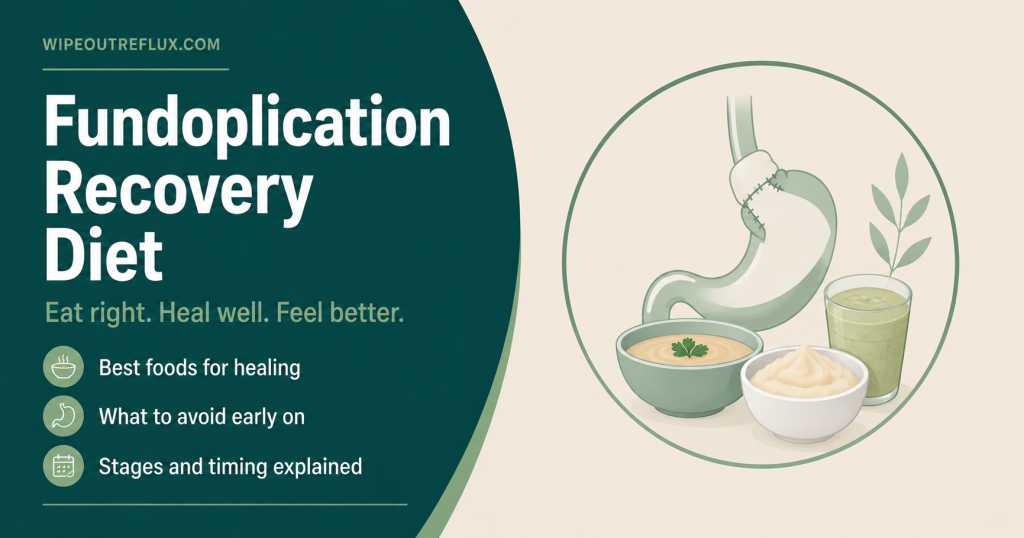
The fundoplication recovery diet moves through four stages over roughly six weeks: clear liquids for the first day or two, full liquids for the rest of week one, purees and very soft foods for weeks two and three, then a gradual return to normal food from around week four to six. The exact timings vary between surgeons, and yours will give you a specific plan — follow theirs over anything you read online, including this.
The reason for the staging is simple. Your new wrap is swollen. In a diary study of 40 patients who had no swallowing problems before surgery, 93% developed some dysphagia afterwards, starting one to two days post-op, worst in the first couple of weeks, and gone in nearly everyone by five to six weeks [Funch-Jensen et al., Scandinavian Journal of Gastroenterology, 2007]. The diet is timed to that swelling curve.
Here’s something no other article on this will tell you, and you should know it: there has never been a trial comparing the staged diet with just eating normally after fundoplication. Not one. The schedule you’ll be given is expert consensus and institutional habit, built on sound physiological reasoning, but it isn’t trial-derived. That doesn’t mean ignore it — the reasoning is good and the downside of getting it wrong is serious. It does mean you should understand the principles rather than treating a printed handout as gospel, because the principles are what let you make sensible decisions when your specific situation doesn’t match the leaflet.
Key Takeaways
- Four stages over about six weeks: clear liquids, full liquids, puree/soft, then normal food.
- Early dysphagia is near-universal (93% in one diary study) and resolves in nearly everyone by five to six weeks — it is not a sign the operation failed [Funch-Jensen et al., Scandinavian Journal of Gastroenterology, 2007].
- The single most important rule is do not vomit or retch. Early post-operative vomiting is a documented risk factor for the wrap slipping or herniating into the chest [Soper et al., Annals of Surgery, 1999].
- Long-term, persistent dysphagia is uncommon: 2% at a median of four years in a series of 350 patients, with 2% needing a dilatation [Nikolic et al., Surgical Endoscopy, 2019].
- Expect to lose weight — an average of 3.9kg, mostly in the first three months, then it plateaus with no rebound [Neumayer et al., Surgical Endoscopy, 2005].
- Gas-bloat and difficulty belching are the trade-off, and they’re commoner after a full Nissen than a partial wrap [Broeders et al., British Journal of Surgery, 2010].
- The “avoid bread and rice” advice is clinical folklore — mechanistically sensible, but never actually tested after fundoplication.
- New chest pain, persistent vomiting or an inability to swallow your own saliva means phone your surgical team the same day.
Why the Diet Is Staged: What’s Actually Happening in There
Understanding this makes the whole six weeks much easier to navigate, because you’ll know what you’re working around.
In a fundoplication, your surgeon has wrapped the top of your stomach around the bottom of your oesophagus and stitched it in place — 360 degrees in a Nissen, 270 in a Toupet, 180 in an anterior Dor. They’ve also pulled the junction back down into your abdomen and stitched the diaphragm closed behind it. There’s more on the differences in my article on Nissen vs Toupet fundoplication.
Two consequences follow, and each drives a different part of the diet.
1. The wrap is swollen
Freshly handled and sutured tissue swells. That swelling narrows the passage through the wrap. This is why solid food that would sail through a normal oesophagus can stick in week one, and why the sensation improves steadily as the weeks pass.
I’ll be straight that this mechanism is standard surgical teaching rather than something anyone has measured — no study has imaged wrap oedema and matched it against dysphagia resolution. But the timeline fits it exactly. Funch-Jensen’s diary study found onset at day one to two, worst in the first weeks, and near-complete resolution by five to six weeks, which is precisely what a swelling-and-settling curve looks like [Funch-Jensen et al., Scandinavian Journal of Gastroenterology, 2007].
That same paper notes the reported frequency of post-fundoplication dysphagia across the literature ranges from 4% to 100%, depending entirely on how you ask. Which tells you how much of this is definitional.
2. The stitches are new
This is the serious one. The wrap and the crural repair are held by sutures that need weeks to be reinforced by scar tissue. A sudden violent rise in abdominal pressure before that happens can pull the repair apart or push the wrap up through the hiatus into the chest.
The evidence is consistent. In 290 laparoscopic antireflux operations, anatomical fundoplication failure occurred in 7%, mostly intrathoracic migration of the wrap, and early post-operative vomiting was among the factors correlating with failure [Soper et al., Annals of Surgery, 1999]. A case-control study of hiatal hernia recurrence found vomiting carried an odds ratio of 4.94 and heavy lifting 3.66 [Kakarlapudi et al., Hernia, 2002]. And in a prospective series of 104 foregut operations, one patient who vomited on the ward had an acute wrap herniation into the chest and went straight back to theatre [Bradshaw et al., Surgical Endoscopy, 2002].
So the real purpose of the early liquid diet isn’t nutrition. It’s to make vomiting as unlikely as possible while the repair is at its most fragile. Liquids don’t get stuck, don’t overfill the stomach, and don’t provoke retching. Every rule that follows — small portions, sip don’t gulp, chew to mush, stop before you’re full — is downstream of that single objective.
Same reasoning applies to your anti-sickness medication. Take it. Nausea is common after this operation: one series found 30% nauseated in recovery and 60% on the ward [Bradshaw et al., Surgical Endoscopy, 2002]. Getting on top of nausea before it becomes vomiting is not a comfort measure here. It’s protecting the repair.
The Week-by-Week Diet
What follows is a typical schedule. Different units run different timings — some keep you on liquids for two weeks, some move to soft food after a few days. If your surgeon’s plan differs from this, theirs wins, because they know what they did to your anatomy.
Days 1–2: Clear liquids
Anything you can see through. Water, clear broth or consommé, weak tea without milk, diluted squash, ice lollies, clear jelly.
Sip. A few mouthfuls every fifteen minutes or so rather than a glass at a time. You’ll feel full remarkably fast — your stomach’s upper portion is now doing a different job and the wrap sits where it used to expand.
Avoid anything fizzy. Gas can’t escape upwards past a fresh wrap.
You may notice liquids feel like they’re “sitting” behind your breastbone, or go down with an odd pressure. Normal.
Days 3–7: Full liquids
Anything smooth and pourable. Smooth soups (blended and sieved, no bits), milk, yoghurt drinks, smooth yoghurt, custard, thin porridge, protein shakes, milky coffee, strained cream soups.
This is the stage where nutrition starts to matter, because you’re likely eating very little. Aim for something every two to three hours rather than three “meals”. Getting protein in matters more than calories at this point — milk, yoghurt, and a protein shake once or twice a day will carry you.
Watch the temperature. Very hot and very cold liquids can both provoke spasm in a freshly handled oesophagus. Lukewarm is easiest.
My reflux-friendly soup recipes work well here if you blend them properly smooth — they’re already built to be low-acid and low-fat, which is what you want.
Weeks 2–3: Puree and very soft
Now you can have texture, as long as it needs no real chewing and has no lumps: mashed potato with plenty of butter or milk, scrambled egg, pureed vegetables, well-mashed banana, hummus, soft flaked white fish, cottage cheese, smooth nut butters, thick porridge, minced meat in plenty of gravy.
Rules that matter more than the food list:
- Small portions. Think a side plate, not a dinner plate. Five or six small meals beats three normal ones.
- Slowly. Twenty to thirty minutes per meal. Put the fork down between mouthfuls.
- Moisture. Dry food is what sticks. Sauce, gravy, stock, yoghurt — everything should be lubricated.
- Stop early. The instant you feel full, stop. Not one more bite. Overfilling is what causes retching.
- Sit up for 30 minutes afterwards. Don’t lie down on a full stomach.
- Drink between meals, not with them. Liquid takes up room you need for food.
Smoothies are useful in this window — reflux-friendly smoothie recipes give you calories and protein without anything to chew. Skip anything citrus or tomato-based while your oesophagus is still irritated.
Weeks 4–6: Soft solids and reintroduction
Add things back one at a time, so if something causes trouble you know what it was. Soft-cooked vegetables, tender chicken or fish, pasta, soft fruit without skins, well-cooked rice with sauce, eggs any way, soft cheese.
Keep the pace and portion rules. They matter far longer than the texture rules.
Chewing genuinely matters now. Your wrap has narrowed the margin for error on bolus size, so food needs to arrive as close to a paste as you can get it. This isn’t just post-op advice — chewing food properly helps reflux generally, and it becomes non-negotiable after a fundoplication.
If something sticks, don’t panic and don’t try to force it down with a big gulp of water. Stand up, walk around, sip warm water slowly, and wait. It nearly always passes within a few minutes.
Week 6 onwards: Normal food, carefully
Most people are eating essentially normally by six to eight weeks. Bread, steak and raw salad tend to be the last three things to come back, and it’s reasonable to leave them until you’ve had a couple of easy weeks on everything else.
Long term, the outlook is good. In a series of 350 patients followed for a median of four years, the median alimentary satisfaction score was 9 out of 10 [Nikolic et al., Surgical Endoscopy, 2019].
The Foods Everyone Tells You to Avoid — and What the Evidence Says
Every hospital handout names the same suspects: bread, rice, tough meat, stringy vegetables, skins and pips, fizzy drinks.
I went looking for the studies behind that list. There aren’t any. No published research identifies which specific foods cause post-fundoplication dysphagia, and nothing compares bread against rice against steak in this population. It’s clinical folklore — accumulated from what patients report back to surgeons, never formally tested.
That’s not a reason to ignore it. The reasoning is sound, and it generalises from what we know about mechanical narrowing from any cause. Fresh bread forms a dense, sticky, poorly lubricated bolus that resists being broken up. Rice separates into hundreds of individual grains that don’t move as one. Tough meat needs peristaltic force that a swollen wrap makes harder to generate. Stringy vegetables like celery and asparagus don’t break down. Skins and pips are small hard objects in an otherwise soft bolus.
So the principle, rather than the list, is: dry, dense, fibrous, or made of many separate pieces is harder work than moist, soft and cohesive. Use that to judge foods that aren’t on anyone’s list. Toasted bread is easier than fresh. Risotto is easier than boiled rice. Slow-cooked shin of beef is easier than a steak.
Carbonated drinks are a separate case with better logic behind them. A competent wrap stops gas venting upwards, so the CO2 has nowhere to go except onwards — which produces bloating and discomfort. Nobody has tested whether avoiding fizzy drinks reduces gas-bloat after fundoplication, but the mechanism is about as clear as mechanisms get.
Gas-Bloat: The Trade-Off Nobody Prepares You For
A wrap that stops acid coming up also stops gas coming up. That’s not a complication, it’s the mechanism working — but it’s the thing patients find most surprising.
Symptoms are bloating, abdominal distension, excess flatulence, and the horrible feeling of needing to burp and being unable to. In the LOTUS randomised trial, at five years bloating affected 40% of surgical patients versus 28% on esomeprazole, and flatulence 57% versus 40% [Galmiche et al., Journal of the American Medical Association, 2011]. Those are randomised numbers, which makes them more trustworthy than most figures in this area.
How much you get depends partly on your wrap. A meta-analysis of seven randomised trials found Nissen carried significantly more gas bloating than Toupet (relative risk 1.58) and more than double the rate of inability to belch (relative risk 2.04), with no difference in acid control [Broeders et al., British Journal of Surgery, 2010]. Comparing Nissen with an anterior 180-degree wrap at one year, gas bloating was 18% versus 11% and inability to belch 31% versus 19% [Broeders et al., Annals of Surgery, 2013].
It also depends on how much air you swallow. In a study of patients who had pre-existing aerophagia before surgery, those who got a Toupet had significantly less troublesome gas bloat and fullness at three months than those who got a Nissen [Granderath et al., Digestive and Liver Disease, 2007]. Which points at the one part of this you control.
Practical things that reduce swallowed air: eat slowly with your mouth closed, don’t talk while chewing, don’t use straws, skip chewing gum and boiled sweets, avoid fizzy drinks, and don’t gulp. If you’re a habitual air-swallower — and a lot of reflux patients are, because swallowing relieves throat symptoms — this is worth working on deliberately. There’s more in my article on acid reflux and gas.
For most people gas-bloat eases over the first six to twelve months as the wrap softens and you unlearn the habits.
You Will Lose Weight, and That’s Expected
In 213 patients followed after laparoscopic Nissen, mean BMI fell from 27.6 to 26.0, an average loss of 3.9kg. Almost all of it happened in the first three months, and at twelve months there was neither further loss nor rebound [Neumayer et al., Surgical Endoscopy, 2005].
Two details from that study are worth knowing. Heavier patients lost more than lean ones, so if you’re slim to begin with you’ll probably lose less. And there was no association between weight loss and dysphagia — meaning this isn’t simply people who can’t swallow. It’s smaller portions, earlier fullness, and less grazing.
The weight loss is a side effect, not a goal. If you’re losing steadily past three months, or you’re underweight, ask for a dietitian referral rather than assuming it’s normal. There’s more on the general relationship in my article on acid reflux and weight loss.
When to Call Your Surgical Team
Most of what happens in the first few weeks is expected. These are the things that aren’t.
- You can’t swallow your own saliva. Complete obstruction. Same day, no waiting.
- Persistent vomiting or retching. Both a warning sign and a cause of further damage. Call.
- New chest pain, especially epigastric or behind the breastbone. In Soper’s series, new-onset epigastric or substernal chest pain “frequently heralded fundoplication failure” [Soper et al., Annals of Surgery, 1999]. Take it seriously.
- Sudden severe breathlessness with upper abdominal pain. Can indicate acute herniation of the wrap into the chest. Emergency.
- Fever, or increasing rather than decreasing abdominal pain.
- Dysphagia that’s getting worse rather than better after week three, or that hasn’t improved at all by week six.
Persistent dysphagia is usually managed with endoscopic dilatation, and it’s not common — 2% of 350 patients needed one at a median of four years [Nikolic et al., Surgical Endoscopy, 2019]. Partial wraps need dilatation less often than full ones; the pooled relative risk for Nissen versus Toupet was 2.45 [Broeders et al., British Journal of Surgery, 2010].
What Happens After the Six Weeks
People ask two questions at this point: will I eat normally again, and will the reflux come back?
Mostly yes to the first. Median alimentary satisfaction of 9 out of 10 at four years is a good result [Nikolic et al., Surgical Endoscopy, 2019]. But a meta-analysis of 1,334 patients at a mean of 13 years found 26% still reported some dysphagia and 53% some gas-bloating — alongside 87% satisfaction and 87% saying they’d have the operation again [Principe et al., Annals of Surgery, 2026]. Both things are true at once. Most people are glad they did it and most people have some residual quirk about how they eat.
On the second question: in that same long-term meta-analysis, heartburn fell from 94.2% before surgery to 33.7% after, symptom recurrence ran at 17%, and 24% were back on a PPI. Reoperation was needed in 6%. At medium term the picture is better — 83% PPI-free at four years [Nikolic et al., Surgical Endoscopy, 2019].
So a fundoplication is very good, and it is not permanent immunity. Which is worth holding on to as you come out of the recovery weeks: the surgery has bought you a rebuilt barrier, and how long that barrier lasts depends partly on how hard you make it work. Sticking with reflux-aware eating — meal timing, portion size, keeping the worst trigger foods occasional rather than routine — is the difference between the wrap coping easily for twenty years and it being asked to hold back a nightly flood. That’s the case for staying on something structured like the Wipeout Diet Plan once you’re eating normally again, rather than treating week six as the finish line.
Conclusion
The fundoplication recovery diet is less complicated than the handouts make it look. Four stages, six weeks, and one overriding objective: don’t let anything happen that makes you vomit while the stitches are still new. Small portions, slow eating, thorough chewing, plenty of moisture, stop before you’re full, stay upright afterwards. Get those six habits right and the specific food lists barely matter. Expect dysphagia in the early weeks — nearly everyone gets it and nearly everyone is over it by week six — expect to lose a few kilos, and expect gas to behave differently from now on.
What matters more is what you do after the six weeks are up. A fundoplication rebuilds the barrier; it doesn’t change what you send at it. Roughly a quarter of patients are back on a PPI a decade later, and while some of that is the wrap loosening, some of it is going straight back to the eating patterns that caused the problem in the first place. This is where the Wipeout Diet Plan is worth your time — it’s a full structured programme for reducing reflux at source, built around meal timing, portion size and the foods that actually drive reflux events, all of which happen to be exactly the habits that protect a fundoplication too. I designed it first and foremost for LPR, the throat-based silent reflux that’s hardest to shift, but because it works on the same underlying mechanisms it’s just as effective for GERD, heartburn and classic acid reflux.
Alongside it, the Wipeout Food Reference Guide is the essential everyday companion — a straight lookup of which foods and drinks are safe with acid reflux and LPR, with the pH of each, which is genuinely useful in the reintroduction weeks when you’re adding foods back one at a time and want to know which are gentle before you test them.
Follow your surgeon’s plan for the six weeks. Then build the habits that mean you only ever need this operation once.
Frequently Asked Questions
How long until I can eat normally after fundoplication?
Most people are eating essentially normally by six to eight weeks, with bread, steak and raw salad usually the last things to return. Early dysphagia resolved in nearly all patients by five to six weeks in a detailed diary study, which is why most protocols run to about six weeks.
What happens if I eat solid food too soon?
Most likely, food sticks and you feel uncomfortable for a few minutes. The real concern is the chain that follows: stuck food causes retching, and retching raises abdominal pressure sharply against fresh sutures. Early post-operative vomiting is a documented risk factor for the wrap slipping or herniating. One episode of accidentally eating something soft won’t undo the surgery, but the reason for caution is genuine.
Why can’t I burp after fundoplication?
Because the wrap works in both directions. It stops stomach contents going up, and gas is stomach contents. Inability to belch affects roughly a third of Nissen patients at one year and about a fifth after an anterior partial wrap. It usually eases over the first six to twelve months. Reducing swallowed air — slower eating, no straws, no gum, no fizzy drinks — is the main thing that helps.
Is it normal to lose weight after fundoplication?
Yes. Average loss is around 3.9kg, almost entirely in the first three months, and it then plateaus without rebounding. Heavier patients lose more. If you’re still losing after three months or you’re becoming underweight, ask for a dietitian.
Can I drink coffee or alcohol after fundoplication?
Coffee, once you’re on full liquids — milky and not too hot is easiest early on. Alcohol is best left until you’re eating normally and off strong painkillers; beer and prosecco are poorly tolerated for longer because of the carbonation. Both are reflux triggers in their own right, so the more relevant question is whether you want them back at all.
How much weight can I lift after surgery?
Ask your surgeon, but the usual advice is nothing heavier than about 5kg for four to six weeks. Heavy lifting carried an odds ratio of 3.66 for hiatal hernia recurrence in one case-control study — the same abdominal-pressure mechanism as vomiting.
Will I need to take a PPI again after fundoplication?
Possibly, eventually. At around four years, 83% of patients are PPI-free. At a mean of 13 years, 24% are back on one. That’s still a large majority off medication long term, but it isn’t a guarantee.
Is the staged diet actually necessary?
Nobody knows, and it’s worth saying so. There’s no randomised trial comparing a staged diet with normal eating after fundoplication — the schedule is expert consensus built on solid physiological reasoning about oedema and suture healing. Given that the failure mode is wrap herniation requiring repeat surgery, this is a case where following consensus while the evidence is absent is the sensible choice.
Research & References
- Funch-Jensen et al., Scandinavian Journal of Gastroenterology, 2007 — Daily dysphagia diaries from 40 consecutive laparoscopic Nissen patients with no pre-operative dysphagia. 93% developed dysphagia, 44% described it as annoying, onset was day one to two, and it resolved in nearly all patients by five to six weeks. Two patients needed a balloon dilatation.
- Nikolic et al., Surgical Endoscopy, 2019 — 350 consecutive standardised laparoscopic Nissen patients at a median of four years. Persistent dysphagia 2%, dilatation 2%, gas-bloat 12.7%, revision surgery 5%, median alimentary satisfaction 9 out of 10, and 83% PPI-free.
- Soper et al., Annals of Surgery, 1999 — 290 laparoscopic antireflux operations. Anatomical failure occurred in 7%, mostly intrathoracic migration of the wrap, with early post-operative vomiting among the correlated factors. New epigastric or substernal chest pain frequently heralded failure.
- Kakarlapudi et al., Hernia, 2002 — Case-control study of hiatal hernia recurrence after antireflux surgery. Vomiting carried an odds ratio of 4.94 and weight lifting 3.66; hiccoughing was not significant. Small and retrospective.
- Bradshaw et al., Surgical Endoscopy, 2002 — Prospective study of 104 laparoscopic foregut operations. Nausea affected 30% in recovery and 60% on the ward; one patient who vomited on the ward had acute wrap herniation into the chest requiring immediate reoperation.
- Broeders et al., British Journal of Surgery, 2010 — Meta-analysis of seven randomised trials, 404 Nissen versus 388 Toupet. Nissen had more dysphagia (relative risk 1.61), more dilatations (2.45), more gas bloating (1.58) and more inability to belch (2.04), with no difference in acid control or patient satisfaction.
- Broeders et al., Annals of Surgery, 2013 — Meta-analysis of five randomised trials, anterior 180-degree versus Nissen. At one year, gas bloating 11% versus 18%, flatulence 14% versus 25%, inability to belch 19% versus 31%, with lower dysphagia scores that persisted at five years.
- Granderath et al., Digestive and Liver Disease, 2007 — 56 GERD patients with pre-existing aerophagia allocated to floppy Nissen or Toupet. At three months, Toupet patients had significantly less impairing gas bloat, flatulence and postprandial fullness, and most retained the ability to belch.
- Neumayer et al., Surgical Endoscopy, 2005 — 213 laparoscopic Nissen patients. Mean BMI fell from 27.6 to 26.0, an average loss of 3.9kg, occurring in the first three months with no further change or rebound at twelve months, and no association between weight loss and dysphagia.
- Galmiche et al., Journal of the American Medical Association, 2011 — The LOTUS randomised trial, 554 patients across 11 European countries. At five years, surgery versus esomeprazole: acid regurgitation 2% versus 13%, dysphagia 11% versus 5%, bloating 40% versus 28%, flatulence 57% versus 40%.
- Principe et al., Annals of Surgery, 2026 — Meta-analysis of 12 studies and 1,334 patients at a mean follow-up of 13.1 years. Heartburn fell from 94.2% to 33.7%, symptom recurrence was 17%, PPI use 24%, dysphagia 26%, gas-bloating 53%, reoperation 6%, and 87% would have the operation again.
- Thomas et al., Journal of Laparoendoscopic and Advanced Surgical Techniques, 2011 — Systematic review of 13 cohort studies on day-case and 23-hour laparoscopic fundoplication. Same-day discharge succeeded in 93% with 5% readmission; dysphagia and pain were the commonest reasons for readmission.

David Gray
12 years living with LPR · Consultant & researcher
I've lived with LPR for twelve years — the misdiagnoses, the PPI courses that did nothing, the slow work of figuring out what actually helps. Wipeout Reflux is where I translate the research into plain terms for people stuck in the same place. Every claim here is sourced to peer-reviewed work, and I consult one-to-one with LPR sufferers.