
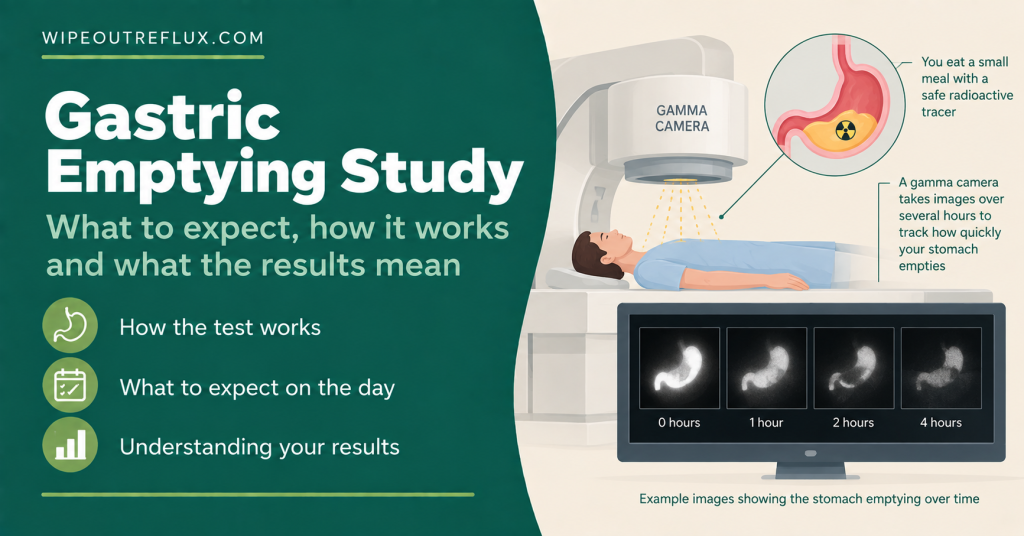
A gastric emptying study measures how fast food leaves your stomach. You eat a standardized radiolabeled meal, a gamma camera takes pictures at intervals over four hours, and the report tells you what percentage of that meal was still sitting in your stomach at each time point.
The number that matters most is the four-hour one. More than 10% of the meal still in your stomach at four hours is delayed emptying. Under 10% is normal. At two hours, normal is roughly 30–60% remaining, and more than 60% is delayed. If less than 30% is left at one hour, your stomach is emptying too fast, which is a separate problem with its own causes [Abell et al., Journal of Nuclear Medicine Technology, 2008].
That’s the short version. The longer version — what the percentages actually mean for how you feel, why a “normal” result doesn’t mean nothing is wrong, and what delayed emptying does and doesn’t do to reflux — is what the rest of this article covers. I’ve had a lot of readers arrive at a consult call holding one of these reports with no real explanation of it, so let’s go through it properly.
Key Takeaways
- The test is scintigraphy: a radiolabeled egg-white meal, then images at 0, 1, 2 and 4 hours. It’s the standard way to measure gastric emptying.
- Delayed emptying is defined as more than 10% of the meal retained at four hours, or more than 60% at two hours.
- Rapid emptying — less than 30% retained at one hour — is the result most people have never heard of, and it causes its own symptoms.
- The four-hour images are the ones that count. A two-hour-only study is a weaker test and misses cases.
- You’ll need to stop prokinetics, opioids, antiemetics, cannabis and some neuromodulators for around 48 hours beforehand, or the result measures the drug rather than your stomach.
- Feeling sick during or after the test is common and expected — a 255-calorie meal on an empty stomach is exactly the challenge that provokes symptoms in someone whose stomach empties slowly.
- How delayed the emptying is correlates only loosely with how bad you feel. A mild delay with severe symptoms is a real and recognized pattern.
- Delayed emptying is common in people with reflux, but it does not reliably explain reflux — and treating it is not guaranteed to fix your symptoms.
How the test is done
The formal name is gastric emptying scintigraphy, which is why the appointment letter often says nuclear medicine. Nothing is injected. The radioactivity is in the food.
The standardized protocol uses a deliberately dull meal: four ounces of liquid egg white, two slices of white bread, 30g of jam and water. That comes to 255 calories, 72% carbohydrate, 24% protein and only 2% fat. The egg white is mixed with technetium-99m sulfur colloid before cooking, which binds to the solid protein and stays with it as it moves through the stomach [Abell et al., Journal of Nuclear Medicine Technology, 2008].
The low fat content isn’t an accident. Fat slows gastric emptying in everyone, so a fatty test meal would produce delayed results in perfectly normal stomachs. The meal is designed to be boring precisely so the numbers mean something.
You eat it within about ten minutes, and you need to eat all of it — partial meals throw the reference values off. Then you stand or sit at the gamma camera for a one-minute image from the front and the back. That first image is time zero, and everything afterwards is expressed as a percentage of it. You come back for the same brief image at one hour, two hours and four hours.
Between images you’re free. Most units let you sit in the waiting area, read, or walk around the hospital. You can’t eat or drink anything other than small sips of water, because more food restarts the clock on the measurement.
The radiation dose is modest — comparable to other routine nuclear medicine studies and far below the level at which risk becomes a practical concern. It’s the reason the test isn’t done in pregnancy, but for everyone else it’s a non-issue.
How to prepare
Preparation matters more here than for most tests, because several common medications directly change the thing being measured.
- Fasting. Nothing to eat for at least six to eight hours, so the test is usually first thing in the morning.
- Medications to stop, usually 48 hours before. It’s customary to stop opioids, cannabinoids, prokinetics, antiemetics and neuromodulators before the test [Camilleri et al., American Journal of Gastroenterology, 2022]. That covers codeine and other opiates, cannabis in any form, metoclopramide, domperidone, erythromycin used as a prokinetic, ondansetron, and drugs like amitriptyline. Anticholinergics slow the stomach too. Check with the unit rather than guessing — and never stop a prescribed medication without asking the prescriber first.
- Blood sugar, if you have diabetes. Acute hyperglycemia slows gastric emptying by itself, so a high reading on the day can manufacture a delayed result. Most units want glucose reasonably controlled before they’ll start, and many use a cutoff around 275 mg/dL (15 mmol/L).
- Acid suppression. PPIs and H2 blockers are generally fine to continue — they aren’t what’s being measured. Confirm with your unit, but you usually won’t need to interrupt them.
- Smoking. Nicotine slows emptying. Don’t smoke on the morning of the test.
- Timing in your cycle. Gastric emptying is slower in the luteal phase, and some units schedule women in the first ten days of the cycle where practical.
The single most common way this test gets wasted is someone taking their usual anti-nausea or pain medication that morning out of habit. If you’ve taken something, say so before you eat the meal, not after.
How long it takes, and why four hours matters
Plan for a five-hour hospital visit. The meal takes ten minutes, each image takes a couple of minutes, and the rest is waiting.
A lot of people ask whether they can leave after two hours, and some units historically stopped there. Don’t, if you can avoid it. The consensus protocol calls for imaging out to four hours as a minimum standard, and the reason is straightforward: a meaningful group of people have entirely normal-looking two-hour images and clearly abnormal four-hour retention [Abell et al., Journal of Nuclear Medicine Technology, 2008]. The ACG guideline takes the same position — emptying should be assessed out to four hours unless more than 90% of the meal has already cleared by three [Camilleri et al., American Journal of Gastroenterology, 2022].
If you’re offered a two-hour study, it’s worth asking whether the four-hour protocol is available. A shortened test that comes back normal doesn’t settle the question.
You should also know the alternatives exist, because not everyone can manage four hours in a nuclear medicine department. The gastric emptying breath test uses a meal labeled with non-radioactive carbon-13 and measures it in your breath, and the wireless motility capsule is a swallowed device that tracks transit through the whole gut. Both are validated alternatives to scintigraphy, though availability varies a lot by country and center.
Reading your results: normal vs abnormal
Here are the reference values the standard protocol is built on. These come from healthy volunteers studied across multiple centers with this exact meal, which is why the meal is so rigidly specified [Tougas et al., American Journal of Gastroenterology, 2000].
- 1 hour: normal is 37–90% of the meal still in the stomach. Over 90% retained is delayed. Under 30% retained is rapid.
- 2 hours: normal is 30–60% retained. Over 60% is delayed.
- 4 hours: normal is 0–10% retained. Over 10% is delayed.
Those are from the joint consensus recommendations [Abell et al., Journal of Nuclear Medicine Technology, 2008]. A few things follow from them that reports rarely explain.
The four-hour value is the headline. If your report says 18% at four hours, that’s delayed emptying regardless of what the earlier images looked like. Anything at or under 10% at four hours is a normal study.
Severity grading is by four-hour retention too. Broadly: 10–15% is mild, 15–35% moderate, and above 35% severe. Useful context, but see the next point before you read too much into it.
The grade doesn’t predict how you feel. This is the part worth internalizing. Across the published evidence, the association between measured emptying delay and actual upper gut symptoms is real but modest [Vijayvargiya et al., Gut, 2019]. When the test is done with the full four-hour protocol, delayed emptying does track with nausea, vomiting, abdominal pain and early fullness, but the odds ratios sit between roughly 1.5 and 2.0 — an association, not a one-to-one relationship [Camilleri et al., American Journal of Gastroenterology, 2022]. Mild retention with miserable symptoms is common. So is severe retention in someone coping reasonably well.
A rapid result is not a lab error. Less than 30% retained at one hour means accelerated emptying, and it’s picked up more often than people expect — in one comparison, scintigraphy identified rapid emptying in 13.8% of patients tested [Camilleri et al., American Journal of Gastroenterology, 2022]. It produces post-meal nausea, bloating, cramping, sweating and diarrhea, and it’s seen after gastric surgery, in diabetes, and sometimes with no identifiable cause at all. The management is close to the opposite of the gastroparesis advice, which is why the distinction matters.
A normal study doesn’t mean nothing is wrong. Gastric emptying is one variable. How well the upper stomach relaxes to accommodate a meal, and how sensitive your gut is to normal distension, are separate mechanisms that scintigraphy doesn’t measure at all. Plenty of people with genuine functional dyspepsia have textbook-normal emptying.
Feeling sick during or after the test
This barely gets mentioned beforehand, and it catches people out: a lot of people feel distinctly unwell during the study, and worse in the hours afterwards.
The mechanism is not mysterious. You’ve fasted overnight, come off whatever medication was keeping the nausea manageable for two days, and then eaten a 255-calorie solid meal in ten minutes. If your stomach empties slowly, that meal is still sitting there at hour two and hour four — which is the entire point of the test. Nausea, fullness, bloating, upper abdominal ache and sometimes vomiting are the predictable consequence of deliberately provoking the system you came in to have measured.
A few practical things help:
- Don’t drive yourself if you’re a known vomiter. Bring someone, or plan on a taxi.
- Walk between images if you can. Gentle movement is more comfortable than sitting hunched, and walking after meals is a reasonable thing to be doing anyway.
- Tell the technologist if you vomit. If you bring the meal back up, a meaningful amount of the tracer goes with it and the study may not be interpretable. Better to stop and rebook than to get a meaningless number.
- Expect a rough evening. Restart your usual medication once the last image is done, unless you’ve been told otherwise, and eat small and low-fat for the rest of the day.
- Reflux symptoms often flare afterwards. A large fasted meal in a stomach that’s slow to empty is a reliable way to provoke both heartburn and throat symptoms. If you get a bad night of it, that’s the test, not a deterioration.
The flip side: symptoms during the test are information. Units increasingly record what you felt and when, and a report that pairs 30% four-hour retention with “severe nausea and fullness from hour two” says considerably more than the percentage on its own.
What delayed emptying means for your reflux
Here’s where I’d push back on how this test often gets framed. The intuitive story is simple: food sits in the stomach, pressure builds, the stomach stays full and distended for longer, transient relaxations of the lower esophageal sphincter become more frequent, and more stomach contents end up in your esophagus and throat. That mechanism is real, and delayed emptying genuinely is more common in people with reflux than in people without it. It’s why gastroparesis and acid reflux so often turn up in the same person.
But the evidence that fixing the emptying fixes the reflux is a lot weaker than that story suggests. A 2025 study measured gastric emptying, esophageal motility and 24-hour pH-impedance in 74 patients with severe lung disease. Delayed emptying was present in 27% of them — and it was not associated with greater acid exposure time, greater total bolus exposure, or more reflux events. The authors concluded delayed emptying had little effect on reflux in any of the disease groups studied [Bradley et al., Gastro Hep Advances, 2025].
That’s one population, and it doesn’t mean delayed emptying never matters. What it means is that finding it on a scan doesn’t automatically make it the cause of your symptoms. If you have both, you have two problems that often travel together, and each may need addressing on its own terms.
The practical implications:
- Prokinetics are worth a conversation, not a guarantee. If emptying is genuinely delayed, speeding it up is a rational target — but the drugs have real limitations and side-effect profiles. I’ve gone through them in detail in prokinetics for acid reflux.
- Meal size and composition do more heavy lifting than people expect. Smaller, lower-fat, lower-volume meals reduce both the emptying burden and the reflux burden simultaneously. This is where the two problems overlap most usefully, and it’s the core of what the Wipeout Diet Plan structures for you.
- Timing matters more if you empty slowly. The standard advice to leave three hours between your last meal and lying down is a minimum for a normal stomach. With documented delayed emptying, four is more realistic — see how long before bed you should stop eating.
- Surgery calculations change. Anyone considering a fundoplication should have gastric emptying and esophageal motility on the table beforehand, alongside esophageal manometry. Wrapping the top of a stomach that empties poorly at the bottom can trade one set of symptoms for another.
The GLP-1 factor
This is the part the hospital handout won’t cover, and it’s now one of the commonest reasons a gastric emptying study gets ordered in the first place.
GLP-1 receptor agonists — semaglutide, liraglutide, tirzepatide and the rest — work partly by slowing gastric emptying. That’s not a side effect; it’s a mechanism of action. A meta-analysis of the scintigraphy data found they lengthen the half-emptying time of a solid meal by a pooled average of 36 minutes, from about 95 minutes to about 138 minutes, with no significant difference between short- and long-acting agents. Liquid emptying wasn’t significantly affected [Hiramoto et al., American Journal of Gastroenterology, 2024].
Two honest conclusions come out of that. First, the average delay is modest — considerably smaller than the internet’s “these drugs cause gastroparesis” framing implies. Second, an average is not an individual, and a minority of people on these drugs do experience marked delay with genuinely severe symptoms.
What follows for you practically: if you’re on a GLP-1 and having a gastric emptying study, the result largely reflects the drug. That’s fine if the question is “how much is this medication slowing me down”, and close to useless if the question is “do I have underlying gastroparesis”. Make sure everyone involved knows which question is being asked, and that the drug is on the record. I’ve covered the reflux side of these medications in GLP-1 drugs and silent reflux and whether Ozempic causes heartburn and reflux.
If your result is normal but you still feel awful
This is a common and demoralizing place to end up, and it doesn’t mean the symptoms are imagined. It means the delay isn’t the explanation, and something else is.
Worth considering next:
- Impaired gastric accommodation or visceral hypersensitivity. The stomach fails to relax properly for a meal, or normal distension is perceived as painful. Scintigraphy measures neither. This is the territory of functional dyspepsia.
- Non-acid reflux. If your symptoms are throat-based — hoarseness, throat clearing, a lump sensation — acid tests can miss the problem entirely. pH-impedance testing catches reflux events that a pH probe alone doesn’t.
- Rumination syndrome. Effortless regurgitation within minutes of eating, very commonly misread as reflux or gastroparesis for years before anyone names it. Worth reading rumination syndrome if that pattern sounds familiar.
- Esophageal rather than gastric motility. Slow clearance in the esophagus itself produces regurgitation and chest symptoms with a perfectly normal stomach. That’s what esophageal motility testing looks at.
- Small intestinal bacterial overgrowth. Bloating and fullness after meals with normal gastric emptying is a classic presentation of SIBO.
For the wider map of which test answers which question, how acid reflux is diagnosed lays out the sequence.
Conclusion
A gastric emptying study answers a narrow question well: how much of a standard meal is still in your stomach after four hours. Over 10% is delayed, under 10% is normal, and less than 30% remaining at one hour means you’re emptying too fast. Get the four-hour protocol, stop the medications that distort it, and have the result read alongside what you actually felt during the test rather than as a number in isolation.
What the test won’t tell you is what to do next, and that’s where most people get stuck. Delayed emptying and reflux overlap constantly, but the evidence that one drives the other is far weaker than the explanation you’ll usually be given — which means chasing the emptying number alone often leaves the symptoms exactly where they were.
The approach that does move both is changing what arrives in the stomach and when. Smaller meals, lower fat, lower volume, the right timing before you lie down, and steadily reducing the acid and pepsin load your throat and esophagus are exposed to. That’s the whole design of the Wipeout Diet Plan — a structured, week-by-week program covering what to eat, how to sequence meals and sleep, how to bring the reflux burden down, and how to taper acid suppression safely when the time is right. I built it first and foremost around LPR, the throat-based form that’s hardest to shift, but because it works on the same underlying mechanisms it’s just as effective for GERD, heartburn and classic acid reflux — including when slow emptying is part of the picture.
If you want an easier starting point, the Wipeout Food Reference Guide is the essential companion — every food and drink that matters for acid reflux and LPR, with its pH, so you can make better choices from your next meal onward.
Frequently Asked Questions
What is a normal gastric emptying study result?
Normal is 10% or less of the meal remaining at four hours. At two hours, normal is roughly 30–60% remaining, and at one hour, 37–90%. Anything above 10% at four hours is reported as delayed emptying.
What does an abnormal 4-hour gastric emptying result mean?
More than 10% retention at four hours means your stomach is emptying more slowly than normal. Severity is usually graded as mild (10–15%), moderate (15–35%) or severe (over 35%). It confirms a delay — it doesn’t identify the cause, which could be diabetes, medication, previous surgery, a viral illness or, most often, no identifiable cause at all.
How long does a gastric emptying study take?
Four hours of imaging, so plan for around five hours at the hospital. Images are taken immediately after the meal and again at one, two and four hours, with waiting in between. Some centers still offer a two-hour version, but it misses cases that only show up on the four-hour images.
Why do I feel sick after a gastric emptying study?
Because the test is designed to provoke exactly that. You’ve fasted overnight, stopped your anti-nausea and prokinetic medication for 48 hours, then eaten a solid meal in ten minutes. If your stomach empties slowly, that meal is still there hours later. Nausea, bloating, fullness and a reflux flare that evening are common and usually settle within a day once you’re back on your normal medication and eating small, low-fat meals.
Can I drink water during a gastric emptying study?
Small sips are usually allowed, but check with the unit before you drink anything. You can’t eat, and you shouldn’t drink anything caloric, because it changes what’s being measured.
Does delayed gastric emptying cause acid reflux?
It contributes in some people, but it’s not a reliable explanation. Delayed emptying and reflux frequently coexist, yet studies measuring both directly have found that delayed emptying doesn’t consistently increase acid exposure or the number of reflux events. Treat it as one factor among several rather than the answer.
Should I stop my GLP-1 medication before a gastric emptying study?
Don’t stop it without talking to whoever prescribed it. These drugs slow solid emptying by design — around 36 minutes on the half-emptying time on average — so a study done on treatment is largely measuring the medication. Whether you pause it depends entirely on what question the test is meant to answer, so ask your specialist which one they’re asking.
Research & References
- [Abell et al., Journal of Nuclear Medicine Technology, 2008] — The joint American Neurogastroenterology and Motility Society and Society of Nuclear Medicine consensus protocol: the 255-calorie, 2% fat egg-white meal labeled with technetium-99m sulfur colloid, imaging at 0, 1, 2 and 4 hours, and the reference cutoffs used to report results (delayed emptying above 90% retention at 1 hour, 60% at 2 hours and 10% at 4 hours; rapid emptying below 30% retention at 1 hour).
- [Tougas et al., American Journal of Gastroenterology, 2000] — Multicenter study in healthy volunteers that established the international control values for gastric emptying of the standardized low-fat egg-white meal, which the normal ranges quoted on scan reports are based on.
- [Camilleri et al., American Journal of Gastroenterology, 2022] — The ACG clinical guideline on gastroparesis: scintigraphy as the standard test, imaging to four hours, customary 48-hour cessation of opioids, cannabinoids, prokinetics, antiemetics and neuromodulators, the associations between delayed emptying and nausea, vomiting, pain and early satiety when optimal methodology is used, and detection of rapid emptying in 13.8% of patients by scintigraphy.
- [Vijayvargiya et al., Gut, 2019] — Systematic review and meta-analysis of the association between delayed gastric emptying and upper gastrointestinal symptoms, finding a real but modest relationship between measured delay and symptom severity.
- [Hiramoto et al., American Journal of Gastroenterology, 2024] — Systematic review and meta-analysis quantifying the gastric emptying delay caused by GLP-1 receptor agonists: a pooled 36-minute increase in solid half-emptying time (138.4 vs 95.0 minutes), no significant delay in liquid emptying, and no significant difference between short- and long-acting agents.
- [Bradley et al., Gastro Hep Advances, 2025] — Study of 74 patients with severe respiratory disease assessed with gastric emptying scintigraphy, high-resolution impedance manometry and 24-hour pH-impedance: delayed emptying in 27%, with no association between delayed emptying and acid exposure time, total bolus exposure time or number of reflux events.

David Gray
12 years living with LPR · Consultant & researcher
I've lived with LPR for twelve years — the misdiagnoses, the PPI courses that did nothing, the slow work of figuring out what actually helps. Wipeout Reflux is where I translate the research into plain terms for people stuck in the same place. Every claim here is sourced to peer-reviewed work, and I consult one-to-one with LPR sufferers.