
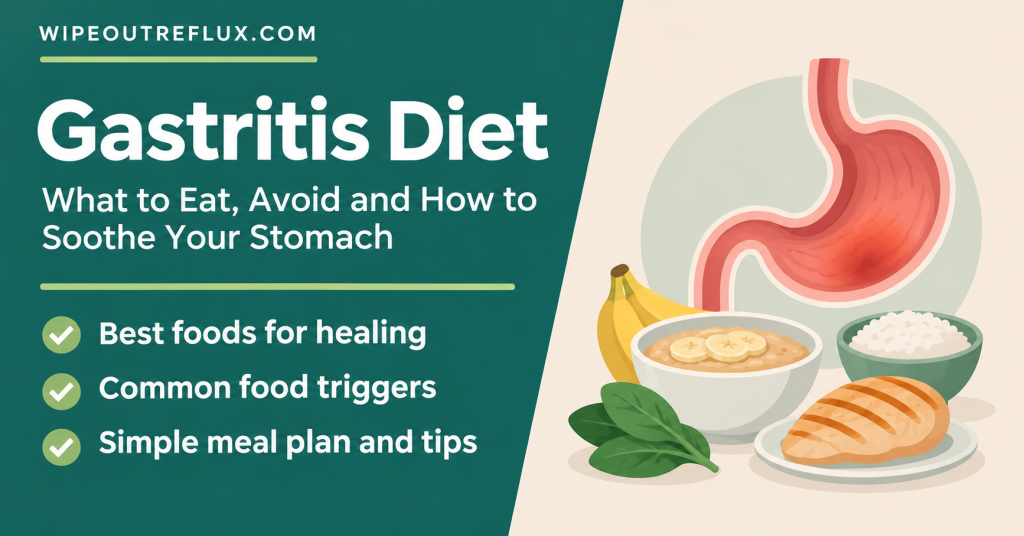
A gastritis diet is built on soft, bland, low-fat foods eaten in smaller portions. Good choices include oatmeal, rice, potatoes, bananas, eggs, lean chicken and fish, cooked vegetables and non-mint herbal teas. Cut back on the things that irritate an inflamed stomach lining: alcohol, NSAID painkillers, very fatty or fried food, and anything that obviously makes your symptoms worse. There’s no single diet that cures gastritis. Diet calms symptoms and gives the lining a better chance to heal, but the cause still needs dealing with.
That last point is where most gastritis diet advice falls short. Food lists help, but the most common cause of chronic gastritis worldwide is an infection, Helicobacter pylori, and no diet removes it. The second most common cause is a medicine cabinet problem: ibuprofen, naproxen and aspirin. So the most useful approach combines a bland eating plan for the flare with a clear look at what’s driving the inflammation.
Gastritis also overlaps heavily with reflux. Many people I work with have both, and the eating approach that settles an inflamed stomach is almost the same one that calms reflux. If you have throat symptoms as well, keep reading, because there’s one extra layer I’d add.
Key Takeaways
- Gastritis means inflammation of the stomach lining. The most common causes are H. pylori infection, NSAID painkillers and alcohol.
- A bland diet of soft, low-fat, non-spicy foods in smaller meals is the standard approach during a flare. It eases symptoms but doesn’t cure the cause.
- Foods that are usually well tolerated include oatmeal, white rice, potatoes, bananas, melon, eggs, skinless chicken, white fish, tofu, cooked vegetables and chamomile or ginger tea.
- The most important things to avoid are alcohol and NSAIDs such as ibuprofen, naproxen and aspirin, because both directly damage the stomach lining.
- Spicy food hasn’t been proven to cause gastritis, and one study linked higher chili intake with fewer ulcers. Avoid it during a flare if it burns, but you may not need to give it up forever.
- A high-salt diet is linked to chronic gastritis and its long-term complications, so cutting back on salty processed food is worthwhile.
- Broccoli sprouts and cranberry juice reduced H. pylori activity in small trials. They may support treatment but don’t replace it.
- If your gastritis comes with reflux or throat symptoms, choosing low-acid foods (pH above 5) protects your throat as well as your stomach.
Why Diet Matters With Gastritis (and Where It Stops)
Your stomach lining is protected by a layer of mucus and bicarbonate that keeps its own acid off the cells underneath. In gastritis that barrier is weakened and the lining is inflamed, so things it would normally shrug off begin to sting. These include large meals that stretch the stomach, fatty foods that sit there longer, alcohol, and acidic or spicy foods.
A bland diet works by lowering that load. Smaller, softer, lower-fat meals empty from the stomach more easily, stretch it less, and give the inflamed lining less to deal with.
However, food is rarely the original cause. The Kyoto global consensus classifies H. pylori gastritis as an infectious disease and recommends treating it, because the infection keeps the inflammation going for as long as it’s there [Sugano et al., Gut, 2015]. The latest Maastricht consensus goes further and recommends that everyone found to have H. pylori be offered treatment [Malfertheiner et al., Gut, 2022]. If you’ve never been tested, a breath test or stool test is simple. See H. pylori and acid reflux.
Think of the diet as what keeps you comfortable while the cause is treated, and what helps you stay well afterward.
Foods to Eat With Gastritis
These foods are soft, low in fat, not acidic and generally easy on an inflamed stomach. Not everyone tolerates every item, so treat this as a starting point.
Grains and starches
- Oatmeal made with water or a non-dairy milk. If oats bother you, see why oatmeal gives some people heartburn.
- White rice, plain noodles and pasta (without tomato sauce)
- Potatoes and sweet potatoes, boiled, baked or mashed without butter-heavy toppings
- Plain crackers, rice cakes and plain bread or toast
Proteins
- Skinless chicken or turkey, baked, poached or grilled
- White fish such as cod, haddock or tilapia
- Eggs, boiled, poached or scrambled with little fat (whites are gentler than yolks for some people)
- Tofu
Fruit and vegetables
- Bananas. Ripe ones are usually best tolerated. See are bananas acidic?
- Melon: cantaloupe, honeydew and watermelon
- Pears and papaya
- Cooked carrots, zucchini, green beans, squash, spinach and broccoli (cooked vegetables are gentler than raw)
Drinks and extras
- Water
- Chamomile tea and ginger tea. See my roundup of the best teas for acid reflux.
- Bone broth or clear chicken broth. See reflux-friendly soups.
- Manuka honey in small amounts
- Low-fat plain yogurt or kefir, if tolerated. These help some people but are acidic, so skip them if you also have throat symptoms.
Foods and Drinks to Avoid With Gastritis
The two that matter most: alcohol and NSAIDs
If you only change two things, change these. Alcohol directly damages the stomach’s protective barrier, and heavy drinking is a recognized cause of acute gastritis. Cutting it out completely during a flare is one of the fastest ways to feel better. See does quitting alcohol help reflux?
NSAIDs (ibuprofen, naproxen, high-dose aspirin) block the prostaglandins that keep the stomach’s mucus and blood flow working. They’re one of the main causes of gastritis and ulcers, and the American College of Gastroenterology has published specific guidance on reducing their stomach risks [Lanza et al., American Journal of Gastroenterology, 2009]. If you need a painkiller, acetaminophen (paracetamol) is gentler on the stomach. If you’re on low-dose aspirin for your heart, don’t stop it without talking to your doctor. See does ibuprofen cause reflux?
Foods that commonly aggravate symptoms
- Fried and very fatty foods: fries, fried chicken, fatty cuts of meat, creamy sauces, pastries. These slow stomach emptying.
- Coffee, including decaf for some people. It increases acid secretion and is a common trigger. See is coffee bad for reflux?
- Citrus fruit and juices: orange, grapefruit, lemon, lime
- Tomatoes and tomato sauces
- Carbonated drinks, which add pressure and bloating
- Salty processed foods: cured meats, chips, instant noodles, salty snacks (more on salt below)
- Very spicy food during a flare, though the evidence here is more nuanced than most lists suggest
The spicy food myth
Almost every gastritis list says “avoid spicy food”, but there’s surprisingly little evidence that chili damages the stomach. In one study of 103 peptic ulcer patients and 87 controls, people who ate more chili, both more often and in larger amounts, had about half the odds of having an ulcer (odds ratio 0.47) [Kang et al., Digestive Diseases and Sciences, 1995].
That doesn’t mean you should eat chili during a flare. Capsaicin can still make an already inflamed stomach burn. But if you enjoyed spicy food before, you probably don’t need to give it up for life once you’ve healed. Reintroduce it slowly and see how you react. For reflux the picture is different; see spicy food and acid reflux.
Why salt deserves more attention
Salt rarely appears on gastritis food lists, but it has a stronger long-term case against it than spice. In the classic model of how stomach cancer develops, chronic gastritis progresses to atrophy, then intestinal metaplasia, then dysplasia, and excessive salt intake is linked to the early stages alongside H. pylori [Correa, Cancer Research, 1992]. In an animal study, a high-salt diet alone produced atrophic gastritis and intestinal metaplasia even without H. pylori infection [Bergin et al., Digestive Diseases and Sciences, 2003].
That was an animal study, so it doesn’t prove the same happens in people. Still, cooking from scratch and cutting back on heavily salted processed food is good advice for a stomach lining that’s under strain.
Foods That May Help Against H. pylori
None of these replace antibiotic treatment, but two have reasonable early evidence.
Broccoli sprouts. Broccoli sprouts are rich in a compound called sulforaphane. In a randomized trial, 48 people with H. pylori ate either 70 g of broccoli sprouts or alfalfa sprouts a day for 8 weeks. Only the broccoli sprout group showed reduced markers of H. pylori activity on breath and stool tests, and the effect faded after they stopped [Yanaka et al., Cancer Prevention Research, 2009].
Cranberry juice. In a double-blind trial in China, 189 adults with H. pylori drank two 250 ml servings of cranberry juice or placebo daily for 90 days. About 14% of the cranberry group tested negative afterward, compared with about 5% on placebo [Zhang et al., Helicobacter, 2005]. Cranberry juice is quite acidic, though. If you have reflux or throat symptoms, see is cranberry juice bad for reflux? first.
Probiotics are covered separately in probiotics for gastritis.
How to Eat, Not Just What to Eat
- Eat smaller meals more often: five or six small meals instead of three large ones. A stretched stomach hurts more.
- Don’t skip meals. An empty stomach often makes gastritis pain worse. Many people feel best with something small and starchy every few hours.
- Chew thoroughly and eat slowly.
- Cook gently: steam, poach, bake or boil rather than fry.
- Stop eating 2 to 3 hours before bed, especially if you have reflux too.
- Keep a simple food and symptom diary for two weeks. Your trigger list will differ from anyone else’s.
A sample gastritis-friendly day
- Breakfast: oatmeal made with water or oat milk, topped with sliced banana and a little honey
- Mid-morning: a few plain crackers and a pear
- Lunch: poached chicken with white rice and steamed carrots and zucchini
- Afternoon: a bowl of melon or a rice cake
- Dinner: baked white fish, a baked potato with a little olive oil, and green beans
- Evening: chamomile tea
If You Have Gastritis and Reflux (or Throat Symptoms)
Gastritis and reflux often appear together. See gastritis vs acid reflux for how to tell them apart. If you also have throat clearing, hoarseness, post-nasal drip or a lump-in-the-throat feeling, there’s an extra layer to consider.
With silent reflux (LPR), the damage in the throat is driven by pepsin, a digestive enzyme that lodges in throat tissue and is reactivated by acidic foods and drinks. So on top of the bland approach above, it helps to favor foods with a pH above 5. That rules out yogurt, kefir, citrus, tomatoes, vinegar, cranberry juice and most fruit juices during the healing phase. My food pH chart and LPR diet guide go into this in detail.
The good news is that almost every food on the gastritis “eat” list above is also low-acid, so a single eating plan can cover both problems.
When to See a Doctor
See a doctor promptly, rather than relying on diet, if you have:
- Black or tarry stools, or vomit containing blood or material that looks like coffee grounds
- Unintentional weight loss
- Difficulty swallowing
- Persistent vomiting
- Severe or worsening pain
- Symptoms that haven’t improved after a few weeks of diet changes and stopping NSAIDs and alcohol
These can signal an ulcer, bleeding or something that needs an endoscopy.
Conclusion
The gastritis diet isn’t complicated: soft, bland, low-fat food in small, regular meals, with no alcohol or NSAIDs, less salt, and coffee, citrus, tomatoes and fried food cut back while you heal. Spicy food is less of a culprit than its reputation suggests, and broccoli sprouts and cranberry juice have interesting but modest evidence against H. pylori.
The bigger point is that diet manages gastritis but rarely cures it. Get tested for H. pylori, review your painkillers, and use the diet to stay comfortable while the cause is treated.
If you have reflux or throat symptoms alongside gastritis, you need meals that are gentle on your stomach and low in acid at the same time, and that’s exactly what the Wipeout Diet Plan is built around. It includes full meal plans and recipes, so you’re not left working out what to eat from a list. I built it originally for LPR, and it works just as well for GERD and an irritated stomach.
Frequently Asked Questions
What is the best breakfast for gastritis?
Oatmeal made with water or non-dairy milk and topped with banana is a reliable choice. Other options are scrambled egg whites on plain toast, or a rice cake with a little nut butter if you tolerate fat. Avoid coffee and orange juice in the morning.
Are eggs good for gastritis?
Usually yes. Boiled, poached or lightly scrambled eggs are a gentle source of protein. Fried eggs and large amounts of yolk are fattier and bother some people more.
Can I drink coffee with gastritis?
It’s best avoided during a flare because it increases acid secretion and commonly worsens symptoms. Some people can reintroduce a small, weak or low-acid coffee after healing. Decaf still bothers some people.
Is milk good for gastritis?
Milk can feel soothing at first, but the fat and protein stimulate more acid afterward, so it isn’t a treatment. Small amounts of skim or low-fat milk are fine if you tolerate them.
How long should I follow a bland diet for gastritis?
Most people follow it strictly for 2 to 4 weeks while the cause is treated, then gradually reintroduce foods one at a time. Healing time depends on the cause. See how long does gastritis last?
Is spicy food bad for gastritis?
It can make an inflamed stomach burn during a flare, so it’s sensible to avoid it then. But there’s no good evidence that chili causes gastritis, and one study linked higher chili intake with fewer ulcers.
Can diet alone cure gastritis?
Sometimes, if the cause was something you’ve now removed, such as alcohol or a short NSAID course. Gastritis caused by H. pylori won’t clear with diet alone and needs antibiotic treatment.
Research & References
- An international consensus classifying H. pylori gastritis as an infectious disease, separating H. pylori-associated dyspepsia from functional dyspepsia, and setting out who should be treated [Sugano et al., Gut, 2015].
- The Maastricht VI/Florence consensus on H. pylori management, recommending in principle that all infected patients receive treatment and addressing rising antibiotic resistance [Malfertheiner et al., Gut, 2022].
- American College of Gastroenterology guidelines for preventing NSAID-related ulcer complications [Lanza et al., American Journal of Gastroenterology, 2009].
- A case-control study of 103 peptic ulcer patients and 87 controls, finding that higher chili intake was associated with lower odds of peptic ulcer (adjusted odds ratio 0.47) [Kang et al., Digestive Diseases and Sciences, 1995].
- The classic multistep model of gastric cancer development (chronic gastritis, atrophy, intestinal metaplasia, dysplasia), linking the early stages to excess salt and H. pylori [Correa, Cancer Research, 1992].
- An animal study showing that a high-salt diet alone induced atrophic gastritis and intestinal metaplasia in uninfected gerbils [Bergin et al., Digestive Diseases and Sciences, 2003].
- A randomized trial in which 70 g a day of broccoli sprouts for 8 weeks reduced breath-test and stool-antigen markers of H. pylori in infected patients, unlike alfalfa sprouts [Yanaka et al., Cancer Prevention Research, 2009].
- A double-blind trial of 189 adults in which 90 days of cranberry juice led to about 14% testing negative for H. pylori, compared with about 5% on placebo [Zhang et al., Helicobacter, 2005].

David Gray
12 years living with LPR · Consultant & researcher
I've lived with LPR for twelve years — the misdiagnoses, the PPI courses that did nothing, the slow work of figuring out what actually helps. Wipeout Reflux is where I translate the research into plain terms for people stuck in the same place. Every claim here is sourced to peer-reviewed work, and I consult one-to-one with LPR sufferers.