
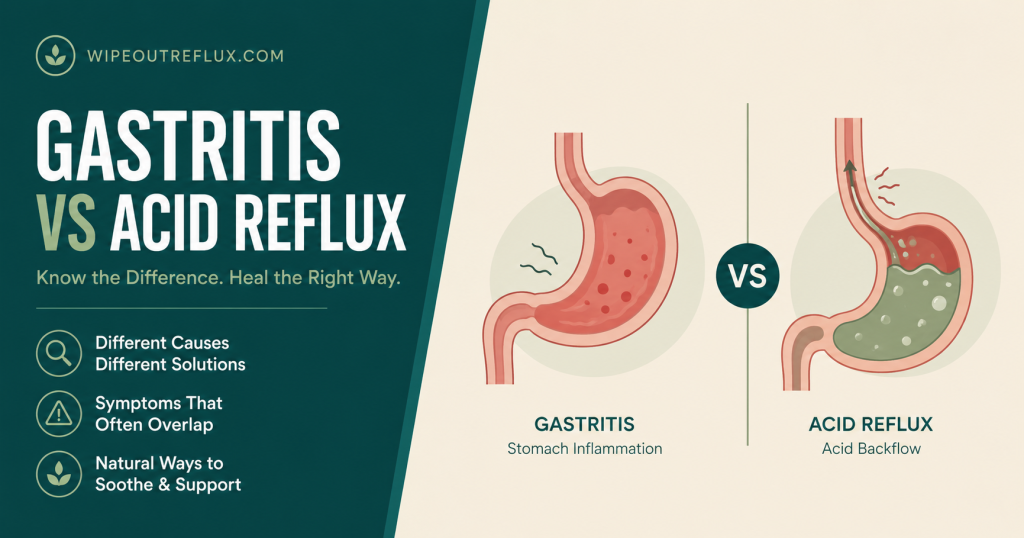
The simplest way to separate them is to ask where the trouble is. Gastritis is inflammation of the stomach lining, so the discomfort sits in the upper abdomen — a gnawing, aching or burning in the pit of your stomach, often with nausea, fullness or getting full far too quickly. Acid reflux is stomach contents travelling the wrong way up, so the burn sits higher: behind the breastbone, rising towards the throat, usually worse after meals and when you lie down.
Two other clues are almost as useful. Reflux is position-dependent — lying flat or bending forward makes it worse, standing up helps. Gastritis doesn’t care what position you’re in. And throat symptoms — hoarseness, constant throat clearing, a lump sensation, a cough that won’t quit — belong to reflux, never to gastritis.
The frustrating part is that these aren’t either/or. Stomach-type symptoms and reflux-type symptoms overlap in around a quarter of people, and the same medication gets prescribed for both, which is exactly why so many people spend years not knowing which one they’re actually treating.
Key Takeaways
- Gastritis is inflammation of the stomach lining; acid reflux is stomach contents escaping upward into the oesophagus or throat.
- Gastritis pain sits in the upper abdomen and often comes with nausea, fullness and early satiety. Reflux burns behind the breastbone and rises.
- Reflux is worse lying down or bending forward; gastritis isn’t position-dependent.
- Hoarseness, throat clearing, a lump sensation and chronic cough point to reflux — specifically silent reflux — not gastritis.
- Dyspepsia and reflux-type symptoms overlap in roughly 26% of people, and the odds of dyspepsia are almost sevenfold higher if you have weekly reflux symptoms.
- Gastritis is a histological diagnosis — it needs a biopsy. Endoscopy and histology disagree about a third of the time.
- The two main causes of gastritis are Helicobacter pylori and NSAIDs, and both need treating at the source, not just suppressing with acid medication.
- Autoimmune atrophic gastritis actually lowers stomach acid, yet still produces dyspeptic and reflux-like symptoms — which is why more acid suppression sometimes makes people worse.
What gastritis actually is
Gastritis means inflammation of the stomach lining. That’s it — it’s a description of what a pathologist sees down a microscope, not a description of how you feel. This distinction matters more than almost anything else in this article, and it’s the reason so many people are confused about whether they “have gastritis”.
Your stomach lining survives an extraordinary environment. It produces hydrochloric acid strong enough to strip protein apart, and protects itself with a mucus layer, a bicarbonate buffer, tight cell junctions and a rich blood supply that repairs damage quickly. Gastritis happens when something overwhelms that defence.
The main causes are:
- Helicobacter pylori — a bacterium that colonises the stomach lining and drives chronic inflammation. It’s astonishingly common: a meta-analysis of over 400,000 people across 73 countries put global prevalence at 44.3%, ranging from 50.8% in developing countries to 34.7% in developed ones Zamani et al., Alimentary Pharmacology & Therapeutics, 2018. Most people carrying it have no symptoms at all.
- NSAIDs — ibuprofen, naproxen, aspirin, diclofenac. They block prostaglandins, which are exactly what the stomach uses to maintain its mucus and blood supply. Alongside H. pylori, they’re one of the two dominant causes of gastric mucosal damage and ulceration Lanas and Chan, The Lancet, 2017.
- Alcohol — directly irritating to the mucosa at higher intakes.
- Autoimmune atrophic gastritis — the immune system attacks the acid-producing parietal cells. More on this below, because it turns the usual assumptions upside down.
- Bile reflux — bile washing back from the duodenum into the stomach, which is a genuinely different mechanism worth understanding if you have bile reflux rather than acid reflux.
Stress and spicy food, incidentally, don’t cause gastritis. They can aggravate an already-inflamed stomach, but they aren’t the reason the inflammation started.
What acid reflux actually is
Reflux is a mechanical failure, not an inflammatory one. The lower oesophageal sphincter is a ring of muscle that should stay shut between swallows. When it relaxes at the wrong moment, or when pressure inside the stomach overcomes it, stomach contents travel back up.
What comes up isn’t only acid. It also contains pepsin, the stomach’s protein-digesting enzyme, which is the part that matters most if the refluxate reaches your throat and voice box. That’s the difference between classic GERD, where the damage is oesophageal, and LPR or silent reflux, where the damage is in the throat and there may be no heartburn at all.
So the two conditions sit in different places, are caused by different things, and behave differently. Which is why, once you know what to listen for, they’re more separable than most people expect.
How the symptoms differ
Here’s the side-by-side. Read both lists and see which one your week actually looks like.
Gastritis symptom pattern
- Location: upper abdomen, just below the breastbone and above the navel — the pit of your stomach
- Character: gnawing, aching, dull, sometimes burning, sometimes a raw or hollow feeling
- Timing: often worse on an empty stomach, and briefly eased by eating; or worse after eating with a heavy, overfull feeling
- Company: nausea, loss of appetite, early satiety (full after a few mouthfuls), bloating, occasionally vomiting
- Position: unchanged by lying down or bending
- Triggers: NSAIDs, alcohol, sometimes coffee; often no obvious food trigger at all
- Relief: antacids may take the edge off; stopping NSAIDs makes a real difference over weeks
Acid reflux symptom pattern
- Location: behind the breastbone, travelling upward towards the throat
- Character: burning, hot, rising — heartburn in the literal sense
- Timing: 30–60 minutes after meals, at night, after large or fatty meals
- Company: sour or bitter taste, regurgitation, throat clearing, hoarseness, chronic cough, a lump sensation in the throat
- Position: clearly worse lying flat or bending forward; better standing or propped up
- Triggers: large meals, late meals, fat, chocolate, alcohol, tight waistbands
- Relief: antacids and alginates often help within minutes; sitting upright helps
The three questions that separate them fastest
1. Point to it. If your finger lands below the breastbone on your abdomen, think stomach. If it lands on your breastbone or you draw a line upward towards your throat, think reflux.
2. Does lying down change it? Reflux is gravity-dependent, so it almost always worsens flat. Gastritis is indifferent to posture. This is one of the most reliable discriminators there is.
3. Is your throat involved? Hoarseness, a persistent need to clear your throat, a cough, a lump sensation, post-nasal drip that won’t respond to allergy treatment — these are LPR symptoms. An inflamed stomach lining cannot produce them.
A fourth clue, if you need it: nausea and early satiety lean strongly towards the stomach. If two mouthfuls of dinner leave you feeling you’ve eaten a full plate, that’s a gastric emptying or gastric lining problem, not an oesophageal one — and it’s worth reading about gastroparesis and acid reflux as well.
Why so many people have both
Now the complication, because a tidy comparison table would be misleading on its own.
A systematic review and meta-analysis of community populations found that dyspepsia — the umbrella term for upper abdominal pain, burning, fullness and early satiety — was present in 43.9% of people with weekly reflux symptoms, and that the two overlapped in 25.9% of individuals overall. The odds of having dyspepsia were almost sevenfold higher in people with reflux symptoms than in those without Eusebi et al., Clinical Gastroenterology and Hepatology, 2018.
There are good mechanical reasons for that. A stomach that empties slowly holds its contents longer and at higher pressure, and pressure is what pushes the sphincter open. Inflammation makes nerve endings more sensitive, so the same amount of acid registers as more pain. And large, fatty meals worsen both problems at once.
The practical consequence: finding gastritis on a biopsy does not mean reflux isn’t also happening, and treating one may leave the other completely untouched. If you’ve been told you have gastritis but your symptoms are still rising into your chest and throat, you are probably dealing with two problems, not one.
The bit almost nobody explains: gastritis can mean less acid, not more
Most people assume gastritis means an acidic, overactive stomach. Sometimes the opposite is true, and it changes everything about treatment.
In autoimmune atrophic gastritis, the immune system destroys the parietal cells that make acid. Prevalence in the general population is estimated at 0.3–2.7%, it’s two to three times more common in women, and it’s most often diagnosed after the age of 60 Castellana et al., Cancers, 2024. As the acid-producing mucosa is lost, stomach acid falls, iron and vitamin B12 absorption fail, and pernicious or iron-deficiency anaemia can follow.
Here’s the part that matters for this article. Patients with autoimmune atrophic gastritis are often entirely asymptomatic — but in a study of 379 of them, 57% reported dyspeptic symptoms, and a subgroup reported heartburn and regurgitation. When those patients were investigated with impedance-pH monitoring, they typically did not show abnormal acid exposure, which suggests their reflux symptoms came from non-acid reflux or had a functional origin Castellana et al., Cancers, 2024.
Read that again, because it explains a lot of frustrated people. You can have real burning, real regurgitation, real reflux symptoms — and a stomach producing too little acid rather than too much. Piling on acid suppression in that situation treats nothing and can worsen the B12 and iron problem. It’s a version of the same puzzle I’ve written about in whether low stomach acid causes acid reflux, and it’s also why long-term omeprazole and B12 deficiency deserve more attention than they usually get.
How each one is actually diagnosed
This is where the two conditions genuinely diverge, and where a lot of people get a partial answer and stop.
Gastritis needs a biopsy
Gastritis is defined histologically. Not by symptoms, and not reliably by what the stomach looks like through a camera. In a series of 400 patients, endoscopic and histological diagnoses disagreed in 136 cases — 34%. Fifty-six had a normal-looking stomach with abnormal biopsies, and eighty had an abnormal-looking stomach with entirely normal biopsies Carr et al., Annals of Diagnostic Pathology, 2012.
So “the endoscopist said my stomach looked a bit inflamed” is not a diagnosis of gastritis, and equally, a normal-looking stomach doesn’t exclude it. If gastritis is the question, biopsies are the answer — and the useful follow-ups are an H. pylori breath or stool antigen test, and, if autoimmune gastritis is suspected, parietal cell antibodies, serum gastrin, pepsinogen levels and B12.
Reflux usually doesn’t need a biopsy
Reflux is generally diagnosed on symptoms plus response to treatment. Current guidance is that for typical heartburn and regurgitation without alarm features, an eight-week trial of acid suppression is a reasonable first step, with endoscopy reserved for alarm features or for people who don’t respond Katz et al., The American Journal of Gastroenterology, 2022.
Crucially, a normal endoscopy does not rule reflux out. Most people with reflux disease have a normal-looking oesophagus — that’s non-erosive reflux disease, and it’s the majority pattern rather than the exception. If you need confirmation, that’s what pH or pH-impedance monitoring is for. I’ve gone through the full menu of tests in how acid reflux is diagnosed and what to expect from endoscopy for acid reflux.
The short version: the test that finds gastritis tells you almost nothing about reflux, and the test that confirms reflux tells you nothing about your stomach lining. If you’ve only had one of them, you only have half the picture.
Treatment diverges more than you’d think
Both conditions often get the same prescription — a proton pump inhibitor — which hides how differently they need to be managed.
Gastritis is about removing the cause. If it’s H. pylori, it needs eradication with combination antibiotics, not acid suppression. A meta-analysis of eighteen randomised controlled trials found that eradication significantly improved dyspeptic symptoms compared with control treatment, in both low- and high-prevalence regions Kang et al., Journal of Clinical Medicine, 2019. If it’s NSAIDs, the drugs have to stop or change — and it’s worth checking the wider list of medications that make reflux worse while you’re at it. If it’s alcohol, that’s the lever. Acid suppression supports healing, but on its own it’s a holding pattern.
Reflux is about mechanics and timing. Suppressing acid changes what the refluxate contains, not whether reflux happens. That’s exactly why PPIs so often fail for LPR — pepsin is still travelling upward and still doing damage at higher pH. Meal size, meal timing, the gap before bed, bed elevation, waistband pressure and food choices do the structural work that medication can’t.
If you’re not sure which lever to pull first, the honest answer is that food and timing are where reflux improvement actually comes from, and where most people are guessing. The Wipeout Food Reference Guide is the essential reference for that side of it — which foods and drinks are genuinely safe with acid reflux and LPR, and their pH values, so you stop having to guess meal by meal.
What to do while you’re working it out
A few things help regardless of which condition you turn out to have, and none of them require a diagnosis first:
- Stop NSAIDs if you possibly can. This is the single highest-yield change for an inflamed stomach, and it does nothing but good for reflux either. Talk to your doctor if you’re on them for a reason.
- Eat smaller and earlier. Smaller meals reduce gastric pressure, which helps reflux, and are gentler on an inflamed lining. Leave at least three hours before lying down — see how long before bed you should stop eating.
- Cut alcohol properly, not partially. It irritates the stomach lining directly and relaxes the lower sphincter. There’s no version of this where it helps.
- Raise the head of your bed. Useless for gastritis, transformative for night-time reflux — which makes it a rather good informal test. If elevating your bed helps, you have reflux.
- Get tested for H. pylori. It’s a simple breath or stool test, it’s treatable, and the relationship between H. pylori and acid reflux is worth understanding before you assume it’s irrelevant to you.
- Don’t self-prescribe stomach acid. If you’re considering betaine HCl, don’t do it with an inflamed lining or an undiagnosed ulcer.
When to see a doctor
Some symptoms need proper assessment rather than a self-management plan. See a doctor promptly for difficulty swallowing or food sticking, unintentional weight loss, persistent vomiting, black or tarry stools, vomiting blood or material that looks like coffee grounds, anaemia, or new upper abdominal symptoms starting after the age of 55.
And if chest pain comes with sweating, breathlessness, or pain spreading to the jaw or arm, treat it as cardiac until proven otherwise — telling heartburn from a heart attack is not something to work out at home.
Conclusion
Gastritis sits in your stomach; reflux rises out of it. Point to where it hurts, notice whether lying down makes it worse, and check whether your throat is involved — those three questions will separate the two most of the time. Gastritis brings nausea, fullness and early satiety with pain low down in the upper abdomen. Reflux brings a rising burn, a sour taste, and throat symptoms that get worse the moment you lie flat.
But hold that distinction loosely, because the overlap is real. Roughly a quarter of people have both symptom sets, gastritis is only confirmed on biopsy, a normal endoscopy doesn’t exclude reflux, and autoimmune gastritis can produce reflux symptoms while lowering stomach acid. Getting the right answer usually means testing for H. pylori, reviewing your NSAID use, and being clear about which test you’ve actually had.
Whichever way it lands, the food side is where most of the day-to-day improvement lives, and it’s the part people find hardest to pin down. The Wipeout Food Reference Guide is the essential starting point — the allowed foods and drinks for acid reflux and LPR, with their pH values, so you’re not guessing. If you’d rather follow a complete system, the Wipeout Diet Plan goes considerably deeper. It was built first around LPR, the stubborn throat-based form of reflux, but because it works on the same underlying mechanisms it’s just as effective for GERD and everyday heartburn — and taking the load off a stomach that’s producing less pressure and less irritation happens to be exactly what an inflamed lining needs too.
Frequently Asked Questions
Can you have gastritis and acid reflux at the same time?
Yes, and it’s common. Dyspepsia and reflux-type symptoms overlap in around 26% of people, and the odds of dyspepsia are nearly seven times higher in those with weekly reflux symptoms. Slow gastric emptying and increased stomach pressure make both more likely at once, so finding one doesn’t rule the other out.
How do I know if my burning is gastritis or reflux?
Point to it. Burning in the upper abdomen, below the breastbone, with nausea or fullness, points to the stomach. Burning behind the breastbone that rises towards the throat, gets worse lying down, and comes with a sour taste, points to reflux. If lying flat clearly makes it worse, it’s reflux.
Does gastritis cause a sore throat or hoarseness?
No. Gastritis is confined to the stomach lining and cannot produce throat symptoms. Hoarseness, throat clearing, a lump sensation and chronic cough are hallmarks of laryngopharyngeal reflux, where refluxate containing pepsin reaches the larynx.
Can gastritis cause acid reflux?
Not directly, but they share drivers. Inflammation and delayed gastric emptying raise pressure inside the stomach and increase visceral sensitivity, both of which make reflux episodes more likely and more painful. Treating the gastritis often helps reflux indirectly for that reason.
Do PPIs treat gastritis?
They reduce acid and support healing, but they don’t treat the cause. If gastritis is driven by H. pylori, eradication with antibiotics is what’s needed — a meta-analysis of eighteen randomised trials found eradication significantly improved dyspeptic symptoms. If it’s NSAID-driven, the drug has to stop. Acid suppression alone is a holding pattern in both cases.
Is gastritis worse on an empty stomach or after eating?
It varies with the pattern. Ulcer-type gastritis pain is often worse when the stomach is empty and eases briefly after eating, which is nearly the opposite of reflux. Other people feel worse after meals, with heavy fullness and nausea rather than burning. Reflux, by contrast, is reliably worse 30–60 minutes after eating and when lying down.
Can gastritis mean you have too little stomach acid?
Yes, in autoimmune atrophic gastritis, where the immune system destroys the acid-producing parietal cells. Prevalence is estimated at 0.3–2.7% and it’s more common in women over 60. Those patients often still report dyspeptic and reflux-type symptoms despite normal acid exposure on impedance-pH testing, which is why more acid suppression can be the wrong move.
What test tells the difference between gastritis and reflux?
Different tests entirely. Gastritis requires endoscopy with biopsies, because endoscopic appearance alone disagrees with histology about a third of the time, plus H. pylori testing. Reflux is usually diagnosed clinically with a treatment trial, and confirmed if needed with pH or pH-impedance monitoring. Having had one test doesn’t answer the other question.
Research & References
- Systematic review and meta-analysis of community populations finding dyspepsia present in 43.9% of individuals with weekly gastro-oesophageal reflux symptoms, a pooled overlap between dyspepsia and reflux of 25.9%, and almost sevenfold higher odds of dyspepsia in those with weekly reflux symptoms Eusebi et al., Clinical Gastroenterology and Hepatology, 2018.
- Study of 400 patients comparing endoscopic and histological diagnosis of gastritis, finding discordance in 136 cases (34%) — 56 with normal endoscopy but abnormal histology and 80 with abnormal endoscopy but normal histology Carr et al., Annals of Diagnostic Pathology, 2012.
- Meta-analysis of 410,879 participants across 73 countries reporting a worldwide Helicobacter pylori prevalence of 44.3%, with 50.8% in developing countries and 34.7% in developed countries Zamani et al., Alimentary Pharmacology & Therapeutics, 2018.
- Clinical review of autoimmune atrophic gastritis reporting a general-population prevalence of 0.3–2.7%, a female-to-male ratio of 2–3:1, dyspeptic symptoms in 57% of a 379-patient cohort, and impedance-pH monitoring that does not usually show abnormal acid exposure despite reflux symptoms Castellana et al., Cancers, 2024.
- Review of peptic ulcer disease identifying Helicobacter pylori infection and non-steroidal anti-inflammatory drug use as the dominant causes of gastroduodenal mucosal damage and ulceration Lanas and Chan, The Lancet, 2017.
- Meta-analysis of eighteen randomised controlled trials showing that Helicobacter pylori eradication significantly improved dyspeptic symptoms compared with control treatment (risk ratio 1.18, 95% CI 1.07–1.30), in both low- and high-prevalence regions Kang et al., Journal of Clinical Medicine, 2019.
- American College of Gastroenterology clinical guideline recommending an eight-week trial of acid suppression for typical reflux symptoms without alarm features, with endoscopy reserved for alarm features or non-response Katz et al., The American Journal of Gastroenterology, 2022.

David Gray
12 years living with LPR · Consultant & researcher
I've lived with LPR for twelve years — the misdiagnoses, the PPI courses that did nothing, the slow work of figuring out what actually helps. Wipeout Reflux is where I translate the research into plain terms for people stuck in the same place. Every claim here is sourced to peer-reviewed work, and I consult one-to-one with LPR sufferers.