
Gaviscon Advance isn’t sold in the US because its active ingredient, sodium alginate, isn’t on the FDA’s approved list of over-the-counter antacid ingredients. US antacids are sold under an FDA rulebook called a monograph, and alginate isn’t in it. So the Gaviscon you’ll find on American shelves is a different product, made by a different company: an aluminum and magnesium antacid, with alginate listed only as an inactive ingredient.
That difference matters. UK Gaviscon Advance contains 1,000 mg of sodium alginate per 10 ml and no aluminum. It’s built to form a thick raft that sits on top of your stomach contents and blocks reflux, and it’s the version with clinical trial evidence in silent reflux (LPR). US Gaviscon is mainly an acid neutralizer.
If you’re in the US and want the real thing, most people order the UK version online. The main US-made alternative is an alginate product like Reflux Gourmet. Always check the ingredients, not just the name on the box.
Key Takeaways
- US Gaviscon and UK Gaviscon Advance share a name but are different products from different companies.
- US Gaviscon’s active ingredients are aluminum hydroxide and magnesium carbonate. Sodium alginate is listed as an inactive ingredient.
- UK Gaviscon Advance contains sodium alginate 1,000 mg and potassium bicarbonate 200 mg per 10 ml, with no aluminum.
- The FDA’s over-the-counter antacid rules don’t include alginate as an active ingredient, which is the main barrier to selling Gaviscon Advance in the US.
- Alginate rafts physically block reflux and can trap pepsin and bile, which antacids don’t do.
- Gaviscon Advance has randomized trial evidence in LPR. US Gaviscon doesn’t.
- US readers usually buy the UK version online or use a US alginate product like Reflux Gourmet.
- Gaviscon Advance is high in sodium and contains potassium, so check with your doctor if you have kidney or heart problems.
US Gaviscon vs UK Gaviscon Advance: Not the Same Product
This is the single biggest source of confusion I see from US readers. Someone hears that Gaviscon helps silent reflux, buys a bottle at CVS, finds it does very little, and decides alginates don’t work for them. They never actually tried an alginate.
What’s in US Gaviscon
The Gaviscon sold in the US is distributed by Haleon. According to the Drug Facts labels:
- Gaviscon Extra Strength liquid: aluminum hydroxide 254 mg and magnesium carbonate 237.5 mg per 5 ml. Sodium alginate is listed as an inactive ingredient.
- Gaviscon Regular Strength liquid: aluminum hydroxide 95 mg and magnesium carbonate 358 mg per 15 ml, again with sodium alginate as an inactive ingredient.
- Gaviscon Extra Strength chewable tablets: aluminum hydroxide 160 mg and magnesium carbonate 105 mg per tablet, with alginic acid and sodium bicarbonate among the inactive ingredients.
The label doesn’t state how much alginate is in any of these, because it isn’t counted as an active ingredient. They’re antacids that may form a weak raft, not alginate products.
What’s in UK Gaviscon Advance
Gaviscon Advance is made by Reckitt. The UK product information lists sodium alginate 1,000 mg and potassium hydrogen carbonate (potassium bicarbonate) 200 mg per 10 ml, with no aluminum or magnesium [Gaviscon Advance Aniseed Oral Suspension, Summary of Product Characteristics, Reckitt Benckiser Healthcare (UK)]. The tablets contain sodium alginate 500 mg and potassium bicarbonate 100 mg each.
Here’s the key difference at a glance:
- Main job: US Gaviscon neutralizes acid. Gaviscon Advance forms a raft that blocks reflux.
- Alginate: unlisted inactive ingredient in US Gaviscon. 1,000 mg per 10 ml in Gaviscon Advance.
- Aluminum: yes in US Gaviscon. None in Gaviscon Advance.
- LPR trial evidence: none for US Gaviscon. Randomized trial evidence for Gaviscon Advance.
I compare the two in much more detail in Gaviscon Advance vs Extra Strength.
Why Isn’t Gaviscon Advance Sold in the US?
There’s no single official statement, but the regulatory picture explains most of it.
1. Alginate isn’t an approved OTC antacid ingredient in the US
Most over-the-counter medicines in the US are sold under FDA monographs. A monograph is essentially a rulebook listing which active ingredients a product category can contain, at what doses and with what labeling. If a product sticks to the monograph, it can be sold without going through a full drug approval.
The antacid monograph lists ingredients like aluminum hydroxide, calcium carbonate, magnesium compounds, sodium bicarbonate and potassium bicarbonate. Sodium alginate and alginic acid aren’t on the list [Code of Federal Regulations, Title 21, Part 331: Antacid Products for Over-the-Counter Human Use]. That’s why US Gaviscon can contain alginate, but only as an inactive ingredient, with aluminum and magnesium doing the official work.
To sell a product whose main active ingredient is alginate as an OTC drug, a company would generally need either a full FDA drug approval, with US clinical data and the cost that comes with it, or a change to the monograph. For a product that has sold well for decades without the US market, neither has happened.
2. The Gaviscon name belongs to different companies in different countries
The Gaviscon in US stores is distributed by Haleon. Gaviscon Advance in the UK is made by Reckitt. Two different companies selling under one brand name, in two different regulatory systems, is why the same name covers such different formulas. It’s also why you can’t assume a product is the same just because the box looks familiar.
3. US reflux treatment developed differently
In the US, reflux treatment has leaned heavily on acid suppression, first H2 blockers, then PPIs. In the UK and Europe, alginates have long been a standard first step for heartburn and reflux in pregnancy, and ENT doctors use Gaviscon Advance for LPR. With PPIs dominating the US market, there’s been less commercial pressure to bring a dedicated alginate medicine through FDA approval.
Does It Actually Matter Which Version You Use?
If you have occasional heartburn, US Gaviscon or any antacid will neutralize acid and help. If you have silent reflux, regurgitation, night-time reflux or reflux that PPIs haven’t fixed, it matters a lot.
How an alginate raft works
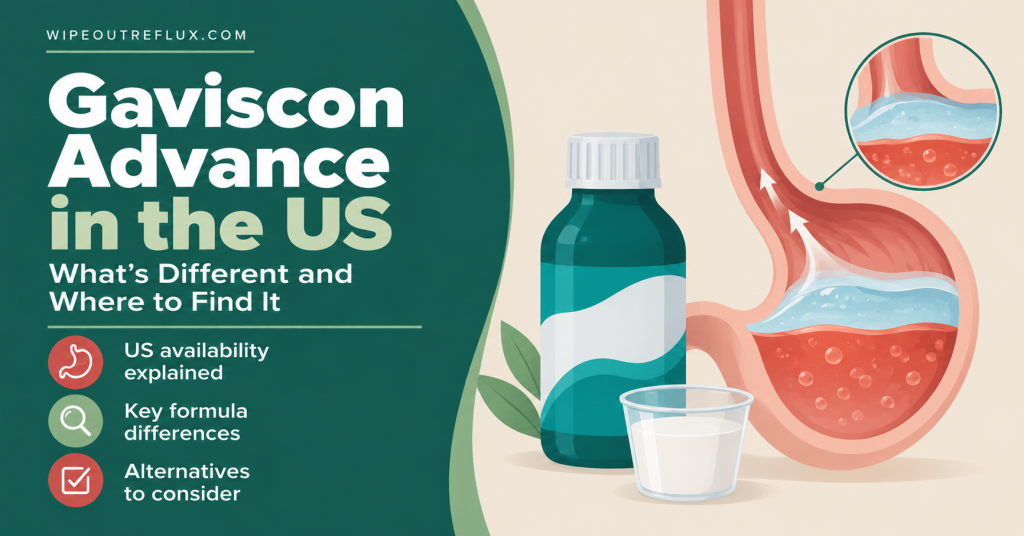
When Gaviscon Advance meets stomach acid, the sodium alginate forms a gel, and the bicarbonate releases carbon dioxide that makes it float. The result is a raft sitting on top of your stomach contents, right where reflux starts. According to the product information, the raft can block reflux for up to around 4 hours, and in lab testing it can also trap pepsin and bile in its structure [Gaviscon Advance Peppermint Oral Suspension, Summary of Product Characteristics, Reckitt Benckiser Healthcare (UK)].
Imaging studies show the raft sits on the “acid pocket,” the layer of unbuffered acid that forms at the top of the stomach after meals. In people with GERD and hiatal hernia, an alginate-antacid raft pushed the acid pocket below the diaphragm in 71% of patients compared with 21% on an antacid alone, and reduced acid reflux episodes [Rohof et al., Clinical Gastroenterology and Hepatology, 2013].
Why that matters for silent reflux
In LPR, the problem isn’t just acid. It’s pepsin reaching the throat, sticking to the tissue and being reactivated. PPIs reduce acid but don’t stop reflux happening. An alginate raft reduces how much material comes up at all. I explain pepsin’s role in how pepsin reactivates in the throat and why PPIs don’t work for LPR.
The evidence
- In a randomized trial in 49 people with LPR, those given Gaviscon Advance had significantly better symptom and throat examination scores than untreated controls [McGlashan et al., European Archives of Oto-Rhino-Laryngology, 2009].
- A meta-analysis of 14 randomized trials found alginate therapy more than quadrupled the odds of resolving GERD symptoms compared with placebo or antacids [Leiman et al., Diseases of the Esophagus, 2017].
- In a lab comparison of alginate products, Gaviscon Advance had the highest alginate content in its raft and the longest-lasting neutralization [Dettmar et al., Drug Development and Industrial Pharmacy, 2018].
In my own experience with LPR, Gaviscon Advance at bedtime was one of the few things that made a clear difference to morning throat symptoms. It’s still the alginate I recommend most in consults. My full guide is here: Gaviscon Advance for LPR.
How to Get Gaviscon Advance in the USA
Most US readers buy the UK version online, usually through Amazon, where it’s sold by UK and third-party sellers. My Gaviscon Advance guide has the links I use.
When buying, check:
- The box says Gaviscon Advance, not Gaviscon Original, Double Action or Extra Strength
- The ingredients list sodium alginate 1000 mg and potassium hydrogen carbonate 200 mg per 10 ml (or 500 mg and 100 mg per tablet)
- There’s no aluminum hydroxide or magnesium carbonate
- The flavor: aniseed is the one I recommend. The peppermint version uses flavoring rather than real peppermint oil, but if mint bothers your reflux, aniseed avoids the question
- The expiry date, since imported stock can be older
The 500 ml aniseed bottle is the best value. The liquid works better than the tablets for night-time and throat symptoms because it coats and forms a raft more quickly. Tablets are handy for travel.
Gaviscon Advance Equivalents in the US
If you can’t or don’t want to import it, these are the realistic options:
Reflux Gourmet
A US-made alginate product with sodium alginate and sodium bicarbonate, no aluminum, and a much nicer taste. It doesn’t have its own published clinical trial, so it relies on the evidence for alginates generally, but it’s the closest thing to Gaviscon Advance on US shelves. See Reflux Gourmet vs Gaviscon.
Make your own alginate
Some people make an alginate drink at home from food-grade sodium alginate and bicarbonate. It’s cheaper but less consistent. I explain how in DIY Gaviscon Advance.
US Gaviscon Extra Strength tablets
The US chewable tablets contain alginic acid and sodium bicarbonate as inactive ingredients, so they may form some raft. They’re a reasonable stopgap for heartburn, but they contain aluminum and aren’t a like-for-like substitute.
What isn’t an equivalent
Tums, Rolaids, Maalox and Mylanta are antacids only. They neutralize acid but don’t form a raft. See Tums vs Gaviscon.
How to Take Gaviscon Advance
- Dose: 5 to 10 ml (or 1 to 2 tablets, chewed) after meals and at bedtime, up to four times a day, for adults and children 12 and over.
- Timing: take it after you’ve finished eating, so the raft forms on top of the meal. The bedtime dose is the most important one for silent reflux.
- Afterward: don’t eat or drink for at least 30 minutes so you don’t break up the raft.
- Other medicines: leave about 2 hours between Gaviscon Advance and other medicines, especially thyroid tablets, iron, some antibiotics and bisphosphonates.
Safety
Each 5 ml contains about 58 mg of sodium and 1 mmol of potassium. Talk to your doctor before using it regularly if you’re on a low-salt diet, have kidney disease or heart failure, or have been told to limit potassium. If you need it every day for more than a week or two, see your doctor to find out what’s driving your reflux.
An alginate works best as part of a bigger plan. It blocks reflux, but it doesn’t change why it’s happening. That’s where diet comes in: the Wipeout Diet Plan pairs well with an alginate, because one stops reflux reaching your throat while the other reduces the triggers behind it. See also alginates for acid reflux.
Conclusion
Gaviscon Advance isn’t sold in the US mainly because alginate isn’t an approved OTC antacid ingredient under FDA rules, and the Gaviscon brand in the US belongs to a different company with a different formula. US Gaviscon is an aluminum and magnesium antacid. Gaviscon Advance is a high-dose alginate that forms a raft, blocks reflux and has trial evidence in silent reflux. If you have LPR, night-time reflux or regurgitation, it’s worth getting the real thing, either by ordering the UK version or using a US alginate like Reflux Gourmet.
But even the best alginate is only half the picture. The Wipeout Diet Plan is where I’d point you next. It’s my complete plan for reducing reflux at its source through what and when you eat, and it’s what I combine with Gaviscon Advance for the best results. I built it around silent reflux, but because it works on the same root causes, it helps just as much with GERD and everyday heartburn.
If you’d like a lighter starting point, the Wipeout Food Reference Guide is the essential companion. It lists foods and drinks that are safe for acid reflux and LPR, with their pH values, so you can check what you’re eating at a glance.
Frequently Asked Questions
Why is Gaviscon Advance not sold in the US?
Its active ingredient, sodium alginate, isn’t on the FDA’s approved list of OTC antacid ingredients, so it can’t be sold as a standard US antacid without a full drug approval. The Gaviscon brand in the US is also owned by a different company and sells a different formula.
Is US Gaviscon the same as UK Gaviscon?
No. US Gaviscon’s active ingredients are aluminum hydroxide and magnesium carbonate, with alginate only as an inactive ingredient. UK Gaviscon Advance contains 1,000 mg of sodium alginate and 200 mg of potassium bicarbonate per 10 ml, with no aluminum.
Can I buy Gaviscon Advance in the USA?
Not in US pharmacies, but many people order the UK version online, usually through Amazon. Check the box says Gaviscon Advance and the ingredients list sodium alginate and potassium hydrogen carbonate.
What is the US equivalent of Gaviscon Advance?
There’s no exact equivalent. The closest US product is Reflux Gourmet, an alginate-based product without aluminum. US Gaviscon Extra Strength tablets may form a weaker raft but are mainly an antacid.
Is Gaviscon Advance better than US Gaviscon for silent reflux?
For LPR, yes. Gaviscon Advance forms a strong raft that blocks reflux and can trap pepsin, and it has randomized trial evidence in LPR. US Gaviscon mainly neutralizes acid, which does little for pepsin reaching the throat.
Is it legal to order Gaviscon Advance from the UK?
Many US readers order it online for personal use without problems. Import rules for personal medication can change, so if you have concerns, check current FDA guidance on personal importation.
Who shouldn’t take Gaviscon Advance?
Check with your doctor first if you have kidney disease, heart failure, are on a low-salt or potassium-restricted diet, or take medicines that need careful timing such as thyroid tablets or certain antibiotics. Children under 12 should only use it on medical advice.
Research & References
- [Gaviscon Advance Aniseed Oral Suspension, Summary of Product Characteristics, Reckitt Benckiser Healthcare (UK)] — Official UK product information listing sodium alginate 1,000 mg and potassium hydrogen carbonate 200 mg per 10 ml, adult dosing and sodium content.
- [Gaviscon Advance Peppermint Oral Suspension, Summary of Product Characteristics, Reckitt Benckiser Healthcare (UK)] — Describes the raft’s mechanism, its ability to block reflux for up to about 4 hours and to trap bile and pepsin in vitro, and cautions on sodium, potassium and drug interactions.
- [Code of Federal Regulations, Title 21, Part 331] — The FDA’s OTC antacid monograph, listing permitted active ingredients; sodium alginate and alginic acid are not included.
- [Rohof et al., Clinical Gastroenterology and Hepatology, 2013] — Scintigraphy in GERD patients with hiatal hernia showed an alginate-antacid raft displaced the postprandial acid pocket below the diaphragm in 71% of patients versus 21% on antacid, and reduced acid reflux episodes.
- [McGlashan et al., European Archives of Oto-Rhino-Laryngology, 2009] — Randomized trial of Gaviscon Advance in 49 patients with LPR; the treated group had significantly better Reflux Symptom Index and Reflux Finding Scores than untreated controls.
- [Leiman et al., Diseases of the Esophagus, 2017] — Meta-analysis of 14 randomized trials finding alginate therapy increased the odds of GERD symptom resolution more than fourfold versus placebo or antacids (odds ratio 4.42).
- [Dettmar et al., Drug Development and Industrial Pharmacy, 2018] — Lab comparison of alginate products; Gaviscon Advance had the highest alginate content in its raft and maintained neutralization for about 93 minutes, versus 5 to 27 minutes for weaker products.

David Gray
12 years living with LPR · Consultant & researcher
I've lived with LPR for twelve years — the misdiagnoses, the PPI courses that did nothing, the slow work of figuring out what actually helps. Wipeout Reflux is where I translate the research into plain terms for people stuck in the same place. Every claim here is sourced to peer-reviewed work, and I consult one-to-one with LPR sufferers.