
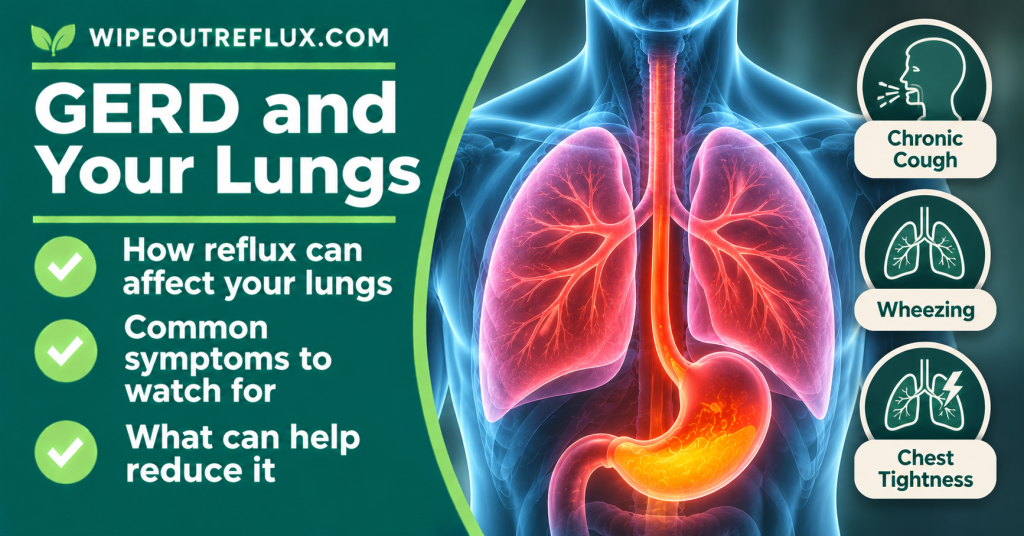
Yes, acid reflux can affect your lungs, although it’s less common and less straightforward than reflux affecting the throat. There are two main ways it happens. Tiny amounts of refluxed stomach contents, including pepsin and bile, can be breathed into the airways (called microaspiration). Or acid in the esophagus can trigger nerve reflexes that cause coughing and tightening of the airways, without anything reaching the lungs at all.
Reflux is strongly linked with chronic cough, asthma, COPD flare-ups and a scarring lung disease called idiopathic pulmonary fibrosis. Pepsin, a digestive enzyme that should only be found in the stomach, has been detected in the lungs of people with some of these conditions. But the research is more mixed than many websites suggest. Acid-suppressing drugs often don’t help lung symptoms, which points to non-acid reflux and pepsin as important players, and to the need to treat reflux at its source.
Key Takeaways
- Reflux can affect the lungs through microaspiration (stomach contents entering the airways) or through nerve reflexes triggered from the esophagus.
- Pepsin, a stomach enzyme, has been found in the lung fluid of lung transplant patients, where higher levels were linked to rejection.
- About 59% of people with asthma report reflux symptoms, and reflux is linked to more frequent COPD flare-ups.
- In one study, 87% of people with idiopathic pulmonary fibrosis had abnormal acid reflux, but fewer than half had typical heartburn.
- PPIs often don’t improve lung symptoms. A large trial found esomeprazole didn’t improve poorly controlled asthma in people without reflux symptoms.
- Night-time reflux, lying flat, large late meals and a weak upper esophageal sphincter all raise the risk of reflux reaching the airways.
- Warning signs include a chronic cough, wheezing at night, coughing after meals or on lying down, hoarseness and recurrent chest infections.
How Reflux Reaches the Lungs
Your esophagus sits right next to your windpipe (trachea), and both share the same opening at the top of the throat. Normally a series of barriers keeps stomach contents well away from your airways: the lower esophageal sphincter at the bottom, the upper esophageal sphincter at the top, the swallowing reflex, and your cough reflex. When those defenses slip, reflux can affect the lungs in two ways.
1. Microaspiration: reflux breathed into the airways
When refluxed material travels all the way up the esophagus and past the upper sphincter, tiny droplets can be inhaled into the windpipe and lungs. This is microaspiration. It’s usually silent: you don’t choke or notice anything. It’s most likely to happen at night, when you’re lying flat and your swallowing and cough reflexes are dampened by sleep.
What gets aspirated isn’t just acid. It can include:
- Pepsin, the protein-digesting enzyme that can damage cells even in weakly acidic conditions
- Bile acids from the small intestine, which are irritating to delicate airway tissue
- Food particles and bacteria from the stomach
This is the same pepsin problem I talk about with silent reflux. Pepsin can stick to tissue and reactivate later when it meets something acidic. If you’re new to it, start with what is pepsin.
2. The reflex pathway: no aspiration needed
The esophagus and the airways share nerve connections through the vagus nerve. When acid irritates the lower esophagus, it can trigger a reflex that causes coughing or narrowing of the airways, even if no reflux reaches the lungs.
Some evidence suggests this reflex route may matter more than aspiration for chronic cough. A study measuring pepsin and bile acids in the coughed-up sputum of chronic cough patients found no more of either than in healthy people. The authors concluded that the reflex theory may be more relevant than aspiration for reflux-related cough [Grabowski et al., Respiratory Medicine, 2011]. For more on this, see reflux cough.
In reality, both mechanisms probably play a part, and how much each contributes varies from person to person and between different lung conditions.
Evidence That Pepsin Reaches the Lungs
The clearest evidence comes from lung transplant patients, who are closely monitored with regular lung washes (bronchoalveolar lavage).
A UK study measured pepsin in lung fluid from 36 transplant recipients. Pepsin levels were raised in transplanted lungs compared with healthy volunteers, and the highest levels were found in patients with more severe acute rejection [Stovold et al., American Journal of Respiratory and Critical Care Medicine, 2007]. Because pepsin is only made in the stomach, finding it in the lungs is good evidence that stomach contents have been aspirated.
Transplant patients are a special case, because the surgery affects the nerves that protect the airways. But this research helped confirm that reflux aspiration is real and can contribute to lung injury.
Lung Conditions Linked to Reflux
Chronic cough
Reflux is one of the most common causes of a cough that lasts longer than eight weeks, alongside asthma and postnasal drip. A reflux cough is often worse after meals, when lying down, on waking or when talking. Many people with reflux cough have no heartburn at all.
Asthma
A systematic review of 28 studies found that 59.2% of people with asthma had reflux symptoms, compared with 38.1% of controls. About half of people with asthma had abnormal acid exposure on pH testing [Havemann et al., Gut, 2007]. The review found a clear association, but couldn’t say which causes which. Asthma itself may promote reflux, because breathing harder changes pressures in the chest and some asthma medications can relax the lower esophageal sphincter.
If your asthma isn’t responding as expected, it’s worth reading asthma misdiagnosis and acid reflux.
COPD
In a study of 86 people with COPD, those with weekly reflux symptoms had twice as many flare-ups per year as those without (3.2 versus 1.6) [Rascon-Aguilar et al., Chest, 2006]. Flare-ups are a big deal in COPD, because each one can permanently reduce lung function. I cover this in more depth in acid reflux and COPD.
Idiopathic pulmonary fibrosis (IPF)
IPF is a progressive scarring of the lungs with no known cause. In a study of 65 people with IPF who had 24-hour pH monitoring, 87% had abnormal acid reflux, and 63% had abnormal acid reaching the upper esophagus. Yet only 47% had classic reflux symptoms. Even on standard doses of PPIs, most of those tested still had abnormal acid exposure [Raghu et al., European Respiratory Journal, 2006]. Whether reflux causes IPF, speeds it up, or is a consequence of it is still being studied.
Bronchitis and recurrent chest infections
Repeated microaspiration can inflame the airways and may make chest infections more likely in some people. This is more of a concern in older adults and people with swallowing problems. A review of aspiration syndromes notes that reflux is considered the leading mechanism for microaspiration, and that it’s linked to COPD, asthma, IPF and chronic cough [Lee and Ryu, Mayo Clinic Proceedings, 2018]. See acid reflux bronchitis.
Why PPIs Often Don’t Fix Reflux-Related Lung Problems
This is the part I think matters most, and it’s where a lot of general advice falls short.
In a large trial, 412 people with poorly controlled asthma and few or no reflux symptoms were given either high-dose esomeprazole (40 mg twice a day) or a placebo for 24 weeks. There was no difference in asthma control, lung function or symptoms, even in the 40% who had reflux confirmed by pH monitoring [Mastronarde et al., New England Journal of Medicine, 2009].
The Mayo Clinic review makes the same point more broadly: acid-reducing therapies have often failed in trials of reflux-related lung disease, which raises questions about how reflux actually causes the damage [Lee and Ryu, Mayo Clinic Proceedings, 2018].
Why? PPIs reduce the acidity of reflux, but they don’t stop reflux from happening. Weakly acidic or non-acid reflux can still carry pepsin, bile and food particles up toward the airways. If aspiration is the problem, making the reflux less acidic doesn’t stop it being inhaled. That’s exactly the same reason PPIs often disappoint people with LPR, which I explain in why PPIs don’t work for LPR and non-acid reflux.
That doesn’t mean PPIs never help. People with clear reflux symptoms and lung problems sometimes improve on them. But reducing the volume and height of reflux is often what really matters for the lungs.
Who’s Most at Risk?
- People with frequent night-time reflux, especially regurgitation while lying down
- Those with a large hiatal hernia
- People with swallowing problems or a weak upper esophageal sphincter (see upper esophageal sphincter and acid reflux)
- Older adults, and people with neurological conditions like stroke or Parkinson’s disease
- People with obstructive sleep apnea
- Lung transplant recipients and people with existing lung disease
- Heavy drinkers, and anyone using sedatives that dull protective reflexes
Warning Signs Reflux May Be Affecting Your Lungs
- A cough lasting more than eight weeks, especially after meals or on lying down
- Wheezing or chest tightness that’s worse at night or in the early morning
- Waking up coughing, choking or short of breath
- Asthma that’s hard to control despite proper inhaler use
- Hoarseness, throat clearing or postnasal drip alongside chest symptoms
- Frequent chest infections or bronchitis
See a doctor promptly if you have shortness of breath that’s getting worse, coughing up blood, fever with a cough, unexplained weight loss or chest pain. These need assessment and shouldn’t be assumed to be reflux.
Protecting Your Lungs From Reflux
The goal is to reduce how much reflux happens and how high it travels, especially at night.
- Stop eating three hours before bed. A full stomach at bedtime is the biggest single setup for night-time reflux reaching the throat and airways.
- Raise the head of your bed. Bed risers or a wedge pillow keep gravity on your side. Sleeping on your left side may also help. See best sleeping position for silent reflux.
- Use an alginate at bedtime. Alginates form a raft on top of stomach contents, physically reducing how much reflux comes up, which is what matters for aspiration. See alginates for acid reflux.
- Keep evening meals small and low in fat. Large, fatty meals relax the lower esophageal sphincter and slow stomach emptying.
- Cut back on alcohol, especially in the evening. It relaxes the sphincter and dulls protective reflexes.
- Get sleep apnea checked if you snore heavily or wake unrefreshed, as the two conditions feed each other.
- Reduce pepsin activation. Lowering acidic foods and drinks reduces the chance that pepsin sitting in tissue is reactivated. This is a central idea in the Wipeout Diet Plan.
If your lung condition is serious or progressive, such as IPF, poorly controlled asthma or COPD with frequent flare-ups, work with your respiratory and GI specialists. Testing like 24-hour pH-impedance monitoring can show whether reflux is reaching the upper esophagus, including non-acid reflux.
Conclusion
GERD can reach your lungs, either directly through microaspiration of stomach contents, including pepsin and bile, or indirectly through nerve reflexes from the esophagus that trigger coughing and airway narrowing. Reflux is linked with chronic cough, asthma, more frequent COPD flare-ups and idiopathic pulmonary fibrosis, and pepsin has been found in the lungs of transplant patients, where it’s associated with rejection. At the same time, the research is honest about its limits: it’s not always clear which comes first, and acid-suppressing drugs often don’t improve lung symptoms.
That last point is the key takeaway for anyone worried about their lungs. If reflux is affecting your airways, the most important thing is reducing how much reflux happens and how high it travels, particularly at night. Meal timing, bed position, alginates and diet changes all do that in ways that PPIs alone don’t.
That’s exactly what I focus on in the Wipeout Diet Plan, my complete, in-depth guide to reducing reflux and pepsin exposure through food, meal timing and daily habits. It was designed first and foremost for LPR, where reflux travels high enough to reach the throat and airways, but it works just as well for GERD and everyday heartburn because it targets the same root causes.
Frequently Asked Questions
Can acid reflux get into your lungs?
Yes. Small amounts of refluxed stomach contents can be inhaled into the airways, usually silently and most often at night. Pepsin, a stomach enzyme, has been found in lung fluid, which confirms this can happen.
What are the symptoms of reflux in the lungs?
Common signs include a chronic cough, wheezing, chest tightness, night-time coughing or choking, hoarseness and frequent chest infections. Many people have no heartburn.
Can GERD cause asthma?
Reflux and asthma are strongly linked, and reflux can worsen asthma symptoms in some people. But it’s not clear that reflux causes asthma, and asthma can also make reflux worse.
Can acid reflux cause pneumonia?
Significant aspiration can cause aspiration pneumonia, especially in older adults and people with swallowing problems. For most people with ordinary reflux, this is uncommon.
Can reflux cause lung scarring?
Abnormal reflux is very common in idiopathic pulmonary fibrosis, and repeated microaspiration is thought to possibly contribute. Whether it causes the scarring isn’t yet proven.
Do PPIs protect the lungs from reflux?
Not reliably. PPIs make reflux less acidic but don’t stop it happening. Trials in asthma found no benefit in people without reflux symptoms. Reducing reflux volume, especially at night, may matter more.
Can silent reflux affect your lungs?
Yes. LPR means reflux is already reaching the throat, so it’s closer to the airways. Many people with reflux-related lung problems have no heartburn at all.
Research & References
- [Stovold et al., American Journal of Respiratory and Critical Care Medicine, 2007] — Pepsin was elevated in lung fluid of transplant recipients compared with controls, with the highest levels in patients with acute rejection grade A2 or higher.
- [Grabowski et al., Respiratory Medicine, 2011] — Pepsin and bile acids in induced sputum didn’t differ between reflux-related chronic cough patients and healthy controls, suggesting the reflex mechanism may be more important for cough.
- [Havemann et al., Gut, 2007] — Systematic review of 28 studies finding reflux symptoms in 59.2% of people with asthma versus 38.1% of controls, with a significant association but unclear causal direction.
- [Rascon-Aguilar et al., Chest, 2006] — COPD patients with weekly reflux symptoms had twice the rate of exacerbations (3.2 vs 1.6 per year) of those without.
- [Raghu et al., European Respiratory Journal, 2006] — 87% of 65 IPF patients had abnormal acid reflux on pH monitoring, only 47% had typical symptoms, and standard-dose PPIs often failed to normalize acid exposure.
- [Mastronarde et al., New England Journal of Medicine, 2009] — In 412 adults with poorly controlled asthma and minimal reflux symptoms, esomeprazole 40 mg twice daily didn’t improve asthma control versus placebo.
- [Lee and Ryu, Mayo Clinic Proceedings, 2018] — Review identifying reflux as the leading mechanism for microaspiration across COPD, asthma, IPF and chronic cough, and noting the failure of acid-targeting therapies in trials.

David Gray
12 years living with LPR · Consultant & researcher
I've lived with LPR for twelve years — the misdiagnoses, the PPI courses that did nothing, the slow work of figuring out what actually helps. Wipeout Reflux is where I translate the research into plain terms for people stuck in the same place. Every claim here is sourced to peer-reviewed work, and I consult one-to-one with LPR sufferers.