
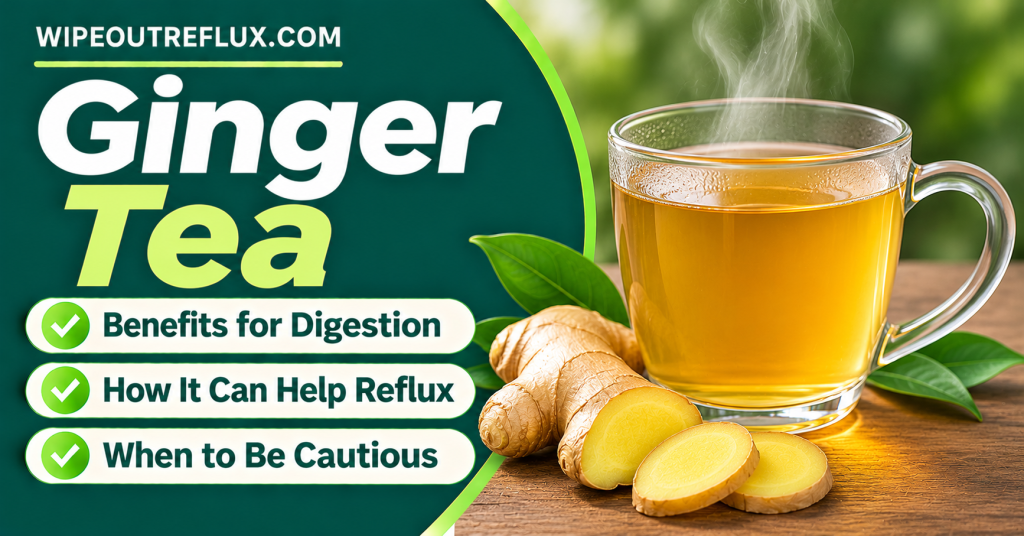
Ginger tea can help some people with acid reflux, but it isn’t a reliable cure, and for some it makes things worse. Its best-proven effect is speeding up how fast your stomach empties, which can ease the full, nauseous, “food sitting there” kind of reflux. On the other hand, one study found ginger caused more relaxation of the valve that keeps acid down, and heartburn is one of its known side effects.
So the honest answer is: a mild cup of ginger tea is worth trying, especially if bloating or nausea are part of your reflux, but keep it gentle and watch how you respond. Below I’ll explain what the research shows, how much is too much, the best time to drink it, and a simple reflux-friendly recipe.
Key Takeaways
- Ginger speeds up stomach emptying. In healthy volunteers, 1.2 g of ginger roughly halved the time it took the stomach to empty half its contents.
- Faster emptying means less time for a full stomach to push acid upward, which is why ginger may help reflux linked to bloating or slow digestion.
- Ginger’s best evidence is for nausea, not heartburn. Around 1.5 g a day in divided doses helps nausea.
- In one study, 1 g of ginger didn’t change resting sphincter pressure but caused more sphincter relaxation, which could allow more reflux.
- In a trial of 1,080 mg a day, heartburn was reported by about 13% of people, so ginger can backfire for some.
- Homemade ginger tea is milder than capsules. Start with a small slice and drink it between meals, not right before bed.
- Skip lemon, keep honey light and avoid ginger ale or ginger shots, which are often acidic or fizzy.
How Ginger Affects Your Stomach and Esophagus
To understand whether ginger tea helps reflux, it helps to know that it does two quite different things.
It speeds up stomach emptying
This is ginger’s clearest effect. In a randomized, double-blind study of 24 healthy volunteers, three ginger capsules (1.2 g total) taken an hour before a meal cut the gastric half-emptying time from about 26.7 minutes to 13.1 minutes compared with placebo. The stomach also contracted more often [Wu et al., European Journal of Gastroenterology and Hepatology, 2008].
The same team then tested ginger in 11 people with functional dyspepsia (chronic indigestion). Again, ginger sped up emptying, from 16.1 to 12.3 minutes, but it didn’t significantly change their symptoms [Hu et al., World Journal of Gastroenterology, 2011].
Why does emptying matter for reflux? A full, stretched stomach is one of the main triggers for the valve at the top of your stomach to open. The faster food moves on, the less time there is for that to happen. That’s the same reason doctors sometimes use prokinetic medications for acid reflux. Ginger is a much milder natural version of that idea.
It may relax the valve that keeps acid down
Here’s the catch. A manometry study in 14 healthy young men gave them 1 g of dried ginger in water. Ginger didn’t change resting pressure in the lower esophageal sphincter, but it did cause more relaxation of the sphincter during swallowing and slowed the speed of esophageal contractions. The authors noted this could increase the chance of reflux [Lohsiriwat et al., Journal of the Medical Association of Thailand, 2010].
It was a small study in people without reflux, so I wouldn’t over-read it. But it fits with what many readers tell me: ginger is soothing for some and a trigger for others.
What the Research Says About Ginger and Reflux Symptoms
There are no good trials of ginger tea specifically for GERD or LPR. What we have is evidence on related symptoms.
Nausea: This is where ginger shines. A systematic review of clinical trials concluded that around 1,500 mg of ginger a day, split into smaller doses, helps relieve nausea. For other digestive conditions, there weren’t enough studies to draw firm conclusions [Nikkhah Bodagh et al., Food Science and Nutrition, 2019]. If nausea is part of your reflux picture, see silent reflux and nausea.
Heartburn as a side effect: In an eight-week trial of 1,080 mg of ginger a day in 47 people with functional dyspepsia, ginger was generally well tolerated. But 12.8% reported heartburn, 14.9% bloating and 10.6% diarrhea, though none stopped because of it [Aregawi and Zoltan, Current Therapeutic Research, 2025].
Put that together and you get a fairly clear picture:
- If your reflux comes with bloating, early fullness or nausea, ginger tea may help.
- If your main symptom is classic burning heartburn, ginger might not help and could aggravate it.
- Concentrated doses (capsules, shots, strong extracts) carry more risk than a mild homemade tea.
For a broader look at ginger in all its forms, read my main article: is ginger good for acid reflux?
How Much Ginger Tea Is Too Much?
There’s no official limit for reflux, but here’s how I’d approach it:
- Start small: one cup a day made with a thin slice (about the size of a coin) of fresh ginger.
- Build slowly: if that’s fine for a week, try two cups a day.
- Stay at food-level amounts: the trials linking ginger to heartburn used concentrated capsules taken daily. A mild tea is a much gentler dose.
- Stop if it burns: if you notice more heartburn, throat burning or burping, ginger may not suit you.
If you take blood thinners or have gallstones, check with your doctor or pharmacist before drinking ginger regularly.
The Best Time to Drink Ginger Tea for Reflux
- Between meals or about 20 to 30 minutes after eating. This is when its stomach-emptying effect is most useful.
- Not right before bed. Lying down soon after drinking anything increases reflux risk.
- Warm, not scalding. Very hot drinks can irritate an already sensitive throat. I explain more in does drinking hot water help acid reflux?
A Simple Reflux-Friendly Ginger Tea Recipe
This makes one gentle cup.
- 1 thin slice of fresh ginger root (about 1/4 inch thick), peeled
- 1 1/4 cups (300 ml) water
- Optional: 1/2 teaspoon honey, or a slice of fresh pear for sweetness
- Thinly slice or lightly crush the ginger to release its flavor.
- Bring the water to a boil, add the ginger and simmer gently for 5 minutes. Simmer longer for a stronger tea once you know you tolerate it.
- Strain into a mug and let it cool to a comfortable, warm temperature.
- Stir in a little honey if you like. Skip the lemon.
Why no lemon? Lemon is very acidic and can trigger burning, especially with LPR. See is lemon acid or alkaline? A small amount of honey is usually fine, and some people find it soothing. I cover that in is manuka honey good for acid reflux?
Gentle variations to try: ginger with chamomile, or ginger with a few fennel seeds. Both chamomile and fennel are generally well tolerated. Avoid adding peppermint, which many people with reflux find relaxes the sphincter. See is peppermint tea good for acid reflux?
Ginger Drinks to Avoid With Reflux
- Ginger ale and ginger beer: carbonated, usually acidic and often low in real ginger. More in is ginger ale good for acid reflux?
- Ginger shots: very concentrated and usually mixed with lemon or other citrus.
- Ginger-lemon tea bags: check the label for citric acid or lemon.
- Chai: often contains black tea (caffeine) and spices that bother some people. See is chai bad for acid reflux?
If you want other options, my roundup of the best teas for acid reflux covers the gentlest choices.
Conclusion
Ginger tea isn’t a reflux cure, but it can be a helpful, gentle drink for the right person. Its strongest effect is speeding up stomach emptying, which may ease the bloated, heavy, nauseous kind of reflux. Its weak point is that it may relax the sphincter and can cause heartburn in some people, particularly at concentrated doses.
The sensible approach is to start with a mild homemade cup, drink it between meals rather than at bedtime, skip the lemon and fizzy ginger drinks, and pay attention to how you feel. If it helps, great. If it burns, drop it. There are plenty of other soothing teas.
Drinks like ginger tea are a small part of the picture, though. What really moves the needle is the overall way you eat: what, how much and when. That’s what the Wipeout Diet Plan is for. It’s my complete guide to calming reflux through food, with meal plans, drink guidance and a clear process for testing foods like ginger. It was built first around LPR, the throat-based form that’s hardest to settle, but because it targets the same root causes, it works just as well if your reflux is classic heartburn.
Frequently Asked Questions
Does ginger tea neutralize stomach acid?
No. Ginger doesn’t neutralize acid like an antacid does. Its main effect is speeding up stomach emptying, which may reduce the chance of reflux after meals.
Can ginger tea make acid reflux worse?
Yes, for some people. Ginger may increase relaxation of the lower esophageal sphincter, and heartburn has been reported as a side effect in ginger trials, especially at concentrated doses.
Is ginger tea good for silent reflux (LPR)?
It may help if bloating or slow digestion contribute to your symptoms. Keep it mild, avoid lemon, and drink it warm rather than hot to avoid irritating your throat.
How many cups of ginger tea a day is safe for reflux?
Start with one mild cup a day. If you tolerate it well, two cups is reasonable. Stop if you notice more burning or burping.
Should I drink ginger tea before or after meals?
About 20 to 30 minutes after a meal, or between meals, works best. Avoid it close to bedtime.
Is ginger tea better than ginger capsules for reflux?
For reflux, a mild tea is usually the safer starting point. Capsules deliver a larger, concentrated dose, which is more likely to cause heartburn in sensitive people.
Can I add honey to ginger tea if I have reflux?
Yes, a small amount is usually fine and may feel soothing on the throat. Keep it to about half a teaspoon.
Research & References
- [Wu et al., European Journal of Gastroenterology and Hepatology, 2008] — Randomized double-blind study in 24 healthy volunteers: 1.2 g ginger cut gastric half-emptying time from 26.7 to 13.1 minutes and increased antral contractions.
- [Hu et al., World Journal of Gastroenterology, 2011] — Randomized double-blind study in 11 people with functional dyspepsia: ginger sped gastric emptying (12.3 vs 16.1 minutes) without significantly changing symptoms.
- [Lohsiriwat et al., Journal of the Medical Association of Thailand, 2010] — Manometry study in 14 healthy men: 1 g ginger did not change resting sphincter pressure but caused more sphincter relaxation and slower esophageal contractions, which may increase reflux risk.
- [Nikkhah Bodagh et al., Food Science and Nutrition, 2019] — Systematic review of clinical trials concluding that about 1,500 mg ginger a day in divided doses helps nausea, with too few studies to draw conclusions for other digestive disorders.
- [Aregawi and Zoltan, Current Therapeutic Research, 2025] — Open-label eight-week trial of 1,080 mg ginger a day in 47 people with functional dyspepsia: generally well tolerated, with heartburn in 12.8%, bloating in 14.9% and diarrhea in 10.6%.

David Gray
12 years living with LPR · Consultant & researcher
I've lived with LPR for twelve years — the misdiagnoses, the PPI courses that did nothing, the slow work of figuring out what actually helps. Wipeout Reflux is where I translate the research into plain terms for people stuck in the same place. Every claim here is sourced to peer-reviewed work, and I consult one-to-one with LPR sufferers.