
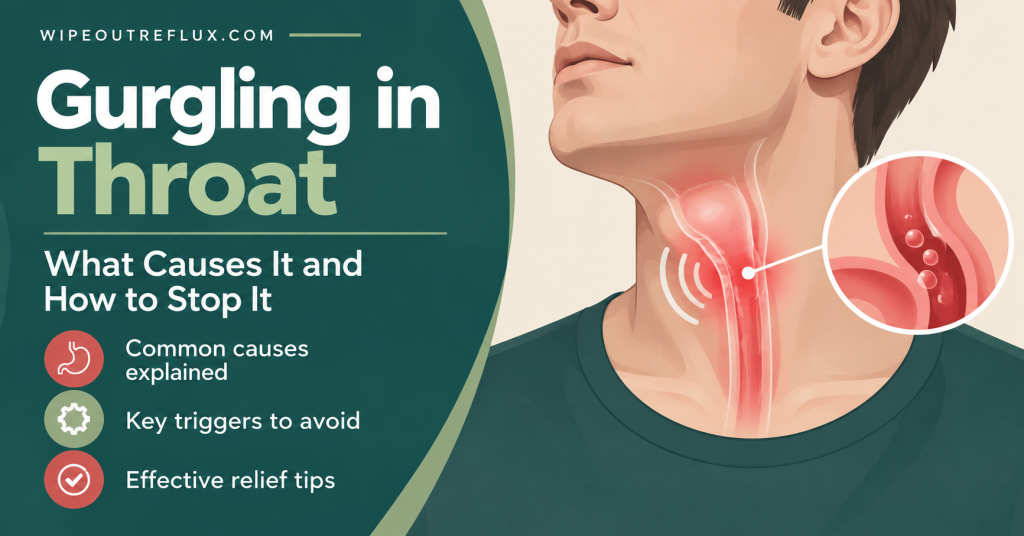
A gurgling sound in your throat is almost always fluid moving around where air is also moving. That fluid is usually saliva, mucus or a small amount of something that has come back up from the stomach. The most common causes are post-nasal drip, thick mucus from silent reflux (LPR), and saliva or reflux pooling in the throat when you lie down.
Gurgling that turns up after eating, when lying flat or at night, together with throat clearing or a lump feeling, points strongly towards reflux. Gurgling with regurgitated, undigested food and bad breath, especially in someone over 60, can be a sign of a pouch in the throat called Zenker’s diverticulum, and that’s worth getting checked.
Most throat gurgling is harmless and settles once you deal with the fluid behind it. Below I’ll go through each cause, how to tell them apart, and what actually stops it.
Key Takeaways
- Throat gurgling is the sound of air passing through saliva, mucus or refluxed liquid sitting at the back of the throat.
- The most common causes are post-nasal drip, excess mucus from silent reflux, and fluid pooling when you lie down.
- Gurgling after eating or when lying down, with throat clearing, hoarseness or a lump feeling, is a classic silent reflux pattern.
- Pepsin from reflux can switch on mucus production in airway cells, which is why reflux and “gurgly” phlegm so often go together.
- Gurgling with regurgitated undigested food, bad breath and trouble swallowing can point to Zenker’s diverticulum, which is most common after 60.
- A wet or gurgly voice straight after swallowing, especially with coughing during meals, should be assessed by a doctor or speech and swallowing therapist.
- Raising the head of the bed, not eating late, an alginate at bedtime and a lower-acid diet stop reflux-related gurgling for most people.
What Causes a Gurgling Sound in the Throat?
Your throat is a shared space. Air passes through it to reach your lungs, and food, drink, saliva and mucus pass through it on their way to your stomach. Normally you swallow often enough that nothing sits there for long. When something does sit there, every breath bubbles through it, and that’s the gurgle you hear and feel.
So the question is really: what is the fluid, and why is it hanging around? There are five main answers.
1. Post-nasal drip
Mucus from the nose and sinuses drains down the back of the throat all day. If you have a cold, allergies or sinus inflammation, there’s more of it and it’s thicker. It collects just above the voice box, and you hear it as a rattle or gurgle, especially in the morning. Post-nasal drip is one of the most common causes of throat irritation and cough in adults [Pratter, Chest, 2006]. I go into this in more depth in silent reflux and post-nasal drip.
2. Silent reflux (LPR) and excess mucus
This is the cause I see most often in readers, and the one most people don’t suspect. In laryngopharyngeal reflux, stomach contents travel up past the upper esophageal sphincter and reach the throat. Most people with LPR never get heartburn, which is why it gets missed [Koufman, The Laryngoscope, 1991].
Reflux causes gurgling in two ways. First, a small amount of liquid or froth can reach the throat directly. Second, and more commonly, the throat responds by making extra mucus to protect itself. In lab work on human airway cells, pepsin switched on a key mucus gene (MUC5AC) even without acid present [Choi et al., International Forum of Allergy & Rhinology, 2021]. That thick, sticky mucus is what bubbles every time you breathe. If you’re forever clearing it, see phlegm stuck in your throat from acid reflux.
3. Saliva and fluid pooling when you lie down
When you lie flat, gravity stops helping. Saliva, mucus and anything that refluxes collects at the back of the throat instead of draining down. You also swallow far less once you fall asleep, so it stays there longer [Orr et al., Digestive Diseases and Sciences, 1981]. That’s why so many people only notice the gurgle in bed, or wake up with a wet, rattly throat.
4. Zenker’s diverticulum
A Zenker’s diverticulum is a small pouch that forms in the back wall of the throat, just above the esophagus, where the muscle is weakest. Food and saliva collect in the pouch, then spill back into the throat later. That produces a distinctive gurgling in the neck, often with regurgitation of undigested food you ate hours earlier, bad breath, coughing and difficulty swallowing [Nesheiwat and Antunes, StatPearls, 2023].
It’s rare and mainly affects people in their seventies and eighties. One telling sign on a throat scope is fluid pooling more on the left side of the throat; in one study this was seen in about half of people with a Zenker’s pouch but in under 3% of people with other swallowing problems [Ongkasuwan et al., Otolaryngology–Head and Neck Surgery, 2012]. My full guide is here: Zenker’s diverticulum.
5. A swallowing problem
Sometimes the gurgle is a sign that food or drink isn’t clearing the throat properly after each swallow, and a little is lingering near the airway. This can happen after a stroke, with Parkinson’s, with age, or with any condition that weakens the swallowing muscles. The giveaway is a “wet” or gurgly voice straight after eating or drinking, often with coughing or throat clearing during meals. Speech and swallowing therapists use voice changes after swallowing as one of their warning signs, though on its own it isn’t a perfect test [dos Santos et al., Dysphagia, 2022]. See dysphagia for more.
Is Throat Gurgling a Sign of Acid Reflux?
Often, yes. Gurgling isn’t one of the classic textbook reflux symptoms, but it sits right in the middle of the silent reflux picture. The Reflux Symptom Index, the questionnaire ENT doctors use to screen for LPR, scores “excess throat mucus or post-nasal drip” as one of its nine core symptoms [Belafsky et al., Journal of Voice, 2002]. That mucus is exactly what gurgles.
Reflux is a likely driver if your gurgling:
- Is worse after meals, especially large, late or fatty ones
- Is worse lying down or first thing in the morning
- Comes with frequent throat clearing, hoarseness, a lump feeling or a chronic cough
- Comes with a sour or bitter taste, or occasional liquid coming up into your mouth
- Flares after coffee, alcohol, fizzy drinks, citrus or tomato
- Hasn’t responded to antihistamines or nasal sprays
If several fit, score yourself on the Reflux Symptom Index. A score above 13 suggests reflux is likely to be involved.
In my own twelve years with LPR, the gurgle was one of the most annoying symptoms because it was constant and nobody else could hear it. It faded only once I got the reflux and the acid in my diet under control, because the mucus calmed down with it.
Gurgling in Throat After Eating
Gurgling that shows up within an hour or so of a meal usually has one of three explanations:
- Reflux after meals. A full stomach stretches, which makes the valve at the bottom of the esophagus relax more often. Small amounts of liquid or gas come up, reach the throat and trigger extra mucus. This is the most common reason.
- Food or liquid not clearing the throat. If the gurgle starts during the meal, or your voice sounds wet right after swallowing, a swallowing problem is more likely. That deserves an assessment.
- Zenker’s diverticulum. If the gurgle comes later, with food coming back up undigested, especially when you bend over or lie down, think about a pouch.
Also, some foods simply make mucus feel thicker for a while afterwards, dairy being the one people notice most. That’s usually a texture effect rather than true extra mucus, but if it bothers you, it’s easy to test by cutting it for a week or two.
Gurgling in Throat When Lying Down and at Night
This is the version I hear about most. You lie down, and within minutes there’s a bubbling or crackling sound in your throat with every breath. Sometimes it wakes you up, or your partner notices it.
Three things come together at night:
- Gravity stops draining your throat, so mucus and saliva pool.
- Reflux reaches higher. Lying flat makes it easier for stomach contents to travel all the way up, especially if you ate within a few hours of bed. See acid reflux at night.
- You swallow far less. During sleep, swallowing drops sharply, so whatever reaches the throat stays there longer [Orr et al., Digestive Diseases and Sciences, 1981].
If the gurgling ever escalates into waking up coughing, gasping or feeling like you can’t get air in, that’s usually a brief spasm of the vocal cords triggered by reflux. It’s frightening but it passes. I explain what’s happening and how to stop it in waking up choking from acid reflux.
Gurgling in Throat and Chest
If you can hear or feel gurgling lower down, in your chest as well as your throat, the fluid is more likely to be in your airways than just sitting in the throat. Common reasons include a chest infection or bronchitis, asthma, COPD and mucus being coughed up from the lungs.
Reflux can be involved here too. Repeated small amounts of refluxed material reaching the airways can inflame the bronchial tubes and drive a wet, productive cough. I cover this in acid reflux bronchitis.
Chest gurgling with breathlessness that is getting worse, breathlessness when lying flat, swollen ankles, a fever or frothy or blood-stained sputum should be seen by a doctor promptly, because those point away from simple reflux.
Gurgling in Throat After Swallowing
A gurgle immediately after you swallow, often with a voice that sounds wet or bubbly, means a little of what you swallowed has stayed behind near the voice box. Occasionally that’s just a sip going down “the wrong way”. If it happens regularly, it’s worth an assessment, because it can mean small amounts are reaching the airway.
Reflux can contribute indirectly. Long-standing throat inflammation can make the area less sensitive and the swallow a little less coordinated. But a regular post-swallow gurgle shouldn’t be put down to reflux without a proper look. A swallowing assessment by a speech and language therapist is simple and very informative.
Cough With Gurgling in Throat
A cough that sounds wet and gurgly usually means you’re trying to shift mucus. If it’s been going on for weeks without a cold, the usual suspects are post-nasal drip, reflux and asthma, which together account for most chronic coughs in adults. A reflux cough often comes after meals, when lying down, when talking a lot or first thing in the morning. See reflux cough for the full picture, and how to stop constant throat clearing if you’re clearing more than coughing.
Gurgling in Throat When Breathing
If you hear a gurgle with every breath while you’re awake and sitting up, there’s usually a fair amount of mucus sitting just above the vocal cords. Try a firm swallow followed by a gentle cough. If the sound disappears and slowly comes back, it’s mucus. That’s typically post-nasal drip or reflux.
If the sound doesn’t clear with swallowing or coughing, if it’s more of a whistle or high-pitched noise, or if you feel short of breath, get it checked. Noisy breathing that doesn’t clear needs a proper look at the airway.
How to Stop Gurgling in Your Throat
The fix depends on the fluid, but because reflux and post-nasal drip are behind most cases, these steps help most people.
If reflux is likely
- Stop eating three hours before bed. For night-time gurgling, this is the most effective single change. See how long before bed you should stop eating.
- Raise the head of your bed by about 15 to 20 cm with risers or a wedge rather than extra pillows. See how to raise the head of your bed.
- Sleep on your left side. Left-side sleeping was linked to less acid exposure and faster clearing than lying on your back or right side [Schuitenmaker et al., American Journal of Gastroenterology, 2022].
- Take an alginate after meals and at bedtime. Alginates form a raft on top of the stomach contents. In a trial of 49 people with LPR, Gaviscon Advance improved symptoms and throat appearance compared with no treatment [McGlashan et al., European Archives of Oto-Rhino-Laryngology, 2009]. See alginates for acid reflux.
- Take the acid out of your diet for a few weeks. Pepsin that’s stuck to throat tissue is switched back on by anything acidic, including acidic food and drink, not just reflux [Johnston et al., The Laryngoscope, 2007]. A strict low-acid diet clearly improved symptoms in people with stubborn LPR [Koufman, Annals of Otology, Rhinology & Laryngology, 2011], and a plant-based Mediterranean-style diet with alkaline water worked as well as acid-reducing medication in another study [Zalvan et al., JAMA Otolaryngology–Head and Neck Surgery, 2017]. My Wipeout Diet Plan lays out exactly what to eat and drink while the throat settles, so you’re not guessing meal by meal.
If it’s post-nasal drip
- Rinse your nose with saline once or twice a day
- Try a steroid nasal spray for a few weeks if allergies or congestion are part of it
- Run a humidifier if your bedroom air is dry, so mucus stays thin enough to swallow
Simple things that help either way
- Stay well hydrated. Thin mucus is easier to swallow than thick mucus.
- Swallow instead of clearing. A hard throat clear slams the vocal cords together and makes more mucus. Try a sip of water and a firm swallow instead.
- Warm, low-acid drinks. Chamomile tea or warm water can loosen mucus without irritating the throat.
- Sit up for a few minutes if the gurgling starts in bed, and swallow a few times before lying back down.
Reflux-related gurgling usually starts easing within two to four weeks of consistent changes, but irritated throat tissue can take a couple of months to settle fully.
When to See a Doctor About Throat Gurgling
Most throat gurgling is mucus and nothing more. Book an appointment if:
- It has lasted more than three or four weeks despite the steps above
- You regularly bring up undigested food, especially hours after eating
- Your voice sounds wet or gurgly after you swallow, or you cough during most meals
- You’ve had pneumonia or chest infections that keep coming back
- Swallowing is getting harder, or you’re losing weight without trying
- You’ve been hoarse for more than three weeks
Seek urgent help if you have severe breathlessness, noisy breathing that won’t clear, chest pain, a high fever with a wet cough, or you cough up blood.
Depending on your symptoms, you might see an ENT specialist, who can look at your throat with a thin camera in a few minutes, or have a barium swallow, which is the standard way to find a Zenker’s pouch. My guide on when to see a doctor for LPR covers what to ask and what to expect.
Conclusion
A gurgling throat sounds strange, but it’s nearly always explained by fluid that isn’t draining away: post-nasal drip, extra mucus triggered by silent reflux, or saliva and reflux pooling when you lie down. The pattern tells you a lot. Gurgling after meals and at night, with throat clearing and hoarseness, points to reflux. Gurgling with undigested food coming back up or a wet voice after swallowing needs a proper look.
If reflux is behind yours, the most effective fix is controlling what reaches your throat and calming the mucus response, and that comes down to what you eat, when you eat and how you sleep. The Wipeout Diet Plan is where I’d start. It’s my complete, step-by-step plan for taking the acid out of your diet so pepsin stops irritating your throat, built from twelve years of managing this myself. I built it first for silent reflux, the throat-based form behind most gurgling and mucus, but because it works on the same underlying causes, it helps just as much with everyday heartburn and GERD.
If you’d prefer a lighter starting point, the Wipeout Food Reference Guide is the essential companion. It lists the foods and drinks that are safe for acid reflux and LPR, with their pH values, so you can quickly check what might be feeding the mucus in your throat.
Frequently Asked Questions
Why does my throat gurgle when I breathe?
There’s usually mucus or saliva sitting just above your voice box, and air bubbles through it as you breathe. Post-nasal drip and silent reflux are the most common reasons. If a swallow and a gentle cough clear the sound, it’s almost certainly mucus.
Can acid reflux cause gurgling in the throat?
Yes. Silent reflux can bring small amounts of liquid into the throat and, more often, triggers the throat to produce extra thick mucus. That mucus gurgles with each breath. It’s typically worse after meals, when lying down and in the morning.
Why does my throat gurgle when I lie down?
Lying flat stops gravity from draining mucus and saliva, makes it easier for reflux to reach the throat, and once you’re asleep you swallow much less. Raising the head of the bed, not eating within three hours of bedtime and sleeping on your left side usually help.
Is gurgling in the throat serious?
Usually not. Most cases are mucus from post-nasal drip or reflux. It’s worth getting checked if it comes with regurgitated undigested food, a wet voice after swallowing, frequent coughing during meals, weight loss, or chest infections that keep coming back.
What does gurgling in the throat after swallowing mean?
It usually means some food, drink or saliva stayed behind near the voice box instead of going down. An occasional one is normal. If it happens most times you eat or drink, see a doctor or ask for a swallowing assessment.
Is throat gurgling a sign of Zenker’s diverticulum?
It can be. Gurgling in the neck is a well-known sign of Zenker’s, particularly with regurgitation of undigested food, bad breath and trouble swallowing. Zenker’s is rare and mostly affects people over 60, so in younger people reflux or post-nasal drip is far more likely.
How do I stop gurgling in my throat at night?
Stop eating at least three hours before bed, raise the head of your bed, sleep on your left side, take an alginate at bedtime and keep your bedroom air from getting too dry. If post-nasal drip is part of it, a saline rinse before bed helps too.
Research & References
- [Pratter, Chest, 2006] — Clinical guideline describing upper airway cough syndrome (post-nasal drip) as one of the most common causes of chronic cough and throat irritation in adults.
- [Koufman, The Laryngoscope, 1991] — Landmark study establishing laryngopharyngeal reflux, in which most patients had throat and voice symptoms while only a minority reported heartburn.
- [Choi et al., International Forum of Allergy & Rhinology, 2021] — In human airway epithelial cells, pepsin exposure increased production of the mucin MUC5AC even without acid, a direct mechanism for reflux-driven mucus overproduction.
- [Orr et al., Digestive Diseases and Sciences, 1981] — Showed that swallowing frequency falls sharply during sleep and acid takes much longer to clear, explaining why material reaching the throat at night lingers.
- [Nesheiwat and Antunes, StatPearls, 2023] — Clinical review of Zenker’s diverticulum describing regurgitation, halitosis, cough, aspiration and difficulty swallowing from food and secretions retained in the pouch, mainly in people aged 70 to 90.
- [Ongkasuwan et al., Otolaryngology–Head and Neck Surgery, 2012] — Case-control study finding greater pooling of secretions in the left piriform sinus in 52% of Zenker’s patients versus 3% of other dysphagia patients, with pooling reduced after surgery.
- [dos Santos et al., Dysphagia, 2022] — Systematic review of 17 studies on voice change after swallowing as an indicator of swallowing problems, concluding it is widely used but not yet reliable enough as a stand-alone test.
- [Belafsky et al., Journal of Voice, 2002] — Developed and validated the Reflux Symptom Index, a nine-item LPR questionnaire that includes excess throat mucus, with scores above 13 considered abnormal.
- [Schuitenmaker et al., American Journal of Gastroenterology, 2022] — Sleep-position and reflux monitoring study finding left-side sleeping was associated with less esophageal acid exposure and faster clearance than back or right-side sleeping.
- [McGlashan et al., European Archives of Oto-Rhino-Laryngology, 2009] — Randomized trial of Gaviscon Advance in 49 people with LPR, showing significantly better symptom and throat examination scores than no treatment.
- [Johnston et al., The Laryngoscope, 2007] — Showed pepsin remains stable at throat pH and is reactivated by acid, explaining ongoing throat irritation between reflux episodes.
- [Koufman, Annals of Otology, Rhinology & Laryngology, 2011] — Reported marked symptom improvement in patients with stubborn LPR after a strict low-acid diet.
- [Zalvan et al., JAMA Otolaryngology–Head and Neck Surgery, 2017] — Found a plant-based Mediterranean-style diet with alkaline water improved LPR symptoms at least as well as proton pump inhibitors.

David Gray
12 years living with LPR · Consultant & researcher
I've lived with LPR for twelve years — the misdiagnoses, the PPI courses that did nothing, the slow work of figuring out what actually helps. Wipeout Reflux is where I translate the research into plain terms for people stuck in the same place. Every claim here is sourced to peer-reviewed work, and I consult one-to-one with LPR sufferers.