
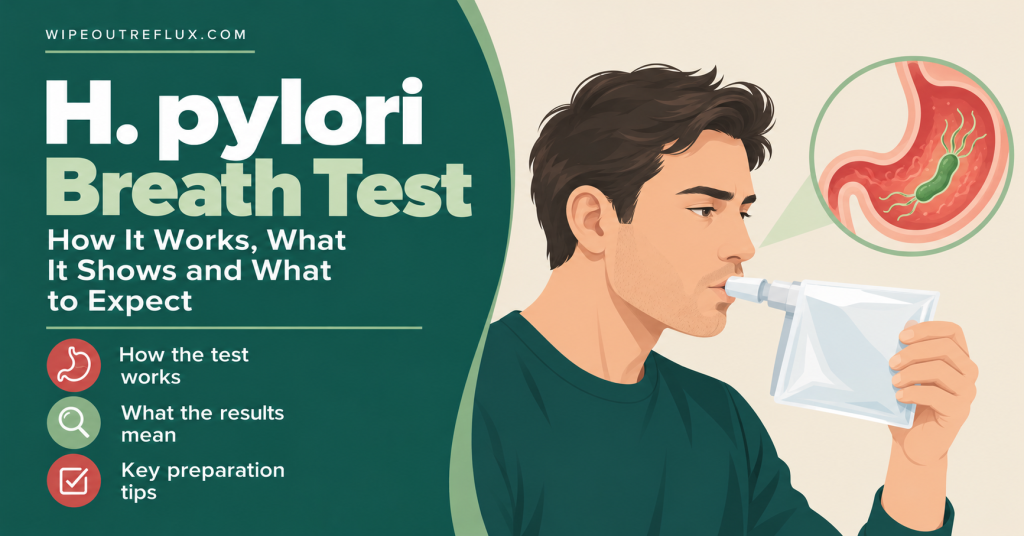
The H. pylori breath test (urea breath test, or UBT) checks for an active Helicobacter pylori infection in your stomach. You breathe into a bag, drink a solution containing a specially labeled form of urea, wait about 15 minutes, then breathe into a second bag. If H. pylori is present, its urease enzyme breaks the urea down, and the labeled carbon shows up in your breath.
It’s one of the most accurate non-invasive tests for H. pylori, detecting around 94% of infections in a large Cochrane review. But it only works if you prepare properly. Proton pump inhibitors (PPIs) like omeprazole need to be stopped for 2 weeks beforehand, and antibiotics and bismuth (Pepto-Bismol) for 4 weeks, or you risk a false negative. Most labs also ask you not to eat or drink for at least an hour before the test.
Quest Diagnostics and Labcorp both offer the test, and it’s also commonly done in doctor’s offices. Results usually come back within a few days.
Key Takeaways
- The urea breath test detects an active H. pylori infection, not a past one, so it can be used both to diagnose infection and to confirm it’s gone after treatment.
- It’s highly accurate: in a Cochrane review, the 13C breath test picked up 94% of infections.
- Stop PPIs 2 weeks before the test, and antibiotics and bismuth 4 weeks before, or the result may be falsely negative.
- Most labs ask for no food or drink for at least 1 hour before the test.
- Antacids and alginates like Gaviscon don’t interfere with the result, so they’re useful for managing reflux while you’re off your PPI.
- Rules for H2 blockers like Pepcid vary between labs, so check your instructions.
- After treatment, retest at least 4 weeks after finishing antibiotics to confirm the infection has cleared.
- The 13C test is non-radioactive. It’s a different test from the hydrogen breath test used for SIBO.
How the H. Pylori Breath Test Works
H. pylori survives in the harsh acid of your stomach thanks to one trick: it produces large amounts of an enzyme called urease. Urease breaks down urea, a waste product found naturally in the stomach, into ammonia and carbon dioxide. The ammonia forms a protective cloud around the bacteria that neutralizes the acid around them.
The breath test turns that survival trick into a detection method. You drink urea that has been labeled with carbon-13, a natural, non-radioactive form of carbon. If H. pylori is in your stomach, its urease splits the labeled urea, and the labeled carbon dioxide is absorbed into your blood, carried to your lungs and breathed out. The lab compares the ratio of carbon-13 to normal carbon-12 in your breath before and after the drink. A clear rise means urease is active in your stomach, which means H. pylori is there.
Because the test needs live, active bacteria producing urease, it only shows a current infection. That’s its big advantage over blood antibody tests, which stay positive for months or years after the infection is gone.
13C vs 14C breath tests
There are two versions. The 13C test, used by most labs in the US and UK, uses a stable, non-radioactive isotope. The older 14C test uses a very small dose of radioactive carbon. It’s accurate, but the 13C test is preferred for children and pregnant women. If you’re booked for a breath test at Quest or Labcorp, it will be a 13C test.
Not the same as a SIBO breath test
People often confuse this with the hydrogen breath test for small intestinal bacterial overgrowth (SIBO). That test measures hydrogen and methane after a sugar drink, takes up to 3 hours and needs a special diet the day before. The H. pylori test is much quicker and simpler. If you’ve been told you need a SIBO test, see SIBO and acid reflux.
Preparation for the H. Pylori Breath Test
This is the part most people get wrong, and it matters most if you have reflux. Several common reflux medications suppress H. pylori enough to give a false negative. You’d be told you’re clear when you’re not.
Medications to stop
- Proton pump inhibitors (PPIs): stop 2 weeks before. This includes omeprazole (Prilosec), esomeprazole (Nexium), lansoprazole (Prevacid), pantoprazole (Protonix), rabeprazole (Aciphex) and dexlansoprazole (Dexilant). Vonoprazan (Voquezna) suppresses acid even more strongly and should be stopped too.
- Antibiotics: stop 4 weeks before.
- Bismuth: stop 4 weeks before. That includes Pepto-Bismol and some other stomach remedies.
Those are the windows recommended in the American College of Gastroenterology’s 2024 H. pylori guideline [Chey et al., American Journal of Gastroenterology, 2024]. Some lab and kit instructions list 2 weeks for bismuth rather than 4, so if your sheet differs, ask, and when in doubt use the longer gap.
Why PPIs matter so much: PPIs raise the pH in the stomach, and H. pylori moves away from the less acidic lower stomach and becomes less active. The urease signal drops even though the infection is still there. In one study of people with confirmed H. pylori, 45% tested falsely negative on the breath test after 4 weeks of omeprazole 40 mg a day, and the effect took around 2 to 4 weeks to wear off after stopping [El-Nujumi et al., European Journal of Gastroenterology & Hepatology, 1998].
What about H2 blockers like Pepcid?
H2 blockers such as famotidine (Pepcid) suppress acid less strongly than PPIs, and their effect on the breath test is smaller. Instructions vary between labs. Some ask you to stop them 2 weeks before, others only for a day or two. Follow the instructions from your lab or doctor.
What you can take
Antacids like Tums and alginates like Gaviscon don’t affect the breath test. Most labs are happy for you to use them until the day before. This makes them the obvious bridge while you’re off your PPI. See alginates for acid reflux and Tums vs Gaviscon.
Coming off your PPI for the test
This is where my reflux readers struggle most. Two weeks off a PPI often brings a rebound flare, because the stomach temporarily overproduces acid after the drug is stopped. Some practical steps:
- Talk to your doctor first. Don’t stop a PPI on your own if you have Barrett’s esophagus, a recent ulcer or bleeding, or severe erosive esophagitis. They may prefer a test that can be done on a PPI, such as an endoscopy with biopsies.
- Take an alginate after meals and at bedtime to block reflux physically.
- Keep an antacid on hand for breakthrough symptoms.
- Eat smaller meals, stop eating 3 hours before bed and raise the head of your bed.
- Cut the big triggers for these 2 weeks: coffee, alcohol, fizzy drinks, citrus, tomato, chocolate and fatty food.
A low-acid diet is the most reliable way I know to get through a PPI break, and it’s the foundation of the Wipeout Diet Plan. For more on handling rebound, see getting off PPIs and acid rebound.
Can I drink water before the H. pylori breath test?
Most labs ask you not to eat or drink anything for at least 1 hour before the test. Food in the stomach can affect how the test drink mixes and is broken down. Some labs allow small sips of plain water up to the hour before. If you’re unsure, have your last drink of water more than an hour before your appointment.
Can you eat before the H. pylori breath test?
You can eat normally up to the fasting window, which is usually 1 hour. Some labs ask for a longer fast or an overnight fast, so check your instructions. Booking a morning appointment makes it easy: eat breakfast early or simply skip it, then eat straight after the test.
Prep checklist
- 4 weeks before: stop antibiotics (if your doctor agrees) and bismuth products.
- 2 weeks before: stop your PPI. Start using alginates and antacids instead.
- Check your lab’s rule on H2 blockers.
- 1 hour before (or as instructed): no food or drink.
- Bring a list of everything you’ve taken in the past month.
What Happens During the Test
The test takes about 20 to 30 minutes and is painless:
- Baseline breath sample. You breathe out through a straw into a collection bag or tube.
- The test drink. You drink a solution of carbon-13 labeled urea, usually dissolved with a citric acid powder, so it tastes slightly sour, like a fizzy drink without the fizz. The citric acid slows stomach emptying, giving the urea time to reach the bacteria.
- Wait. Usually 15 minutes. You sit quietly. Don’t eat, drink, smoke or chew gum.
- Second breath sample. You breathe into a second bag.
The bags go to the lab, where a machine measures the change in carbon-13. The result is reported as positive or negative, sometimes with a “delta over baseline” value showing how much the carbon-13 level rose.
The test drink contains aspartame in some kits, so tell the staff if you have phenylketonuria (PKU).
H. Pylori Breath Test at Quest Diagnostics
Quest lists the test as “Helicobacter pylori, Urea Breath Test” (test code 14839) in its test directory. You’ll need an order from your doctor. Not every Quest patient service center does breath tests, because the samples have to be timed, so call ahead or check when booking. Results typically come back within a few days and go to your doctor and your MyQuest account.
H. Pylori Breath Test at Labcorp
Labcorp lists it as “Helicobacter pylori Urea Breath Test” (test number 180836). As with Quest, your doctor orders it, and you should check that your local Labcorp location performs breath tests before you go. Results usually appear in the Labcorp patient portal and are sent to your doctor.
Whichever lab you use, the medication rules are the same, and they’re the most important thing to get right.
How Accurate Is the H. Pylori Breath Test?
Very. A Cochrane review pooling dozens of studies found the 13C urea breath test detected 94% of infections at a fixed specificity of 90%. That was better than both blood antibody tests (84%) and stool antigen tests (83%) [Best et al., Cochrane Database of Systematic Reviews, 2018]. The authors noted the study quality was often weak and that comparisons between tests were indirect, but the breath test consistently came out on top.
In practice, the accuracy depends almost entirely on preparation. Most “wrong” results come from people who were still taking a PPI, recently had antibiotics or took Pepto-Bismol.
What can cause a false negative
- PPIs, vonoprazan or (to a lesser degree) H2 blockers taken too close to the test
- Antibiotics or bismuth in the past 4 weeks
- Testing too soon after H. pylori treatment (less than 4 weeks)
- Previous stomach surgery, which can stop the drink staying in the stomach long enough
What can cause a false positive
- Very low stomach acid (achlorhydria), for example from atrophic gastritis, which lets other urease-producing bacteria grow
- Rare related bacteria, such as Helicobacter heilmannii
- Very young children, in whom results are less reliable
Breath test vs other H. pylori tests
- Stool antigen test: also detects active infection and also needs PPIs stopped. Slightly less accurate in the Cochrane review, but easy to do at home.
- Blood antibody test: can’t tell a current infection from a past one, so it isn’t used to check whether treatment worked.
- Endoscopy with biopsies: the most direct test, and useful if you also need your esophagus or stomach examined. See endoscopy for acid reflux.
What Your Results Mean
Positive result
A positive result means you have an active H. pylori infection. Current guidance is that everyone who tests positive should be treated. Treatment is usually a combination of acid suppression and antibiotics for 14 days, most often bismuth quadruple therapy, or a newer vonoprazan-based regimen [Chey et al., American Journal of Gastroenterology, 2024]. European guidance also recommends bismuth quadruple therapy as a first-line option [Malfertheiner et al., Gut, 2022]. Adults living in the same household may be advised to get tested too.
Negative result
If you prepared properly, a negative result is reliable. If you were still on a PPI or had antibiotics recently, it may be a false negative, and your doctor may suggest repeating it.
Testing after treatment
Treatment doesn’t always work, so you should be retested to confirm the infection is gone. This is called a test of cure. Do it at least 4 weeks after finishing the antibiotics, and stop PPIs for 2 weeks beforehand, just as for the first test [Chey et al., American Journal of Gastroenterology, 2024]. Breath or stool tests are used for this, never blood antibodies.
H. Pylori and Acid Reflux
Many of my readers get tested for H. pylori because they have reflux or indigestion that hasn’t settled. The relationship is more complicated than “H. pylori causes reflux.” H. pylori is a major cause of stomach ulcers and gastritis, and it can cause indigestion, upper abdominal pain, nausea and bloating that feel very like reflux. But clearing it doesn’t reliably cure GERD, and in some people reflux symptoms carry on or even become more noticeable afterward.
I cover this in detail in H. pylori and acid reflux. If you’re trying to tell ulcer-type pain from reflux, see stomach ulcer or acid reflux and gastritis vs acid reflux. For the bigger picture on testing, see how acid reflux is diagnosed.
Conclusion
The H. pylori breath test is quick, painless and one of the most accurate ways to find out whether you have an active infection. The catch is preparation. Stop PPIs 2 weeks before, antibiotics and bismuth 4 weeks before, follow your lab’s fasting rule, and check whether they want H2 blockers stopped. Get that right and you can trust the result. If you test positive and get treated, a repeat breath test at least 4 weeks after the antibiotics confirms the infection is gone.
For reflux sufferers, the hardest part is often the 2 weeks off a PPI. That’s where diet does the heavy lifting. The Wipeout Diet Plan is what I’d use to get through it. It’s my complete plan for calming reflux through what and when you eat, so you’re not relying on acid suppression to keep symptoms down. I designed it mainly for LPR, the stubborn throat-based form, but it works on the same root causes, so it’s just as useful for classic heartburn and GERD.
If you want something lighter to keep you on track during the washout, the Wipeout Food Reference Guide is the essential companion. It lists foods and drinks that are safe for acid reflux and LPR, with their pH values, so you can quickly check what’s safe to eat while you’re off your medication.
Frequently Asked Questions
How do you prepare for an H. pylori breath test?
Stop PPIs such as omeprazole for 2 weeks before, and antibiotics and bismuth (Pepto-Bismol) for 4 weeks before. Check whether your lab wants H2 blockers like Pepcid stopped. Don’t eat or drink for at least 1 hour before the test, or longer if your lab asks. Antacids and alginates are fine until the day before.
Can I drink water before an H. pylori breath test?
Most labs ask for nothing to eat or drink for at least 1 hour before the test, including water. Some allow small sips of plain water. Follow your lab’s instructions, and if unsure, have your last drink more than an hour before.
How accurate is the H. pylori breath test?
Very accurate. A Cochrane review found the 13C breath test detected about 94% of infections, more than blood or stool tests. Accuracy drops if you’ve taken PPIs, antibiotics or bismuth too close to the test, which can cause false negatives.
Why do I have to stop omeprazole before an H. pylori test?
PPIs like omeprazole reduce H. pylori activity in the stomach, so the bacteria produce less urease and the test can come back falsely negative. In one study, 45% of infected people tested negative after 4 weeks on omeprazole. Stopping for 2 weeks lets the bacteria become active again.
Can I take Gaviscon or Tums before the breath test?
Yes. Antacids and alginates don’t affect the result. Most labs allow them until the day before, which makes them a useful way to manage reflux while you’re off your PPI.
How long does an H. pylori breath test take?
About 20 to 30 minutes. You give a breath sample, drink the test solution, wait around 15 minutes and give a second sample. Results usually come back in a few days.
When should I retest after H. pylori treatment?
At least 4 weeks after finishing the antibiotics, with PPIs stopped for 2 weeks before the test. A breath or stool test is used for this. Blood tests can’t confirm the infection has cleared.
Research & References
- [Chey et al., American Journal of Gastroenterology, 2024] — The ACG clinical guideline on H. pylori, advising that PPIs be held for 2 weeks and bismuth and antibiotics for 4 weeks before testing, that all infected patients be treated, and that test of cure be done at least 4 weeks after therapy.
- [Best et al., Cochrane Database of Systematic Reviews, 2018] — Review of non-invasive H. pylori tests; at a fixed specificity of 0.90, sensitivity was 0.94 for the 13C urea breath test, 0.92 for the 14C breath test, 0.84 for serology and 0.83 for stool antigen.
- [El-Nujumi et al., European Journal of Gastroenterology & Hepatology, 1998] — 45% of H. pylori-positive patients had false negative breath tests after 4 weeks of omeprazole 40 mg daily, with the effect persisting for 2 to 4 weeks after stopping.
- [Malfertheiner et al., Gut, 2022] — The Maastricht VI/Florence consensus report on managing H. pylori infection, covering diagnosis, treatment regimens and confirmation of eradication.

David Gray
12 years living with LPR · Consultant & researcher
I've lived with LPR for twelve years — the misdiagnoses, the PPI courses that did nothing, the slow work of figuring out what actually helps. Wipeout Reflux is where I translate the research into plain terms for people stuck in the same place. Every claim here is sourced to peer-reviewed work, and I consult one-to-one with LPR sufferers.