
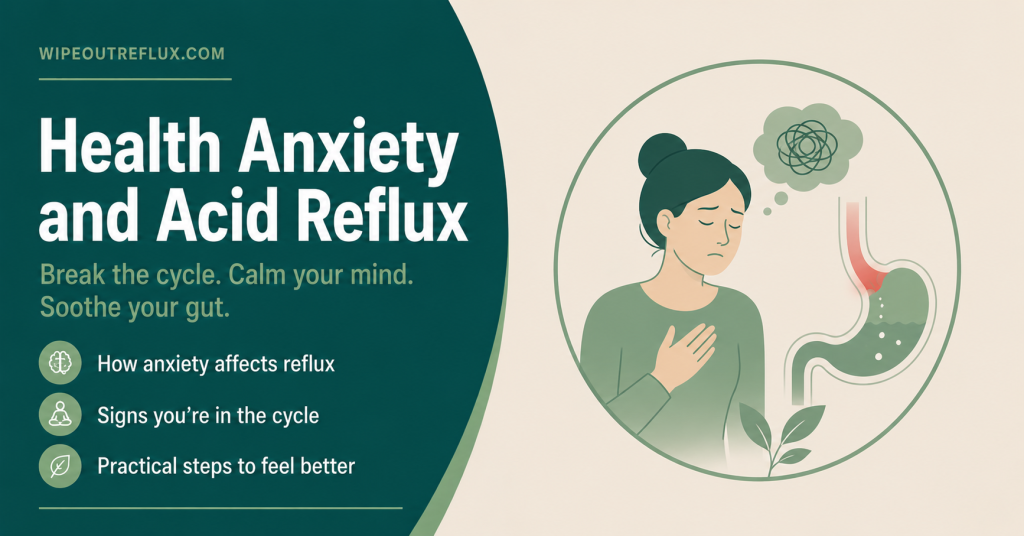
Health anxiety and acid reflux feed each other, and the engine that keeps the cycle turning is something that feels helpful but isn’t: checking. When reflux gives you a lump in the throat, a burning chest or a tickle that won’t clear, health anxiety makes you monitor it — swallowing to test the lump, clearing your throat, scanning your body, googling symptoms at midnight. Every check trains your nervous system to watch that area more closely, and the closer it watches, the more it feels. The symptom gets louder, not quieter.
This isn’t a character flaw or a sign you’re “being dramatic.” It’s a well-documented feature of how the oesophagus and the brain talk to each other. In fact, the research is striking: how severe reflux symptoms feel often tracks far more closely with anxiety and hyper-awareness than with how much acid is actually present. Understanding that changes everything about how you break the loop.
Here’s how health anxiety and reflux lock together, why symptom checking backfires, and the practical ways to interrupt the cycle from both ends — without ever dismissing the fact that your symptoms are completely real.
Key Takeaways
- Health anxiety and reflux form a self-reinforcing loop: real reflux sensations trigger worry, and worry amplifies how intensely you feel them.
- Symptom checking is the fuel — monitoring, throat clearing, swallowing tests and repeated googling all sharpen your brain’s focus on the area and make sensations feel worse.
- Research shows reflux symptom severity relates strongly to oesophageal hypervigilance and anxiety, but often not to the actual amount of acid measured.
- This hyper-awareness is common across every type of reflux, and in silent reflux (LPR) it can matter more for how you feel than the reflux itself.
- Your symptoms are real — hypervigilance amplifies genuine sensations, it doesn’t invent them, so this is not “all in your head.”
- The cycle breaks from both sides: reduce the real reflux that sets off the alarms, and gently retrain the checking and catastrophising that amplify them.
How the reflux-anxiety loop works
Let me walk through the cycle, because seeing the mechanism is the first step to loosening its grip. It usually starts with something genuinely physical — a reflux episode that leaves your throat tight, a burning behind the breastbone, a lump-in-the-throat sensation that won’t shift. That sensation is uncomfortable and, understandably, a little alarming.
Health anxiety takes that alarm and runs with it. The mind asks “what if this is something serious?” and, to feel safer, starts monitoring the area for more information. But monitoring a body part doesn’t reassure the brain — it does the opposite. It tells the nervous system this region matters, so please report everything happening there in high definition. Sensations you’d normally never notice now reach conscious awareness, and each one feels like fresh evidence that something is wrong. More worry leads to more checking, more checking leads to more sensation, and the loop tightens. Stress also genuinely worsens reflux physically, which is why understanding how stress drives acid reflux matters here — the anxiety isn’t only amplifying the signal, it’s adding to it.
Why symptom checking makes it worse
This is the counterintuitive heart of it. Checking feels like taking control, but every check is a small instruction to your brain to pay even more attention. The behaviours are familiar to anyone caught in this: repeatedly swallowing to see if the lump is still there, clearing your throat again and again, pressing on your chest, testing whether you can breathe fully, and searching your symptoms online for the tenth time that day.
Each of these does three unhelpful things at once. It heightens your focus on the sensation, so you feel it more. It reinforces the belief that the sensation is dangerous and needs watching. And in the case of throat clearing, it can physically irritate an already sensitive throat, producing more of the very mucus and rawness you’re worried about — a genuinely self-perpetuating loop. Reassurance from googling or from repeated doctor visits works the same way: the relief lasts minutes, then the doubt returns and the search starts again. The checking never delivers the lasting safety it promises, because certainty about your own body is something no amount of monitoring can provide.
What the research actually shows
Here’s the part I find genuinely reassuring, and it’s backed by solid gastroenterology research rather than reassurance for its own sake. When researchers measure both how severe people’s reflux symptoms feel and how much acid is actually reaching their oesophagus, the two often don’t match. What symptom severity does track closely with is oesophageal hypervigilance and visceral anxiety — essentially, how much attention and fear the person directs at their oesophagus [Wong et al., Alimentary Pharmacology & Therapeutics, 2021].
This isn’t a fringe finding. Hypervigilance and symptom-specific anxiety show up across the whole spectrum of reflux presentations — erosive, non-erosive, functional and non-acid reflux alike — regardless of how much acid the tests detect [Guadagnoli et al., Neurogastroenterology & Motility, 2021]. And in silent reflux specifically, studies find that hypervigilance and anxiety may be more important than the reflux burden itself in determining how bad the throat symptoms feel [Wong et al., American Journal of Gastroenterology, 2023]. If your reflux symptom scores feel disproportionate to what any test shows, this is very likely part of why — and it’s a mechanism you can actually work with.
“Real, but amplified” — the key reframe
I want to be careful here, because the wrong takeaway is “so it’s all in my head.” That’s not what the science says, and it’s not what I’m saying. Your symptoms are real. The burning, the lump, the tightness — you genuinely feel all of it. Hypervigilance doesn’t manufacture sensations out of nothing; it turns up the volume on real ones until they dominate your day.
That reframe — real, but amplified — is the one that helps, because it points to a way out that dismissiveness never could. You’re not being told to ignore a phantom. You’re being shown that a genuine signal is being amplified by attention and fear, and that the amplifier has a volume knob you can reach. Turning it down doesn’t require pretending you feel fine; it requires changing your relationship to the sensation. This is also why being told “it’s just anxiety” by a rushed clinician feels so invalidating and unhelpful — it’s half-right about the amplification but wrong to imply the reflux isn’t real, and the same confusion runs through the question of whether silent reflux causes anxiety in the first place.
How to break the cycle
Because the loop runs both ways, you break it from both ends: quieten the real reflux that keeps setting off the alarm, and gently retrain the checking and catastrophising that amplify it.
- Reduce the checking, deliberately. This is the hardest and most important step. Each time you resist the urge to swallow-test the lump, clear your throat, or google, you weaken the loop. It feels worse briefly, then the sensation fades faster than when you check. Aim to postpone and reduce, not white-knuckle perfection.
- Cut the reassurance-seeking. Endless googling and repeat appointments feel productive but keep the fear topped up. Agree a sensible plan with one doctor, then stop re-litigating it hourly online.
- Calm the nervous system directly. Slow breathing exercises downregulate the stress response that both amplifies and worsens reflux, working on the same vagus nerve pathway that links gut and mind.
- Treat the actual reflux. The fewer genuine reflux episodes there are, the less raw material the anxiety has to amplify — which is where a structured silent reflux treatment approach pays off twice over.
- Get proper support if it’s taking over. If health anxiety is dominating your life, therapies like CBT are genuinely effective for it, and there’s no shame in getting help — it’s a recognised, treatable pattern, not a weakness.
Conclusion
Health anxiety and acid reflux trap so many people precisely because the instinct to check feels like the solution when it’s actually the fuel. The reassuring truth from the research is that how bad reflux feels is powerfully shaped by hypervigilance and anxiety rather than by acid alone — which means the intensity you’re experiencing is real, but it’s also something you can turn down. Reduce the checking, ease the reassurance-seeking, calm the nervous system, and get support if it’s overwhelming: the loop loosens from the anxiety side more than most people expect.
At the same time, the most grounding move is to shrink the physical reflux that keeps triggering the alarms in the first place, because fewer genuine sensations means less for an anxious mind to seize on — and that comes down to what you eat and drink. The Wipeout Diet Plan is the complete, step-by-step method I built to calm reflux at its source; it was designed first and foremost around LPR, the throat-based form behind so many of these anxiety-provoking symptoms, but because it targets the same underlying mechanisms it works just as well for GERD, heartburn and classic acid reflux. If you’d like a gentler starting point, the Wipeout Food Reference Guide is the essential companion, showing which foods and drinks are safe for reflux and LPR and their pH values. Settle the real reflux, stop feeding the checking loop, and the two halves of the cycle stop reinforcing each other.
One important note: if you have new, severe or unexplained symptoms — particularly chest pain, difficulty swallowing, unintended weight loss, or anything that frightens you — get them checked properly by a doctor. Breaking the checking habit is about stopping the endless re-checking of a known, benign pattern, never about ignoring genuine warning signs.
Frequently Asked Questions
Can health anxiety make acid reflux worse?
Yes, in two ways. Anxiety physically worsens reflux by ramping up the stress response, and health anxiety amplifies how intensely you perceive the reflux sensations you do have. Research shows reflux symptom severity often tracks more closely with anxiety and hyper-awareness than with the actual amount of acid, so calming the anxiety side genuinely reduces how bad symptoms feel.
Why does checking my symptoms make them feel worse?
Because monitoring a body part tells your brain that area is important and to report every sensation in detail. That heightened focus makes normally unnoticed feelings reach awareness, so you feel more, not less. Checking also reinforces the belief that the sensation is dangerous, and behaviours like throat clearing can physically irritate the throat, adding real symptoms to the amplified ones.
Is my throat lump real or just anxiety?
It’s almost certainly real — but its intensity is likely being amplified by hyper-awareness. Reflux commonly causes a genuine globus (lump) sensation, and anxiety then magnifies it by keeping your attention locked on your throat. “Real but amplified” is usually the accurate description, which is why treating the reflux and easing the checking both help. Persistent or one-sided swallowing difficulty should always be checked by a doctor.
How do I stop obsessively worrying about my reflux symptoms?
The core move is to reduce checking and reassurance-seeking, since those keep the worry alive. Postpone the urge to swallow-test, throat-clear or google; calm your nervous system with slow breathing; and reduce the real reflux so there’s less to react to. If the worry dominates your life, cognitive behavioural therapy is highly effective for health anxiety and well worth seeking out.
Does treating reflux reduce the anxiety too?
Often, yes. When there are fewer genuine reflux sensations setting off the alarms, there’s less for an anxious mind to fixate on, so the anxiety tends to ease alongside the physical symptoms. It usually works best combined with directly tackling the checking and catastrophising, since those can keep the cycle going even as the reflux improves.
Research & References
- Study of reflux patients finding that oesophageal hypervigilance and visceral anxiety related to reflux symptom severity and psychological distress, but not to objective acid reflux burden or mucosal integrity — indicating that symptom intensity is strongly shaped by attention and anxiety rather than acid alone [Wong et al., Alimentary Pharmacology & Therapeutics, 2021].
- Study showing that oesophageal hypervigilance and symptom-specific anxiety are prevalent across the full spectrum of GERD presentations — including erosive, non-erosive and functional forms — independent of measured acid exposure [Guadagnoli et al., Neurogastroenterology & Motility, 2021].
- Study of laryngopharyngeal reflux (silent reflux) finding that oesophageal hypervigilance and symptom-specific anxiety may be more important than reflux burden in determining how severe patients’ symptoms feel [Wong et al., American Journal of Gastroenterology, 2023].

David Gray
12 years living with LPR · Consultant & researcher
I've lived with LPR for twelve years — the misdiagnoses, the PPI courses that did nothing, the slow work of figuring out what actually helps. Wipeout Reflux is where I translate the research into plain terms for people stuck in the same place. Every claim here is sourced to peer-reviewed work, and I consult one-to-one with LPR sufferers.