
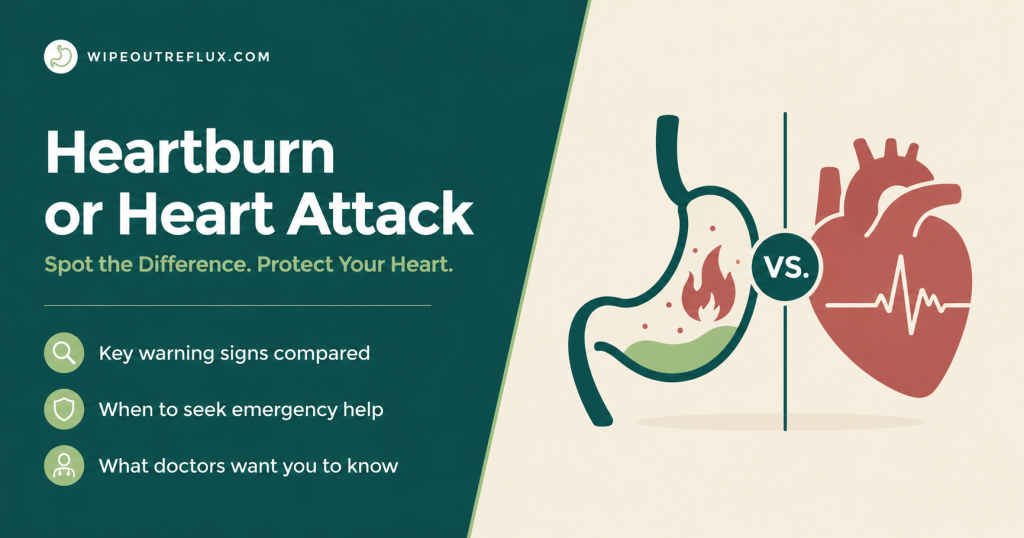
If you’ve got chest pain right now and you’re not sure whether it’s heartburn or a heart attack, don’t try to diagnose it from an article — if there’s any doubt, call your local emergency number (911 in the US) straight away. A heart attack is far safer to over-react to than to miss. That said, once serious causes have been ruled out, the truth is that acid reflux is one of the most common reasons people end up in the ER with chest pain that turns out not to be their heart at all.
Here’s the short version of how they differ. Heartburn usually feels like a burning that rises up behind the breastbone toward your throat, often after eating or when you lie down, sometimes with a sour taste, and it tends to ease with an antacid. A heart attack more often feels like pressure, tightness, or squeezing in the center or left of the chest that can spread to the arm, jaw, neck, or back, and it’s commonly joined by shortness of breath, a cold sweat, nausea, or lightheadedness. Antacids won’t touch it.
The catch is that these two can feel almost identical, which is exactly why emergency teams run tests rather than guess. Below I’ll walk through the real differences, the red flags that mean stop reading and get help, and why reflux causes chest pain in the first place — but please treat the safety advice as the most important part.
Key Takeaways
- When in doubt, treat chest pain as a possible heart attack and call emergency services — it’s always better to be checked and cleared.
- Heartburn is typically a burning sensation that rises toward the throat, often after meals or lying down, and usually eases with an antacid.
- A heart attack is more often pressure or squeezing that may radiate to the arm, jaw, neck, or back, with shortness of breath, cold sweat, nausea, or dizziness.
- Reflux pain is usually linked to food, position, or an empty stomach; heart pain often comes on with exertion and doesn’t care what you ate.
- Antacids can relieve reflux but will not relieve a heart attack — never use “the antacid didn’t work” as your only test.
- Gastroesophageal reflux disease is the single most common non-cardiac cause of chest pain, so once your heart is cleared, reflux is a leading suspect.
- The symptoms genuinely overlap, and certain groups (women, older adults, people with diabetes) can have atypical heart attacks — so err on the side of caution.
Why Heartburn and a Heart Attack Feel So Alike
It seems strange that a digestive problem and a heart problem could feel the same, but there’s a simple reason: your heart and your esophagus share the same neighborhood and, to a large extent, the same nerve supply. Your esophagus (the food pipe) runs directly behind your heart, and pain signals from both travel along overlapping nerve pathways into the same region of your spinal cord. Your brain then has to work out where a deep, dull chest signal is coming from — and it often can’t tell them apart.
That’s not a minor overlap. Chest pain caused by the esophagus can be genuinely indistinguishable from the pain of heart disease, which is why a proper cardiac work-up has to come first before anyone blames the gut Fass & Achem, Journal of Neurogastroenterology and Motility, 2011. So if you’ve ever been sent home from the ER being told your heart is fine but the pain was very real, you’re not imagining it — and reflux is one of the usual culprits.
The Key Differences (When You Have Time to Think)
This section only applies when the pain is mild, familiar, and you’re not experiencing any of the red flags further down. If you are, skip straight to calling for help. Otherwise, these are the features that tend to separate the two.
What the pain actually feels like
Heartburn is a burning. It rises from behind the lower breastbone up toward your throat, and it often brings a sour or bitter taste as stomach contents travel up. A heart attack is usually described as pressure, fullness, squeezing, or a heavy weight on the chest rather than a burn. If someone clenches a fist over their breastbone as they describe it, that’s a classic cardiac gesture; if they draw a line rising up toward the throat, that leans reflux.
Where it is and where it spreads
Reflux pain tends to stay central, behind the breastbone, and points upward toward the throat. Heart-attack pain frequently radiates outward — into the left arm or both arms, the jaw, the neck, the shoulders, or the upper back. Pain traveling into your jaw or down your arm is a heart symptom until proven otherwise.
What sets it off
Heartburn is usually tied to something you did: a large or fatty meal, a trigger food, bending over, or lying down soon after eating. It can even show up on an empty stomach when there’s acid but no food to buffer it — there’s more on that in why you can get heartburn when you haven’t eaten. A heart attack, by contrast, often comes on with physical exertion or emotional stress and doesn’t care whether or what you’ve eaten.
How long it lasts and what relieves it
Heartburn tends to come and go over minutes to a couple of hours and often eases when you sit up, take an antacid, or the meal digests. Cardiac pain that represents a heart attack typically persists, doesn’t reliably improve with position, and — crucially — will not be fixed by an antacid. But please don’t run this as a home experiment: “the antacid didn’t help” is a reason to seek help, not a reason to wait longer.
The symptoms that come along for the ride
This is often the most telling difference. A heart attack is frequently accompanied by shortness of breath, a cold sweat, nausea or vomiting, lightheadedness, or a sense of impending doom. Reflux might come with a sour taste, a lump-in-the-throat feeling, or an irritated, burning throat, but it doesn’t usually drench you in a cold sweat or leave you gasping for air.
Red Flags: Stop and Get Emergency Help
No article can rule out a heart attack, and some heart attacks are quiet or atypical — women, older adults, and people with diabetes in particular can have heart attacks without the textbook crushing chest pain. Call your emergency number immediately if chest discomfort comes with any of the following:
- Pressure, tightness, or squeezing rather than a clear burn — especially in the center or left of the chest.
- Pain spreading to the arm(s), jaw, neck, shoulder, or back.
- Shortness of breath, with or without chest pain.
- A cold sweat, nausea, or vomiting alongside the pain.
- Lightheadedness, dizziness, or feeling like you might pass out.
- Pain brought on by exertion, or pain that is severe, new, or different from your usual reflux.
- Chest pain that lasts more than a few minutes, goes away and comes back, or that antacids don’t touch.
If you’re weighing it up, weigh it in favor of getting checked. Emergency teams would far rather see you and clear your heart than have you talk yourself out of a real emergency at home.
When It’s More Likely to Be Reflux
Once your heart has actually been checked and cleared — not just assumed to be fine — reflux becomes a very reasonable explanation for recurring chest pain. In fact, gastroesophageal reflux disease is the most common non-cardiac (esophageal) cause of chest pain, ahead of every other digestive explanation Li et al., Gastroenterology & Hepatology, 2024. Reflux-type chest pain is more likely when the discomfort burns rather than presses, follows meals or lying down, eases with antacids, and travels up toward your throat rather than out to your arm or jaw.
It also often keeps company with other reflux clues: a chronic cough, a hoarse voice, that persistent lump-in-the-throat sensation, or symptoms that flare at night. Reflux at night is especially common because lying flat removes gravity’s help — here’s more on acid reflux at night and why it can wake you with chest discomfort.
Why Reflux Causes Chest Pain in the First Place
Understanding the mechanism helps you take reflux chest pain seriously without panicking about your heart every time. There are two main ways reflux produces chest pain.
The first is direct acid irritation. When stomach acid — and pepsin, the digestive enzyme that comes up with it — washes back into the esophagus, it irritates the sensitive lining, and your brain reads that as a burning pain behind the breastbone. The second is esophageal spasm. Acid exposure can trigger the muscle of the esophagus to contract abnormally, producing a gripping, squeezing pain that mimics cardiac pain almost perfectly. This is a big reason reflux pain can feel like pressure rather than just a burn, and why it fools so many people.
There’s also a strong stress connection. Anxiety amplifies chest sensations and is extremely common in people with non-cardiac chest pain — at least half of patients with this kind of chest pain also have anxiety or depression, which can intensify the experience Li et al., Gastroenterology & Hepatology, 2024. Reflux can also set off heart palpitations and a fluttering feeling that adds to the worry, and in some people it contributes to breathlessness — both of which understandably make the whole thing feel more cardiac than it is.
How to Calm Reflux-Related Chest Pain
If your heart has been cleared and reflux is the confirmed cause, the goal is to stop acid and pepsin reaching your esophagus so the lining can settle and the spasms stop. A few of the biggest levers:
- Don’t eat late. Leave three hours between your last meal and lying down so your stomach is emptier when you’re horizontal.
- Sleep on an incline. Raising the head of the bed uses gravity to keep stomach contents down overnight — see the best sleeping position for reflux.
- Ease the acute burn sensibly. Antacids or an alginate raft can settle an episode, but if there’s ever any doubt about your heart, that’s an emergency, not an antacid moment. Here’s the lowdown on baking soda for heartburn and when it helps.
- Fix the food that’s feeding it. Cutting fatty, fried, acidic, and trigger foods reduces how much reflux you generate in the first place — this is where lasting relief actually comes from, and it’s exactly what the Wipeout Diet Plan is built around, originally for LPR and silent reflux but equally effective for classic heartburn and GERD.
The Bottom Line
Heartburn and a heart attack can feel remarkably alike because your esophagus and your heart sit side by side and share the same nerves, so your brain honestly struggles to tell them apart. The useful rules of thumb are that heartburn tends to burn, rise toward the throat, follow meals or lying down, and ease with an antacid — while a heart attack tends to press or squeeze, spread to the arm, jaw or back, and arrive with shortness of breath, a cold sweat, nausea, or dizziness that antacids do nothing for. But rules of thumb are not a diagnosis. If you are ever unsure, or if any of the red flags are present, call emergency services and let professionals rule out your heart. Missing a heart attack is a far worse outcome than an unnecessary trip to be checked.
Once your heart has been properly cleared, reflux is a genuinely common and very treatable explanation for recurring chest pain — it’s the leading non-cardiac cause. And because reflux chest pain comes down to how much acid and pepsin reach your esophagus, the real fix is upstream: what you eat, when you eat it, and how you protect yourself overnight. A great place to start is the Wipeout Food Reference Guide, the essential reference to which foods and drinks are safe for acid reflux and LPR along with their pH values, so you can build a low-reflux diet without guesswork. And if you want the complete, step-by-step system for calming reflux at its source so the chest pain stops coming back, the Wipeout Diet Plan goes far deeper — it’s the ultimate guide to healing the underlying reflux for good.
Frequently Asked Questions
Can acid reflux really feel like a heart attack?
Yes. Reflux can cause a burning or even a squeezing, pressure-like chest pain, partly because acid can trigger the esophagus to spasm. Because the esophagus sits right behind the heart and shares nerve pathways with it, reflux pain can be genuinely indistinguishable from cardiac pain — which is why doctors test rather than guess.
How can I tell if my chest pain is heartburn or my heart?
Heartburn usually burns, rises toward the throat, follows meals or lying down, and eases with an antacid. A heart attack more often feels like pressure or squeezing, spreads to the arm, jaw, neck, or back, and comes with shortness of breath, cold sweat, nausea, or dizziness. If you can’t be sure, or any of those heart symptoms are present, treat it as an emergency.
If antacids relieve the pain, does that rule out a heart attack?
No. Feeling better after an antacid can be reassuring, but it is not a reliable test — relief can be coincidental or partial, and you should never delay emergency care because an antacid seemed to help. Antacids failing to work is a warning sign, but antacids appearing to work does not clear your heart.
Which groups are more likely to have an atypical heart attack?
Women, older adults, and people with diabetes can have heart attacks without the classic crushing chest pain, sometimes with only fatigue, breathlessness, nausea, jaw or back discomfort, or indigestion-like symptoms. If you’re in one of these groups, it’s especially important not to dismiss unusual chest or upper-body symptoms as “just reflux.”
I keep getting chest pain but my heart tests were normal — what now?
If your heart has been properly evaluated and cleared, reflux is one of the most common explanations for ongoing chest pain. It’s worth looking at reflux triggers — late meals, fatty or acidic foods, and night-time reflux — and addressing them, ideally alongside your doctor, who may suggest reflux testing or a trial of acid-suppressing treatment.
Can anxiety make reflux chest pain worse?
Yes. Anxiety heightens how intensely you feel chest sensations, and it’s very common in people with non-cardiac chest pain. That doesn’t mean the pain isn’t real — it means calming reflux and managing stress often work together to reduce it. It also underlines why getting your heart formally cleared matters: reassurance itself helps break the worry cycle.
Research & References
- Li et al., Gastroenterology & Hepatology, 2024 — Review of non-cardiac chest pain confirming that gastroesophageal reflux disease is the most common esophageal cause, and that at least half of patients also have anxiety or depression.
- Fass & Achem, Journal of Neurogastroenterology and Motility, 2011 — Review of the epidemiology and mechanisms of non-cardiac chest pain, noting that esophageal chest pain is indistinguishable from ischaemic cardiac pain and that a cardiac work-up must come first.

David Gray
12 years living with LPR · Consultant & researcher
I've lived with LPR for twelve years — the misdiagnoses, the PPI courses that did nothing, the slow work of figuring out what actually helps. Wipeout Reflux is where I translate the research into plain terms for people stuck in the same place. Every claim here is sourced to peer-reviewed work, and I consult one-to-one with LPR sufferers.