
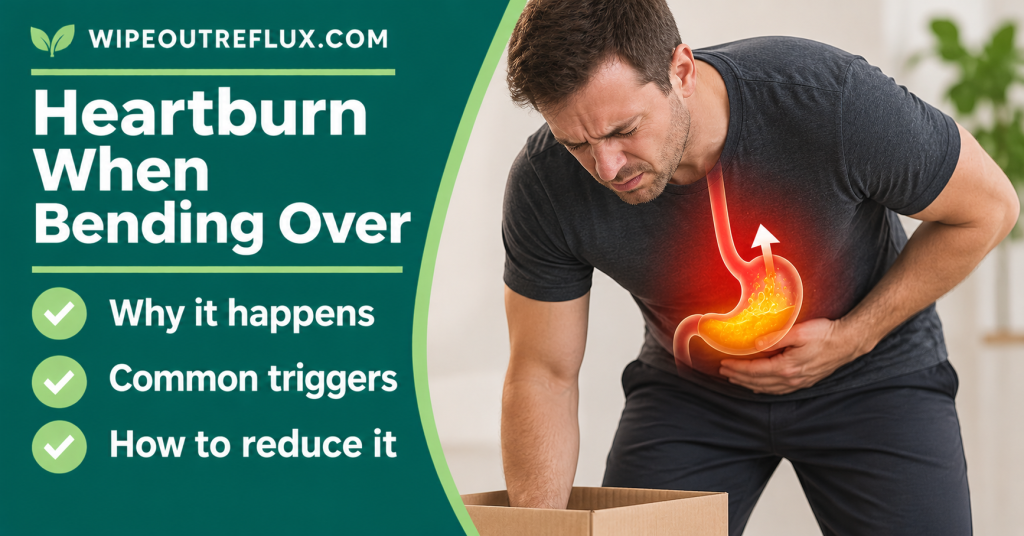
Heartburn when bending over happens because two things change at once. Bending folds your abdomen, which squeezes your stomach and raises the pressure inside it. It also tips your stomach above the valve at the bottom of your esophagus, so gravity is no longer helping keep stomach contents down. If that valve, the lower esophageal sphincter (LES), is even slightly weak, acid gets pushed up into your esophagus.
It’s one of the most classic reflux triggers, and it’s especially common if you have a hiatal hernia, carry extra weight around your middle, or bend down soon after eating. The fix is usually mechanical: change how and when you bend, reduce pressure on your stomach, and strengthen the barrier that holds reflux back.
Key Takeaways
- Bending raises pressure inside your abdomen and removes gravity’s help, so a weak valve lets acid escape.
- Heartburn when bending is a hallmark of a hiatal hernia, which removes the diaphragm’s “second sphincter” support.
- Bending soon after a meal is the worst timing, because the stomach is full and acid production is at its peak.
- Belly fat, tight waistbands, constipation and heavy lifting all add to the pressure on your stomach.
- Squat with a straight back instead of folding at the waist, and avoid bending for 2–3 hours after eating.
- An alginate after meals can form a protective raft that blocks reflux when you do need to bend.
- Weight loss and diaphragm breathing exercises can strengthen the reflux barrier over time.
Why Bending Over Triggers Heartburn
Your body has a pressure system that normally keeps stomach contents where they belong. Bending upsets it in three ways.
1. It squeezes your stomach
When you fold at the waist, your abdominal organs are compressed and your abdominal muscles tighten. That raises intra-abdominal pressure, which pushes on the stomach. If the pressure in your stomach rises above the pressure your LES can hold, contents get forced upward.
A study in Gastroenterology showed how powerful this effect is. When researchers increased abdominal pressure in reflux patients using a tightened waist belt, acid reflux just above the sphincter rose by about eightfold, and the number of reflux events after a meal doubled. The pressure also impaired the esophagus’s ability to clear acid, causing rapid re-reflux [Lee et al., Gastroenterology, 2017]. Bending creates a similar squeeze.
2. It removes gravity’s help
Upright, gravity keeps liquid stomach contents pooled at the bottom of the stomach, below the LES. When you bend forward, the stomach tilts and its contents move toward the junction with the esophagus. The valve now has to hold back liquid that’s sitting right against it.
3. It tests the “second sphincter”
Your reflux barrier isn’t just the LES muscle. The diaphragm wraps around the lower esophagus and acts as a second, external sphincter. When abdominal pressure suddenly rises, during coughing, straining or bending, the diaphragm normally contracts reflexively to tighten the junction. As reflux expert Peter Kahrilas explains, the crural diaphragm acts as a “second sphincter” during abrupt pressure increases, and that protection is substantially impaired when the opening it surrounds is enlarged [Kahrilas, Yale Journal of Biology and Medicine, 1999].
That’s exactly what happens with a hiatal hernia. For more on how the valve itself works, see my guide to the lower esophageal sphincter and acid reflux.
Does Bending Really Cause Reflux? What the Research Shows
Yes, at least in people who already have reflux. Researchers in India had 25 patients with confirmed GERD wear a 24-hour pH monitor on two days, one without exercise and one including a 30-minute routine with bending and abdominal contractions. They concluded that exercise involving bending provokes reflux in people with moderate-to-severe GERD [Sodhi et al., Indian Journal of Gastroenterology, 2008].
This also fits with how hiatal hernias behave. Because the diaphragm can no longer pinch the junction closed when pressure spikes, people with a gaping hiatus are far more prone to reflux during sudden increases in abdominal pressure, and hiatal hernias, like reflux itself, become more common with age and weight gain [Kahrilas, Yale Journal of Biology and Medicine, 1999].
Is It a Hiatal Hernia?
Not always, but heartburn on bending is one of the most telling signs. With a sliding hiatal hernia, the top of the stomach pushes up through the diaphragm into the chest. That separates the LES from the diaphragm, so the two parts of your reflux barrier no longer work together.
Other clues that point toward a hiatal hernia:
- Reflux that’s much worse lying down or bending, and better upright
- Regurgitation of food or sour liquid, not just burning
- A feeling of fullness or pressure in the chest after eating
- Frequent belching, or water brash
- Symptoms that only partly respond to acid-reducing medication
A hiatal hernia is usually diagnosed by endoscopy or a barium swallow. I explain how they cause reflux in hiatal hernia and reflux, and what helps in how to treat a hiatal hernia.
Other Things That Make Bending Heartburn Worse
- Bending after eating. A full stomach plus peak acid production is the worst combination. Gardening, tidying up or tying shoelaces right after dinner is a classic trigger.
- Large or fatty meals. They stretch the stomach and trigger more transient relaxations of the LES. See does overeating cause acid reflux.
- Extra weight around the middle. Abdominal fat raises baseline pressure on the stomach, so it takes less bending to tip the balance.
- Tight clothing. Waistbands and belts add compression, as the belt study shows. See tight clothing and acid reflux.
- Constipation and straining. Bearing down raises abdominal pressure in the same way.
- Lifting while bent. Holding your breath and bracing to lift something heavy spikes pressure. See weightlifting and acid reflux.
- Pregnancy. The growing uterus pushes up on the stomach, and hormones relax the LES.
How to Stop Heartburn When Bending Over
Change how you bend
- Squat, don’t stoop. Bend at your knees and hips with your back fairly straight, keeping your chest up. This keeps your stomach more upright and compresses your abdomen less than folding forward at the waist.
- Use tools to avoid bending. A long-handled grabber, a raised garden bed, a stool to sit on while weeding, or a shoe horn for shoes all help.
- Breathe out as you lift rather than holding your breath and bracing.
- Move slowly. Sudden bending creates sharp pressure spikes.
Change when you bend
- Avoid bending, heavy chores and floor exercises for 2–3 hours after a main meal.
- Plan gardening, cleaning or yoga for before meals, or when your stomach is relatively empty.
- If you exercise, avoid core work and inverted poses after eating. My guides to exercise and acid reflux and yoga for acid reflux cover which moves to watch.
Reduce pressure on your stomach
- Eat smaller meals. Less volume means less pressure against the valve.
- Loosen your waistband, especially after eating.
- Keep your bowels moving with fiber and fluids to avoid straining.
- Lose weight if you carry extra around your middle. In a large Norwegian study of nearly 30,000 people, weight loss was dose-dependently linked with fewer reflux symptoms and better results from reflux medication [Ness-Jensen et al., American Journal of Gastroenterology, 2013].
Strengthen the barrier
You can train the diaphragm that forms your “second sphincter.” In a small randomized trial, people with non-erosive GERD who practiced abdominal breathing exercises had significantly less time with acid in their esophagus than controls [Eherer et al., American Journal of Gastroenterology, 2012]. I explain the technique in breathing exercises for acid reflux.
Use a raft when you need to bend
If you know you’ll be bending after a meal, an alginate such as Gaviscon Advance forms a gel raft on top of your stomach contents. This physically blocks reflux in a way acid reducers don’t. It’s a good fit for this specific problem, because the issue is reflux being pushed up rather than too much acid. See alginates for acid reflux.
Reduce how irritating the reflux is
Even if some reflux still happens when you bend, what’s in your stomach determines how much it hurts. Fewer trigger foods, smaller meals and better meal timing mean milder symptoms when reflux does escape. That foundation is what the Wipeout Diet Plan is built to give you.
When to See a Doctor
Occasional heartburn when bending is common and usually manageable. Get checked if:
- It happens most days or is getting worse
- You regurgitate food, or wake up choking or coughing at night
- You have trouble swallowing, unexplained weight loss, vomiting, or black stools
- Over-the-counter remedies don’t help, or you’ve needed them for more than a couple of weeks
- You have chest pain on exertion, not just when bending
The last point matters. Chest pain that comes on with effort, such as climbing stairs or carrying heavy things, can be heart-related. Don’t assume it’s reflux. See heartburn or heart attack for the warning signs.
Conclusion
Heartburn when bending over is mechanics more than mystery. Folding at the waist squeezes your stomach, removes the help gravity normally gives, and challenges the diaphragm’s role as a second sphincter. When the valve is weak, as it is with a hiatal hernia, extra abdominal weight or a full stomach, acid gets pushed up.
The fixes follow the same logic. Squat rather than stoop, keep bending away from mealtimes, loosen tight waistbands, avoid straining, and eat smaller meals. Over the longer term, weight loss and diaphragm breathing exercises can strengthen the barrier. An alginate raft is a useful backup on days when you can’t avoid bending after eating. If it’s happening often, or comes with swallowing trouble, regurgitation or exertional chest pain, get it checked.
The other half of the equation is making what’s in your stomach less likely to cause trouble when it does escape. The Wipeout Diet Plan is my complete, in-depth guide to the foods, meal sizes and timing that calm reflux at its source. It was built first and foremost for LPR, the stubborn throat-based form of reflux, but it targets the same underlying mechanisms, so it works just as well for GERD and the kind of heartburn that flares when you bend.
Frequently Asked Questions
Why do I get heartburn when I bend over?
Bending raises the pressure in your abdomen and tilts your stomach so its contents press against the lower esophageal sphincter. If the valve is weak, acid escapes into the esophagus.
Is heartburn when bending over a sign of a hiatal hernia?
It’s a common sign. A hiatal hernia separates the valve from the diaphragm that normally supports it, so reflux is easily triggered by bending, lifting or lying down. Only tests can confirm one.
How long after eating should I wait before bending?
Ideally 2–3 hours after a main meal. The stomach is fullest and acid production highest in the first couple of hours.
What’s the best way to pick things up with acid reflux?
Squat by bending at your knees and hips with a straight back, keep your chest up, and breathe out as you lift. Avoid folding forward at the waist.
Can bending over cause regurgitation?
Yes. The same pressure that pushes acid up can push food or liquid into your throat or mouth, especially after a meal or if you have a hiatal hernia.
Does losing weight help heartburn when bending?
Often, yes. Less abdominal fat means less pressure on the stomach, and large studies link weight loss with fewer reflux symptoms.
Can bending over cause chest pain that isn’t heartburn?
Yes. Muscle strain, rib or spine problems and, importantly, heart conditions can all cause chest pain with movement or exertion. Get new or unexplained chest pain checked.
Research & References
- [Lee et al., Gastroenterology, 2017] — Raising abdominal pressure with a waist belt increased acid reflux near the sphincter about eightfold, doubled post-meal reflux events and impaired esophageal clearance in reflux patients.
- [Kahrilas, Yale Journal of Biology and Medicine, 1999] — Review explaining that the crural diaphragm acts as a “second sphincter” during abrupt abdominal pressure increases, and that this is impaired with hiatal hernia.
- [Sodhi et al., Indian Journal of Gastroenterology, 2008] — 24-hour pH study of 25 GERD patients concluding that exercise involving bending provokes reflux in moderate-to-severe GERD.
- [Ness-Jensen et al., American Journal of Gastroenterology, 2013] — Norwegian HUNT cohort of 29,610 people showing weight loss was dose-dependently associated with reduced reflux symptoms and better response to reflux medication.
- [Eherer et al., American Journal of Gastroenterology, 2012] — Randomized trial in which abdominal breathing training significantly reduced esophageal acid exposure in non-erosive GERD.

David Gray
12 years living with LPR · Consultant & researcher
I've lived with LPR for twelve years — the misdiagnoses, the PPI courses that did nothing, the slow work of figuring out what actually helps. Wipeout Reflux is where I translate the research into plain terms for people stuck in the same place. Every claim here is sourced to peer-reviewed work, and I consult one-to-one with LPR sufferers.