
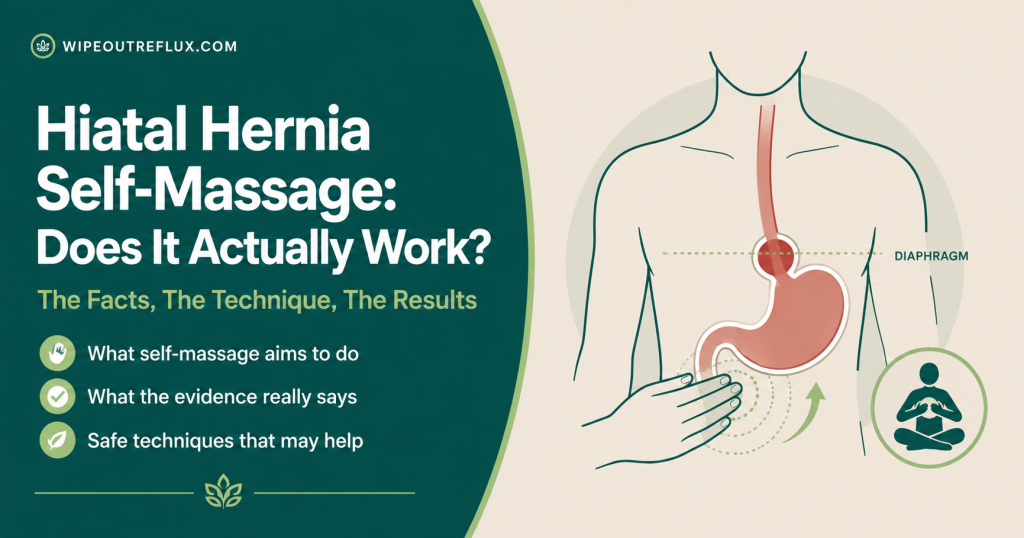
Here’s the honest answer: hiatal hernia self-massage might give some people a little temporary relief, but there’s no solid proof it works, and it will not fix the hernia itself. No proper clinical trial has ever tested the self-massage technique that’s all over YouTube, so the strongest claims you’ll read are anecdotes, not evidence. What limited research exists is on hands-on therapy done by a trained practitioner — not on rubbing your own stomach — and even that is early and small-scale.
That doesn’t make it worthless. Done gently, self-massage is low-risk, and the act of relaxing your abdomen and breathing slowly may ease symptoms in the moment for some people. But it’s important to be clear-eyed about what it can and can’t do: a hiatal hernia is an anatomical issue, and you can’t permanently push your stomach back into place by hand. If a technique is going to help your reflux long term, it’s far more likely to be the two things with real evidence behind them — diaphragmatic breathing and calming your reflux at the source.
Let me walk through what the technique actually is, what the research does and doesn’t show, whether it’s safe to try, and where your effort is better spent.
Key Takeaways
- No clinical trial has tested hiatal hernia self-massage directly — the support for it is anecdotal, not scientific.
- The closest evidence is for hands-on therapy delivered by a trained practitioner, and even that comes from small, early studies.
- Self-massage cannot repair the hernia; you can’t permanently reposition the stomach by pressing on your belly.
- It’s low-risk if done gently, and may offer some people short-term relief — partly through relaxation and slower breathing.
- Diaphragmatic (belly) breathing has genuine trial evidence for reducing reflux and is a better use of your time.
- See a doctor for diagnosis first — large hernias, or any alarm symptoms, need proper medical assessment, not self-treatment.
- The biggest, most durable gains come from tackling the reflux itself through diet, weight and meal habits.
What is hiatal hernia self-massage?
A hiatal hernia happens when part of the stomach pushes up through the hiatus — the small opening in your diaphragm that the oesophagus normally passes through. Because the diaphragm is part of the valve system that keeps acid down, a hernia can weaken that barrier and make reflux worse, which is the connection I explain in hiatal hernia and reflux.
Self-massage is a home technique that claims to coax the stomach back down and relax the diaphragm around it. The version you’ll usually see goes something like this: drink a glass of warm water on an empty stomach, lie back or stand relaxed, place your fingertips just below the breastbone, and use gentle, downward strokes toward the navel — the idea being to “pull” the stomach down away from the hiatus. Some routines add slow breathing or a heel-drop afterward. It’s gentle, it’s free, and it feels like you’re doing something — which is a big part of its appeal.
The theory: why people think it works
The reasoning sounds plausible on the surface. If the top of the stomach has slipped upward, then relaxing the surrounding muscle and easing it back down should, in theory, restore the normal anatomy and take pressure off the valve. Practitioners of hands-on visceral techniques describe using gentle pressure to release tension around the oesophagus-diaphragm-stomach junction.
The catch is that most hiatal hernias are “sliding” hernias that move up and down on their own throughout the day anyway — with breathing, swallowing and posture. So even if a bit of massage seems to help in the moment, it’s very hard to know whether you changed anything lasting or simply caught the hernia at a naturally better moment. That uncertainty is exactly why we need actual studies rather than testimonials.
What does the evidence actually say?
This is where the honesty has to come in. There is no published clinical trial testing self-administered hiatal hernia massage. None. Every enthusiastic before-and-after you’ll find online is a personal story, and personal stories can’t separate a real effect from placebo, natural fluctuation, or the other changes someone made at the same time.
The nearest real evidence is for practitioner-delivered manual therapy. In one small randomized controlled trial, people with reflux who received hands-on osteopathic visceral treatment saw greater short-term improvement in their symptoms and quality of life than a control group Eguaras et al., Journal of Clinical Medicine, 2019. That’s genuinely interesting — but it involved a trained therapist, a handful of participants, and short follow-up. When researchers pooled the wider body of visceral manual-therapy studies, they concluded the evidence remains limited and of low quality, with more rigorous trials needed before anyone can claim it works da Silva et al., BMC Complementary Medicine and Therapies, 2023. In other words: a promising hint for professional treatment, and nothing solid at all for the DIY version.
The technique that actually has evidence: diaphragmatic breathing
If your instinct is that strengthening the diaphragm could help your reflux, you’re onto something — you’ve just got the wrong technique. The diaphragm forms part of the anti-reflux barrier, and training it directly has real support. In a randomized controlled trial, patients who practised diaphragmatic breathing exercises reduced their acid exposure, improved their quality of life, and cut their reliance on reflux medication compared with controls Eherer et al., American Journal of Gastroenterology, 2012.
That’s a much better return on the same few minutes a day. Slow belly breathing — expanding the abdomen on the inhale, letting it fall on the exhale — strengthens the very muscle that helps hold the valve shut, and it’s something you can genuinely keep doing for yourself. Gentle movement helps too; the same diaphragm-and-posture logic is why I’m a fan of yoga for acid reflux. If you’re going to spend time on a self-help technique, this is the one I’d point you to first.
Can self-massage “fix” a hiatal hernia?
No — and this is the part I most want you to take away. A hiatal hernia is a structural feature of your anatomy. Gentle pressure from your fingertips cannot permanently reposition the stomach or close the gap in the diaphragm, and no amount of massage will “cure” the hernia. At best, it’s a comfort measure, not a repair.
It also matters what kind of hernia you have. Small sliding hernias are common and often managed well with lifestyle and reflux treatment. Larger ones — and the less common paraesophageal type, where part of the stomach sits up alongside the oesophagus — are a medical matter, and pushing on your abdomen is not the answer. That’s why step one isn’t a massage video; it’s getting a proper diagnosis so you know what you’re actually dealing with.
Is it safe to try?
For most people, gentle self-massage is low-risk, and if it brings you a little comfort there’s usually no harm in it. A few sensible guardrails, though. Keep the pressure light — this should never hurt, and forceful prodding of your abdomen is a bad idea. Do it on an empty stomach rather than straight after a meal. And treat it as a comfort measure that sits alongside proper care, never as a replacement for it.
Please see a doctor before relying on any self-treatment, and seek prompt medical attention rather than reaching for self-massage if you have alarm symptoms: difficulty or pain when swallowing, unexplained weight loss, vomiting, black or bloody stools, chest pain, or a feeling of food getting stuck. Those need assessment, not a home technique. If you’re not sure whether your symptoms are simple reflux or something more, my overview of GERD versus silent reflux and the broader acid reflux guide are good places to get your bearings before you speak to a professional.
What actually moves the needle
If self-massage is a maybe-it-helps comfort measure, here’s where the real, durable gains live — by reducing how often and how forcefully you reflux in the first place:
- Don’t overfill the stomach. Large meals raise pressure and push against a weakened valve; smaller, more frequent meals help, as I cover in does overeating cause acid reflux.
- Stay upright after eating. Don’t lie down for a few hours after a meal, and a gentle stroll helps — see walking after meals.
- Ease the pressure. Losing excess weight around the middle and skipping tight waistbands both take load off the hiatus. Be mindful with heavy lifting too, which I discuss in weightlifting and acid reflux.
- Calm the acid at the source. A lower-acid, reflux-friendly diet is the foundation everything else is built on — and it’s exactly what my Wipeout Diet Plan is designed to do.
None of these are as exciting as a technique that promises to fix the hernia in five minutes. But they’re the ones that actually work — and there’s strong evidence that a lower-acid, plant-forward approach can rival medication for calming reflux Zalvan et al., JAMA Otolaryngology–Head & Neck Surgery, 2017.
Conclusion
So, does hiatal hernia self-massage actually work? There’s no good evidence that it does, and it definitely won’t repair the hernia — but it’s gentle, low-risk, and may offer a little short-term comfort, largely through relaxation and slower breathing. If that helps you feel better in the moment, there’s no harm in it, provided you’ve been properly diagnosed and you’re not using it in place of real treatment. Just don’t expect it to be the fix, because the evidence simply isn’t there. The techniques worth your time are diaphragmatic breathing, which has genuine trial support, and reducing your reflux at the root.
And that root-cause piece is where the lasting change comes from. A hernia may be part of your anatomy, but how much it actually bothers you depends heavily on how often and how strongly you reflux — and that you can change. My Wipeout Diet Plan is the complete, in-depth system for getting reflux under control for good, calming the acid so a hernia has far less to work with. I built it first and foremost around LPR — the stubborn, throat-based kind that’s hardest to treat — but because it targets the same underlying reflux mechanisms, it works just as well for GERD, heartburn and everyday acid reflux.
And for the everyday question of which foods and drinks are actually safe to build around, the Wipeout Food Reference Guide is the essential companion — it lays out the real pH values of foods and drinks for acid reflux and LPR, so you always know what’s calming your symptoms and what’s feeding them. Skip the miracle-fix promises, calm the reflux itself, and a hiatal hernia becomes a much smaller part of your day.
Frequently Asked Questions
Does hiatal hernia self-massage really work?
There’s no clinical evidence that it does. No trial has tested the self-massage technique, so its support is entirely anecdotal. It may bring some people brief comfort — partly through relaxation and slower breathing — but it won’t repair the hernia and shouldn’t be relied on as a treatment.
Can you push a hiatal hernia back into place by hand?
No. A hiatal hernia is an anatomical issue, and gentle fingertip pressure can’t permanently reposition the stomach or close the gap in the diaphragm. Most sliding hernias already move up and down on their own, so any “success” is usually temporary or coincidental rather than a real repair.
Is hiatal hernia self-massage safe?
For most people, gentle self-massage is low-risk. Keep the pressure light so it never hurts, do it on an empty stomach, and treat it as a comfort measure alongside proper care — not a substitute. See a doctor first, and seek medical attention rather than self-massage if you have trouble swallowing, weight loss, vomiting, chest pain or bleeding.
What actually helps a hiatal hernia?
The most effective steps reduce how often you reflux: smaller meals, staying upright for a few hours after eating, losing excess belly weight, avoiding tight waistbands, and following a lower-acid, reflux-friendly diet. Diaphragmatic breathing exercises also have real evidence for strengthening the anti-reflux barrier.
Are breathing exercises better than self-massage for reflux?
The evidence says yes. Diaphragmatic breathing has been tested in randomized trials and shown to reduce acid exposure and medication use, whereas self-massage has never been trialled. Both take only a few minutes a day, so breathing is simply the better-supported choice.
Research & References
- A randomized controlled trial found that patients with gastroesophageal reflux who received hands-on osteopathic visceral treatment from a practitioner had greater short-term improvement in symptoms and quality of life than a control group — though the study was small and short-term Eguaras et al., Journal of Clinical Medicine, 2019.
- A systematic review of randomized trials of visceral manual (fascial) therapy concluded that the current evidence is limited and of low quality, and that more rigorous research is needed before firm conclusions can be drawn da Silva et al., BMC Complementary Medicine and Therapies, 2023.
- In a randomized controlled trial, diaphragmatic (abdominal) breathing training reduced oesophageal acid exposure, improved quality of life, and decreased reflux-medication use compared with controls — direct evidence for training the diaphragm rather than massaging the abdomen Eherer et al., American Journal of Gastroenterology, 2012.
- A study of patients with laryngopharyngeal reflux found that a plant-based, Mediterranean-style diet with alkaline water was about as effective as proton pump inhibitor medication at reducing symptoms — underscoring the value of tackling reflux at its source Zalvan et al., JAMA Otolaryngology–Head & Neck Surgery, 2017.

David Gray
12 years living with LPR · Consultant & researcher
I've lived with LPR for twelve years — the misdiagnoses, the PPI courses that did nothing, the slow work of figuring out what actually helps. Wipeout Reflux is where I translate the research into plain terms for people stuck in the same place. Every claim here is sourced to peer-reviewed work, and I consult one-to-one with LPR sufferers.