
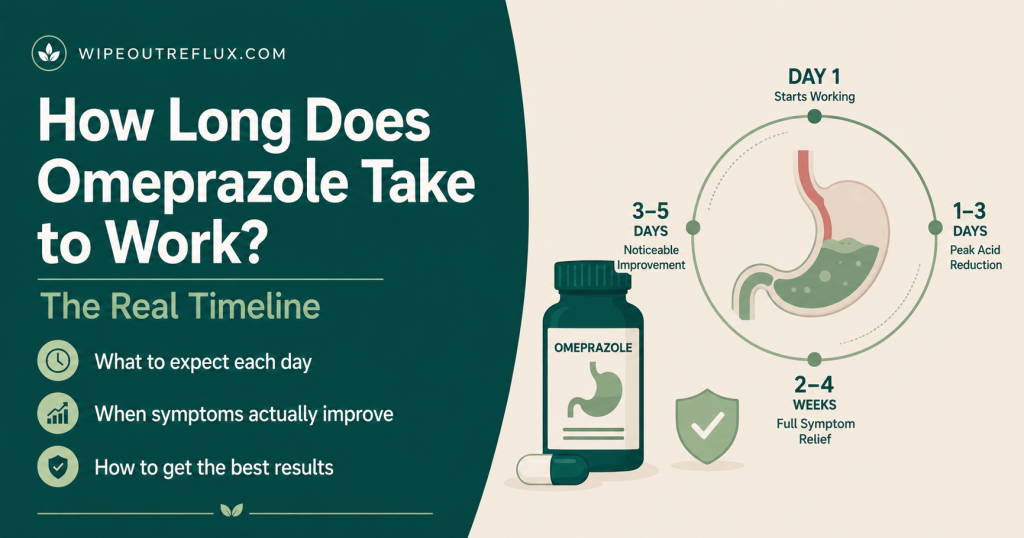
Most people notice some improvement on omeprazole within one to four days, but the drug doesn’t reach full strength until you’ve taken it daily for three to five days. That gap is the single biggest reason people decide it isn’t working — they’re judging a drug that hasn’t finished switching on yet.
The delay is a genuine quirk of how omeprazole works. It can only disable proton pumps that are actively secreting acid at the moment the drug is in your bloodstream, and at any given time only a portion of your pumps are switched on. Your stomach also builds new ones constantly. So each dose disables a share of the pumps, the next dose catches more, and the effect climbs over several days until it plateaus — taking about three days to reach steady-state inhibition of acid secretion Shin & Kim, Journal of Neurogastroenterology and Motility, 2013.
Two other clocks run alongside that one, and they’re much slower. If you have visible damage in your oesophagus, healing takes roughly four to eight weeks even once the burning has stopped. And if your symptoms are in your throat — hoarseness, throat clearing, a lump sensation, chronic cough — you may be looking at three to six months, with a real chance the drug never helps at all.
Key Takeaways
- Partial relief often begins within 1–4 days; full acid suppression takes 3–5 days of consistent daily dosing.
- Omeprazole only disables proton pumps that are actively secreting acid, and around 20% of your pumps are replaced every 24 hours — which is why the effect builds gradually rather than arriving all at once.
- Even at steady state, once-daily dosing only suppresses roughly two-thirds of your maximum acid output. It was never designed to eliminate stomach acid.
- Healing is a different clock from symptom relief: oesophagitis heals at roughly 12% of patients per week, with most healing complete by 8 weeks.
- Throat symptoms (LPR) run on a far longer and less certain timeline — often 3–6 months, sometimes 9, and frequently no response at all.
- CYP2C19 genotype matters. Fast metabolisers clear omeprazole quickly and get measurably less acid suppression from the same dose.
- Taking it with or after food, rather than 30–60 minutes before, measurably reduces how well it controls acid.
- Taking it “when I need it” instead of daily means you never reach steady state, so it never works properly.
- If nothing has changed after 8 weeks of correct daily use, the likeliest explanation isn’t a weak drug — it’s that acid isn’t causing your symptoms.
The Honest Day-by-Day Timeline
Assuming a standard 20 mg dose once daily, 30–60 minutes before your first meal, here’s what’s actually happening while you wait.
Day 1
Something is happening, but not much. Omeprazole starts inhibiting acid secretion within about an hour and peaks a couple of hours later — but it only catches pumps that happen to be active in that window, a minority of the total. Most people feel little to nothing on day one.
If you’re used to antacids or Gaviscon, that’s jarring. Those neutralise acid that’s already there. Omeprazole neutralises nothing; it turns production down, slowly.
Days 2–3
This is where most people notice a real change. Each dose catches a fresh batch of pumps that weren’t active the day before, so the cumulative inhibition climbs. Heartburn usually becomes less frequent and less severe before it disappears entirely, and night-time symptoms often improve before daytime ones.
Days 3–5
Steady state. The drug is now doing everything it’s going to do at that dose. It takes roughly three days to get there, as a balance is struck between covalent inhibition of active pumps, the stimulation of previously inactive pumps once the drug has cleared your blood, and the manufacture of brand new pumps Shin & Kim, Journal of Neurogastroenterology and Motility, 2013. Clinical pH studies typically measure acid control at day 5 for exactly this reason.
One under-explained detail: steady state is not the same as zero acid. On once-daily dosing, steady-state inhibition works out at around 66% of maximal acid output. Omeprazole turns your acid down substantially. It does not switch it off.
Weeks 1–8
Nothing more is added pharmacologically from here. What changes is your tissue — erosions healing in a lower-acid environment, which takes weeks.
Why Day One Feels Like Nothing Happened
This is the part almost nobody explains properly, and it’s the whole reason the drug behaves the way it does.
Omeprazole is a prodrug — swallowed, it’s inactive and harmless. It only becomes the reactive molecule that disables a proton pump when it lands in an extremely acidic space, and the only space in your body below pH 4 is the secretory canaliculus of a parietal cell that is currently pumping acid. There it accumulates at around 1,000 times its blood concentration, converts to its active form, and covalently binds to the pump, permanently disabling it.
The consequence is that a resting pump is invisible to the drug. If a pump isn’t switched on when omeprazole passes through, it survives untouched. The researchers who established the before-meals rule put it plainly — PPIs inactivate the H+, K+ ATPase molecules of the parietal cell, “but possibly only those that are actively secreting acid,” implying that meal-stimulated secretion is necessary for optimal inhibition Hatlebakk et al., Alimentary Pharmacology & Therapeutics, 2000.
Now add the second half of the problem. Omeprazole has an elimination half-life of about one hour — it’s gone from your blood long before the day is over. Meanwhile the pump protein itself has a half-life of around 54 hours, meaning your stomach manufactures roughly 20% brand new, drug-naive pumps every 24 hours Shin & Kim, Journal of Neurogastroenterology and Motility, 2013.
Picture it as a slow bailing-out job. Each morning’s dose disables the pumps active in its brief window; overnight, some you missed switch on and a fresh 20% are built; tomorrow’s dose catches a chunk of those. After three to five days you reach an equilibrium, disabling pumps about as fast as your stomach replaces and activates them.
That’s why day one feels like a placebo and day four often doesn’t. Nothing has gone wrong — you’re watching a drug climb to its plateau in real time.
Symptom Relief and Healing Are Two Different Clocks
People routinely conflate these, which causes worry in both directions — some stop too early because they feel fine, others panic because they feel fine and assume nothing is fixed.
Symptom relief tracks acid suppression closely. Once the acid is down, the burning stops, usually within days.
Tissue healing is slower and independent of how you feel. In a meta-analysis of 43 trials covering 7,635 patients with erosive oesophagitis, PPIs healed a mean of 83.6% of patients at a rate of about 11.7% of patients per week — roughly twice as fast as H2 blockers, but still a matter of weeks. Heartburn relief ran at a similar 11.5% per week, with 77.4% of patients heartburn-free overall Chiba et al., Gastroenterology, 1997.
Do the arithmetic on that healing rate and you land on the standard eight-week course. It isn’t arbitrary — it’s roughly how long it takes for the large majority of erosions to close, and modern trials still use an eight-week endpoint, with 84.6% of PPI-treated patients healed by week 8 in a recent randomised comparison Laine et al., Gastroenterology, 2023.
So feeling better at day five doesn’t mean you’re healed, and finishing the course matters even if symptoms vanished in week one.
If Your Symptoms Are in Your Throat, the Clock Is Much Longer
This is the most important section on the page for a large share of the people reading it, and the one competitors almost never cover honestly.
If your symptoms are hoarseness, constant throat clearing, a lump sensation, post-nasal drip, chronic cough or a raw throat — rather than classic heartburn — you’re likely dealing with laryngopharyngeal reflux, and the entire timeline changes. Three things are true at once here, and you need all three.
1. It takes far longer. In a prospective study of 127 LPR patients, only 28.1% had a high or complete response at three months, while 47.1% needed six or nine months. Symptom scores kept improving from three months out to six, and laryngeal findings improved more slowly still Lechien et al., The Laryngoscope, 2021. A later study of 159 patients agreed: a one-month course suits about a third of people, and early non-responders may require three to nine months Lechien, Otolaryngology–Head and Neck Surgery, 2024.
2. It often doesn’t work at all. In the largest placebo-controlled trial in this area, 16 weeks of esomeprazole 40 mg twice daily resolved the primary throat symptom in 14.7% of patients versus 16.0% on placebo — no evidence of therapeutic benefit Vaezi et al., The Laryngoscope, 2006. Other trials are positive and the picture is genuinely mixed, but a failure rate that high means “it isn’t working” is an ordinary outcome, not a sign you’ve been misdiagnosed.
3. There’s a mechanistic reason. The main agent damaging laryngeal tissue is pepsin, not acid itself, and pepsin stays active well above the pH omeprazole targets. Reducing acidity doesn’t remove it. I’ve laid out the full argument in why PPIs don’t work for LPR, with the practical alternatives in proton pump inhibitors for LPR and the best medication for LPR.
So if you started omeprazole a week ago for a hoarse voice and nothing has changed, that’s expected. Judging it at one week is meaningless; three months is reasonable. For what recovery actually looks like, see the LPR recovery timeline and how long an acid reflux sore throat takes to heal.
Your Genetics Change How Well It Works
This one is genuinely useful and almost nobody mentions it.
Omeprazole is broken down in the liver largely by an enzyme called CYP2C19, and how fast you produce it is genetically determined — people fall broadly into rapid or ultrarapid, normal, intermediate and poor metabolisers.
The effect isn’t subtle. Poor metabolisers show 3- to 10-fold higher drug exposure than fast metabolisers on the same dose, and intermediate metabolisers 2- to 3-fold higher Shin & Kim, Journal of Neurogastroenterology and Motility, 2013. Crucially, the difference shows up in the stomach, not just in blood tests. When volunteers took 20 mg of omeprazole daily for eight days with 24-hour intragastric pH monitoring, both plasma concentrations and achieved intragastric pH were significantly dependent on CYP2C19 genotype after single and repeated doses Shirai et al., Alimentary Pharmacology & Therapeutics, 2001.
In plain English: if you’re a fast metaboliser, your body clears omeprazole before it has finished the job, and you get less acid suppression than the person next to you on an identical prescription. You aren’t imagining that it’s underpowered.
This is established enough to have its own international prescribing guideline. The Clinical Pharmacogenetics Implementation Consortium recommends using CYP2C19 genotype to guide PPI dosing — identifying patients whose genotype predicts lower drug exposure and prescribing a higher dose to increase the likelihood of efficacy, and reducing the dose in those with higher exposure on long-term therapy Lima et al., Clinical Pharmacology & Therapeutics, 2021.
Testing isn’t routine and I’m not suggesting you demand it, but it’s worth knowing this exists — because “the standard dose isn’t enough for me” is a legitimate clinical conversation rather than a complaint. It’s one reason doctors sometimes move to twice-daily dosing, or switch to a drug less dependent on CYP2C19 — including the newer potassium-competitive acid blockers, which reach full effect after a single dose Laine et al., Gastroenterology, 2023. More in Voquezna (vonoprazan) for acid reflux.
Five Reasons It Seems Slower Than It Should Be
If you’re past day five and getting nowhere, work through these before concluding the drug has failed.
1. You’re taking it with food, or after it
The most common and most fixable error. Because omeprazole only disables actively secreting pumps, you want peak blood levels to coincide with the meal-triggered surge in pump activity — which means taking it 30–60 minutes before eating, not with breakfast and not afterwards.
The difference is bigger than most people expect. In a crossover study, taking omeprazole or lansoprazole before breakfast rather than without a meal cut the proportion of daytime with gastric pH below 4 from 42.0% to 17.2% Hatlebakk et al., Alimentary Pharmacology & Therapeutics, 2000. That’s a large chunk of the benefit thrown away by timing alone. Details, including what to do if you skip breakfast, in the best time to take omeprazole.
2. You’re taking it on demand rather than daily
Omeprazole isn’t an as-needed drug. Taking one on a bad day and skipping the good days means you never accumulate enough pump inhibition to reach steady state, so you stay stuck at the day-one level of effect. If you want to know whether it works, take it daily for at least two weeks without gaps. Antacids and alginates are the appropriate as-needed options.
3. You haven’t given it long enough for the problem you actually have
Five days is a fair test of acid suppression. It isn’t a fair test of oesophageal healing (eight weeks), and it’s nowhere near a fair test of throat symptoms (three months minimum). Match your expectations to the tissue involved.
4. The dose is too low for you
Standard over-the-counter omeprazole is 20 mg. Twice-daily dosing produces meaningfully more acid suppression than once-daily, because the drug’s one-hour half-life leaves long uncovered gaps. Combined with fast metaboliser status, a standard dose genuinely isn’t enough for some people — a conversation for your doctor rather than something to self-adjust.
5. Acid isn’t what’s causing your symptoms
This is the uncomfortable one, and statistically it’s a big category. Persistent symptoms despite PPI therapy are common: across observational primary care and community studies, 45% of people on a PPI reported ongoing reflux symptoms El-Serag et al., Alimentary Pharmacology & Therapeutics, 2010.
When researchers put 78 PPI non-responders through 24-hour pH-impedance monitoring while still on the drug, only 9% had genuinely persistent acid reflux. Thirty-six per cent had reflux sensitivity — normal acid exposure but symptoms triggered by it — and 55% had functional symptoms with no reflux relationship at all. The authors concluded that treatment of non-responders should focus on mechanisms beyond reflux, such as visceral hypersensitivity and hypervigilance Roman et al., Neurogastroenterology & Motility, 2015.
That reframes the question entirely. Among people for whom a PPI isn’t working, the overwhelming majority don’t have an acid problem the drug failed to fix — they have something else:
- LPR / silent reflux, where pepsin rather than acid drives the damage
- Eosinophilic oesophagitis, an allergic inflammation that mimics reflux and needs entirely different treatment
- Bile reflux, which isn’t acidic and therefore isn’t touched by acid suppression
- Gastroparesis, where delayed stomach emptying keeps pushing contents upward
- Functional heartburn and reflux hypersensitivity, where the oesophagus is normal but over-reactive
None of these respond to more omeprazole. The route forward is testing rather than escalation — see how acid reflux is diagnosed.
When to Conclude It Isn’t Going to Work
Here’s the framework I’d use, assuming you’ve been taking it correctly — daily, before food, without gaps.
- Day 5: too early to judge anything except whether you’re taking it right.
- Week 2: if classic heartburn hasn’t improved at all, something is off. Check your timing first, then raise it with your doctor.
- Week 8: a full course. If heartburn is unchanged after eight correct weeks, more omeprazole is unlikely to be the answer.
- Month 3–6 (throat symptoms): the earliest fair judgement point for LPR. Improvement can still be arriving at month six.
If you reach the end of the relevant window with nothing to show, confirm the diagnosis rather than escalate the dose, address the dietary and mechanical drivers acid suppression never touches, and discuss alternatives with your doctor — famotidine, an alginate barrier, or a potassium-competitive acid blocker. Fuller decision tree in what to do when acid reflux medication isn’t working.
One firm caution: don’t stop omeprazole abruptly after weeks of use. Rebound acid hypersecretion is real and will convince you that you needed the drug more than you did — taper with your doctor’s input, as set out in getting off PPIs and acid rebound. If your reason for wanting off it is tolerability rather than efficacy, that’s covered separately in omeprazole side effects.
The Bottom Line
Omeprazole is slow by design, not by fault. It only disables pumps that are actively secreting, your stomach rebuilds around a fifth of those every day, and the drug leaves your bloodstream within hours — so the effect accumulates across several doses before plateauing at three to five days. Day one feeling like nothing happened isn’t a warning sign; it’s the mechanism doing exactly what it does. Healing then runs on a separate eight-week clock, and throat symptoms on a three-to-six-month one that frequently doesn’t resolve at all.
While you wait, stop treating the medication as the whole plan. Omeprazole changes how acidic your reflux is; it doesn’t reduce how often you reflux, and it does nothing about the acid you’re swallowing in your food and drinks — a much larger factor than most people realise, because acidity hides in packaged foods, dressings, fizzy drinks and almost everything marketed as healthy. That’s what the Wipeout Food Reference Guide exists for — the essential reference of which foods and drinks are safe for acid reflux and LPR, with their real pH values, so you’re working from numbers rather than guesswork.
And if you want the whole thing sequenced properly rather than pieced together, the Wipeout Diet Plan goes considerably deeper: what to change in what order, how long to give each stage, and how to widen your diet again once things settle. I built it first and foremost around LPR and silent reflux, the stubborn throat-based form that most often defeats medication, but because it works on the same underlying mechanisms it does just as much for GERD and everyday heartburn. The people who do best are almost always the ones who used the medication to buy a calmer few weeks — and used those weeks to fix what was causing the reflux.
Frequently Asked Questions
How long does omeprazole take to work for heartburn?
Partial relief often begins within one to four days, with full acid suppression after three to five days of daily dosing. Most people notice fewer and milder episodes before symptoms stop completely. For same-day relief while you wait, an antacid or alginate works within minutes; omeprazole never will.
Why isn’t omeprazole working after 3 days?
Three days is right at the edge of when steady state is reached, so partial or no relief at that point is normal. Before worrying, check that you’re taking it daily rather than as needed, and 30–60 minutes before food rather than with it — that timing alone accounts for a large share of the effect.
How long before omeprazole heals the oesophagus?
Roughly four to eight weeks. Erosive oesophagitis heals at about 12% of patients per week on a PPI, which is why the standard course is eight weeks. Symptoms usually disappear long before healing is complete, so finishing the course matters even if you feel fine after a week.
How long does omeprazole take to work for throat symptoms and LPR?
Much longer, and less reliably. Only around 28% of LPR patients respond well by three months, many need six to nine, and the largest placebo-controlled trial found no benefit over placebo at 16 weeks. Judging it before three months isn’t meaningful, and a lack of response is common rather than unusual.
Does omeprazole work better at a higher dose?
Sometimes, though not the way people expect. Increasing dose frequency tends to help more than increasing a single dose, because the one-hour half-life leaves long uncovered gaps. Fast CYP2C19 metabolisers may need more. Decide this with your doctor.
What should I do if omeprazole hasn’t worked after 8 weeks?
Stop escalating and start investigating. Among people who don’t respond to a PPI, the majority turn out not to have an acid problem — the alternatives include LPR, eosinophilic oesophagitis, bile reflux, gastroparesis and functional heartburn. Ask about testing rather than a higher dose, and don’t stop the drug abruptly.
Research & References
- Shin & Kim, Journal of Neurogastroenterology and Motility, 2013 — Review of PPI pharmacokinetics establishing that steady-state inhibition of acid secretion takes about three days, that the pump protein’s ~54-hour half-life means roughly 20% of pumps are newly synthesised every 24 hours, that once-daily dosing yields around 66% inhibition of maximal acid output, and that poor metabolisers show 3- to 10-fold higher drug exposure than fast metabolisers.
- Hatlebakk et al., Alimentary Pharmacology & Therapeutics, 2000 — Crossover study in 21 volunteers: omeprazole or lansoprazole taken before breakfast reduced daytime with gastric pH below 4 to 17.2%, versus 42.0% taken without a meal.
- Chiba et al., Gastroenterology, 1997 — Meta-analysis of 43 trials in 7,635 patients with erosive oesophagitis: mean healing proportion 83.6% with PPIs at 11.7% of patients per week, and heartburn relief at 11.5% per week with 77.4% heartburn-free.
- Shirai et al., Alimentary Pharmacology & Therapeutics, 2001 — 24-hour intragastric pH monitoring on days 1 and 8 of omeprazole 20 mg daily showed that both plasma drug concentrations and achieved intragastric pH were significantly dependent on CYP2C19 genotype.
- Lima et al., Clinical Pharmacology & Therapeutics, 2021 — CPIC guideline for CYP2C19-guided PPI dosing, recommending higher doses where genotype predicts lower drug exposure and reduced doses where it predicts higher exposure on long-term therapy.
- Lechien et al., The Laryngoscope, 2021 — Prospective controlled study of 127 LPR patients: only 28.1% had a high or complete response at three months while 47.1% required six or nine months, with laryngeal findings improving more slowly than symptoms.
- Lechien, Otolaryngology–Head and Neck Surgery, 2024 — Prospective study of 159 impedance-confirmed LPR patients concluding that a one-month regimen suffices for about a third, while early non-responders may need three to nine months.
- Vaezi et al., The Laryngoscope, 2006 — Multicentre randomised trial of esomeprazole 40 mg twice daily versus placebo for 16 weeks in chronic posterior laryngitis; the primary symptom resolved in 14.7% versus 16.0% on placebo (p = 0.799).
- El-Serag et al., Alimentary Pharmacology & Therapeutics, 2010 — Systematic review of 19 studies finding that 45% of participants in observational primary care and community studies reported persistent reflux symptoms despite PPI therapy.
- Roman et al., Neurogastroenterology & Motility, 2015 — pH-impedance monitoring in 78 PPI non-responders found only 9% with persistent acid reflux, 36% with reflux sensitivity and 55% with functional symptoms unrelated to reflux.
- Laine et al., Gastroenterology, 2023 — Randomised trial in 1,024 patients with erosive oesophagitis: 84.6% healed by week 8 on lansoprazole versus 92.9% on the potassium-competitive acid blocker vonoprazan, which reaches full acid suppression far faster than a PPI.

David Gray
Content Researcher & Author
David Gray founded Wipeout Reflux to address a critical gap in reflux management. His research synthesizes over 100 peer-reviewed studies on laryngopharyngeal reflux (LPR), pepsin biology, and GERD pathophysiology. For LPR specifically—a condition most physicians misdiagnose—his work focuses on pepsin reactivation and why standard PPI therapy fails most patients. He develops evidence-based protocols targeting root causes of both LPR and GERD, integrating emerging research on sphincter dysfunction, dietary interventions, and newer clinical approaches. Wipeout Reflux represents practical application of clinical science for patients seeking real solutions.