
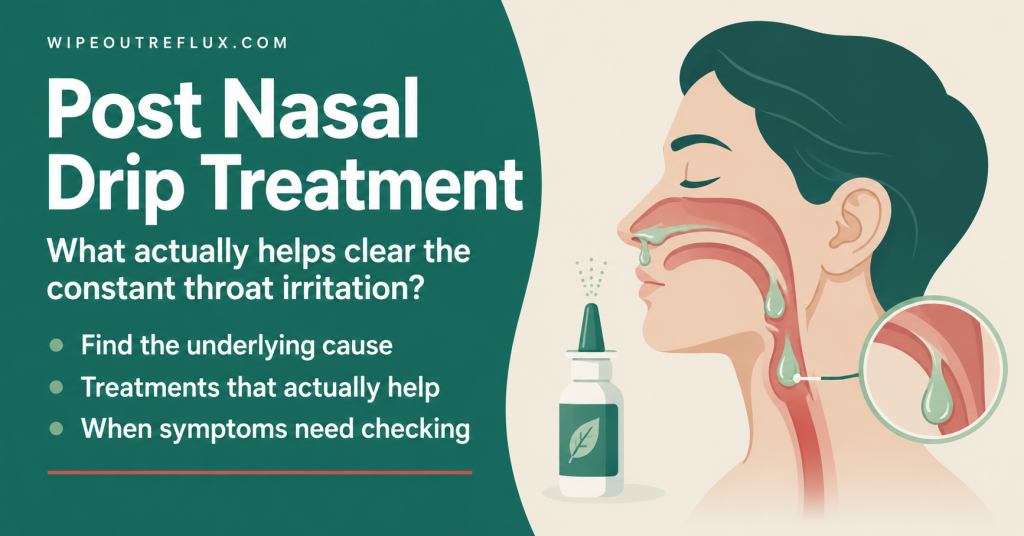
To get rid of post nasal drip, you have to treat whatever is producing it. If the mucus comes from your nose, that means allergies, a lingering cold, sinus inflammation or irritants, and saline rinses, steroid nasal sprays and the right antihistamine are the tools that work. If the “drip” is really coming from your throat, those same treatments do almost nothing, and the fix is calming the throat itself, most often by dealing with silent reflux.
That second group is bigger than most people realize. A lot of what gets labeled post nasal drip is the throat and voice box making their own mucus, or simply feeling as if mucus is there, because they are being irritated. It feels identical. It’s the reason so many people work through every antihistamine and nasal spray on the pharmacy shelf and still clear their throat all day.
Below I’ll show you how to work out which kind you have, what to do right now for quick relief, and how to stop it coming back.
Key Takeaways
- Post nasal drip is the feeling of mucus running down the back of your throat. It can come from the nose and sinuses, or from irritation in the throat itself.
- Studies of people with post nasal drip often find no allergy or sinus problem, and about one in five people with bothersome drip in one study had no visible mucus at the back of the nose.
- Nasal causes (allergies, colds, sinusitis, nonallergic rhinitis) respond to saline rinses, steroid nasal sprays and antihistamines.
- Throat-driven “drip,” most often from silent reflux (LPR), does not respond to nasal treatments. It improves when the reflux and pepsin irritation are dealt with.
- In a placebo-controlled trial of people with chronic post nasal drip and no sinus or allergy problem, 60% improved substantially on reflux medication, compared with 24% on placebo.
- Fast relief: sip water, use a saline spray or rinse, breathe steam, sleep with your head raised and swallow instead of clearing your throat.
- Constant throat clearing makes the throat produce more mucus, so breaking that habit is part of the cure whatever the cause.
- See a doctor if drip comes with blood, one-sided blockage, facial pain and fever, trouble swallowing or a hoarse voice lasting over three weeks.
What Post Nasal Drip Actually Is
Your nose and throat make mucus all day, every day, and you swallow most of it without noticing. Post nasal drip is when you do notice it: a sense of mucus sliding down the back of your throat, a need to keep clearing or swallowing, sometimes a cough or a sore throat.
There are really two ways to end up with that sensation:
- Too much mucus, or mucus that’s too thick, coming from the nose and sinuses. This is the classic picture: allergies, colds, sinus infections and nonallergic rhinitis.
- An irritated throat that makes its own mucus or misreads normal mucus. When the lining of the throat and voice box is inflamed, it produces thick, sticky mucus to protect itself, and its nerves become more sensitive. Your brain can’t tell the difference. It feels like drip from the nose either way.
Most articles only talk about the first one. If you’ve had post nasal drip for months and nothing has touched it, there’s a good chance you’re in the second group.
The Post Nasal Drip That Isn’t Coming From Your Nose
This is the part I wish someone had explained to me years ago. When I had my own throat symptoms, I was convinced I had a sinus problem. The constant need to clear, the mucus I could never quite shift, the feeling of something sitting at the back of my throat. Antihistamines did nothing. Nasal sprays did nothing. The problem wasn’t in my nose at all.
Researchers have noticed the same thing. One study set out to explain why people often report post nasal drip even when tests find no sign of sinus disease or allergy. Using 24-hour pH probes placed in the back of the nose and the throat, they found that people with reflux reaching those areas had significantly more post nasal drip symptoms [Wise et al., American Journal of Rhinology, 2006].
Another study looked directly into the noses of people with chronic rhinitis using an endoscope. Mucus at the back of the nose was more common in those who complained of drip, but it was missing in about 22% of them, while more than half of the people who didn’t complain of drip had it [Tarmizi et al., International Archives of Otorhinolaryngology, 2023]. In other words, how much mucus is actually there and how much drip you feel are not tightly linked.
To be fair, in an ENT clinic most people complaining of drip do have some visible mucus, and where it sits in the nose helps point to the cause [Patel et al., OTO Open, 2025]. But a meaningful minority don’t, and they’re the ones who get stuck in an endless cycle of nasal treatments.
Why the throat produces “drip”
With silent reflux, or laryngopharyngeal reflux (LPR), small amounts of stomach contents reach the throat and voice box. The main troublemaker isn’t acid alone. It’s pepsin, the stomach’s protein-digesting enzyme, which can be taken up into throat tissue and stay there. Lab work shows pepsin remains stable at throat pH and becomes active again whenever more acid arrives, including from acidic food and drink [Johnston et al., The Laryngoscope, 2007]. I cover this in more detail in how pepsin reactivates in the throat.
The irritated lining responds by producing thick protective mucus, and the nerves in the area become oversensitive. The result feels exactly like drip. ENT specialists know the two overlap so closely that the standard reflux questionnaire, the Reflux Symptom Index, lumps them into one question: “excess throat mucus or postnasal drip” [Belafsky et al., Journal of Voice, 2002].
For the full breakdown of the reflux connection, see my article on silent reflux and post nasal drip. This article is about getting rid of it, whatever the cause.
Which Kind of Post Nasal Drip Do You Have?
Before you buy anything else, work out where the mucus is likely coming from. These patterns are a good guide:
Signs it’s coming from your nose
- Runny or blocked nose, sneezing, itchy eyes or nose
- You can blow mucus out of your nose, not just clear it from your throat
- It’s seasonal, or worse around pets, dust or pollen
- It started with a cold and is slowly fading
- Facial pressure, reduced sense of smell or discolored mucus (sinus involvement)
- Antihistamines or steroid sprays clearly help
Signs it’s coming from your throat (often reflux)
- Your nose feels fairly clear, but your throat always feels coated
- The mucus feels thick and stuck rather than runny
- It’s worse after meals, after coffee, wine or chocolate, or first thing in the morning
- You also have a lump-in-the-throat feeling, a husky voice, a tickly cough or a sour taste
- You clear your throat dozens of times a day and it never brings relief
- Antihistamines and nasal sprays haven’t made a real difference
- You may have no heartburn at all
Plenty of people have both. Allergies and reflux are both common, and a blocked nose can make you mouth-breathe at night, which dries and irritates the throat further. If you’re unsure, my guide to LPR vs allergies goes through the differences in more depth.
How to Get Rid of Post Nasal Drip Fast
These won’t fix the underlying cause, but they ease the drip and stop it from snowballing into a sore throat or coughing fit. Most are useful whichever type you have.
- Sip water steadily through the day. Well-hydrated mucus is thinner and easier to swallow. Thick, sticky mucus is what makes drip feel unbearable.
- Use a saline spray or rinse. A saline nasal spray or squeeze-bottle rinse washes out mucus and irritants from the nose. Always use distilled, sterile or previously boiled water, never straight tap water.
- Breathe steam. A hot shower or a bowl of hot water with a towel over your head loosens thick mucus for a while.
- Swallow instead of clearing. Hard throat clearing slams your vocal cords together and irritates the throat, which then makes more mucus. A firm swallow or a sip of water does the same job far more gently. More on this in how to stop constant throat clearing.
- Sleep with your head and upper body raised. This helps mucus drain without pooling in your throat, and it reduces nighttime reflux. Bed risers or a wedge work better than stacked pillows. See how to raise the head of your bed.
- Run a humidifier if your bedroom air is dry, especially with central heating or air conditioning.
- Gargle with warm salt water if your throat is sore from the drip.
How to Get Rid of Post Nasal Drip From Your Nose
If your symptoms clearly point to the nose, these are the treatments with evidence behind them. A pharmacist or doctor can help you choose.
Saline irrigation
Large-volume saline rinses (a squeeze bottle or neti pot rather than a light mist) clear mucus, allergens and debris. In chronic sinus inflammation, the evidence is limited but suggests a modest benefit for symptoms and quality of life with large-volume rinses [Chong et al., Cochrane Database of Systematic Reviews, 2016]. It’s cheap, drug-free and safe for most people, which makes it a sensible first step.
Steroid nasal sprays
Sprays such as fluticasone, mometasone or budesonide calm inflammation in the nose. In chronic rhinosinusitis they give a small benefit for runny nose and a larger one for blockage, with nosebleeds the main side effect [Chong et al., Cochrane Database of Systematic Reviews, 2016]. They take a week or two of daily use to work properly, so a few days isn’t a fair trial. Aim the nozzle slightly outward, away from the middle of your nose.
Antihistamines (the right kind for the job)
Non-drowsy antihistamines like cetirizine, loratadine and fexofenadine help when allergies are driving the drip. For drip-related cough, chest doctors’ guidelines specifically recommend the older, sedating antihistamines combined with a decongestant, because their drying effect seems to be what helps [Pratter, Chest, 2006]. These cause drowsiness and aren’t suitable for everyone, especially if you have high blood pressure, glaucoma or prostate problems, so check with a pharmacist.
One caution: drying the nose can make throat mucus feel thicker and stickier. If an antihistamine leaves your throat feeling more clogged, that’s a clue the problem isn’t purely nasal. I’ve written more about this trade-off in antihistamines and acid reflux.
Ipratropium nasal spray
For a constantly runny, watery nose that isn’t allergic (common with nonallergic rhinitis and the drip some people get when eating), a doctor may prescribe ipratropium nasal spray, which reduces mucus secretion from the nose.
Decongestants (short term only)
Decongestant nasal sprays such as oxymetazoline open a blocked nose quickly, but using them for more than three days can cause rebound congestion that’s worse than the original problem. Oral decongestants are an option for some people, but they can raise blood pressure.
Treat sinus infections properly
If you have thick, discolored mucus with facial pain, fever or symptoms that got better and then worse again, you may have bacterial sinusitis and need a doctor. Recurring sinus infections can also have a reflux component, which I cover in can acid reflux cause sinus infections.
How to Get Rid of Post Nasal Drip From Reflux
If your symptoms point to the throat, this is where real progress happens. The evidence that treating reflux helps post nasal drip is stronger than most people expect.
In a randomized, placebo-controlled trial, 75 people with chronic post nasal drip, and no sinus disease or allergy on testing, took either the reflux drug lansoprazole or a placebo for 16 weeks. Sixty percent of the lansoprazole group improved by more than half, compared with 24% on placebo [Vaezi et al., Gastroenterology, 2010]. A more recent trial in people with LPR found that eight weeks of a PPI plus diet advice cut post nasal drip scores significantly more than diet advice alone [Lee et al., Journal of Rhinology, 2023].
That’s a striking result for something most people treat with nasal sprays. But acid-suppressing medication isn’t the whole story. PPIs lower acid, not reflux itself, and pepsin can still irritate the throat in weakly acidic reflux. That’s why many people with LPR only partly respond to them, which I explain in why PPIs don’t work for LPR. These are the steps that make the biggest difference.
1. Change what you eat and drink
This is the foundation. Two things matter: reducing the foods that trigger reflux, and reducing the acidic foods and drinks that reactivate pepsin already sitting in your throat. The biggest offenders for most people are coffee, alcohol (especially wine), fizzy drinks, citrus, tomato, chocolate, mint, vinegar, and fried or fatty meals. My list of LPR foods to avoid is a good place to start, and the Wipeout Diet Plan sets out exactly what to eat, step by step, so you’re not guessing.
2. Stop eating three hours before bed
Lying down on a full stomach is the easiest way for reflux to reach the throat. This is why reflux drip is so often worst first thing in the morning. Give your stomach about three hours to empty before you lie down. See how long before bed you should stop eating.
3. Raise the head of your bed
Gravity keeps stomach contents where they belong. Raising the head of the bed by 6 to 8 inches on risers, or using a wedge pillow, reduces reflux overnight and helps mucus drain.
4. Use an alginate after meals and at bedtime
Alginate products such as Gaviscon Advance form a foam raft on top of your stomach contents that physically blocks reflux. In a randomized trial in people with LPR, those taking Gaviscon Advance improved significantly more on both symptoms and throat examination than those who weren’t [McGlashan et al., European Archives of Oto-Rhino-Laryngology, 2009]. More in my guide to Gaviscon Advance.
5. Give it time
Throat tissue heals slowly. Most people need several weeks to a few months of consistent changes before the mucus noticeably settles, and the trials above ran for 8 to 16 weeks. A few weeks of half-measures isn’t a fair test.
Post Nasal Drip Cough
Drip is one of the most common causes of a chronic cough, now often called upper airway cough syndrome. Mucus or irritation at the back of the throat triggers the cough reflex, and the cough is often worse at night or first thing in the morning.
Treating the source is what stops the cough. If it’s nasal, the sedating antihistamine-plus-decongestant approach is the guideline first step. If it’s reflux, the cough usually settles as the throat calms. A dry, tickly cough that brings nothing up, triggered by talking or laughing, points more toward a sensitized throat than mucus. My guide to reflux cough explains how to tell, and laryngeal sensory neuropathy covers the cough that keeps going after the trigger is gone.
Post Nasal Drip in Your Throat and Sore Throat
Mucus sitting at the back of the throat, combined with constant clearing and coughing, leaves the throat raw. You might wake up with a sore throat that eases as the day goes on.
For the soreness:
- Warm salt-water gargles and warm (not hot) drinks
- Honey, which coats the throat (never give it to babies under one)
- Non-mint, non-citrus lozenges. If reflux is involved, mint and menthol can make things worse. See my guide to throat lozenges for acid reflux.
- Resting your voice and cutting back on throat clearing
If the sore throat keeps coming back every morning, that pattern points strongly toward nighttime reflux. I cover recovery times in how long an acid reflux sore throat takes to heal.
If the main problem is mucus that feels lodged and won’t shift, rather than drip, my article on phlegm stuck in your throat goes into that specifically.
How to Get Rid of Post Nasal Drip Naturally
Many of the most effective measures don’t involve medication at all:
- Saline rinses for nasal drip
- Hydration to keep mucus thin
- Diet changes and meal timing for reflux-driven drip
- Head-of-bed elevation for both
- Allergen control: wash bedding hot each week, keep pets out of the bedroom, use a HEPA filter and keep windows closed on high-pollen days
- Avoiding smoke, vaping and strong fumes, all of which irritate the nose and throat
- Swallowing instead of clearing to break the irritation cycle
What about dairy? Many people swear it makes mucus worse. The research hasn’t shown that milk actually increases mucus production, though some people find it makes existing mucus feel thicker. If you notice a difference, it’s harmless to cut back and see.
For more on the throat side, my guide to natural remedies for LPR covers the options with the best evidence.
Other Causes Worth Knowing About
- Eating-triggered drip. A runny nose while eating, especially hot or spicy food, is called gustatory rhinitis. It’s harmless and often responds to ipratropium spray.
- Medications. Some blood pressure tablets, hormonal medications and overuse of decongestant sprays can cause nasal symptoms. ACE inhibitors can also cause a tickly throat and cough. See ACE inhibitor cough.
- Pregnancy and hormonal changes can cause nasal congestion and drip.
- Cold air. Many people get a runny nose in cold weather.
- A deviated septum or nasal polyps can trap mucus and cause one-sided symptoms. These need an ENT assessment.
When to See a Doctor
Most post nasal drip is harmless, if annoying. See a doctor if you have:
- Blood in your mucus, or one-sided nasal blockage or discharge
- Fever with facial pain, or symptoms that improved and then got worse
- Difficulty or pain swallowing, or food sticking
- A hoarse voice lasting more than three weeks
- Unexplained weight loss
- A lump in your neck
- Symptoms lasting more than 8 to 12 weeks despite treatment
An ENT doctor can look at the back of your nose and throat with a small camera. That can show whether there’s mucus coming from the sinuses, signs of reflux irritation on the voice box, or something else entirely.
Conclusion
Getting rid of post nasal drip starts with one question: is the mucus coming from your nose, or from your throat? If it’s nasal, saline rinses, a steroid spray used consistently and the right antihistamine will usually get it under control. If your nose feels clear but your throat is always coated, it’s worse after meals or in the morning, and nasal treatments haven’t helped, the “drip” is very likely your throat reacting to reflux. That’s why it doesn’t respond to drying the nose.
For that kind, the most effective thing you can do is take the reflux and pepsin irritation out of your throat, and the Wipeout Diet Plan is where I’d start. It’s my complete, step-by-step plan covering what to eat, what to drink, meal timing and how to reintroduce foods without setting your throat off again. I designed it around silent reflux, the throat-based kind behind most stubborn drip, but because it targets the same root causes as GERD, it works just as well if you also get classic heartburn.
If you’d like something lighter alongside it, the Wipeout Food Reference Guide is the essential list of foods and drinks that are safe for acid reflux and LPR, with their pH values, so you can stop feeding the irritation while your throat settles. Be consistent, give it a few months, and stop clearing your throat. Most people find the drip fades far more than they expected.
Frequently Asked Questions
Why won’t my post nasal drip go away?
The most common reason is treating the wrong source. If antihistamines and nasal sprays haven’t helped after a fair trial, the mucus may be coming from an irritated throat rather than your nose, often because of silent reflux. Constant throat clearing can also keep it going by irritating the throat further.
How do I stop post nasal drip at night?
Raise the head of your bed, avoid eating for three hours before lying down, use a saline rinse before bed and run a humidifier if the air is dry. If allergies are involved, keep pets out of the bedroom and wash bedding weekly. A sedating antihistamine at night helps some people with nasal drip.
Can acid reflux cause post nasal drip?
Yes. Reflux that reaches the throat irritates the lining, which produces thick mucus and becomes oversensitive, creating a feeling identical to nasal drip. In one trial, reflux medication substantially improved chronic post nasal drip in 60% of people who had no sinus or allergy problem.
What is the fastest way to get rid of post nasal drip?
For quick relief, sip water, use a saline spray or rinse, breathe steam and swallow instead of clearing your throat. These ease symptoms within minutes to hours. Lasting relief depends on treating the cause, which usually takes days for nasal treatments and weeks for reflux-related drip.
Do antihistamines help post nasal drip?
They help when allergies are the cause. Older, sedating antihistamines combined with a decongestant are recommended for drip-related cough. They do little for reflux-related drip and can make throat mucus feel thicker.
Is post nasal drip a sign of something serious?
Usually not. It’s most often due to allergies, colds, sinus inflammation or reflux. See a doctor if you have blood in your mucus, one-sided symptoms, trouble swallowing, a hoarse voice lasting over three weeks, a neck lump or weight loss.
How long does it take for post nasal drip to clear up?
Drip after a cold usually settles within a few weeks. Allergic drip improves within days to two weeks of the right treatment. Reflux-related drip typically takes 8 to 16 weeks of consistent diet and lifestyle changes, since that’s how long the throat lining needs to heal.
Research & References
- [Wise et al., American Journal of Rhinology, 2006] — Using pH probes in the nasopharynx and throat, found that people with reflux reaching these areas had significantly more post nasal drip symptoms, suggesting reflux explains drip in people whose sinus and allergy findings don’t.
- [Tarmizi et al., International Archives of Otorhinolaryngology, 2023] — Endoscopy study of 98 adults with chronic rhinitis; posterior nasal secretions were seen in 78.3% of those with post nasal drip and 55.3% of those without.
- [Patel et al., OTO Open, 2025] — In 118 ENT patients with post nasal drip, most had visible mucus on nasal endoscopy, and its location was linked to different underlying causes.
- [Johnston et al., The Laryngoscope, 2007] — Lab study showing pepsin stays stable at throat pH and can be reactivated by acid, explaining ongoing throat irritation in reflux.
- [Belafsky et al., Journal of Voice, 2002] — Validation of the Reflux Symptom Index, the standard LPR questionnaire, which includes “excess throat mucus or postnasal drip” as a single item.
- [Chong et al., Cochrane Database of Systematic Reviews, 2016] — Review of saline irrigation for chronic rhinosinusitis, finding low-quality evidence of modest benefit from large-volume hypertonic rinses.
- [Chong et al., Cochrane Database of Systematic Reviews, 2016] — Review of intranasal steroids for chronic rhinosinusitis, showing a small benefit for runny nose and a larger benefit for blockage, with increased nosebleed risk.
- [Pratter, Chest, 2006] — ACCP guideline on upper airway cough syndrome (post nasal drip cough), recommending first-generation antihistamine plus decongestant treatment.
- [Vaezi et al., Gastroenterology, 2010] — Randomized placebo-controlled trial in 75 people with chronic post nasal drip and no sinus disease or allergy; 60% on lansoprazole improved by more than half versus 24% on placebo.
- [Lee et al., Journal of Rhinology, 2023] — Randomized trial in 80 people with LPR; eight weeks of a PPI plus diet counseling significantly reduced post nasal drip scores compared with diet counseling alone.
- [McGlashan et al., European Archives of Oto-Rhino-Laryngology, 2009] — Randomized trial showing Gaviscon Advance significantly improved LPR symptom and throat examination scores compared with no treatment.

David Gray
12 years living with LPR · Consultant & researcher
I've lived with LPR for twelve years — the misdiagnoses, the PPI courses that did nothing, the slow work of figuring out what actually helps. Wipeout Reflux is where I translate the research into plain terms for people stuck in the same place. Every claim here is sourced to peer-reviewed work, and I consult one-to-one with LPR sufferers.