
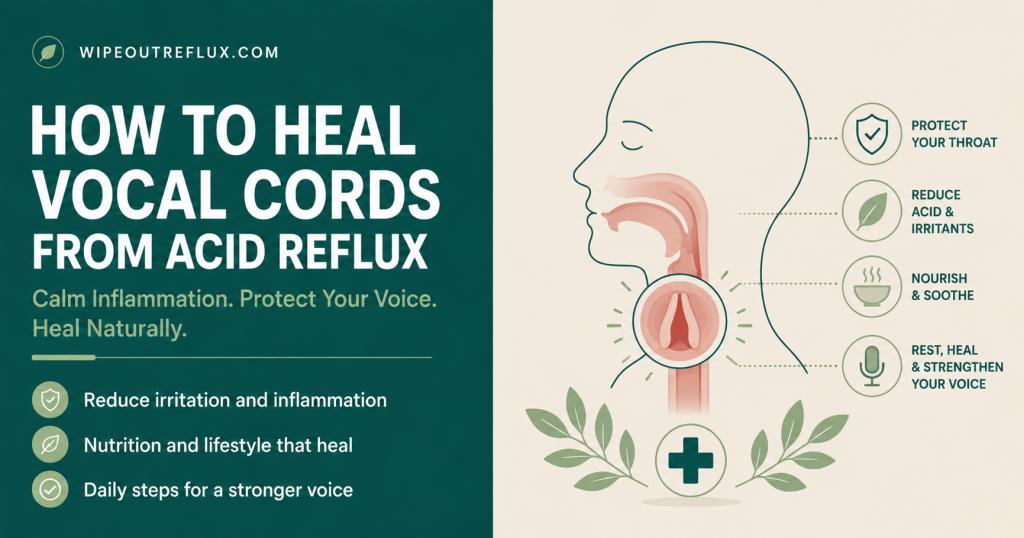
If reflux has left your voice hoarse, tired or unreliable, the good news is that vocal cords are resilient and usually heal well — but only once you stop the thing that’s irritating them. Healing your voice from acid reflux really comes down to doing two things at the same time: shutting off the reflux reaching your voice box, and protecting the cords while they repair.
Neither half works alone. You can rest your voice all you like, but if acid and pepsin keep washing over your vocal cords every night, they never get a clean stretch of time to recover. And you can control your reflux beautifully, but if you’re clearing your throat a hundred times a day and pushing your voice, you keep re-traumatising the very tissue you’re trying to heal.
The other thing to know up front is that this takes time — usually weeks, sometimes a few months. Laryngeal tissue heals slowly. Let me walk through exactly how to give it the best possible conditions to do that.
Key Takeaways
- Reflux damages your voice mainly through pepsin — a stomach enzyme that lodges on the vocal cords and reactivates whenever acid reaches them.
- Vocal cords can’t heal while they’re still being irritated daily, so stopping the reflux at its source is the non-negotiable first step.
- The foundation is a low-acid, reflux-friendly diet, which has been shown to improve laryngeal reflux symptoms and clinical findings.
- An alginate barrier like Gaviscon Advance significantly improved LPR symptoms and voice-box findings in a controlled trial and is one of the most useful add-ons.
- Protect the voice while it repairs: stop the throat clearing, hydrate well, and avoid yelling, whispering and long talking marathons.
- Expect weeks to months, not days — and use returning voice quality as your sign of progress.
- Any hoarseness lasting more than two to three weeks should be checked by an ENT to rule out other causes.
How acid reflux damages your vocal cords
To heal the cords, it helps to know what’s actually harming them. Most voice damage from reflux comes from the silent, throat-based kind — laryngopharyngeal reflux, or LPR. Unlike classic heartburn, LPR often causes no burning at all; instead, small amounts of reflux, frequently as a fine mist, reach all the way up past the upper esophageal sphincter and settle on your larynx.
And the real culprit isn’t the acid itself — it’s pepsin, a digestive enzyme carried up with the reflux that binds to the delicate lining of your vocal cords. Once it’s there, it depletes the proteins that normally protect that tissue, and it springs back into a damaging, active state every time it’s re-exposed to acid — which happens with reflux and with acidic food and drink Johnston et al., The Laryngoscope, 2007. That repeated injury is what leaves vocal cords swollen, red and stiff, which you hear as hoarseness, a rougher or lower voice, vocal fatigue and loss of your higher notes. If your main symptom is a rough or breaking voice, there’s more in can acid reflux cause hoarseness, and the reactivation mechanism is covered in how pepsin reactivates in the throat.
Why the cords won’t heal until you stop the source
This is the principle everything else hangs on. Vocal cords vibrate hundreds of times a second when you speak, so they’re under near-constant mechanical stress. For them to repair, they need calm, uninterrupted time — and they can’t get that if fresh pepsin and acid are landing on them every night. It’s the same reason a reflux sore throat takes so long to heal: the tissue keeps getting re-injured before it can recover.
So the order matters. Stop the reflux first, protect the voice second. Do both together and the cords finally get the conditions they need. Let me take them in turn.
Step 1: Stop the reflux reaching your larynx
This is the foundation, and it’s where most of your results will come from.
Build your days around a low-acid, reflux-friendly diet
What you eat and drink is the single biggest lever, both because it reduces reflux and because it stops feeding acid directly onto pepsin-coated cords. A strict low-acid diet — keeping foods and drinks above about pH 5 — has been shown to improve symptoms and clinical findings in stubborn LPR Koufman, Annals of Otology, Rhinology & Laryngology, 2011. A diet-first approach isn’t a weak option, either: a plant-based, Mediterranean-style diet with alkaline water performed at least as well as reflux medication for improving laryngeal reflux scores Zalvan et al., JAMA Otolaryngology–Head & Neck Surgery, 2017. This reflux-friendly way of eating is what the LPR diet is built around, and the structured, step-by-step version is the Wipeout Diet Plan.
Add an alginate barrier
Alginates are one of the most useful tools specifically for throat reflux. After you swallow one, it forms a gel raft that floats on top of your stomach contents, physically blocking reflux — including the upright, daytime reflux that reaches the voice box. In a controlled trial, LPR patients given Gaviscon Advance alongside vocal hygiene advice had significantly greater improvement in both their symptom scores and their voice-box findings than those given vocal hygiene alone McGlashan et al., European Archives of Oto-Rhino-Laryngology, 2009. It’s a genuinely evidence-backed add-on — more in Gaviscon Advance and alginates for reflux.
Protect your voice overnight
Nighttime is when a lot of laryngeal reflux happens, because lying flat lets stomach contents travel up freely. Two habits make a real difference: stop eating in the three hours before bed so your stomach is empty when you lie down, and adjust your sleeping position — raising the head of the bed and sleeping on your left side both reduce overnight reflux onto the cords.
Medication, where it’s needed
Some people also need acid-suppressing medication, prescribed by a doctor, particularly if there’s significant inflammation. It’s worth knowing that PPIs are less reliable for the throat-based form than for heartburn, which is why diet and alginates carry so much of the load in LPR. A broader overview is in silent reflux treatment.
Step 2: Protect and rest the voice while it heals
With the reflux settling, the second job is to stop re-injuring the cords yourself — because a surprising amount of voice damage is self-inflicted through habits reflux encourages.
Stop the throat clearing
This is the big one. Every forceful throat clear slams your vocal cords together hard, and if you have reflux you’re probably doing it constantly. It feels like it helps; it actually adds a fresh layer of trauma on top of the reflux irritation. Breaking the habit — swallowing, sipping water or doing a gentle silent cough instead — is one of the highest-value things you can do. There’s a full method in how to stop constant throat clearing from reflux.
Keep your cords hydrated
Well-hydrated vocal cords vibrate more easily and resist irritation better. Sip water through the day so the tissue stays moist from the inside — there’s no separate healing drink, systemic hydration is what matters, and the right water for reflux keeps you on the safe side of the pH line while you do it.
Ease off the voice — but don’t whisper
Give your voice relative rest while it recovers: cut back on long talking, avoid shouting and loud environments, and don’t sing through hoarseness. One counter-intuitive point — don’t force-whisper. A hard whisper actually strains the cords more than quiet, easy speech. Aim for a soft, relaxed voice at normal pitch rather than whispering.
Consider voice therapy, especially if you use your voice professionally
If you’re a singer, teacher, presenter or anyone who relies on their voice, a speech and language therapist can retrain how you produce sound so you stop overloading healing cords. It’s particularly worthwhile for singers and professional voice users, where technique and reflux control together make the difference.
How long does it take?
Honestly, longer than most people want to hear. With the reflux genuinely under control and the voice protected, many people notice their hoarseness easing within a few weeks, but full recovery of voice quality often takes two to three months, and longer if there’s been long-standing swelling or a granuloma. The cords heal on their own timeline, and consistency beats intensity — a steady, sustained approach heals faster than a strict week followed by a slip back. Returning clarity, range and stamina in your voice are your real signs of progress, and the broader LPR recovery timeline gives a fuller picture of what to expect.
When to see a doctor
Reflux is a common cause of a hoarse voice, but it isn’t the only one, and voice changes shouldn’t be left to guesswork. Any hoarseness lasting more than two to three weeks warrants an ENT assessment, usually with a look at the vocal cords, to rule out other causes such as nodules, polyps and — rarely — something more serious. See a doctor sooner if you have a lump in the neck, difficulty swallowing, coughing up blood, or your voice suddenly disappears. Getting the cords looked at isn’t only about safety; it also tells you exactly what you’re healing, which makes the plan above far more targeted.
Conclusion
Healing your vocal cords from acid reflux isn’t complicated, but it does demand patience and both halves of the job at once: take the reflux and its pepsin off your voice box, and protect the cords while they knit back together. Get the reflux under control, add an alginate, fix your nights, stop the throat clearing, hydrate, and go easy on your voice — do that consistently and the tissue gets exactly the calm it needs to recover. The cords will do the healing; your job is to give them the conditions.
Because the reflux is the root of it, that’s where I’d put your energy first, and it’s what the Wipeout Diet Plan is built for — the complete, structured system for getting reflux under control so your voice box stops being bathed in acid and pepsin night after night. I designed it first and foremost around LPR and silent reflux, the stubborn throat-based kind that wrecks voices, but because it works on the same underlying mechanisms it’s just as effective for GERD, heartburn and everyday acid reflux. Pair it with the voice-protection habits above and you’re treating the problem from both directions at once, which is exactly what damaged cords need.
To make the daily choices simple, the Wipeout Food Reference Guide is the essential companion — a downloadable reference to which foods and drinks are safe for reflux and their pH values, so you can keep acid off healing cords without second-guessing every meal. Calm the reflux, protect the voice, give it time — that’s how your voice comes back.
This article is for general information only and is not medical advice. Hoarseness lasting more than two to three weeks should be assessed by a doctor or ENT, and any new medication should be started under medical guidance.
Frequently Asked Questions
Can vocal cords heal from acid reflux damage?
Yes, in most cases. Vocal cords recover well once the reflux irritating them is brought under control and the voice is protected while it repairs. The key is removing the ongoing source of injury — pepsin and acid — because cords can’t heal while they’re still being irritated daily.
How long does it take for reflux-damaged vocal cords to heal?
Usually weeks to a few months. Many people notice hoarseness easing within a few weeks of getting their reflux under control, but full return of voice quality commonly takes two to three months, and longer if there’s been long-standing swelling. Consistency is what speeds it up.
Can silent reflux permanently damage your voice?
Long-standing, untreated LPR can cause lasting changes like chronic swelling, granulomas or scarring, but most reflux-related voice damage is reversible when caught and treated. That’s exactly why persistent hoarseness shouldn’t be ignored — earlier treatment means a better and faster recovery.
What’s the fastest way to soothe reflux-irritated vocal cords?
In the moment: sip water steadily, stop clearing your throat, rest your voice, and avoid acidic or minty foods and drinks. An alginate after meals and at bedtime helps block reflux quickly. But fast soothing isn’t the same as healing — lasting recovery still needs the reflux itself brought under control.
Should I rest my voice completely?
Relative rest is better than total silence for most people — cut back on loud, prolonged or strained voice use, but you don’t need to stop speaking entirely. Importantly, don’t force-whisper, which strains the cords more than quiet, easy speech at your normal pitch.
Does drinking water actually help vocal cords heal?
Indirectly, yes. You can’t pour water directly onto the cords, but staying well hydrated keeps the whole vocal tract moist, which helps the cords vibrate smoothly and resist irritation. It’s a genuine support to healing, just not a treatment on its own.
Research & References
- Human pepsin depletes the proteins that protect laryngeal tissue and, though inactive at throat pH, remains stable and is reactivated to a damaging state when re-exposed to acid — the mechanism behind reflux-related vocal cord injury Johnston et al., The Laryngoscope, 2007.
- A strict low-acid diet keeping foods and drinks above pH 5 improved symptoms and clinical findings in patients with recalcitrant laryngopharyngeal reflux Koufman, Annals of Otology, Rhinology & Laryngology, 2011.
- In LPR patients, a liquid alginate suspension (Gaviscon Advance) added to vocal hygiene advice produced significantly greater improvement in Reflux Symptom Index and Reflux Finding Score than vocal hygiene alone McGlashan et al., European Archives of Oto-Rhino-Laryngology, 2009.
- A plant-based, Mediterranean-style diet with alkaline water was at least as effective as proton pump inhibitors at improving laryngopharyngeal reflux symptom scores Zalvan et al., JAMA Otolaryngology–Head & Neck Surgery, 2017.

David Gray
12 years living with LPR · Consultant & researcher
I've lived with LPR for twelve years — the misdiagnoses, the PPI courses that did nothing, the slow work of figuring out what actually helps. Wipeout Reflux is where I translate the research into plain terms for people stuck in the same place. Every claim here is sourced to peer-reviewed work, and I consult one-to-one with LPR sufferers.