
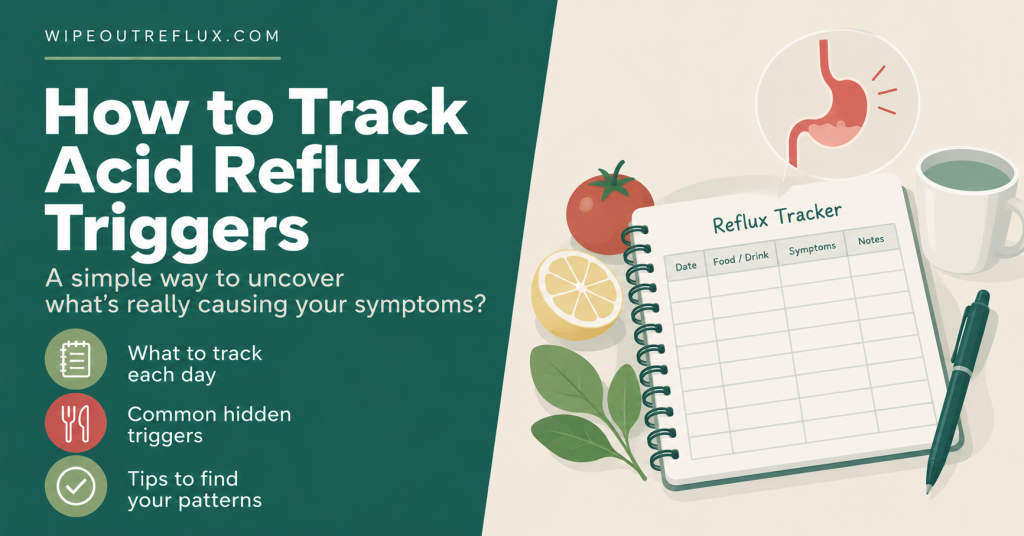
If you want to find out what actually sets off your reflux, a 30-day symptom diary is the single most useful thing you can do — more useful, honestly, than any generic “foods to avoid” list. Here’s the method in one line: for 30 days, log what you eat and drink with times, log your symptoms with a severity score and times, note a few key habits (meal-to-bed gap, sleep, stress), and then read the patterns backwards to see which inputs keep showing up before your bad spells.
The reason this beats a list is simple: reflux triggers are deeply individual. When researchers looked hard at the evidence for blanket dietary rules — cut coffee, chocolate, citrus, spicy and fatty foods — they found the support surprisingly thin, while weight loss and raising the head of the bed had real evidence behind them [Kaltenbach et al., Archives of Internal Medicine, 2006]. In other words, the standard trigger list is a starting hypothesis, not gospel. Coffee wrecks some people and does nothing to others. The only way to know your triggers is to gather your data.
Below is exactly how I’d run a 30-day trigger diary — what to record, how to structure the month so it actually reveals something, and how to read the results without fooling yourself.
Key Takeaways
- Reflux triggers are individual — the evidence for universal “avoid” lists is weak, so tracking your own patterns beats following a generic list.
- A symptom diary works because self-monitoring is consistently linked to better outcomes, and the more consistently you log, the more you get out of it.
- Record four things: food and drink (with times and rough portions), symptoms (with a 0–5 severity score and times), key habits (meal-to-bed gap, sleep, stress), and a weekly overall symptom score.
- Account for the lag: reflux symptoms often show up hours after the meal, or overnight — so look back several hours, not just at the last thing you ate.
- Structure the 30 days: a week of honest baseline, two weeks of pattern-spotting, then a week of testing your top suspects by removing and reintroducing them.
- For silent reflux, score yourself with the Reflux Symptom Index so you’re tracking a validated number, not just a vague sense of “better” or “worse.”
- The goal is a short, personal shortlist of real triggers you can actually act on — not a life lived avoiding everything on the internet’s list.
Why a Diary Works Better Than a Trigger List
Two things make structured tracking worth the effort. First, as above, the universal trigger lists are far less reliable than people assume — the strongest lifestyle evidence is for weight loss and sleeping position, not for cutting specific foods across the board [Kaltenbach et al., Archives of Internal Medicine, 2006]. So blindly banning coffee and tomatoes might cost you foods you enjoy for no benefit, while missing the thing that’s actually getting you.
Second, the act of monitoring itself helps. Across weight-loss research, self-monitoring shows a consistent, significant association with better results — and more frequent logging works better than occasional logging [Burke et al., Journal of the American Dietetic Association, 2011]. The same principle carries over: writing it down makes you notice patterns you’d otherwise wave away, and it turns “I think dairy might bother me” into something you can actually check.
What to Record Each Day
Keep it simple enough that you’ll actually stick with it for a month. You need four streams of information:
1. Food and drink — with times and rough portions. Everything that goes in, and when. Times matter enormously because of the lag (more on that below), and portion size matters because a big meal refluxes more than a small one regardless of what’s in it. Don’t forget drinks, sauces, snacks and that late handful of something.
2. Symptoms — with a severity score and times. Log each symptom episode, when it happened, and how bad it was on a 0–5 scale (0 = none, 5 = severe). Note the type too: heartburn, throat clearing, cough, hoarseness, lump-in-throat, regurgitation. For silent reflux the throat symptoms are the ones to watch — if you’re not sure which are yours, my guide to LPR symptoms lays them out.
3. Key habits. A few daily notes that are known to move reflux: how many hours between your last food and lying down, how you slept and in what position, alcohol, and a rough stress level (1–5). These often explain “mystery” bad days that the food column alone can’t.
4. A weekly overall score. Once a week, score your week as a whole so you can see the trend. For silent reflux, use the Reflux Symptom Index — a validated nine-item questionnaire scored 0–5 per item (max 45), where a total above about 13 is generally considered abnormal [Belafsky et al., Journal of Voice, 2002]. Tracking that number weekly tells you honestly whether you’re improving, rather than relying on memory.
You can run all of this in a notebook, a notes app, or a simple spreadsheet with a column for each of the above. A one-page-per-day printable layout makes it easier to keep up with — the structure above is the template.
The Lag: The Mistake Almost Everyone Makes
This is the part that trips people up, so it gets its own section. Reflux symptoms frequently don’t appear right after the trigger food. Acid and pepsin can take hours to provoke symptoms, and a late meal often shows up as symptoms overnight or the next morning — which is exactly why so many people find their reflux is worse in the morning without connecting it to dinner.
So when you’re reading your diary, don’t just look at the meal right before a symptom. Look back over the previous several hours, and for morning or night symptoms, look at the evening before — especially your meal-to-bed gap. A “healthy” dinner eaten at 10pm and taken straight to bed can cause more trouble than a “trigger” food eaten at lunch with hours to clear. This is why logging times, not just foods, is non-negotiable.
How to Structure the 30 Days
A month is enough to see patterns and test them. I’d split it like this:
Week 1 — honest baseline. Change nothing. Eat and live as you normally would, and just record everything. The temptation is to “be good” during week one, but that hides your real triggers. You want the truth, not your best behaviour.
Weeks 2–3 — spot patterns. Keep logging, and start reviewing every few days. Circle the days with the worst symptom scores and look back (with the lag in mind) for what they have in common. You’re building a shortlist of suspects — maybe it’s fat load, maybe portion size, maybe alcohol, maybe a specific food, maybe the late-eating habit rather than any food at all.
Week 4 — test your suspects. Now you experiment. Take your top one or two suspects and remove them cleanly for several days, watching your scores. If things improve, reintroduce that item deliberately and see if symptoms return. A trigger that disappears when removed and comes back when reintroduced is a real trigger — that “remove and reintroduce” step is what separates a genuine culprit from a coincidence.
If your top suspect turns out to be a habit rather than a food — late meals, big portions, lying down too soon — that’s arguably the best result you can get, because those are the highest-evidence things to fix anyway. Simple moves like a longer gap before bed, smaller evening meals, and even a short walk after eating often do more than any single food swap.
Reading Your Results Without Fooling Yourself
A few honest cautions, because it’s easy to draw the wrong conclusion:
- Look for repeats, not one-offs. One bad day after pizza doesn’t convict pizza. A pattern across several exposures does. That’s what the reintroduction test is for.
- Watch for confounders. The night the “spicy curry” hit you, was it also a large late meal with a couple of beers? Isolate one variable at a time in week four.
- Don’t over-restrict. The aim is a short personal list of real triggers, not fear of food. If you end up “unable to eat anything,” something’s gone wrong with the method — you’re probably blaming foods for what’s really a portion or timing problem.
- Bring it to your doctor. A completed 30-day diary is genuinely useful clinical information and pairs well with proper assessment and diagnosis — especially if symptoms are persistent or severe.
Once you know your real triggers and patterns, you can compare them against the usual suspects in foods to avoid and foods to eat — but now with your own evidence telling you which of them actually apply to you.
Conclusion
A 30-day symptom diary turns reflux from a guessing game into something you can read. Log food and symptoms with times, respect the lag, spend a week testing your top suspects by removing and reintroducing them, and you’ll come out with a short, personal list of what genuinely sets you off — which is worth far more than any one-size-fits-all list. It’s cheap, it’s evidence-friendly, and it puts you back in control.
The natural next step, once you know your triggers, is a way of eating built around them — and that’s exactly what the Wipeout Diet Plan gives you. It takes everything a diary teaches you and turns it into a complete, liveable framework; I built it around LPR, the stubborn throat-based form, but because it targets the same underlying reflux mechanics it works just as well for classic GERD and heartburn. If you want a lighter companion to check foods against as you track, the Wipeout Food Reference Guide is the essential quick reference — it shows which foods and drinks are safe for reflux and LPR and where they sit on the pH scale, so your diary and the guide work hand in hand.
Frequently Asked Questions
How long should I keep an acid reflux food diary?
Around 30 days is the sweet spot. It’s long enough to see genuine patterns across many meals and to run a proper remove-and-reintroduce test on your top suspects, but short enough to stay motivated. If a month feels like a lot, even two weeks of honest logging will reveal your biggest triggers.
What should I write in a reflux symptom diary?
Record four things: everything you eat and drink with times and rough portions; each symptom with a 0–5 severity score and the time it happened; key habits like your meal-to-bed gap, sleep, alcohol and stress level; and a weekly overall symptom score. Times matter as much as the foods, because reflux symptoms often lag hours behind the trigger.
Why don’t my symptoms match what I ate?
Because of the lag. Reflux symptoms can appear hours after a meal, and a late dinner often shows up as symptoms overnight or the next morning rather than straight away. When reviewing your diary, look back several hours — and for morning symptoms, look at the evening before, especially how soon you lay down after eating.
How do I know if a food is really a trigger?
Use the remove-and-reintroduce test. Take the suspected food out cleanly for several days and watch your symptom scores; if they improve, deliberately reintroduce it and see if symptoms return. A food that consistently causes symptoms when reintroduced — not just once — is a genuine trigger. A single bad day proves nothing.
Should I change my diet during the first week?
No — keep your first week as a normal baseline and change nothing. It’s tempting to eat carefully while you’re paying attention, but that hides the very triggers you’re trying to catch. Record your real habits first, then start experimenting in the later weeks.
Is a symptom diary useful for silent reflux (LPR)?
Very. Because LPR symptoms are throat-based and often delayed, patterns are especially hard to spot without tracking. Scoring yourself weekly with the Reflux Symptom Index gives you a validated number to follow over the month, so you can tell whether you’re genuinely improving rather than relying on impressions.
Can I just use an app or spreadsheet instead of paper?
Absolutely — the method matters more than the medium. A notes app or a simple spreadsheet with a column for foods, times, symptoms, severity and habits works perfectly. The key is logging consistently and in enough detail to see the timing, since more frequent, complete records give you far more to work with.
Research & References
- [Kaltenbach et al., Archives of Internal Medicine, 2006] — Evidence-based review finding good support for weight loss and head-of-bed elevation in GERD, but little evidence that blanket dietary restrictions (caffeine, chocolate, citrus, spicy and fatty foods) improve outcomes — supporting individualised trigger identification.
- [Burke et al., Journal of the American Dietetic Association, 2011] — Systematic review finding a consistent, significant association between self-monitoring and better outcomes, with more frequent monitoring linked to greater success.
- [Belafsky et al., Journal of Voice, 2002] — Developed and validated the Reflux Symptom Index, a nine-item self-administered questionnaire (each item 0–5, maximum 45) for laryngopharyngeal reflux, with scores above about 13 considered abnormal.

David Gray
12 years living with LPR · Consultant & researcher
I've lived with LPR for twelve years — the misdiagnoses, the PPI courses that did nothing, the slow work of figuring out what actually helps. Wipeout Reflux is where I translate the research into plain terms for people stuck in the same place. Every claim here is sourced to peer-reviewed work, and I consult one-to-one with LPR sufferers.