
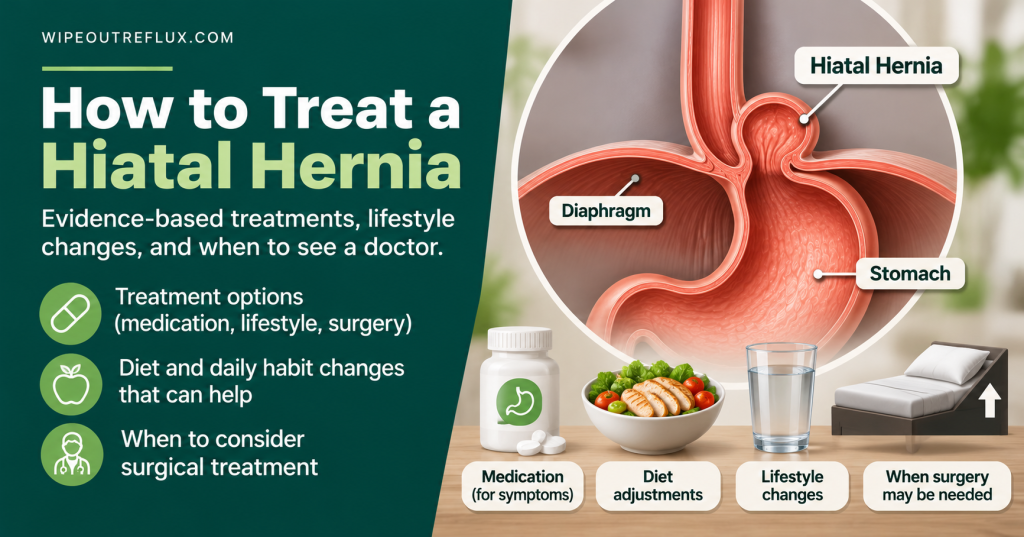
Most hiatal hernias are treated by treating the reflux they cause, not the hernia itself. That usually means a combination of lifestyle changes (smaller meals, no late eating, raising the head of your bed, and losing weight if needed), a reflux-friendly diet, and medication such as alginates, H2 blockers or proton pump inhibitors (PPIs). Surgery is reserved for large or paraesophageal hernias that cause symptoms, complications, or reflux that doesn’t respond to other treatment.
A small sliding hiatal hernia that isn’t causing problems doesn’t need treatment at all. And no, it won’t usually close up on its own. But the reflux it drives can very often be brought under control without an operation.
Key Takeaways
- A hiatal hernia happens when part of your stomach pushes up through the opening in your diaphragm into your chest.
- Small sliding hernias with no symptoms don’t need any treatment.
- Treatment focuses on reflux: weight loss, smaller meals, not eating late, and raising the head of your bed have the best evidence.
- PPIs treat the acid a hernia lets through, but they don’t shrink or fix the hernia.
- Larger hernias tend to cause more acid reflux and more esophageal damage, and may need stronger treatment.
- Hiatal hernias don’t go away on their own and tend to get bigger over time, especially with weight gain.
- Surgery is recommended for symptomatic paraesophageal hernias and for reflux that doesn’t respond to other treatment.
What a Hiatal Hernia Actually Is
Your esophagus passes through an opening in your diaphragm, called the hiatus, to reach your stomach. Normally, the diaphragm wraps around the bottom of the esophagus and works together with the lower esophageal sphincter to stop acid escaping. Think of them as two valves stacked on top of each other.
With a hiatal hernia, that opening has stretched and part of your stomach has slipped up through it. The two valves get pulled apart, and the barrier against reflux gets much weaker. There are two main types:
- Sliding hiatal hernia (type I). The junction between your esophagus and stomach slides up above the diaphragm. This accounts for the vast majority of hiatal hernias and is the type most linked with reflux.
- Paraesophageal hernia (types II to IV). Part of the stomach, and sometimes other organs, pushes up beside the esophagus. These are less common but more likely to cause mechanical problems like trouble swallowing, chest pressure or, rarely, the stomach twisting.
Size matters too. In one study of patients with confirmed reflux, larger hernias were linked to a weaker lower esophageal sphincter, weaker esophageal contractions, more acid reflux and more severe esophagitis [Schlottmann et al., The American Surgeon, 2018]. I go deeper into how hernias drive reflux in my guide to hiatal hernia and reflux.
Do You Need Treatment at All?
Not always. Hiatal hernias are very common, and many are found by chance on a scan or endoscopy. Surgical guidelines say a sliding hernia that isn’t causing symptoms doesn’t need to be repaired [Kohn et al., Surgical Endoscopy, 2013].
Treatment becomes worthwhile when your hernia is causing:
- Heartburn, regurgitation or other reflux symptoms
- Throat symptoms like hoarseness, cough or a lump in the throat
- Difficulty swallowing or food feeling stuck
- Chest pressure or feeling full very quickly
- Complications like esophagitis or anemia from slow bleeding
Lifestyle Changes That Actually Help
This is where most hernia treatment starts, and it’s not a box-ticking exercise. When the diaphragm can no longer pinch the bottom of the esophagus shut, gravity and pressure become your main allies or enemies.
Lose weight if you’re carrying extra
Extra weight around your middle raises the pressure inside your abdomen and pushes your stomach up through the hiatus. A systematic review found weight loss was one of only two lifestyle measures with good evidence of improving reflux [Kaltenbach et al., Archives of Internal Medicine, 2006], and current guidelines recommend it for anyone who is overweight [Katz et al., The American Journal of Gastroenterology, 2022].
Weight also appears to affect whether the hernia itself gets bigger. In a 10-year study using CT scans, hiatal hernias tended to grow over time, and those that grew were in people with a higher BMI than those that shrank [Kim et al., BMJ Open Gastroenterology, 2021].
Raise the head of your bed
Raising the head of your bed was the other lifestyle measure backed by evidence in that review [Kaltenbach et al., Archives of Internal Medicine, 2006]. It matters even more with a hernia, because lying flat lets acid pool in the herniated pouch and flow straight up. Aim for 6 to 8 inches using bed risers or a wedge. Here’s how to raise the head of your bed, and my picks for the best wedge pillows.
Eat smaller meals, and stop eating 3 hours before bed
A big meal stretches your stomach, pushes more of it up through the hiatus and triggers the sphincter to relax. Smaller meals ease that pressure. Guidelines also recommend avoiding meals 2 to 3 hours before lying down [Katz et al., The American Journal of Gastroenterology, 2022]. More in does overeating cause acid reflux.
Reduce pressure on your abdomen
- Avoid tight belts and waistbands. See tight clothing and acid reflux.
- Avoid straining on the toilet. Treat constipation with fiber and fluids.
- Be careful with heavy lifting and exercises that crunch your abdomen. My guide to weightlifting and acid reflux covers safer approaches.
- Stop smoking, as it weakens the sphincter and triggers coughing that puts pressure on the hiatus.
Try diaphragm breathing exercises
The crura of the diaphragm (the muscle around the hiatus) can be trained. In a small randomized trial, people with reflux who did abdominal breathing exercises had less acid exposure, better quality of life and needed fewer PPIs, with the benefit lasting at 9 months in those who kept going [Eherer et al., The American Journal of Gastroenterology, 2012]. One caveat: that study excluded people with large hernias, so it’s most relevant if yours is small. I show you how in breathing exercises for acid reflux.
Diet for a Hiatal Hernia
Food can’t push your stomach back down, but it can make a huge difference to how much reflux gets through. The goals are simple:
- Keep meals small and low in fat, as fat slows stomach emptying and relaxes the sphincter.
- Cut back on common triggers like fried food, chocolate, mint, alcohol, coffee, fizzy drinks, citrus, tomatoes and spicy food.
- Choose low-acid foods so whatever does reflux is less irritating, especially if you get throat symptoms.
- Avoid foods that make you gassy or bloated, as a distended stomach pushes up through the hiatus.
Rather than guessing your way through it, the Wipeout Diet Plan gives you a structured, low-acid way of eating built around exactly these principles.
Medications for a Hiatal Hernia
No medication can repair a hernia. What they do is reduce the acid, or the reflux, that the hernia allows.
Alginates (Gaviscon)
Alginates make a lot of sense with a hernia. After a meal, a layer of highly acidic gastric juice, known as the acid pocket, floats on top of your food. Research shows that a hiatal hernia traps this acid pocket above the diaphragm, which is a major reason people with hernias, especially large ones, get more acid reflux [Beaumont et al., Gut, 2010]. Alginates form a raft right where that acid pocket sits. Take them after meals and before bed. More in alginates for acid reflux and my review of Gaviscon Advance.
Antacids and H2 blockers
Antacids like Tums give quick relief for occasional symptoms but only last an hour or so. H2 blockers like famotidine (Pepcid) reduce acid production for up to 12 hours and work well taken before bed. See what is an antacid for how they differ.
PPIs for a hiatal hernia
PPIs such as omeprazole, esomeprazole and pantoprazole are the most powerful acid reducers available and the standard medical treatment for reflux caused by a hiatal hernia. Guidelines recommend an 8-week trial, taken 30 to 60 minutes before a meal, then trying to reduce to the lowest effective dose [Katz et al., The American Journal of Gastroenterology, 2022].
A few things to know if you have a hernia:
- PPIs don’t fix the hernia. They make the reflux less acidic, but the reflux still happens. Symptoms usually return if you stop.
- Bigger hernias are harder to control. You may need a higher dose or twice-daily dosing, which should be guided by your doctor.
- Timing matters. Taking a PPI at the wrong time is one of the most common reasons it seems not to work. See the best time of day to take omeprazole.
- They don’t help throat symptoms as reliably. PPIs reduce acid but don’t stop reflux or pepsin reaching your throat, which is why they often disappoint for LPR. I explain why in why PPIs don’t work for LPR.
- Don’t stop suddenly. If you want to come off them, taper slowly to avoid rebound acid. See getting off PPIs.
For severe erosive esophagitis, newer drugs like vonoprazan are another option. See vonoprazan for acid reflux.
When Is Surgery Needed?
Surgery is the only treatment that actually repairs a hiatal hernia. The surgeon pulls the stomach back down into the abdomen, tightens the opening in the diaphragm with stitches, and usually wraps the top of the stomach around the esophagus (a fundoplication) to rebuild the valve. Current guidelines suggest routinely adding a fundoplication when a hernia is repaired [Daly et al., Surgical Endoscopy, 2024].
Surgery is generally recommended for [Kohn et al., Surgical Endoscopy, 2013]:
- Paraesophageal hernias that cause symptoms
- Sliding hernias with reflux that doesn’t respond well to medication, or if you don’t want lifelong medication
- Complications such as severe esophagitis, strictures, bleeding or anemia
- Emergencies, such as the stomach twisting or getting trapped
I’ve covered what the operation involves, recovery and what to eat afterward in my guide to hiatal hernia surgery and recovery diet, and compared the main wrap types in Nissen vs Toupet fundoplication.
Can a Hiatal Hernia Go Away on Its Own?
Unfortunately, no. A sliding hernia can slip in and out of the chest, so it may not show up on every scan, but the stretched opening in your diaphragm doesn’t tighten back up by itself. In fact, among people in the CT study who were rescanned 10 years later, the median hernia area grew from 9.9 to 17.9 square centimeters [Kim et al., BMJ Open Gastroenterology, 2021].
You may have seen videos claiming you can massage a hernia back into place. I looked at the evidence in hiatal hernia self-massage, and it doesn’t support it as a fix.
The good news is that you don’t need the hernia to disappear to feel well. Many people with hiatal hernias live symptom-free once their weight, eating habits and reflux are under control.
Can a Hiatal Hernia Be Cured?
Only surgery repairs the hernia, and even then it isn’t always permanent. Hernias can come back after repair, especially large ones. For most people with a small sliding hernia, the realistic goal is controlling symptoms rather than a cure, and that’s very achievable without an operation.
When to Get Urgent Help
Rarely, part of the stomach can become trapped or twisted in the chest, cutting off its blood supply. Seek emergency care if you have sudden severe chest or upper abdominal pain, retching without being able to vomit, inability to swallow anything, or you vomit blood or pass black stools. Severe chest pain should always be checked to rule out your heart. See heartburn or heart attack.
Conclusion
Treating a hiatal hernia usually means treating the reflux it causes. Small sliding hernias with no symptoms don’t need treatment, and most symptomatic ones can be managed with weight loss, smaller meals, no eating within 3 hours of bed, raising the head of your bed and reducing pressure on your abdomen. Alginates are a smart fit because they target the acid pocket a hernia traps, and PPIs reduce acid but don’t fix the hernia or stop reflux. Hernias don’t go away on their own, and surgery is reserved for symptomatic paraesophageal hernias, complications and reflux that won’t respond to other treatment.
The part of all this that’s most in your control, every single day, is what and how you eat. Smaller, gentler, low-acid meals mean less pressure on the hiatus and less damage from whatever does get through.
That’s why I’d recommend the Wipeout Diet Plan as your foundation. It was built first and foremost for LPR, the stubborn throat-based kind of reflux, but because it targets the same underlying causes, it works just as well for the heartburn and regurgitation a hiatal hernia brings. It shows you what to eat, what to avoid and how to time your meals, so you can take the pressure off your hernia and rely less on medication.
Frequently Asked Questions
What is the best treatment for a hiatal hernia?
For most people, the best treatment is controlling reflux with weight loss, smaller meals, no late eating, raising the head of the bed and a reflux-friendly diet, plus medication like alginates or PPIs if needed. Surgery is best for symptomatic paraesophageal hernias and reflux that doesn’t respond.
Do PPIs help a hiatal hernia?
PPIs help the acid reflux a hiatal hernia causes, and they can heal esophagitis. They don’t shrink or repair the hernia, though, and they don’t stop reflux itself. Larger hernias may need higher doses.
Can a hiatal hernia go away on its own?
No. The stretched opening in your diaphragm doesn’t close by itself, and hernias tend to get bigger over time, particularly with weight gain. Symptoms, however, can often be controlled very well without surgery.
Can a hiatal hernia be cured without surgery?
The hernia itself can’t be cured without surgery, but the symptoms often can be. Many people with small sliding hernias become symptom-free with lifestyle changes, diet and the right medication.
What foods should I avoid with a hiatal hernia?
The most common triggers are fried and fatty foods, chocolate, mint, alcohol, coffee, fizzy drinks, citrus, tomatoes and spicy food. Large meals of any kind can also make symptoms worse.
What sleeping position is best for a hiatal hernia?
Sleep with the head of your bed raised 6 to 8 inches and, ideally, on your left side. This keeps your stomach below your esophagus. See my guide to the best sleeping position for reflux.
When does a hiatal hernia need surgery?
Surgery is usually recommended for paraesophageal hernias that cause symptoms, for reflux that doesn’t respond to medication, for complications like strictures or bleeding, and for emergencies such as the stomach twisting or becoming trapped.
Research & References
- [Schlottmann et al., The American Surgeon, 2018] — Study of 175 patients with confirmed reflux showing larger hiatal hernias were linked to a weaker lower esophageal sphincter, weaker peristalsis, more acid reflux and more severe esophagitis.
- [Kohn et al., Surgical Endoscopy, 2013] — SAGES guidelines for managing hiatal hernia, advising that asymptomatic sliding hernias don’t need repair and setting out when surgery is indicated.
- [Daly et al., Surgical Endoscopy, 2024] — Updated SAGES guidelines suggesting a fundoplication be routinely performed during hiatal hernia repair and outlining criteria for repairing asymptomatic hernias.
- [Kaltenbach et al., Archives of Internal Medicine, 2006] — Systematic review finding weight loss and head of bed elevation were the lifestyle measures with evidence of improving reflux.
- [Katz et al., The American Journal of Gastroenterology, 2022] — ACG clinical guideline recommending weight loss, avoiding meals 2 to 3 hours before bed, and an 8-week PPI trial taken before a meal for GERD.
- [Kim et al., BMJ Open Gastroenterology, 2021] — CT study of 3,200 adults finding hiatal hernias became more common with age and tended to enlarge over 10 years, with growth linked to higher BMI.
- [Eherer et al., The American Journal of Gastroenterology, 2012] — Randomized controlled study showing abdominal breathing exercises reduced acid exposure, improved quality of life and lowered PPI use in reflux patients without large hernias.
- [Beaumont et al., Gut, 2010] — Study showing the position of the post-meal acid pocket is largely determined by hiatal hernia, and that entrapment above the diaphragm drives acid reflux, especially in large hernias.

David Gray
12 years living with LPR · Consultant & researcher
I've lived with LPR for twelve years — the misdiagnoses, the PPI courses that did nothing, the slow work of figuring out what actually helps. Wipeout Reflux is where I translate the research into plain terms for people stuck in the same place. Every claim here is sourced to peer-reviewed work, and I consult one-to-one with LPR sufferers.