
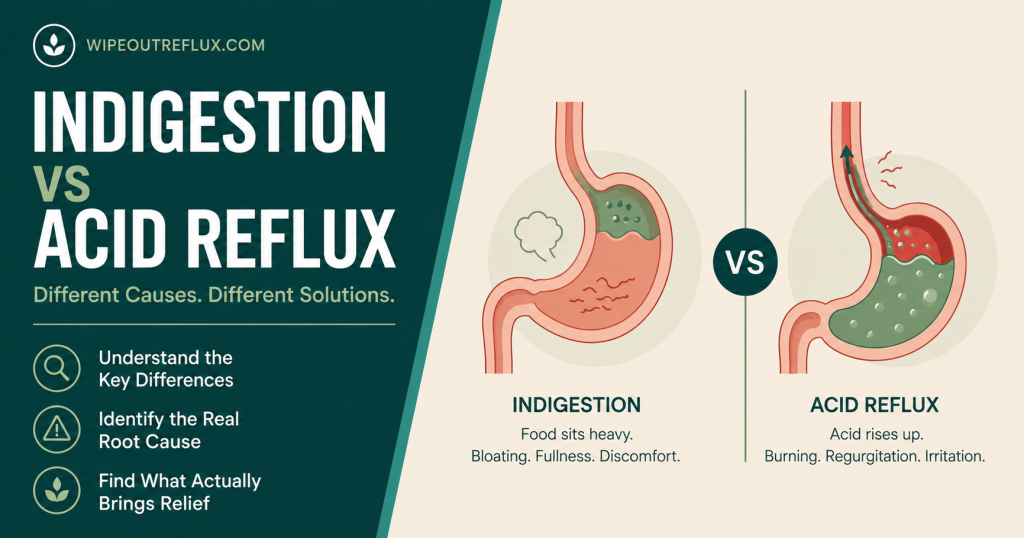
Here’s the thing nobody tells you: indigestion isn’t a diagnosis. It’s a description. The medical term is dyspepsia, and it’s an umbrella covering pain or burning in the upper abdomen, feeling uncomfortably full after normal-sized meals, and getting full after a few mouthfuls. Acid reflux, by contrast, is a specific mechanical event — stomach contents travelling upward past a sphincter that should have stayed shut.
So the practical difference is location and direction. Indigestion sits in your stomach: heaviness, fullness, nausea, a gnawing ache below the breastbone. Reflux moves upward: a burn rising behind the breastbone towards the throat, worse lying flat, often with a sour taste or regurgitation.
But asking “is it indigestion or reflux?” is a bit like asking “is it a headache or a migraine?” One is the symptom, the other is a cause. The question worth answering is what’s producing your indigestion — and for most people who get investigated, the answer is functional dyspepsia, which affects around 8.4% of people worldwide and is very much a real condition with real mechanisms behind it.
Key Takeaways
- “Indigestion” is a symptom label, not a diagnosis. The medical term is dyspepsia — upper abdominal pain or burning, postprandial fullness, or early satiety.
- Acid reflux is a specific mechanical failure: stomach contents moving upward into the oesophagus or throat.
- Indigestion sits low and stays put. Reflux rises, worsens lying flat, and can reach the throat.
- The two overlap heavily — dyspepsia is present in 43.9% of people with weekly reflux symptoms, and the odds are nearly sevenfold higher than in people without.
- Global pooled prevalence of functional dyspepsia is 8.4%, and it’s more common in women (9.0% versus 7.0%).
- Functional dyspepsia isn’t “nothing wrong” — it involves impaired gastric accommodation, visceral hypersensitivity and low-grade duodenal immune activation.
- PPIs help dyspepsia only modestly overall, with a number needed to treat of 13 — and the benefit is confined to ulcer-like and reflux-like symptoms, with no advantage at all for dysmotility-type symptoms.
- If your main complaints are fullness, early satiety and nausea rather than burning, acid suppression is statistically unlikely to help you.
“Indigestion” isn’t actually a diagnosis
This matters more than it sounds, because it’s the reason so many people go round in circles.
Dyspepsia is defined by symptoms, not by a mechanism. Under the current criteria it means one or more of the following, bad enough to bother you: epigastric pain, epigastric burning, uncomfortable fullness after a normal-sized meal, or early satiety — feeling full after a few mouthfuls. That’s it. Nothing in that definition says anything about acid, or the stomach lining, or a sphincter.
Doctors split it into two groups. Uninvestigated dyspepsia is where you have the symptoms and nobody has looked yet. Functional dyspepsia is where somebody has looked — endoscopy, tests — and found no structural explanation. Pooled global prevalence of uninvestigated dyspepsia ranges from 17.6% under the older Rome I definition to 6.9% under the stricter Rome IV criteria, depending entirely on how narrowly you draw the boundary Ford et al., Alimentary Pharmacology & Therapeutics, 2020.
Functional dyspepsia also has two recognised subtypes, and knowing which one you have changes what’s likely to help:
- Postprandial distress syndrome (PDS) — bothersome fullness after meals and early satiety. This is the commoner of the two.
- Epigastric pain syndrome (EPS) — pain or burning in the upper abdomen, not necessarily meal-related.
Plenty of people meet both. But if you can work out which side you lean towards, you’re already ahead of most people managing this.
What acid reflux actually is
Reflux is far more specific. The lower oesophageal sphincter should stay shut between swallows. When it relaxes at the wrong moment, or when pressure inside the stomach overwhelms it, contents travel back up into the oesophagus — and sometimes as far as the throat.
What comes up isn’t just acid. It carries pepsin, the stomach’s protein-digesting enzyme, which is the real problem when refluxate reaches the voice box. That’s the difference between classic GERD, where the oesophagus takes the damage, and LPR or silent reflux, where the throat does and there may be no heartburn at all.
Reflux is a transport problem. Indigestion is a processing problem. That distinction generates almost everything below.
The symptom split that actually matters
Indigestion pattern
- Location: upper abdomen, below the breastbone — the pit of your stomach
- Sensation: heaviness, pressure, bloating, a gnawing or aching pain, sometimes burning
- Meal relationship: comes on during or immediately after eating; a normal portion feels like a feast
- Hallmark: early satiety — you sit down hungry and can’t finish the plate
- Company: nausea, excessive burping, bloating, loss of appetite
- Position: lying down doesn’t change it much
- Duration: a heavy, uncomfortable hour or two after meals
Reflux pattern
- Location: behind the breastbone, travelling upward towards the throat
- Sensation: burning, hot, rising — heartburn in the literal sense
- Meal relationship: typically 30–60 minutes after eating, and worse in the evening
- Hallmark: a sour or bitter taste, or actual liquid arriving at the back of your throat
- Company: hoarseness, throat clearing, chronic cough, lump-in-throat sensation — all LPR symptoms
- Position: clearly worse lying flat or bending forward; better upright
- Duration: can persist for hours, especially overnight
The two fastest tests
Does lying down change it? Reflux is gravity-dependent, so it almost always worsens flat and eases when you sit up. Indigestion is largely indifferent to posture. If raising the head of your bed helps, that’s reflux, and it’s about as close to a free diagnostic test as you’ll get.
Can you finish a normal meal? Early satiety is the single most specific indigestion symptom. Reflux doesn’t stop you eating — it punishes you afterwards. If half a plate defeats you, you’re dealing with something in the stomach, not the oesophagus.
Why they overlap so much
Now the complication, because a clean split would be misleading.
A systematic review of community populations found dyspepsia present in 43.9% of people with weekly reflux symptoms, an overall overlap between the two of 25.9%, and almost sevenfold higher odds of dyspepsia in people with weekly reflux symptoms compared with those without Eusebi et al., Clinical Gastroenterology and Hepatology, 2018. Roughly one person in four has both.
The mechanical logic is straightforward. A stomach that doesn’t relax properly to accommodate food, or empties slowly, holds its contents longer and at higher pressure — and pressure is exactly what forces the sphincter open. So the same underlying dysfunction can produce fullness and reflux at once. It’s also why overeating drives reflux so reliably.
The practical consequence: don’t treat this as a choice between two boxes. Work out how much of each you have, because they need different levers.
So what’s actually causing the indigestion?
This is the question the symptom lists can’t answer, and it’s where the real work is. The realistic differential:
- Functional dyspepsia — by far the commonest outcome once people are investigated.
- Helicobacter pylori gastritis — treatable with antibiotics, and worth ruling out first because it’s cheap and it changes management. Worth understanding how H. pylori and reflux interact too.
- Peptic ulcer — less common than it used to be, but the reason alarm features matter.
- Medications — anti-inflammatories are the big one, but iron, antibiotics, bisphosphonates and GLP-1 drugs all feature. Check the list of medications that make reflux and stomach symptoms worse.
- Gallstones — classically right-sided pain after fatty meals, but frequently mistaken for indigestion.
- Delayed gastric emptying — worth reading about gastroparesis and acid reflux if nausea and fullness dominate.
- Coeliac disease and other food-related conditions — a simple blood test is worth having.
- Bacterial overgrowth — particularly if bloating and excess gas dominate; see SIBO and acid reflux.
Reflux, meanwhile, has its own separate causes — sphincter tone, hiatal hernia, meal timing, abdominal pressure. Which is precisely why one prescription rarely fixes both.
Functional dyspepsia isn’t “nothing wrong”
If you’ve been told your tests are normal and it’s “just functional”, I want to push back on how that’s usually delivered, because it leaves people feeling dismissed.
Functional means no structural lesion. It does not mean no mechanism. In functional dyspepsia the recognised disturbances include impaired relaxation of the gastric fundus — the part of the stomach that should expand to receive a meal — visceral hypersensitivity, where normal amounts of stretch register as pain, low-grade mucosal immune activation, altered gut microbiota, and disrupted brain–gut signalling Wang et al., Frontiers in Medicine, 2025.
That same review makes a point worth holding onto: although delayed gastric emptying is often blamed, the association between emptying speed and actual symptoms is weak, and true gastroparesis is relatively uncommon. Impaired accommodation and hypersensitivity appear to matter more.
Translated: your stomach may be failing to relax to receive food, and your nervous system may be reading ordinary stretch as pain. Neither shows up on a camera. Both are real, and both respond to different things than acid does — which brings us to the most useful finding in this whole article.
Globally, functional dyspepsia has a pooled prevalence of 8.4% across 256,915 participants in 40 countries, it’s more common in women than men (9.0% versus 7.0%), and postprandial distress syndrome is the commonest subtype Lee et al., Scientific Reports, 2024. You are not an unusual case.
The PPI trap
Almost everyone with indigestion ends up on a proton pump inhibitor. For a large share of them, it was never going to work — and the evidence on this is unusually clear.
A Cochrane review of PPIs in functional dyspepsia found them only slightly better than placebo overall: a risk ratio of 0.88 across 5,968 participants, with a number needed to treat of 13. In other words, thirteen people take a PPI for one to get a benefit they wouldn’t have had from a dummy pill.
The subgroup analysis is the part that should be on a poster in every waiting room. The benefit was confined to people with ulcer-like and reflux-like dyspepsia. There was no advantage of PPI treatment in people with dysmotility-like or unspecified dyspepsia Pinto-Sanchez et al., Cochrane Database of Systematic Reviews, 2017.
Read that against your own symptoms. If your problem is burning pain, acid suppression is a reasonable bet. If your problem is fullness, early satiety, bloating and nausea — the dysmotility picture — the evidence says the drug does nothing for you, and the years you’ve spent on it were never going to pay off. That’s not a failure on your part. It’s the wrong tool.
Worse, coming off is its own ordeal, because acid rebound after withdrawal generates symptoms in people who never had reflux to begin with. If you’re planning to stop, read how to get off PPIs without acid rebound first, and do it gradually. And if a proper trial genuinely hasn’t helped, that’s information — it’s a reason to investigate, not to double the dose. I’ve written more on that in what to do when reflux medication isn’t working.
How to get an actual answer
The pathway is largely driven by age and alarm features.
Guidance recommends that people under 60 with dyspepsia have a non-invasive Helicobacter pylori test — a breath or stool antigen test — and treatment if positive, rather than an immediate endoscopy. People 60 and over are advised to have upper endoscopy to exclude organic disease, and alarm features in younger patients are weighed case by case rather than triggering a camera automatically Moayyedi et al., The American Journal of Gastroenterology, 2017.
For reflux specifically, the approach differs: for typical heartburn and regurgitation without alarm features, an eight-week trial of acid suppression is the sensible first move, with endoscopy reserved for alarm features or non-response Katz et al., The American Journal of Gastroenterology, 2022. And a normal endoscopy doesn’t rule reflux out — most people with reflux disease have a normal-looking oesophagus, which is why endoscopy for acid reflux so often comes back clear. The full range of tests is covered in how acid reflux is diagnosed.
The single highest-value action for most people with indigestion: get tested for H. pylori. It’s cheap, non-invasive, and it’s the one result most likely to change what you do next.
What actually helps each one
If it’s mostly indigestion
- Smaller, more frequent meals. If your stomach isn’t accommodating well, stop asking it to accommodate so much at once. This is the highest-yield change in postprandial distress syndrome.
- Cut fat at the problem meals. Fat slows gastric emptying and is a reliable trigger for fullness and nausea — fried food is the usual culprit.
- Chew properly and slow down. Unglamorous, and it genuinely helps — see whether chewing your food helps.
- Consider motility support rather than more acid suppression. Prokinetics target the actual mechanism in dysmotility-type symptoms. Ginger is the gentlest starting point.
- Take the brain–gut axis seriously. Not because it’s “in your head”, but because visceral hypersensitivity runs through the nervous system. Breathing exercises and the vagus nerve are genuinely relevant here, and stress modulates the whole system.
If it’s mostly reflux
- Fix the timing. A proper gap before lying down does more than most medication — see how long before bed you should stop eating.
- Raise the head of your bed and take pressure off your abdomen.
- Sort the food out. This is where reflux improvement actually comes from, and where the advice online contradicts itself most. The Wipeout Food Reference Guide is the essential reference for it — which foods and drinks are genuinely safe with acid reflux and LPR, and their pH values, so you’re not guessing meal by meal.
When to see a doctor
Indigestion is usually benign, but some things need proper assessment rather than self-management. See a doctor promptly for unintentional weight loss, difficulty swallowing or food sticking, persistent vomiting, black or tarry stools, vomiting blood or coffee-ground material, unexplained anaemia, or new dyspepsia starting later in life.
And if chest discomfort comes with sweating, breathlessness, or pain spreading to the jaw or arm, treat it as cardiac until proven otherwise. Telling heartburn from a heart attack is not something to work out over dinner.
Conclusion
Indigestion is a symptom; reflux is a mechanism. Indigestion sits in your stomach and shows up as fullness, heaviness, nausea and not being able to finish a normal meal. Reflux rises out of your stomach and shows up as a burn behind the breastbone, a sour taste, and symptoms that worsen the moment you lie flat. Lying down and early satiety are the two questions that sort most people quickly.
The more useful reframe is this: if it’s indigestion, the job isn’t to name it, it’s to find out what’s producing it. Get tested for H. pylori. Review your medications, especially anti-inflammatories. And be honest about which symptom pattern you actually have — because the evidence says acid suppression helps ulcer-like and reflux-like symptoms and does nothing for the fullness-and-early-satiety picture. If you’ve been on a PPI for years without improvement, that finding probably explains why, and it’s worth a conversation with your doctor rather than another repeat prescription.
Where reflux is genuinely part of the picture, the day-to-day work is food, portion size, timing and posture. The Wipeout Food Reference Guide is the essential starting point — the allowed foods and drinks for acid reflux and LPR, with their pH values, so you stop second-guessing every meal. If you’d rather follow a complete system, the Wipeout Diet Plan goes considerably deeper. It was built first around LPR, the stubborn throat-based form of reflux, but because it works on the same underlying mechanisms it does the job just as well for GERD and everyday heartburn — and smaller, better-timed, lower-fat meals happen to be exactly what a stomach that struggles to accommodate food needs anyway.
Frequently Asked Questions
Is indigestion the same as acid reflux?
No. Indigestion, or dyspepsia, is an umbrella term for upper abdominal pain or burning, fullness after meals and early satiety. Acid reflux is a specific mechanical process in which stomach contents travel upward into the oesophagus. Reflux can cause dyspeptic symptoms, but plenty of indigestion has nothing to do with reflux at all.
Can you have indigestion without heartburn?
Very commonly. Postprandial distress syndrome — fullness after normal-sized meals and early satiety — is the most common form of functional dyspepsia and involves no burning whatsoever. If that’s your pattern, treating it as reflux is likely to disappoint you.
Why doesn’t omeprazole help my indigestion?
Because for many people it was never going to. A Cochrane review found PPIs only slightly better than placebo in functional dyspepsia, with a number needed to treat of 13, and the benefit was confined to ulcer-like and reflux-like symptoms. There was no advantage at all in dysmotility-type dyspepsia — the fullness, bloating and nausea pattern.
What’s the difference between indigestion and heartburn?
Heartburn is one specific sensation: a burn behind the breastbone that rises towards the throat, caused by reflux. Indigestion is a broader category that includes upper abdominal pain, burning, fullness and early satiety. Heartburn can be part of indigestion, but most indigestion isn’t heartburn.
Is functional dyspepsia serious?
It isn’t dangerous and it doesn’t progress to anything sinister, but it’s not trivial either — it can meaningfully affect quality of life, and it has identifiable mechanisms including impaired gastric accommodation, visceral hypersensitivity and low-grade mucosal immune activation. Being told it’s functional means no structural damage was found, not that nothing is happening.
How do I know if my indigestion is something more serious?
Alarm features are the thing to watch: unintentional weight loss, difficulty swallowing, persistent vomiting, black tarry stools, vomiting blood, unexplained anaemia, or new symptoms starting later in life. Guidance suggests endoscopy from age 60 with dyspepsia, and H. pylori testing first in younger people.
Can indigestion cause acid reflux?
They share drivers rather than one causing the other. Impaired gastric accommodation and slow emptying raise pressure inside the stomach, and that pressure is what pushes the sphincter open. So the same dysfunction can produce fullness and reflux together, which is part of why around a quarter of people have both.
What should I eat if I get indigestion after every meal?
Start with volume rather than content: smaller, more frequent meals are the single most effective change for postprandial fullness. Then reduce fat at the meals that trouble you most, since fat slows gastric emptying. Eating slowly and chewing thoroughly genuinely helps too. If reflux is also part of the picture, meal timing before bed becomes just as important as what’s on the plate.
Research & References
- Systematic review and meta-analysis reporting pooled global prevalence of uninvestigated dyspepsia ranging from 17.6% (95% CI 9.8–27.1) using Rome I criteria to 6.9% (95% CI 5.7–8.2) using Rome IV criteria Ford et al., Alimentary Pharmacology & Therapeutics, 2020.
- Systematic review and meta-analysis of 44 studies including 256,915 participants from 40 countries, reporting a global pooled prevalence of functional dyspepsia of 8.4% (95% CI 7.4–9.5), higher in women than men (9.0% versus 7.0%), with postprandial distress syndrome the commonest subtype Lee et al., Scientific Reports, 2024.
- Cochrane review of proton pump inhibitors in functional dyspepsia finding PPIs slightly more effective than placebo (risk ratio 0.88, 95% CI 0.82–0.94; 5,968 participants; number needed to treat 13), with benefit confined to ulcer-like and reflux-like dyspepsia and no advantage in dysmotility-like or unspecified dyspepsia Pinto-Sanchez et al., Cochrane Database of Systematic Reviews, 2017.
- Systematic review and meta-analysis of community populations finding dyspepsia in 43.9% of individuals with weekly gastro-oesophageal reflux symptoms, a pooled overlap of 25.9%, and almost sevenfold higher odds of dyspepsia in those with weekly reflux symptoms Eusebi et al., Clinical Gastroenterology and Hepatology, 2018.
- Narrative review of functional dyspepsia mechanisms describing impaired gastric fundus relaxation, visceral hypersensitivity, mucosal immune activation, microbiota imbalance and disrupted brain–gut signalling, and noting that the association between delayed gastric emptying and clinical symptoms is weak while true gastroparesis is relatively uncommon Wang et al., Frontiers in Medicine, 2025.
- American College of Gastroenterology and Canadian Association of Gastroenterology guideline recommending non-invasive Helicobacter pylori testing and treatment for dyspeptic patients under 60, with upper gastrointestinal endoscopy advised from age 60 to exclude organic pathology Moayyedi et al., The American Journal of Gastroenterology, 2017.
- American College of Gastroenterology clinical guideline recommending an eight-week trial of acid suppression for typical reflux symptoms without alarm features, with endoscopy reserved for alarm features or non-response Katz et al., The American Journal of Gastroenterology, 2022.

David Gray
12 years living with LPR · Consultant & researcher
I've lived with LPR for twelve years — the misdiagnoses, the PPI courses that did nothing, the slow work of figuring out what actually helps. Wipeout Reflux is where I translate the research into plain terms for people stuck in the same place. Every claim here is sourced to peer-reviewed work, and I consult one-to-one with LPR sufferers.