
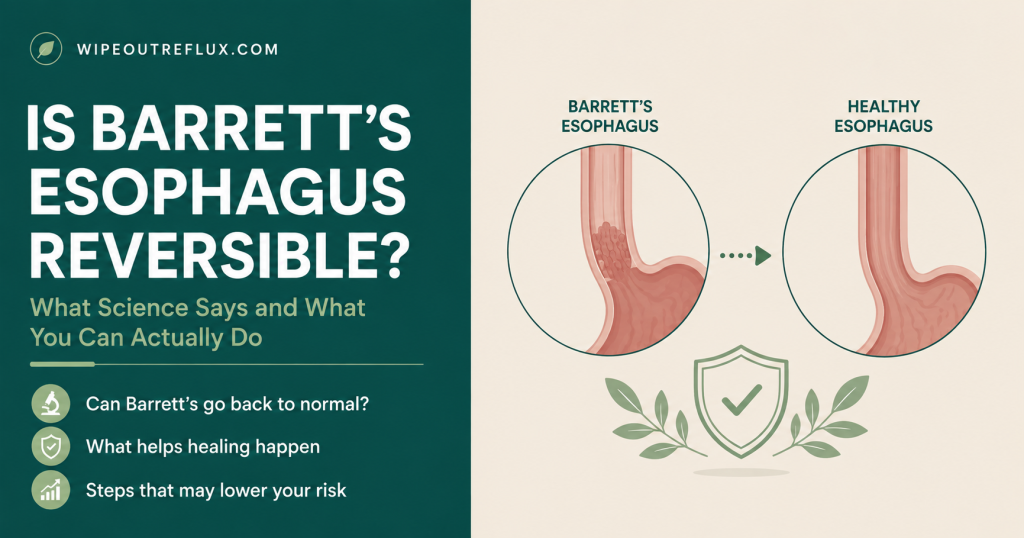
If you’ve just been told you have Barrett’s esophagus, the first question is almost always the same: can I make it go away? It’s an understandable and important question, and the honest answer has two halves.
On its own, Barrett’s esophagus doesn’t reliably reverse. Once the cells lining your lower esophagus have changed, they rarely turn back into normal tissue by themselves, and neither diet nor acid-blocking medication reliably switches them back. But that isn’t the end of the story. The tissue can be removed with endoscopic treatment so that normal lining regrows, and — just as importantly — you can dramatically lower the chance it ever progresses by getting the underlying reflux under control.
So the useful way to think about it isn’t “cure or no cure.” It’s: you usually can’t undo Barrett’s with lifestyle alone, but you can stop it getting worse, and it can be eradicated medically when there’s reason to. Let me walk through what’s actually reversible, what isn’t, and what genuinely helps — all of which is a conversation to have alongside your doctor, not instead of one.
Key Takeaways
- Barrett’s esophagus doesn’t reliably reverse on its own — the changed cells rarely turn back to normal spontaneously.
- Diet and PPIs don’t reverse Barrett’s either, but they play a crucial role: they heal inflammation and lower the risk it progresses.
- In one meta-analysis, PPI use was linked to a 71% lower risk of Barrett’s progressing to high-grade dysplasia or cancer.
- Barrett’s tissue can be physically removed with endoscopic treatments like radiofrequency ablation, allowing normal lining to regrow — this is standard when dysplasia is present.
- The overall risk of Barrett’s turning into cancer is low — roughly 0.1–0.3% per year without dysplasia — but it’s real, which is why surveillance matters.
- The single most useful thing you can do yourself is control reflux aggressively, because ongoing acid and bile are what drive it forward.
- Barrett’s is a condition to manage with a gastroenterologist, including regular surveillance endoscopy — not something to self-treat.
What Barrett’s esophagus actually is
To understand what’s reversible, it helps to know what’s changed. The normal lining of your esophagus is a smooth, pale squamous tissue — not built to handle acid. After years of reflux washing over it, that lining can adapt by transforming into a different, more acid-tolerant type of cell, similar to the lining of your intestine. That swap is called intestinal metaplasia, and it’s what Barrett’s esophagus is.
In one sense it’s your body protecting itself — the new lining copes with acid better than the original. The catch is that these changed cells carry a small but real risk of developing further abnormal changes (dysplasia) and, in a minority of people over many years, esophageal cancer. That’s the whole reason Barrett’s is taken seriously and monitored, and it’s the long tail of chronic reflux I’ve written about in can silent reflux cause Barrett’s and can acid reflux cause cancer.
It usually follows years of reflux, often alongside erosive esophagitis and frequently a hiatal hernia. Understanding that it’s a cellular change — not just inflammation — is the key to understanding why it doesn’t simply melt away when you calm things down.
So, is Barrett’s esophagus reversible?
Here’s the direct answer. Once intestinal metaplasia is established, it does not reliably reverse itself. Some studies have documented partial regression when reflux is well controlled — small patches shrinking — but complete, reliable reversal back to normal squamous lining through medication or lifestyle alone is uncommon. You should not expect Barrett’s to disappear simply because your reflux improves.
That sounds discouraging, but it reframes the goal rather than removing it. The medically important question was never really “does the Barrett’s shrink?” — it’s “does it stay stable and never progress?” And on that question, you have a great deal of influence. Stability is very achievable. Progression is largely preventable. That’s where your effort actually pays off.
Why diet and PPIs don’t simply turn it back
This trips a lot of people up, so it’s worth explaining the mechanism. Acid-suppressing medication and a reflux-friendly diet both do something valuable: they reduce the acid load hitting your esophagus, which calms inflammation and gives the tissue a more stable environment. What they don’t do is command already-transformed cells to change back. Metaplasia is a settled cellular identity, not a temporary irritation.
There’s a second reason acid control alone isn’t a magic reset. Reflux isn’t only acid — it also contains bile and the enzyme pepsin, and PPIs don’t neutralise those. That’s part of why suppressing acid reduces damage without fully switching off the process, and it’s the same reason bile reflux matters and why PPIs often disappoint even when they’re doing part of the job.
But — and this is the part worth holding onto — not reversing isn’t the same as not helping. Controlling acid meaningfully lowers the risk of Barrett’s advancing. In a systematic review and meta-analysis, people with Barrett’s who took PPIs had about a 71% lower risk of progressing to high-grade dysplasia or esophageal adenocarcinoma Singh et al., Gut, 2014. So the medication earns its place not by reversing the change, but by keeping it from getting worse. Take any PPI your doctor prescribes seriously — and if you’re trying to reduce it, do it properly, because stopping abruptly causes acid rebound.
What can actually remove Barrett’s: endoscopic treatment
Here’s the genuinely reversible part. While cells won’t revert on their own, they can be physically removed — and when they are, healthy squamous lining grows back in their place. This is done endoscopically, without surgery, most commonly with radiofrequency ablation (RFA), which uses controlled heat energy to remove the Barrett’s layer; sometimes combined with endoscopic mucosal resection to lift out visible abnormal areas first.
The evidence here is strong. In a landmark sham-controlled trial, radiofrequency ablation completely eradicated dysplasia in around 81–90% of patients with dysplastic Barrett’s, and significantly reduced progression to cancer compared with monitoring alone Shaheen et al., New England Journal of Medicine, 2009. In that specific sense, Barrett’s is reversible — the abnormal tissue can be eliminated and normal lining restored.
The important caveat is who this is for. Endoscopic eradication is standard treatment when Barrett’s has developed dysplasia. For flat, non-dysplastic Barrett’s — the most common kind — the usual approach is not ablation but careful monitoring plus reflux control, because for most people the yearly risk is low enough that surveillance is the safer, more proportionate strategy. Your gastroenterologist decides which camp you’re in based on your biopsies, and that decision is exactly why regular endoscopy matters so much.
How likely is Barrett’s to become cancer?
Because this is the fear sitting underneath the question, let me put the numbers in perspective — they’re more reassuring than most people expect. In a large national cohort study, the annual risk of esophageal adenocarcinoma among people with Barrett’s was about 0.12% per year — roughly one in a thousand each year — and lower still for those without dysplasia Hvid-Jensen et al., New England Journal of Medicine, 2011.
That’s a low number, and the great majority of people with Barrett’s never develop cancer. But it isn’t zero, and the risk rises once dysplasia appears — which is the entire logic behind surveillance. Regular endoscopy exists to catch any change at the earliest, most treatable stage, long before it would ever become dangerous. Barrett’s isn’t a diagnosis to panic about; it’s one to stay on top of.
What you can actually do about it
This is where your own effort genuinely counts — not to reverse the cells, but to control the one thing that drives Barrett’s forward: ongoing reflux. Everything here is about lowering the acid and pepsin load on your esophagus so the tissue stays as stable as possible.
The core moves are the same ones that calm any serious reflux, done consistently rather than occasionally. Take acid-suppressing medication as prescribed. Don’t eat in the three hours before bed, and raise the head of your bed so you’re not refluxing all night. Keep meals smaller. If you carry extra weight around the middle, losing some meaningfully reduces reflux pressure. And build your eating around a genuinely reflux-friendly pattern — that’s what the low-acid reflux diet and the 2-week reset are built around.
None of this reverses Barrett’s, and I won’t pretend it does. What it does is reduce the ongoing damage that pushes it toward progression — which, given that stability is the actual goal, is precisely the right target. It works best as the daily-habit layer sitting underneath your medical care, not as a replacement for it. The structured version of that reflux-control approach is what the Wipeout Diet Plan lays out.
When to see a doctor
Barrett’s should always be managed with a gastroenterologist, including biopsies and surveillance endoscopy on the schedule they set. See a doctor promptly — sooner than your next routine check — if you develop difficulty or pain swallowing, food sticking, unintended weight loss, vomiting blood, or black stools. These aren’t things to watch and wait on. The reassuring flip side is that with proper monitoring, the dangerous changes are caught early and dealt with, which is exactly why staying in the surveillance programme matters more than any single lifestyle change.
Conclusion
So, is Barrett’s esophagus reversible? Not in the way most people hope — the changed cells don’t reliably turn back on their own, and no diet or pill reverses them. But it’s far from a hopeless diagnosis. The tissue can be removed endoscopically when there’s reason to, healthy lining grows back, the cancer risk is low to begin with, and progression is largely preventable when reflux is properly controlled. The goal isn’t to undo Barrett’s — it’s to keep it stable and monitored, and that is very much within reach.
The part you control is the reflux, and that’s where I’d focus your energy. Getting acid and pepsin off your esophagus, consistently, is what gives the tissue its calmest possible environment and keeps the odds firmly in your favour. That’s what the Wipeout Diet Plan is built to do — it’s the complete, structured system for getting reflux under control, and it sits alongside your medical care as the daily foundation, never as a substitute for your PPIs or your surveillance. I designed it first and foremost around LPR and silent reflux, the stubborn throat-based kind, but because it works on the same underlying reflux mechanisms it’s just as effective for GERD, heartburn and the classic acid reflux that leads to Barrett’s in the first place.
To make the everyday choices easier, the Wipeout Food Reference Guide is the essential companion — a downloadable reference to which foods and drinks are safe for reflux and their pH values, so you can quickly keep the acid load down. Control the reflux, keep your surveillance appointments, and let your specialist guide the rest — that’s how you keep Barrett’s exactly where you want it.
This article is for general information only and is not medical advice. Barrett’s esophagus is a precancerous condition that must be managed by a doctor, including regular surveillance endoscopy. Do not start, stop or change any medication, or alter your monitoring schedule, without your gastroenterologist.
Frequently Asked Questions
Can Barrett’s esophagus go away on its own?
Rarely and unreliably. The metaplastic cells that define Barrett’s are a settled change, not temporary inflammation, so they don’t usually revert to normal by themselves. Small patches sometimes regress when reflux is well controlled, but you shouldn’t expect Barrett’s to disappear spontaneously.
Can diet reverse Barrett’s esophagus?
No — diet doesn’t reverse the cellular change. What a reflux-friendly diet does, and does well, is reduce the ongoing acid and pepsin damage that drives Barrett’s forward, which helps keep it stable and lowers the risk of progression. That’s a genuinely worthwhile goal, just not the same as reversal.
Do PPIs reverse Barrett’s esophagus?
PPIs don’t reliably reverse it, but they matter a lot. By suppressing acid they heal inflammation and are associated with a substantially lower risk of Barrett’s progressing to dysplasia or cancer. Most people with Barrett’s are advised to stay on acid suppression for that protective effect, even though it isn’t a cure.
Can Barrett’s esophagus be cured or removed?
The tissue can be removed endoscopically — most often with radiofrequency ablation, sometimes with mucosal resection first — after which normal squamous lining regrows. This is standard when dysplasia is present. For flat, non-dysplastic Barrett’s, most people are managed with surveillance and reflux control rather than ablation.
Does Barrett’s esophagus always turn into cancer?
No — the great majority of people with Barrett’s never develop cancer. The annual risk is low, around one in a thousand without dysplasia, though it rises if dysplasia develops. That low-but-real risk is why regular surveillance endoscopy is recommended: to catch any change early.
How often will I need an endoscopy?
That’s set by your gastroenterologist based on your biopsies. Non-dysplastic Barrett’s is typically monitored every few years, while dysplasia is followed much more closely or treated. The exact interval is individual, which is why staying in your surveillance programme is so important.
Research & References
- In a systematic review and meta-analysis of patients with Barrett’s esophagus, use of proton pump inhibitors was associated with a 71% reduction in the risk of progression to high-grade dysplasia or esophageal adenocarcinoma Singh et al., Gut, 2014.
- In a randomised, sham-controlled trial, radiofrequency ablation completely eradicated dysplasia in roughly 81–90% of patients with dysplastic Barrett’s esophagus and significantly reduced progression to cancer compared with surveillance alone Shaheen et al., New England Journal of Medicine, 2009.
- In a nationwide population-based cohort of patients with Barrett’s esophagus, the annual risk of esophageal adenocarcinoma was approximately 0.12%, and lower among those without dysplasia at diagnosis Hvid-Jensen et al., New England Journal of Medicine, 2011.

David Gray
12 years living with LPR · Consultant & researcher
I've lived with LPR for twelve years — the misdiagnoses, the PPI courses that did nothing, the slow work of figuring out what actually helps. Wipeout Reflux is where I translate the research into plain terms for people stuck in the same place. Every claim here is sourced to peer-reviewed work, and I consult one-to-one with LPR sufferers.