
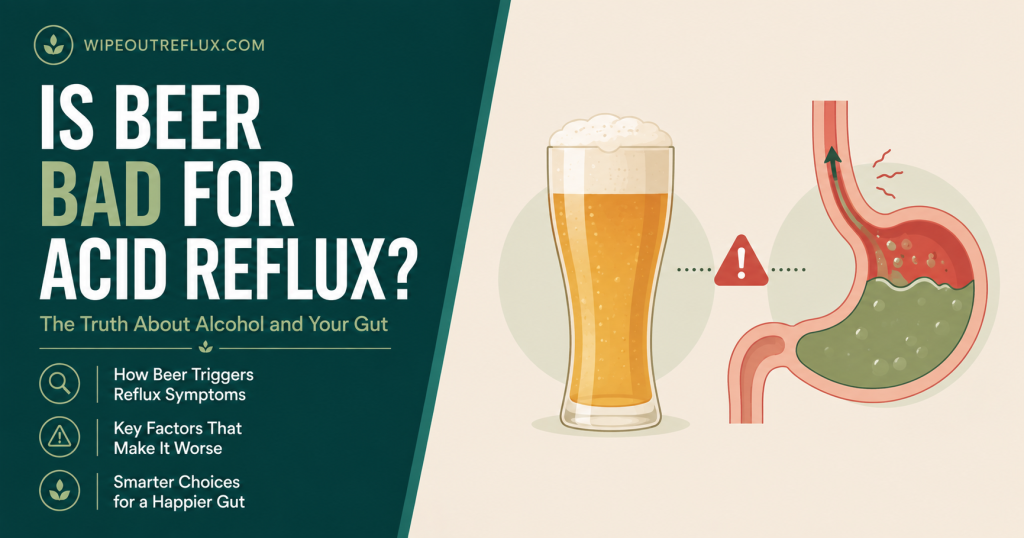
Yes — and beer is worse for reflux than its alcohol content suggests. Most people assume the alcohol is the problem. It isn’t, or at least it’s only one of five separate things beer does to you at once.
The finding that changed how I think about this: fermented drinks like beer and wine are powerful stimulants of stomach acid secretion, while distilled spirits of equal or higher alcohol content are not. The culprits are by-products of fermentation itself — maleic acid and succinic acid — not the ethanol. Beer then adds carbonation, sheer volume, a pH around 4.1, and the alcohol on top.
The uncomfortable consequence of that, which almost nobody mentions: alcohol-free beer is still fermented, still carbonated and still acidic. Taking the alcohol out removes exactly one of the five mechanisms. If you’ve swapped to zero-percent and wondered why nothing improved, that’s why.
Key Takeaways
- Beer stacks five reflux mechanisms at once: fermentation by-products, carbonation, volume, acidity and alcohol.
- Fermented drinks are powerful stimulants of gastric acid and gastrin release, while distilled spirits at the same alcohol strength are not — so it isn’t the ethanol doing it.
- The acid-stimulating compounds have been identified as maleic acid and succinic acid, produced during fermentation.
- Carbonated drinks lower resting sphincter pressure and increase the frequency of transient sphincter relaxations — the main mechanism of reflux.
- Alcohol consumption is associated with a 48% higher odds of GERD overall, rising to more than double in frequent drinkers.
- Non- and low-alcoholic beers measured pH 3.29–4.64, mean 4.13 — all firmly acidic, and all below the pH 5 threshold that matters for pepsin.
- A pint is 568 ml. Two pints puts over a litre into your stomach in an evening, which is a pressure problem regardless of what’s in it.
- If you drink beer, timing and volume matter more than choosing a “gentler” style — and finishing at least three or four hours before bed makes the biggest single difference.
Beer’s real problem isn’t the alcohol
This is the part that surprised me, and it comes from a series of careful human studies.
Researchers compared what happened to gastric acid output and gastrin release after people drank different alcoholic beverages. Fermented drinks — beer and wine — turned out to be powerful stimulants of both. Distilled spirits like whisky, gin and cognac, at the same or higher ethanol content, did not have the same effect Teyssen et al., Gut, 1997.
If ethanol were the driver, spirits should have been the worst offenders. They weren’t. So the team went looking for what in fermented drinks was actually doing it, using yeast-fermented glucose as a stripped-back model of a fermented beverage. They isolated the responsible compounds: maleic acid and succinic acid, small carbohydrate metabolites produced by the fermentation process Teyssen et al., Journal of Clinical Investigation, 1999.
In other words, the very thing that makes beer beer — yeast converting sugars — also creates the compounds that tell your stomach to produce more acid. It’s baked into the product. You cannot brew it out.
That doesn’t make spirits a good idea, incidentally. Alcohol has its own separate effects on the sphincter and on oesophageal clearance, which I’ve covered in whether alcohol is acid or alkaline. It just means beer brings something extra to the table that a measure of whisky doesn’t.
The five things beer does at once
1. It tells your stomach to make more acid
As above — the fermentation by-products drive an acid and gastrin response. More acid in the stomach means more acid available to reflux, and a more irritating refluxate when it happens.
2. The carbonation opens the sphincter
Carbon dioxide comes out of solution in your warm stomach and expands. That distension does two things, both bad: it physically pushes upward on the lower oesophageal sphincter, and it triggers the stretch reflex that produces transient sphincter relaxations — the single most common mechanism by which reflux actually occurs.
This has been measured directly. In healthy volunteers studied with high-resolution manometry, a chilled carbonated drink lowered resting lower oesophageal sphincter pressure and increased the frequency of transient relaxations compared with baseline and with water Shukla et al., Indian Journal of Gastroenterology, 2012.
And of course the gas has to go somewhere. All that burping isn’t incidental — each belch is a sphincter opening, and refluxate frequently comes up with it. The same logic applies to sparkling water and every other fizzy drink.
3. The volume is enormous
This one gets overlooked because it’s so obvious. A UK pint is 568 ml. Two pints is well over a litre of liquid, usually drunk fairly quickly, on top of whatever you’ve eaten. Your stomach has to accommodate all of it.
Nobody drinks 1.1 litres of whisky. The serving culture around beer means you’re delivering a volume challenge that would cause pressure problems even if the drink were plain water — which is the same reason overeating drives reflux so reliably.
4. It’s acidic
More on this below, but beer typically sits around pH 4 to 4.5 — genuinely acidic, and relevant if your reflux is the throat-based kind.
5. The alcohol relaxes the sphincter
Ethanol reduces resting sphincter tone, impairs the clearing contractions that should sweep refluxate back down, and increases oesophageal sensitivity. The epidemiology matches: a meta-analysis of 29 studies found people who drink alcohol had 48% higher odds of GERD than non- or occasional drinkers (OR 1.48), rising to more than double for frequent drinkers (OR 2.12), with the strongest association for erosive oesophagitis (OR 1.78) Pan et al., Alcohol and Alcoholism, 2019.
Note the dose-response. It was linear. Less genuinely is better.
How acidic is beer?
Most beers land somewhere between pH 4.0 and 4.5, with sour styles going considerably lower — into the threes.
Whether that number worries you depends on which kind of reflux you have. For classic heartburn and GERD, the acidity of the drink is a minor factor compared with the volume and the sphincter effects; your stomach is far more acidic than any beer.
For LPR, the throat-based form, it matters more. The reason is pepsin, the stomach enzyme that travels up with refluxate and lodges in throat tissue. Pepsin is dormant at neutral pH but reactivates when acid arrives from any source — including a drink. That’s the reasoning behind low-acid dietary approaches for stubborn LPR, which use a pH 5 cut-off for what’s allowed Koufman, Annals of Otology, Rhinology and Laryngology, 2011.
Beer, at pH 4-something, sits below that threshold. Every mouthful is a small dose of acid passing the exact tissue where pepsin is waiting. If your symptoms are hoarseness, throat clearing and a lump sensation rather than heartburn, that’s the mechanism that should concern you — and it’s worth reading how to neutralise pepsin in the throat.
Why alcohol-free beer isn’t the safe swap
This is the section I most wanted to write, because the assumption is so widespread and so wrong.
Alcohol-free and low-alcohol beer is made the same way as ordinary beer. It’s fermented — that’s what produces the flavour — and the alcohol is removed afterwards, or the fermentation is arrested early. Either way, the fermentation by-products are still in the glass. The carbonation is still there. The volume is still there. The acidity is still there.
On that last point we now have good numbers. A 2025 analysis measured 71 commercially available non- and low-alcoholic beers across ten styles. Every single product was acidic, with pH ranging from 3.29 to 4.64 and a mean of 4.13. Sour styles were the most acidic at a mean pH of 3.56, and even sparkling hop water averaged 3.93 Tamayo-Cabeza and Lippert, Biological Trace Element Research, 2025.
So switching to zero-percent removes one of five mechanisms and leaves four intact. It’s a real improvement — the alcohol effects are genuine and worth eliminating — but it’s a quarter of a solution, not a fix. If you made the switch and your symptoms didn’t budge, you weren’t imagining it and you didn’t do it wrong.
It’s the same trap as decaf coffee, where removing the obvious suspect leaves the actual mechanism untouched. And the same reason other fermented drinks like kombucha aren’t the gentle option they’re marketed as.
Is any beer better than another?
Honestly, the differences are smaller than the marketing suggests. But if you’re going to drink beer, the ranking runs roughly like this:
- Worse: sours and heavily hopped IPAs. Sours were the most acidic style measured, at a mean pH of 3.56. Strong beers add more alcohol per serving.
- Middling: lagers and pale ales. Standard acidity, standard carbonation, but often drunk in larger volumes.
- Marginally better: lower-carbonation styles served at cellar temperature — a cask ale is less aggressively fizzy than a keg lager. Lower alcohol content genuinely helps, given the dose-response relationship.
What matters far more than style is how much and when. One beer with a meal at 6pm is a different proposition from three at 10pm. Volume and timing beat style selection every time.
If you’re going to drink beer anyway
I’d rather give you something workable than tell you to abstain and have you ignore the whole article.
- Set a hard stop three to four hours before bed. This is the highest-yield change on the list, because it means the volume has cleared before you go horizontal — see how long before bed you should stop and why night-time reflux does the most damage.
- Cap the volume. One or two, not four. The pressure effect is dose-dependent and so is everything else.
- Drink it with food, not on an empty stomach. Food slows the delivery and buffers some of the acid response.
- Choose halves or bottles over pints. Smaller vessels genuinely mean smaller gastric volumes, and it slows the pace.
- Let it go flat, or pour it slowly. Unfashionable, but it directly reduces the carbonation load.
- Consider an alginate afterwards. A raft-forming product taken after your last drink sits on top of the stomach contents overnight — see alginates for acid reflux and Gaviscon Advance.
- Sleep propped up that night — see the best sleeping position for silent reflux.
- Don’t chase it with a late meal. The combination of a large volume of beer and a late curry is the classic reflux night, and it’s usually the pairing rather than either alone.
If you’re navigating a pub or a wedding rather than your own kitchen, eating out with acid reflux and holiday heartburn cover the social side of this properly.
What to drink instead
The goal is something still, low-acid and not fermented. That rules out most of the interesting options, which is the honest answer nobody wants.
- Still water is the boring winner, and alkaline water has a specific rationale in LPR — see alkaline water for LPR and the best water for acid reflux.
- Chamomile tea if you want something warm and settling — see chamomile tea for acid reflux.
- Coconut water as a cold non-alcoholic option with a reasonable profile — see coconut water and acid reflux.
- Not fizzy soft drinks as a substitute. Swapping beer for cola or tonic water keeps the carbonation and adds more acid.
The full run-through is in what to drink with acid reflux, which covers the whole drinks category rather than just the alcohol-shaped hole.
How long until things settle?
If beer is a significant contributor for you, a proper two-week break tends to be enough to tell. Not a reduction — a genuine stop, because the dose-response relationship means cutting from four to two may not produce an obvious signal.
Throat symptoms take longer than heartburn. Laryngeal tissue heals slowly, so if you have LPR, give it four to six weeks before you judge the experiment. Heartburn usually responds within days.
Conclusion
Beer is bad for acid reflux, and it’s bad for more reasons than most people realise. The alcohol matters, but it’s the fermentation that makes beer distinctively problematic — maleic and succinic acid drive a genuine gastric acid and gastrin response that distilled spirits at the same strength simply don’t produce. Add carbonation that measurably lowers sphincter pressure and increases transient relaxations, well over a litre of volume in a typical evening, and a pH around 4.1, and you have a drink that attacks the problem from five directions at once.
The practical upshot is that alcohol-free beer isn’t the answer people hope it is. It removes one mechanism and leaves four. If you want beer to stop causing you trouble, the levers that actually work are volume, timing and frequency — a hard stop several hours before bed, smaller servings, with food, and fewer of them. And if you’ve never tested it properly, a genuine two-week stop will tell you more than any amount of reading.
Drinks are only one part of the picture, though, and the food side is where most people are still guessing. The Wipeout Food Reference Guide is the essential reference for it — which foods and drinks are genuinely safe with acid reflux and LPR, with their pH values, so you can check rather than guess. If you’d rather follow a complete system, the Wipeout Diet Plan goes considerably deeper. It was built first around LPR, the stubborn throat-based form of reflux where drink acidity matters most, but because it works on the same underlying mechanisms it’s just as effective for GERD and everyday heartburn.
Frequently Asked Questions
Is beer worse than wine for acid reflux?
Both are fermented, so both stimulate gastric acid and gastrin release in a way distilled spirits don’t. Beer adds carbonation and far greater volume — a pint is 568 ml against roughly 175 ml for a glass of wine — while wine is typically more acidic and higher in alcohol per serving. In practice, volume and carbonation make beer the bigger problem for most people.
Does alcohol-free beer cause acid reflux?
It can. Alcohol-free beer is still fermented, still carbonated and still acidic — 71 non- and low-alcohol beers measured pH 3.29 to 4.64, with a mean of 4.13. Removing the alcohol eliminates one of five mechanisms. It’s an improvement, not a solution.
What is the pH of beer?
Most beers sit around pH 4.0 to 4.5. Sour styles go lower, into the threes. That’s below the pH 5 threshold used in low-acid dietary approaches for stubborn throat reflux, because pepsin lodged in throat tissue can be reactivated by acid from any source, including a drink.
Which beer is least likely to trigger reflux?
The differences between styles are modest. Lower-alcohol, lower-carbonation options served at cellar temperature are marginally gentler, and sours are the worst on acidity at a mean pH of 3.56. But how much you drink and how close to bedtime matters far more than which style you pick.
Why does beer give me heartburn but wine doesn’t?
Usually volume and carbonation. Beer is drunk in much larger quantities, and the carbon dioxide distends the stomach, which lowers sphincter pressure and triggers the relaxations that let reflux through. If you drink beer in pints and wine in small glasses, you’re not comparing like with like.
Can I drink beer if I have LPR or silent reflux?
It’s one of the harder drinks to justify with LPR, because the acidity sits below the pH 5 threshold that matters for pepsin, and pepsin is the main agent of throat damage. If you’re going to, keep it to one, early in the evening, with food. Give any change four to six weeks before judging it, since throat tissue heals slowly.
Does letting beer go flat help?
It helps with one mechanism. Removing the carbonation genuinely reduces gastric distension and the sphincter effects that come with it. The fermentation by-products, acidity and volume are all unchanged, so treat it as a partial measure rather than a fix.
How long should I stop drinking beer to see if it’s the problem?
Two weeks of complete abstinence is usually enough to read the signal for heartburn. Cutting down rather than stopping tends to be inconclusive, because the relationship between alcohol and reflux is dose-dependent and linear. If your symptoms are throat-based, allow four to six weeks.
Research & References
- Human study comparing alcoholic beverages, finding that drinks produced by fermentation such as beer and wine are powerful stimulants of gastric acid output and gastrin release, whereas beverages produced by distillation at equal or higher ethanol content are not Teyssen et al., Gut, 1997.
- Study separating and identifying the gastric acid stimulatory constituents of fermented alcoholic beverages using yeast-fermented glucose as a model, identifying maleic acid and succinic acid as the responsible compounds Teyssen et al., Journal of Clinical Investigation, 1999.
- Systematic review and meta-analysis of 29 studies reporting a pooled odds ratio for gastro-oesophageal reflux disease of 1.48 (95% CI 1.31–1.67) in drinkers versus non- or occasional drinkers, rising to 2.12 (95% CI 1.63–2.75) in more frequent drinkers, with an odds ratio of 1.78 for reflux oesophagitis and a linear dose-response relationship Pan et al., Alcohol and Alcoholism, 2019.
- High-resolution manometry study in 18 healthy volunteers showing that ingestion of a chilled carbonated beverage decreased lower oesophageal sphincter pressure and increased the frequency of transient lower oesophageal sphincter relaxations compared with baseline and with water Shukla et al., Indian Journal of Gastroenterology, 2012.
- Analysis of 71 commercially available non- and low-alcoholic beers across ten styles, finding all products acidic with pH ranging from 3.29 to 4.64 and a mean of 4.13, with sour styles lowest at a mean pH of 3.56 Tamayo-Cabeza and Lippert, Biological Trace Element Research, 2025.
- Study of a low-acid diet in recalcitrant laryngopharyngeal reflux, using a pH 5 threshold on the basis that pepsin deposited in laryngeal tissue can be reactivated by hydrogen ions from ingested acid Koufman, Annals of Otology, Rhinology and Laryngology, 2011.

David Gray
12 years living with LPR · Consultant & researcher
I've lived with LPR for twelve years — the misdiagnoses, the PPI courses that did nothing, the slow work of figuring out what actually helps. Wipeout Reflux is where I translate the research into plain terms for people stuck in the same place. Every claim here is sourced to peer-reviewed work, and I consult one-to-one with LPR sufferers.