
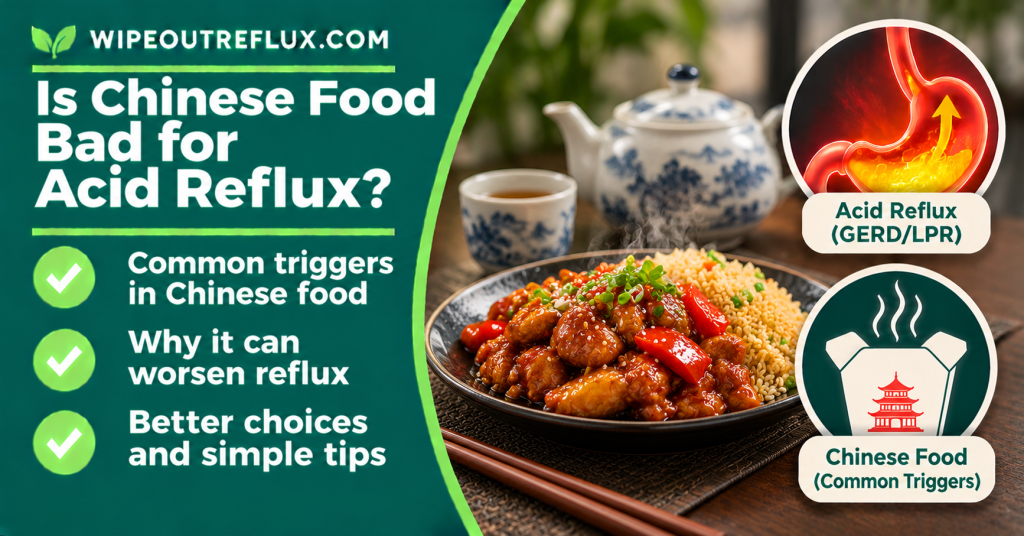
Chinese food isn’t automatically bad for acid reflux, but a typical American Chinese takeout order can be. The problem dishes are the deep-fried, heavily sauced ones like General Tso’s chicken, orange chicken, sweet and sour pork and crab rangoon, especially in the large portions that takeout containers encourage. They combine several of the biggest reflux triggers at once: lots of fat, big portions, sugar, vinegar or citrus, chili, garlic and onion, and often a late-night meal.
The good news is that Chinese cuisine also has some of the most reflux-friendly options on any menu. Steamed dishes, clear soups, stir-fried vegetables, plain rice and simply cooked chicken or fish are all gentle choices. If you know what to order, and ask for a couple of small changes, you can enjoy Chinese food without a night of heartburn.
Key Takeaways
- The worst Chinese dishes for reflux are deep-fried and coated in sweet, sour or spicy sauces, like General Tso’s, orange chicken and sweet and sour pork.
- High-fat meals increase reflux symptoms, and large, high-calorie meals increase acid exposure in the esophagus.
- Raw onion significantly increased reflux in people with heartburn in one study, while having no effect on people without it.
- Chili can trigger heartburn and abdominal burning in people with reflux, even when it doesn’t bother people without reflux.
- MSG has no good evidence linking it to reflux. Salt, fat, portion size and late eating matter far more.
- Safer orders include steamed dumplings, wonton or egg drop soup, chicken with broccoli, moo goo gai pan, steamed fish and plain white rice.
- Ask for sauce on the side, less oil and no chili, share dishes and eat at least 3 hours before bed.
Why Chinese Takeout Triggers Heartburn
It’s rarely one ingredient. Most Chinese takeout heartburn comes from stacking several triggers in one meal.
1. Deep frying and fat
Many popular American Chinese dishes are battered and deep-fried before they go into the sauce. Fat slows down stomach emptying and relaxes the lower esophageal sphincter, the valve that keeps acid in your stomach.
In a study using 4 days of esophageal pH monitoring, people with reflux had significantly more reflux symptoms on a high-fat diet than on a low-fat one. Higher-calorie meals also increased the amount of acid reaching the esophagus [Fox et al., Clinical Gastroenterology and Hepatology, 2007]. A plate of fried chicken in sauce plus fried rice and an egg roll is high in both. See is fried food bad for acid reflux.
2. Portion size
American Chinese portions are large, and family-style ordering makes it easy to keep picking. Meal volume is one of the most consistent reflux triggers. In healthy volunteers, an 800 ml meal caused much more upright acid exposure than a 500 ml meal [Iwakiri et al., Digestive Diseases and Sciences, 1996]. A stretched stomach triggers more relaxations of the valve. See does overeating cause acid reflux.
3. Sweet, sour and acidic sauces
Sweet and sour sauce is usually made with vinegar, sugar, ketchup and sometimes pineapple juice. Orange chicken uses orange juice or zest. Many sauces also contain rice vinegar or black vinegar. These acids are a particular problem for silent reflux, because acidic food can reactivate pepsin that has settled in the throat. See is vinegar acid or alkaline.
4. Chili and Sichuan heat
Kung pao chicken, Sichuan dishes, chili oil and hot and sour soup all bring chili heat. In a double-blind study, 2 g of chili in capsules caused more abdominal burning and a trend toward more heartburn in people with reflux, but not in healthy volunteers [Patcharatrakul et al., Nutrients, 2020]. In other words, people with reflux seem to be more sensitive to chili. See spicy food and acid reflux.
5. Garlic, onion and scallions
Garlic, onion and scallions are in most Chinese dishes. Cooked into a sauce they are usually less of a problem, but raw scallions sprinkled on top can be. In one study, adding a slice of raw onion to a hamburger significantly increased reflux episodes, acid exposure, heartburn and belching in people with heartburn, but had no effect in people without it [Allen et al., American Journal of Gastroenterology, 1990]. See is onion good for acid reflux and is garlic acidic or alkaline.
6. Salt and soy sauce
Chinese takeout is often very high in sodium from soy sauce, oyster sauce and stock. In a large Norwegian study, people who always added extra salt to their food had 70% higher odds of reflux symptoms than those who never did [Nilsson et al., Gut, 2004]. That’s an association rather than proof, but it’s another reason to go easy on extra soy sauce. See is soy sauce acidic.
7. Late-night eating
Takeout is often a late evening meal, eaten on the sofa, then followed by bed. Lying down less than 3 hours after dinner was linked to more than 7 times the odds of reflux disease in a Japanese study [Fujiwara et al., American Journal of Gastroenterology, 2005].
What About MSG?
MSG (monosodium glutamate) gets blamed for a lot of post-takeout symptoms, but there’s no good evidence that it causes acid reflux. It’s a flavor enhancer that adds a small amount of sodium. The fat, portion size, acidic sauces, chili and late timing are far more likely culprits. If you find you react to it, it’s easy to ask for no MSG, but I wouldn’t make it your main focus.
Chinese Dishes to Avoid or Limit With Acid Reflux
- General Tso’s chicken: deep-fried, with a sweet, vinegary, chili sauce.
- Orange chicken: deep-fried plus citrus.
- Sweet and sour pork or chicken: deep-fried with a vinegar, sugar and ketchup sauce.
- Kung pao chicken: dried chilies, Sichuan pepper and lots of oil.
- Hot and sour soup: vinegar, white pepper and chili in one bowl.
- Sesame chicken: deep-fried with a heavy, sugary sauce.
- Crab rangoon and egg rolls: deep-fried, and crab rangoon is filled with cream cheese.
- Fried rice and greasy lo mein: usually cooked in a lot of oil. Fine in a small side portion, but not as the whole meal.
- Szechuan or Hunan dishes with chili oil: heat plus oil.
- Black bean sauce and garlic sauce dishes can be fine for some people, but are often salty and garlic-heavy.
The Safest Chinese Food to Order
- Steamed dumplings: chicken, pork or vegetable, steamed rather than pan-fried. Go easy on the dipping sauce.
- Wonton soup or egg drop soup: mild, brothy and filling, especially as a starter that slows you down.
- Chicken with broccoli: ask for light sauce or sauce on the side.
- Moo goo gai pan: chicken with mushrooms and vegetables in a mild white sauce.
- Steamed chicken or fish with vegetables: many restaurants have a “steamed” or “diet” section of the menu.
- Buddha’s delight: mixed vegetables and tofu, steamed or lightly stir-fried.
- Plain white or brown rice: one of the most reflux-friendly foods there is. See is rice acidic or alkaline.
- Chicken chow mein or lo mein: as a moderate portion, ideally with less oil.
- Ginger dishes: ginger chicken or fish with scallion, minus the raw scallion. Ginger itself is often soothing. See is ginger good for acid reflux.
To drink, jasmine or green tea is a traditional match, though some people find green tea a mild trigger. Water is the safest choice. Beer and soda add carbonation and, with beer, alcohol. See is green tea good for acid reflux and is beer bad for acid reflux.
Simple Swaps That Keep LPR Calm
- Instead of General Tso’s or orange chicken: try chicken with broccoli, sauce on the side.
- Instead of sweet and sour pork: try moo goo gai pan.
- Instead of hot and sour soup: try wonton or egg drop soup.
- Instead of egg rolls or crab rangoon: try steamed dumplings.
- Instead of fried rice: try steamed white or brown rice.
- Instead of kung pao chicken: try cashew chicken without chilies.
- Instead of chili oil and extra soy sauce: try a little low-sodium soy sauce or fresh ginger.
- Instead of beer or soda: try water or a mild herbal tea.
How to Order Chinese Food With Acid Reflux
- Ask for sauce on the side. You control how much you use, and it’s the single biggest change you can make.
- Ask for less oil, or steamed instead of fried. Most restaurants are happy to do this.
- Ask for no chili and no raw scallions on top.
- Start with a mild soup. It fills you up and slows you down.
- Share dishes and fill half your plate with rice and vegetables.
- Stop before you’re full and save the rest for tomorrow. Takeout containers usually hold two meals.
- Eat earlier. Aim to finish at least 3 hours before bed, and stay upright afterward.
- Skip the fortune cookie and dessert if you’re already full.
- Keep an alginate on hand. Taking one after a bigger meal adds a physical barrier against reflux. See alginates for acid reflux.
For more tips on eating out in general, see eating out with acid reflux. You might also find my guides to sushi and curry useful.
Cooking Chinese-Style at Home
Making your own Chinese-style food is the easiest way to keep the flavor without the triggers. A simple stir-fry with chicken, broccoli, carrots, snow peas and bok choy, cooked in a teaspoon of oil with fresh ginger and a splash of low-sodium soy sauce, served over rice, is about as reflux-friendly as dinner gets. Thicken the sauce with a little cornstarch rather than sugar, and use ginger instead of chili for warmth.
If you’d like a full set of reflux-friendly recipes and meal plans like this, the Wipeout Diet Plan includes them, along with guidance on which ingredients to use and which to leave out.
Conclusion
So, is Chinese food bad for acid reflux? Not inherently. The problem is the typical takeout order: deep-fried meat in sweet, sour or spicy sauce, a large portion, fried rice and an egg roll, eaten late in the evening. That stacks fat, volume, acid, chili, raw onion and salt into one meal, and research shows each of these can increase reflux on its own.
Chinese cuisine also has plenty of gentle options. Steamed dumplings, brothy soups, chicken with broccoli, moo goo gai pan, steamed fish and plain rice are all good choices. Ask for sauce on the side, less oil and no chili, share dishes, and finish eating a few hours before bed, and you can still enjoy a Chinese meal without paying for it later.
For a complete approach to eating with reflux, including restaurant strategies and home recipes, the Wipeout Diet Plan is my in-depth guide. It was built primarily around LPR, the throat-based reflux that acidic sauces like sweet and sour are so good at aggravating, but since it targets the same root causes, it works equally well for classic heartburn and GERD.
Frequently Asked Questions
Is Chinese food bad for acid reflux?
Not all of it. Deep-fried dishes with sweet, sour or spicy sauces are the main problem. Steamed dishes, clear soups, vegetable stir-fries and plain rice are usually well tolerated.
What is the best Chinese food for acid reflux?
Steamed dumplings, wonton or egg drop soup, chicken with broccoli, moo goo gai pan, steamed fish with vegetables and plain white rice are among the safest choices.
Why does Chinese food give me heartburn?
Usually because of a combination of frying, large portions, acidic or sugary sauces, chili, garlic and onion, salt, and eating late in the evening.
Does MSG cause acid reflux?
There’s no good evidence that MSG causes reflux. Fat, portion size, acidic sauces and late eating are much more likely causes of post-takeout heartburn.
Is fried rice bad for acid reflux?
It’s usually cooked in a lot of oil, so a large portion can trigger symptoms. Plain steamed rice is a much better choice, or keep fried rice to a small side.
Is soy sauce bad for acid reflux?
Soy sauce is mildly acidic and very salty. A small amount is usually fine, but heavy use adds a lot of sodium. Low-sodium soy sauce is a better option.
Is wonton soup good for acid reflux?
Yes, it’s one of the gentler options on a Chinese menu. It’s brothy, mild and filling. Avoid adding chili oil or vinegar to it.
Research & References
- [Fox et al., Clinical Gastroenterology and Hepatology, 2007] — In reflux patients, high-calorie meals increased esophageal acid exposure and high-fat meals increased the frequency of reflux symptoms.
- [Iwakiri et al., Digestive Diseases and Sciences, 1996] — Larger meal volume increased upright acid exposure, and high-fat meals increased acid exposure when lying down.
- [Patcharatrakul et al., Nutrients, 2020] — Chili caused more abdominal burning and a trend toward more heartburn in non-erosive reflux patients, but not in healthy volunteers.
- [Allen et al., American Journal of Gastroenterology, 1990] — Raw onion significantly increased reflux episodes, acid exposure, heartburn and belching in heartburn sufferers, but not in healthy people.
- [Nilsson et al., Gut, 2004] — In over 43,000 Norwegians, always adding extra table salt was associated with 1.7 times the odds of reflux symptoms.
- [Fujiwara et al., American Journal of Gastroenterology, 2005] — Going to bed less than 3 hours after dinner was linked to 7.45 times the odds of GERD.

David Gray
12 years living with LPR · Consultant & researcher
I've lived with LPR for twelve years — the misdiagnoses, the PPI courses that did nothing, the slow work of figuring out what actually helps. Wipeout Reflux is where I translate the research into plain terms for people stuck in the same place. Every claim here is sourced to peer-reviewed work, and I consult one-to-one with LPR sufferers.