
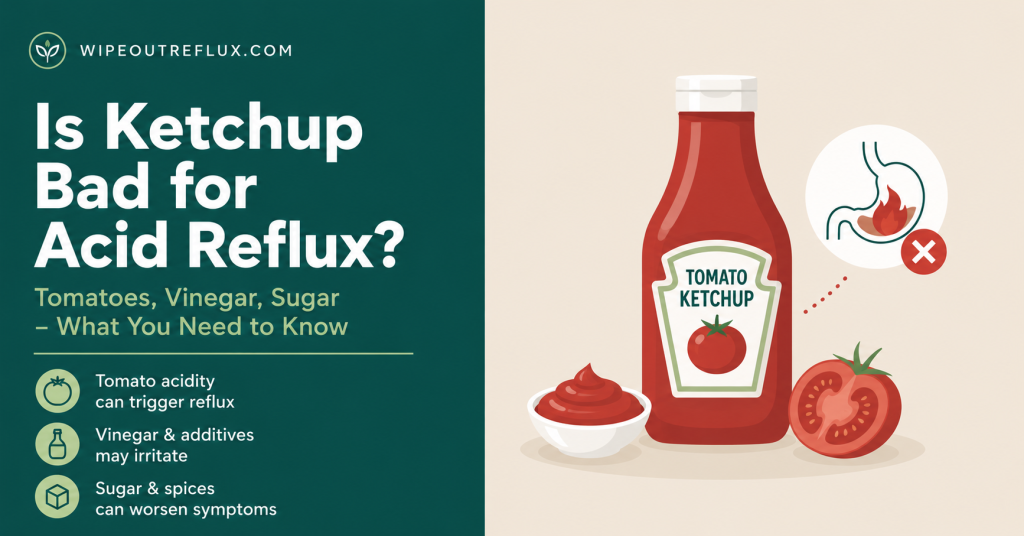
Yes — ketchup is one of the worst condiments for acid reflux, and it’s worth understanding why, because it isn’t a single problem but three stacked into one squeeze. Ketchup is concentrated tomato, which is acidic and a well-known reflux trigger; it’s sharpened with vinegar, which is more acid again; and it’s loaded with sugar. Put those together in a thick, concentrated paste and you have a small dollop that punches well above its size.
The amount is what fools people. A tablespoon of ketchup doesn’t look like much, but it’s concentrated tomato and vinegar with a pH down around 3.7 — firmly in the range that matters for reflux, and especially for the silent, throat-based kind. So while a tomato itself is a moderate trigger, ketchup takes the acidic parts, concentrates them, and adds vinegar on top.
Here’s exactly what makes ketchup so troublesome, and what to do about it.
Key Takeaways
- Ketchup combines three reflux problems at once: acidic concentrated tomato, added vinegar, and sugar.
- It’s genuinely acidic — around pH 3.7 — which is well below the threshold that matters for reflux, particularly silent reflux (LPR).
- Tomato-based products are among the most commonly reported dietary reflux triggers.
- The concentration is the catch: a small dollop delivers a lot of acid in very little volume.
- For LPR, that acidity can reactivate throat-bound pepsin and keep symptoms going.
- Low-acid, tomato-free ketchup alternatives exist and are worth trying if you can’t do without it.
- Cutting back the amount, or swapping to a gentler condiment, usually helps quickly.
Three Problems in One Squeeze
1. Concentrated, acidic tomato
Ketchup is essentially tomatoes reduced down to a thick paste, which concentrates their natural acidity. Tomatoes are already a moderate reflux trigger — acidic, and a frequent culprit in people’s food diaries — and concentrating them makes it worse, not better. Ketchup typically sits around pH 3.7, which is firmly acidic. On the scale of things people carefully avoid, that puts it alongside citrus. You can see where it falls on the food pH chart.
2. Vinegar
Ketchup is sharpened with vinegar — acetic acid — which adds a second layer of acid on top of the tomato. Vinegar in its own right is a common reflux aggravator, as covered in is vinegar acid or alkaline. So ketchup isn’t just acidic tomato; it’s acidic tomato with more acid deliberately added.
3. Sugar
Ketchup is also high in sugar — a large part of why it tastes so moreish. Sugar isn’t as clear-cut a reflux trigger as acid or fat, but it adds nothing helpful, and sugary, acidic foods tend to be the ones people overdo. There’s more in is sugar acid or alkaline. The bigger picture is that ketchup manages to be acidic and sugary at once, which is a difficult combination for a sensitive gut.
Why the Small Portion Still Hurts
The thing that catches people out is that ketchup is used in small amounts, so it feels harmless. But it’s a concentrate. A single tablespoon carries the acidity of a lot more tomato than it looks, plus the vinegar, in a form your throat and oesophagus meet directly. So the usual “it was only a little” logic doesn’t apply the way it might with a milder food — a little ketchup is still a concentrated hit of acid. It’s one of the mainstays of any condiments to avoid with acid reflux list, and much of the same logic applies to its close cousin, barbecue sauce.
Ketchup and Silent Reflux (LPR)
If your reflux is the throat-based, silent kind, ketchup is particularly worth avoiding. In LPR, pepsin — the stomach enzyme carried up with reflux — lodges in the throat tissue, and acidic food or drink can switch it back on, keeping the irritation going. Human pepsin stays partly active well above the pH people assume, which is the reasoning behind strict low-acid eating [Johnston et al., The Laryngoscope, 2007]. A low-acid diet removing everything below about pH 5 improved symptoms in the large majority of treatment-resistant LPR patients in one study [Koufman, Annals of Otology, Rhinology & Laryngology, 2011]. At pH 3.7, ketchup sits well below that line — it’s exactly the kind of concentrated acid that low-acid eating aims to remove. The mechanism is explained in what is pepsin, and if your throat’s already sore, neutralising pepsin in the throat is worth a read.
Broader dietary guidance reflects this too: clinical guidelines suggest identifying and avoiding individual trigger foods for symptom control, and tomato-based products are among the usual suspects [Katz et al., The American Journal of Gastroenterology, 2022].
What to Do About It
The fix is refreshingly simple, and it’s the same swap-and-reduce logic the Wipeout Diet Plan uses for the small everyday triggers that add up:
- Cut the amount first. If you’re not ready to give it up, a scrape rather than a lake makes a real difference, since the harm scales with the concentrated acid you actually eat.
- Try a low-acid or tomato-free ketchup. There are reduced-acid ketchups, and tomato-free versions made from ingredients like beetroot, carrot or butternut squash, aimed at exactly this problem. They’re worth a try if ketchup is a habit you don’t want to lose.
- Swap the condiment. A little low-fat mayonnaise, a herb dressing, or a mild non-acidic sauce can fill the same role without the acid hit. Many people find they were reaching for ketchup out of habit rather than need.
- Watch what it’s on. Ketchup usually accompanies chips, fried food and processed meat — all triggers in their own right — so the ketchup is often one part of a difficult plate. It appears near the top of most LPR foods to avoid lists for good reason.
- Test your own tolerance. During a flare, drop it entirely and see how much difference it makes — for a lot of people it’s more than they expected.
Conclusion
Ketchup is genuinely one of the harder condiments for acid reflux, and not by bad luck — it combines concentrated acidic tomato, added vinegar and sugar in a small, potent dollop. At around pH 3.7 it’s firmly acidic, tomato-based products are a well-known trigger, and for silent reflux that concentrated acid is exactly what keeps throat symptoms simmering. The reassuring part is that ketchup is easy to cut back or swap: use far less, try a low-acid or tomato-free version, or reach for a gentler condiment instead. Small change, quick payoff.
Spotting which everyday foods and condiments quietly drive symptoms — and finding swaps you can actually live with — is exactly what the Wipeout Diet Plan is built around. I designed it first and foremost for LPR and silent reflux, the stubborn throat-based form that medication so often fails to touch, but because it works on the same underlying mechanisms it applies just as well to GERD and everyday heartburn. And the Wipeout Food Reference Guide is the practical companion for exactly this question — which foods and drinks are safe for acid reflux and LPR, with their real pH values, so the acidity hiding in something like ketchup never catches you out.
Frequently Asked Questions
Is ketchup bad for acid reflux?
Yes, it’s one of the worst condiments for it. Ketchup is concentrated acidic tomato with added vinegar and sugar, sitting around pH 3.7 — firmly acidic. Tomato-based products are a common reflux trigger, and ketchup concentrates the acid into a small, potent dollop, so even a little can set off symptoms.
Why does ketchup cause heartburn?
Because it stacks several triggers at once. The concentrated tomato is acidic, the added vinegar is more acid, and it’s high in sugar. That combination, in a form that meets your throat and oesophagus directly, makes ketchup more troubling than the small serving size suggests.
How acidic is ketchup?
Ketchup typically sits around pH 3.7, which is firmly acidic — roughly comparable to many citrus products. That’s well below the pH 5 threshold that matters in silent reflux, where acidic foods can reactivate throat-bound pepsin, which is why ketchup is worth avoiding if you have LPR.
Is there a ketchup that’s okay for acid reflux?
Reduced-acid ketchups and tomato-free versions — made from ingredients like beetroot, carrot or butternut squash — are designed for this and are worth trying. If you stick with regular ketchup, using far less is the simplest way to reduce its impact, since the harm scales with how much concentrated acid you actually eat.
Is ketchup or mustard worse for reflux?
It depends on the mustard, but ketchup is often the bigger problem because it combines concentrated tomato acidity, vinegar and sugar. Many mustards are also vinegary and some are spicy, so neither is ideal — but a small amount of a mild mustard is usually gentler than the concentrated acid load in ketchup.
Can I eat ketchup with silent reflux (LPR)?
It’s best avoided. At around pH 3.7, ketchup sits well below the pH 5 threshold used in low-acid diets for LPR, so it can reactivate throat-bound pepsin and prolong symptoms. If you want a similar condiment, a low-acid or tomato-free alternative, or a mild non-acidic sauce, is a much safer choice.
Research & References
- Johnston et al., The Laryngoscope, 2007 — Laboratory work showing human pepsin retains proteolytic activity well above pH 4. This is why an acidic food like ketchup (around pH 3.7) matters in silent reflux, where it can reactivate pepsin bound in the throat tissue.
- Koufman, Annals of Otology, Rhinology & Laryngology, 2011 — Prospective study of treatment-resistant LPR patients on a strict low-acid diet removing everything below pH 5. Ninety-five percent improved — the pH threshold that places ketchup firmly on the acidic side to avoid.
- Katz et al., The American Journal of Gastroenterology, 2022 — ACG clinical guideline suggesting identification and avoidance of individual trigger foods for symptom control, with tomato-based products among the commonly reported culprits.
- Newberry & Chandar, Journal of Thoracic Disease, 2019 — Review of diet in reflux disease identifying acidic and tomato-based foods among recognised aggravators of reflux symptoms.

David Gray
12 years living with LPR · Consultant & researcher
I've lived with LPR for twelve years — the misdiagnoses, the PPI courses that did nothing, the slow work of figuring out what actually helps. Wipeout Reflux is where I translate the research into plain terms for people stuck in the same place. Every claim here is sourced to peer-reviewed work, and I consult one-to-one with LPR sufferers.