
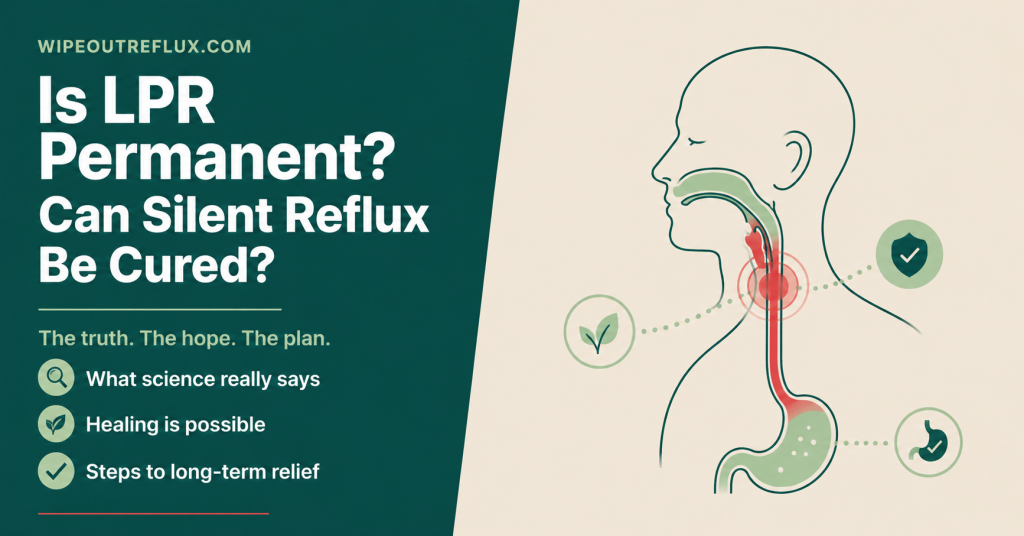
For most people, LPR (silent reflux) is not permanent — it’s a highly treatable condition, and the majority of sufferers see major improvement or full symptom resolution with consistent diet and lifestyle changes. What LPR usually isn’t, though, is “cured” in the one-and-done sense. It behaves more like a manageable, relapse-prone condition: get the right habits in place and symptoms fade, but let those habits slip and they can return.
So the honest answer is somewhere in the middle. You can absolutely become symptom-free. Whether you stay that way depends largely on maintaining the changes that got you there. After more than eight years managing my own LPR, that’s exactly how it’s played out for me — and it’s what the research shows too.
Let me explain what “cured” really means for silent reflux, why it comes back for some people, and how to give yourself the best shot at long-term freedom from symptoms.
Key Takeaways
- LPR is treatable and reversible for most people — it’s rarely a truly permanent condition.
- The word “cure” is tricky: symptoms can fully resolve, but LPR is prone to relapse if habits slip.
- Lifestyle compliance is the single biggest predictor of success — strict adherers do dramatically better in studies.
- Around 25–50% of people experience recurrent episodes over their lifetime, usually tied to diet, stress, or lifestyle.
- Healing is slow: symptom relief often takes 4–6 weeks, with tissue healing needing 3–6 months.
- Long-term freedom comes from maintaining core habits, not from a temporary “fix and forget” approach.
What “Cured” Actually Means for LPR
Here’s where a lot of confusion starts. When people ask “can silent reflux be cured?”, they usually mean two different things:
- Can my symptoms go away completely? — Yes, very often they can.
- Can I fix it permanently and go back to eating and living exactly how I did before? — Usually not, at least not entirely.
LPR isn’t like a bacterial infection you clear with a course of antibiotics. It’s a functional condition — your symptoms come from stomach contents (and the enzyme pepsin) repeatedly reaching your throat. Remove the triggers and reduce those reflux events, and the tissue heals and the symptoms stop. But the underlying tendency to reflux doesn’t necessarily vanish forever, which is why the framing that works best is “put LPR into lasting remission” rather than “cure it and forget it.”
That’s not bad news. Plenty of people reach a point where they can relax the strict phase considerably and only keep a handful of core habits. But understanding the distinction saves you the frustration of expecting a permanent fix that lets you ignore reflux entirely.
The Evidence: LPR Really Does Improve
The research here is genuinely encouraging. In a prospective study of LPR patients treated with a three-month regimen, quality of life significantly improved in 62.7% of patients [Musarrat et al., Cureus, 2021]. Diet-focused studies show similar results — significant reductions in symptoms and quality-of-life scores after just 60 days of dietary and lifestyle changes alongside treatment [Kamdi et al., Journal of Laryngology and Voice, 2023].
And it’s not just medication doing the work. Diet alone has been shown to work as a standalone LPR treatment, with a low-fat, alkaline, high-protein approach producing meaningful symptom improvement. This matters because it means the power to reverse LPR is largely in your own hands, not just in a prescription. If you want the deeper background on why silent reflux develops in the first place, my complete guide to LPR covers the mechanisms in full.
Why Silent Reflux Comes Back for Some People
If LPR is so treatable, why do some people struggle for years? The answer almost always comes down to consistency — and the evidence on this is striking.
In one prospective cohort study, patients with high compliance to lifestyle modifications (over 90%) had a 91.7% chance of a good treatment response, compared to just 53.8% in those with lower compliance [Kim et al., Scientific Reports, 2023]. That’s an enormous gap, and it tells you almost everything about why some people recover and others don’t. It’s rarely that their LPR is “incurable” — it’s that the habits didn’t stick.
There’s also a natural relapse tendency to be aware of. Reviews of LPR’s natural history estimate that 25–50% of patients experience recurrent episodes throughout life, often exacerbated by stress, poor diet, or lifestyle slips [Lechien et al., European Annals of Otorhinolaryngology, 2020]. So relapse isn’t a sign you did something wrong — it’s a known feature of the condition, and it’s manageable once you expect it.
The other common reason for “it won’t go away” is treating LPR like GERD. Because silent reflux is driven by pepsin rather than just acid, acid-suppressing medication alone often underperforms. I explain why in why acid reflux medication isn’t working.
How Long Does It Take to Recover From LPR?
Patience is the hardest part. Here’s a realistic timeline:
- Weeks 1–2: You may notice small improvements in throat-clearing or globus sensation, but don’t expect dramatic change yet.
- Weeks 4–6: This is where meaningful symptom relief typically kicks in for those following the plan consistently.
- Months 3–6: The throat and larynx tissue continues healing. Full resolution often lands in this window.
The reason it’s slow is that the delicate tissue in your throat has often been exposed to pepsin for months or years before you started treating it, and that lining needs time to repair. If you’ve had symptoms for a long time, plan for the longer end of the range. I set realistic expectations in my article on acid reflux sore throat healing time.
How to Give Yourself the Best Chance of Lasting Remission
If the goal is symptom-free-and-staying-that-way, here’s what actually moves the needle:
- Commit to the strict phase first. A period of tight low-acid eating gets your throat healed before you test what you can reintroduce. My LPR foods to avoid list is the place to start.
- Nail your meal timing. Finishing food 3–4 hours before bed prevents the overnight reflux that quietly undermines healing.
- Use alginate therapy. Products like Gaviscon Advance physically block reflux and have real LPR evidence — see my Gaviscon Advance guide.
- Reintroduce foods slowly, one at a time. Once you’re symptom-free, test trigger foods individually so you learn your personal limits rather than relapsing blindly.
- Keep a maintenance core forever. Even after recovery, holding on to sensible timing and avoiding your worst triggers is what prevents the 25–50% relapse pattern.
The people who stay well aren’t the ones who “cured” LPR and forgot about it — they’re the ones who found a sustainable version of good habits they can live with long-term.
Frequently Asked Questions
Can LPR go away on its own without treatment?
Mild, short-lived LPR triggered by a temporary cause (like a period of stress or a course of unusually acidic eating) can sometimes settle on its own once the trigger is removed. But established, ongoing LPR rarely resolves without some deliberate diet and lifestyle change, because the reflux events keep re-exposing your throat to pepsin.
Is LPR a lifelong condition?
Not usually in the sense of constant symptoms. Many people become completely symptom-free. What tends to be lifelong is a tendency toward reflux, which is why maintaining a core of good habits matters. Think of it as a condition you manage into remission rather than one you’re stuck suffering with forever.
Can silent reflux be cured permanently with surgery?
Anti-reflux surgery (like fundoplication) is an option in select, severe cases and can significantly reduce reflux, but it’s not a guaranteed permanent cure and carries its own risks. For the large majority of people, diet and lifestyle changes are the first and most effective approach. Surgery is generally reserved for those who don’t respond to thorough conservative treatment.
Why do my symptoms keep coming back?
The most common reason is inconsistency — reflux habits creeping back in once you feel better. The compliance research is clear that strict adherence dramatically improves outcomes. Recurrence can also be triggered by stress, weight gain, or a return to late-night or acidic eating. It’s manageable, but it usually means tightening up the habits that worked before.
Will I ever be able to eat normally again?
Most people can, to a large degree. After the healing phase, you can usually reintroduce many foods in moderation. The key is doing it gradually and learning your personal triggers, rather than jumping straight back to everything at once. A permanent return to heavy late-night, acidic, high-fat eating is what tends to bring symptoms back.
Conclusion
So, is LPR permanent? For the vast majority of people, no. Silent reflux is a treatable, reversible condition, and becoming completely symptom-free is a realistic goal. The more useful way to think about it isn’t “cure versus incurable” but “remission you maintain” — and the research is clear that the people who commit to consistent diet and lifestyle changes are the ones who get there and stay there.
The single biggest lever is your diet, and the biggest predictor of success is sticking to it. That’s precisely the problem the Wipeout Diet Plan was built to solve. Instead of leaving you guessing which foods are safe or trying to white-knuckle your way through a vague low-acid diet, it gives you a structured, done-for-you plan designed specifically for LPR recovery — the kind of consistency that the compliance studies show makes all the difference. It’s the most direct way to move from “will this ever go away?” to lasting remission.
To make everyday choices even simpler, the Wipeout Food Reference Guide is an essential companion — it lists exactly which foods and drinks are safe for acid reflux and LPR along with their pH values, so you can check anything in seconds. Use the Food Reference Guide as your quick daily lookup and the Wipeout Diet Plan as the deeper roadmap to actually getting better. Be patient with the timeline, stay consistent, and give your throat the conditions it needs to heal — that’s how silent reflux goes from a daily frustration to something firmly in your past.
Research and References
- [Musarrat et al., Cureus, 2021] — Prospective study of 102 LPR patients; quality of life significantly improved in 62.7% after three months of treatment with lifestyle modification.
- [Kim et al., Scientific Reports, 2023] — Patients with over 90% lifestyle compliance had a 91.7% good-response rate versus 53.8% for lower compliance; salivary pepsin and adherence were independent predictors of outcome.
- [Lechien et al., European Annals of Otorhinolaryngology, 2020] — Review of LPR management noting 25–50% of patients experience recurrent episodes over their lifetime, with lifestyle/diet measures continued to reduce recurrence.
- [Kamdi et al., Journal of Laryngology and Voice, 2023] — Diet and lifestyle changes alongside treatment produced significant improvement in all LPR quality-of-life scores after 60 days.

David Gray
12 years living with LPR · Consultant & researcher
I've lived with LPR for twelve years — the misdiagnoses, the PPI courses that did nothing, the slow work of figuring out what actually helps. Wipeout Reflux is where I translate the research into plain terms for people stuck in the same place. Every claim here is sourced to peer-reviewed work, and I consult one-to-one with LPR sufferers.