
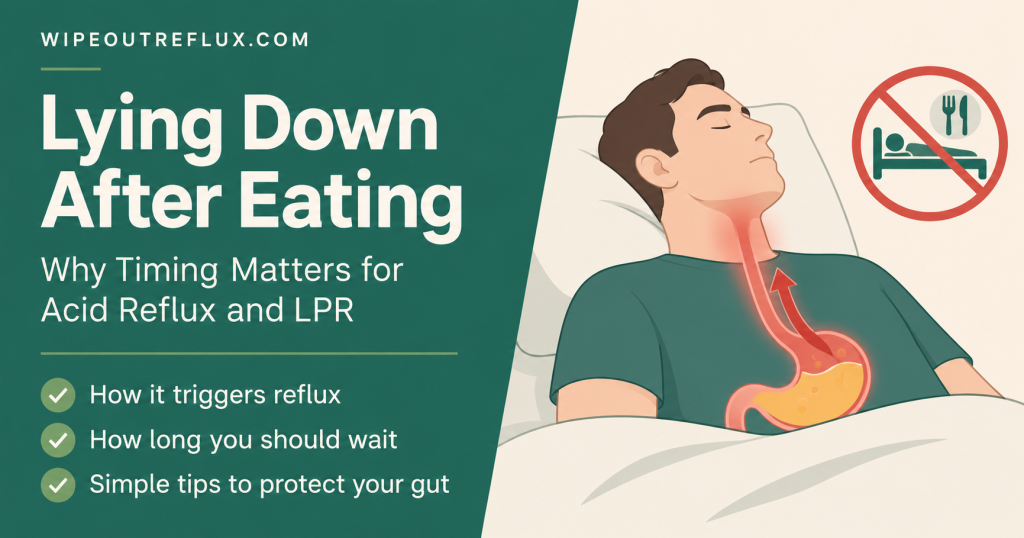
Yes — lying down after eating is bad for reflux, and it’s one of the few reflux “rules” where the mechanism is genuinely straightforward. When you’re upright, gravity holds stomach contents in the stomach and helps clear anything that does escape back down. When you lie flat, both of those protections disappear at exactly the moment your stomach is fullest and most acidic.
The research bears this out. In healthy volunteers, simply changing recumbent position after a meal moved esophageal acid exposure from 2.0% to 7.0% of the monitored period, with reflux episodes rising from 0.9 to 3.8 per hour [van Herwaarden et al., American Journal of Gastroenterology, 2000]. That’s in people without reflux disease. If you already have GERD or LPR, the same meal and the same position will do considerably more.
The practical answer most people are looking for: stay upright for around two to three hours after eating, and if you have to rest, recline rather than lie flat — and lie on your left side rather than your right.
Key Takeaways
- Lying down after eating removes gravity’s help at the worst possible moment — when your stomach is full, distended, and sitting on a pool of unbuffered acid.
- Most reflux episodes happen within the first two to three hours after a meal, which is exactly the window people tend to spend on the sofa.
- Recumbent position matters: right-side lying produced roughly three and a half times the acid exposure of left-side lying in healthy subjects.
- Slouching counts too. Compressing your abdomen in a chair raises pressure on the stomach in much the same way lying flat removes gravity.
- Waiting isn’t about “digesting your food” — gastric emptying is barely faster sitting up. It’s about keeping the refluxate below the sphincter and clearing it quickly if it escapes.
- For LPR, the post-meal window matters even more, because pepsin deposited in the throat doesn’t wash away the way acid does.
- Meal size is the lever most people ignore: smaller, more frequent meals produced fewer reflux episodes and less acid exposure than fewer large ones.
What Actually Happens When You Lie Down After a Meal
I want to explain the mechanism before the advice, because once you understand why it happens, the timing guidance stops feeling arbitrary and you can adapt it to your own situation.
Your stomach is at its most distended
Eating stretches the stomach. That stretch is detected by receptors in the stomach wall, which trigger a reflex called a transient lower esophageal sphincter relaxation — a TLESR. The sphincter that normally holds the top of your stomach shut simply opens for a few seconds, unprompted by swallowing. This is the single most important mechanism in reflux, and gastric distension is its main trigger [Holloway et al., Gastroenterology, 1985].
So after a meal you have more openings of the sphincter than at any other time of day. Whether an opening produces reflux depends heavily on what’s sitting against the sphincter when it happens — and that’s where position comes in.
The acid pocket sits right at the door
Food buffers stomach acid, which is why your stomach contents as a whole become less acidic after eating. But there’s a layer of freshly secreted, unbuffered acid that floats on top of the meal in the upper stomach, right beneath the sphincter. It’s called the postprandial acid pocket, and it’s been repeatedly identified as a distinct acidic zone sitting between less acidic regions above and below it [Herbella et al., Diseases of the Esophagus, 2012].
Where that pocket sits relative to the diaphragm turns out to be a major determinant of whether reflux episodes are acidic [Beaumont et al., Gut, 2010]. Lie down, and you reposition the pocket relative to the junction. You’ve essentially moved the most corrosive part of your stomach contents to the doorway and then opened the door thirty or forty times over the next couple of hours.
Gravity is your esophagus’s clearance system
This is the part people underestimate. Your esophagus clears refluxate in two stages: a peristaltic wave sweeps the volume back down, then swallowed saliva neutralizes what’s left clinging to the lining. Upright, gravity does most of the volume clearance for free. Flat, peristalsis has to do all of it against no gravitational help, and you swallow less often.
So lying down doesn’t just cause more reflux episodes — it makes each one last longer. In the recumbent position study, the difference in acid clearance time between positions was measured in tens of seconds per episode. Multiply that across dozens of episodes and you get the difference between a mild afternoon and a bad one.
Sitting up doesn’t empty your stomach faster
Here’s where I’ll push back on something you’ll read everywhere: the advice to stay upright “so your food digests” isn’t really accurate. When researchers compared sitting with lying flat after a drink, transpyloric flow was higher sitting up — but the overall gastric emptying rate wasn’t significantly different between positions [Jones et al., Digestive Diseases and Sciences, 2006].
Staying upright isn’t speeding up your stomach. It’s keeping the contents at the bottom of the bag rather than at the top, and letting gravity handle whatever escapes. That distinction matters, because it tells you that “just wait a bit longer” is worth less than “eat less at once.”
How Long Should You Wait Before Lying Down?
Two to three hours is the figure I’d give, and it’s the one the evidence supports best. The American College of Gastroenterology’s guideline suggests avoiding meals within two to three hours of bedtime [Katz et al., American Journal of Gastroenterology, 2022], and the same reasoning applies to daytime lying down — the stomach doesn’t know whether it’s 2pm or 10pm.
There’s direct evidence for the window too. When reflux patients ate a high-fat, caffeinated meal either six hours or two hours before lying down, the late-meal group had significantly more supine time with esophageal pH below 4 — with the effect most pronounced in people who were overweight or who had esophagitis or a hiatal hernia [Kang and Kang, Therapeutic Advances in Chronic Disease, 2015].
A few honest caveats on the number:
- It’s a minimum, not a guarantee. A large or fatty meal can still have your stomach substantially full at three hours. A light meal may be fine at ninety minutes.
- Delayed gastric emptying changes everything. If you have gastroparesis, diabetes, or you’re on a GLP-1 medication, three hours may not be enough. Judge by whether you still feel full.
- The clock starts when you finish, not when you start. A meal that takes an hour to eat starts its timer at the last bite.
For the bedtime version of this question specifically — when to stop eating in the evening, and what to do about the overnight window — I’ve covered that separately in how long before bed you should stop eating, because the overnight situation has its own set of problems.
Posture After Eating: Slouching Is the Quieter Problem
Everyone knows lying flat is a bad idea. Far fewer people think about the two hours they spend hunched over a laptop or folded into a sofa, and that’s where a lot of afternoon reflux actually comes from.
Why slouching raises reflux risk
The mechanism is different from lying down, but it ends in the same place. Lying flat removes gravity. Slouching adds abdominal pressure. When you fold forward — chest dropped, belly compressed, hips rolled back — you increase pressure inside the abdomen. That pressure gradient across the lower esophageal sphincter is what pushes contents upward through any relaxation that occurs.
Add a full stomach and the effect compounds, because a distended stomach is already generating more sphincter relaxations. You’ve increased both the opportunity and the driving force at the same time.
The everyday culprits
- The post-lunch desk slump. Sitting forward over a keyboard with your ribcage collapsed onto your stomach.
- Deep, soft sofas. A sofa that lets your hips sink below your knees folds you at the waist whether you intend it or not. This is the classic “I only sat down for a minute” reflux trigger.
- Tight waistbands and belts. Same effect as slouching, applied mechanically. Loosen the belt before the meal, not after.
- Bending forward to load the dishwasher. The single most common post-meal complaint I hear on consults, and it’s pure abdominal compression.
- Post-meal core work. Crunches, planks and heavy lifting all spike intra-abdominal pressure. I’ve written more on this in weightlifting and acid reflux.
What good post-meal posture actually looks like
You don’t need to sit at attention for three hours. What you want is an open, uncompressed abdomen and a torso above roughly 45 degrees:
- Sit with your hips at or slightly above knee height, not below.
- Keep your ribcage stacked over your pelvis rather than collapsed into it.
- If you’re going to recline, use a chair that reclines from the hip with your torso staying above 45 degrees — not one that folds you in half.
- Get up every twenty minutes or so. A gentle walk after eating is one of the few post-meal habits with genuine evidence behind it, which I’ve covered in does walking after meals help acid reflux.
If You Have to Lie Down, Which Side?
Left. It isn’t close.
In the study I opened with, healthy volunteers lying on the right side after a meal had 7.0% esophageal acid exposure versus 2.0% on the left, 3.8 reflux episodes per hour versus 0.9, and 6.5 sphincter relaxations per hour versus 3.2. Crucially, the proportion of relaxations that actually produced reflux jumped from 22.4% on the left to 57.0% on the right [van Herwaarden et al., American Journal of Gastroenterology, 2000]. A later systematic review found the same direction of effect for acid exposure time and acid clearance [Simadibrata et al., World Journal of Clinical Cases, 2023].
The anatomical reason is simple: on your left side, the junction between esophagus and stomach sits above the level of the gastric contents. On your right, it sits below them. You’re either putting the door above the waterline or below it.
The same logic applies overnight, but the overnight situation involves sleep architecture, saliva production and positional drift over several hours, so I’ve dealt with it properly in the best sleeping position for silent reflux rather than repeating it here.
Why This Matters More If You Have LPR
If your reflux is throat-based — hoarseness, throat clearing, a lump sensation, chronic cough — the post-meal window deserves more respect, not less.
The reason is pepsin. When refluxate reaches the throat, it deposits the enzyme pepsin into laryngeal tissue, where it can bind and stay. It doesn’t get swept away by a peristaltic wave the way acid volume does, and it can be reactivated later by any subsequent acid exposure. I’ve explained this in detail in how pepsin reactivates in the throat.
The practical consequence: with heartburn, a post-meal reflux episode causes discomfort that resolves when the acid clears. With LPR, the same episode can leave behind something that keeps causing symptoms for hours. A single slouched hour on the sofa after dinner can account for a whole evening of throat clearing. This is exactly the kind of overlooked lever the Wipeout Diet Plan is built around — the mechanics of when and how you eat, not just what.
If you’re not sure which type you’re dealing with, GERD vs LPR lays out the differences.
What to Do Instead in the Two Hours After a Meal
Rather than just “stay upright,” here’s what I’d actually do with that window:
- Eat less at once. This is the highest-value change. When GERD patients ate three 600 mL meals a day versus six 300 mL meals, the smaller-meal pattern produced fewer reflux episodes, less esophageal acid exposure and fewer symptoms [Wu et al., Journal of Gastroenterology and Hepatology, 2014]. Less distension means fewer sphincter relaxations. More on this in does overeating cause acid reflux.
- Take a gentle ten to fifteen minute walk. Upright, mild, not vigorous.
- Chew sugar-free gum. It increases saliva production, which helps neutralize and clear residual acid. See chewing gum and acid reflux.
- Loosen anything tight at the waist. Immediately, not when it starts to bother you.
- Save the horizontal stuff for later. Stretching, yoga, floor work, naps — all of it belongs outside the two-hour window.
- If you must rest, recline rather than lie. Torso above 45 degrees, left side if you’re going to be on your side at all.
When It’s Not Just Position
If you’re doing all of this and still getting substantial symptoms whenever you lie down — even four or five hours after eating — it’s worth looking beyond timing.
A hiatal hernia changes the picture significantly, because it disrupts the anatomical relationship between the sphincter and the diaphragm that positional advice relies on. Recumbent symptoms that don’t respond to timing are a common presentation, and I’ve covered it in hiatal hernia and reflux.
Delayed gastric emptying is the other one. If you regularly still feel full three or four hours after a normal-sized meal, feel nauseated, or find that the two-hour rule simply doesn’t help, that’s worth raising with your doctor rather than extending the waiting time indefinitely.
Conclusion
Lying down after eating is bad for reflux, and unusually, it’s bad for reasons you can reason about directly: your stomach is at its most distended, an unbuffered layer of acid is sitting against the sphincter, the sphincter is relaxing more often than at any other point in the day, and going horizontal removes the one force that was keeping all of that where it belonged. Two to three hours upright, with an uncompressed abdomen, addresses all four at once.
But position is a damage-limitation measure, not a fix. If you’re having to manage post-meal posture carefully every single day, the underlying problem is upstream — in meal size, meal composition, timing, and the specific triggers that are keeping your sphincter unreliable in the first place. That’s what the Wipeout Diet Plan is for. It’s the complete protocol I built out of twelve years of managing this myself — a structured approach to reducing reflux at source rather than defending against it meal by meal. It was designed first and foremost around LPR, the stubborn throat-based form, though because it works on the same underlying mechanisms it does just as much for GERD and everyday heartburn.
If you want somewhere lighter to start, the Wipeout Food Reference Guide is the essential companion — it covers which foods and drinks are safe for acid reflux and LPR along with their pH values, so you can cut the meals that are making your post-meal window harder than it needs to be.
Frequently Asked Questions
How long after eating can I lie down?
Two to three hours is the standard recommendation and the one I’d follow. Start the clock from your last bite, not the start of the meal. If the meal was large or fatty, or if you know your stomach empties slowly, give it longer — the practical test is whether you still feel full.
Is it bad to lie down after eating if I don’t get heartburn?
Possibly. Silent reflux produces no heartburn at all, and throat symptoms like hoarseness, chronic throat clearing or a lump sensation often show up hours after the episode that caused them. Absence of heartburn tells you very little about whether reflux is happening.
Does lying on my left side really help?
Yes, and the effect is larger than most people expect. In healthy volunteers, right-side lying produced roughly three and a half times the esophageal acid exposure of left-side lying after the same meal. On the left, the esophagus-stomach junction sits above the gastric contents rather than beneath them.
Can I nap after lunch if I prop myself up?
Propping helps, but only if you do it properly. Torso above 45 degrees, supported from the hips rather than from the shoulders and neck — a stack of pillows under your head bends you at the waist and can make things worse. A reclining chair is usually better than a bed for this.
Why does my reflux start the moment I sit on the sofa, not while I’m eating?
Two things happen at once. A soft, deep sofa folds you at the waist and compresses your abdomen, and you’ve stopped moving and swallowing as often. You get more driving pressure and less clearance, right in the window when sphincter relaxations are at their most frequent.
Does standing up work better than sitting?
Marginally, mainly because standing makes abdominal compression almost impossible. But upright sitting with good posture achieves most of the same thing. What matters is the angle of your torso and whether your belly is being squashed, not whether you’re on your feet.
Does waiting longer help my food digest faster?
No — and this is a common misunderstanding. Sitting up doesn’t meaningfully increase the rate your stomach empties. The benefit of staying upright is gravitational: keeping contents away from the sphincter and clearing anything that escapes quickly. That’s why reducing meal size helps more than simply waiting longer.
Research & References
- [van Herwaarden et al., American Journal of Gastroenterology, 2000] — In healthy subjects, the right lateral recumbent position after a meal produced 7.0% esophageal acid exposure versus 2.0% on the left, with 3.8 versus 0.9 reflux episodes per hour. The increase was driven by more transient sphincter relaxations and a higher proportion of them producing reflux, not by impaired acid clearance alone.
- [Holloway et al., Gastroenterology, 1985] — Established gastric distension as a mechanism for postprandial reflux, showing that stretching the stomach provokes transient lower esophageal sphincter relaxations.
- [Herbella et al., Diseases of the Esophagus, 2012] — Describes the postprandial proximal gastric acid pocket: an unbuffered layer of acidity that escapes neutralization by food and sits in the upper stomach between less acidic regions.
- [Beaumont et al., Gut, 2010] — Found the position of the acid pocket relative to the diaphragm to be a major risk factor for acidic reflux in both healthy subjects and GERD patients.
- [Jones et al., Digestive Diseases and Sciences, 2006] — Sitting upright increased transpyloric flow compared with lying supine, but overall gastric emptying rate did not differ significantly between the two positions.
- [Katz et al., American Journal of Gastroenterology, 2022] — The ACG clinical guideline for GERD suggests avoiding meals within two to three hours of bedtime, alongside weight loss, head-of-bed elevation and trigger food avoidance.
- [Kang and Kang, Therapeutic Advances in Chronic Disease, 2015] — Review of lifestyle measures in reflux. Notes that most reflux episodes occur within three hours of eating, and summarises trial data showing significantly greater supine acid exposure when a meal was eaten two hours rather than six hours before lying down.
- [Wu et al., Journal of Gastroenterology and Hepatology, 2014] — Compared three 600 mL meals with six 300 mL meals in reflux patients; the smaller, more frequent pattern produced fewer reflux episodes, less esophageal acid exposure and fewer symptoms.
- [Simadibrata et al., World Journal of Clinical Cases, 2023] — Systematic review and meta-analysis finding the left lateral decubitus position reduced acid exposure time and acid clearance time compared with both right lateral and supine positions.

David Gray
12 years living with LPR · Consultant & researcher
I've lived with LPR for twelve years — the misdiagnoses, the PPI courses that did nothing, the slow work of figuring out what actually helps. Wipeout Reflux is where I translate the research into plain terms for people stuck in the same place. Every claim here is sourced to peer-reviewed work, and I consult one-to-one with LPR sufferers.