
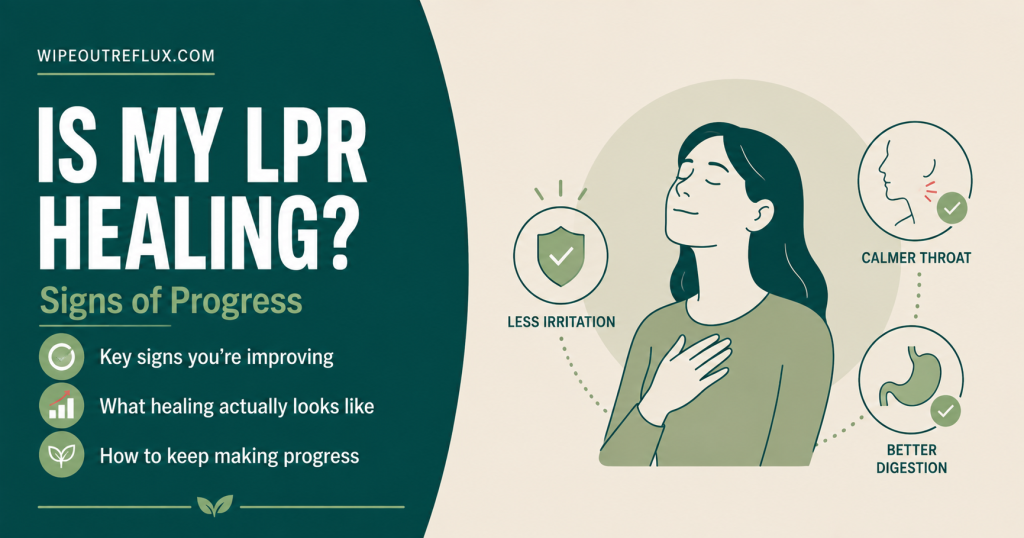
If you’re wondering whether your LPR is healing, the most reliable early sign is that your symptoms are easing — less throat clearing, a lump sensation that’s fading, a voice that’s clearing, fewer bad mornings. Those improvements are real progress, even though they arrive well before your throat has fully healed on the inside.
That gap is the single most important thing to understand about LPR recovery: your symptoms get better before the tissue does. You can feel noticeably improved while the lining of your throat is still healing quietly in the background for months more. It’s genuinely good news — it means the treatment is working — but it’s also the exact point where people stop too soon and relapse.
Here’s how to read the signs your LPR is healing, what recovery actually looks like over time, and why feeling better is a milestone rather than a finish line.
Key Takeaways
- The clearest early sign of healing is symptom improvement: less throat clearing, reduced globus (lump sensation), clearer voice, less cough, and fewer night-time or morning symptoms.
- Symptoms improve before the throat tissue heals — research shows symptom relief comes within weeks to a couple of months, while the physical findings resolve more slowly over six months or more.
- Feeling better is real progress, but it’s not proof of full healing, which is why stopping treatment at that point is a common cause of relapse.
- Recovery is gradual and rarely linear — occasional flare-ups on the way down don’t mean you’ve lost progress.
- A dropping Reflux Symptom Index (RSI) score is a useful, trackable way to measure improvement over time.
- Different people need different lengths of treatment; some settle in a month, many need three to nine months to fully respond.
- If nothing improves after a fair, consistent effort, it’s worth reassessing the diagnosis and approach rather than simply pushing harder.
The signs your LPR is healing
Because LPR is diagnosed largely by its symptoms, those same symptoms easing off is your first and best evidence of healing. You don’t need a scope to notice the trend — you’ll feel it. The most common symptoms of LPR tend to soften in roughly this way:
- Less throat clearing. That constant need to clear your throat easing is one of the earliest wins — here’s more on throat clearing from reflux.
- The lump sensation fading. The globus feeling becoming less noticeable, or disappearing for stretches, is a strong sign.
- A clearer voice. Less hoarseness and a voice that holds up better through the day.
- Fewer coughs and less mucus. The nagging cough and need to hawk mucus settling down.
- Better mornings. Waking with less of a raw, tight or gunky throat — a sign your night-time reflux is coming under control.
A useful way to make this concrete is to track your Reflux Symptom Index (RSI) — a simple questionnaire — every few weeks. A falling score over time is objective proof you’re moving in the right direction, even on days that feel mixed.
Why symptoms heal before your throat does
This is the part that surprises people and matters most. When you feel better, it’s tempting to assume you’re healed — but the relief you feel runs ahead of the actual tissue repair. Your symptoms can be most of the way gone while the lining of your throat and larynx is still visibly inflamed on examination.
This is well established. In a study tracking LPR patients through treatment, symptoms measured by the RSI improved significantly within about two months, while the physical findings in the throat — scored objectively on laryngoscopy — resolved far more slowly and kept improving across at least six months Belafsky et al., The Laryngoscope, 2001. A later study following both symptoms and findings over treatment reached the same conclusion: symptoms responded, but the visible laryngeal healing lagged behind Lechien et al., The Laryngoscope, 2021. So feeling 80% better doesn’t mean you’re 80% healed — the tissue is still catching up. This is exactly why the LPR recovery timeline stretches over months.
What healing looks like over time
Recovery tends to unfold in overlapping phases rather than all at once. In the first few weeks, you’ll often notice the sharpest, most irritating symptoms starting to ease — the throat clearing and the raw mornings. Over the following one to three months, the deeper symptoms like globus and voice changes tend to settle, and good days start outnumbering bad ones. Beyond that, from around three to six months and sometimes longer, the throat tissue itself continues healing even as you feel largely normal.
How long the whole process takes varies a lot from person to person. Encouragingly, research on the minimum effective treatment duration found that about a third of people respond within a single month, while those who don’t respond early typically need three to nine months of consistent treatment to get there Lechien, Otolaryngology–Head and Neck Surgery, 2024. If you’re a slower responder, that’s normal — it doesn’t mean it isn’t working. A related benchmark is the healing time for a reflux sore throat, which follows the same unhurried pattern.
Flare-ups don’t erase your progress
Here’s something that trips people up emotionally: healing isn’t a straight line. You can be clearly improving and still have a bad day or a short flare — after a trigger food, a late meal, a stressful week, or sometimes for no obvious reason. It feels like a setback, but a single flare against a backdrop of overall improvement doesn’t undo the healing you’ve done.
The thing to watch is the trend, not the day. If your worst days are getting less frequent and less severe over weeks, you’re healing — even with the odd bad patch. This is also why lingering pepsin can cause a quiet stretch to flare briefly: understanding what pepsin is helps make sense of the occasional bump without reading it as failure.
Why you shouldn’t stop when you feel better
This follows directly from the symptoms-heal-first gap, and it’s the single most important practical takeaway. The moment you feel good is precisely when the tissue is still healing and the underlying reflux is still active — so easing off treatment then is how many people slide straight back into symptoms.
Feeling better is the green light to keep going, not to stop. The durable approach is to continue your silent reflux treatment and protective habits well past the point of symptom relief, giving the tissue time to fully recover before you gradually ease back. Having a steady LPR protocol you can stick to makes this far easier than relying on willpower day to day. And because this is often a condition that can flare again, healing fully now sets you up to stay well — it’s a big part of why LPR doesn’t have to be permanent.
What if nothing’s improving?
If you’ve given a consistent, genuine effort — not a stop-start few weeks — and you’re seeing no movement at all, that’s worth taking seriously rather than just trying harder at the same thing. Sometimes the issue is that acid-suppressing medication alone isn’t enough, which is common in LPR: it’s worth understanding why PPIs often don’t work for LPR and whether reflux is being reduced at the source rather than just chemically neutralised.
Other times, persistent throat symptoms that won’t budge deserve a fresh look to confirm the diagnosis, since other conditions can mimic LPR. If you’re stuck, or if symptoms are worsening, alarming, or accompanied by things like difficulty swallowing, weight loss or a persistent voice change, don’t wait it out — here’s when to see a doctor for LPR.
Conclusion
The best way to know your LPR is healing is to watch your symptoms trend downward over weeks: less throat clearing, a fading lump sensation, a clearer voice, calmer mornings, and a Reflux Symptom Index score that keeps dropping. Those are real signs of progress. Just remember that they arrive ahead of the tissue — your throat keeps healing for months after you feel better — and that recovery comes with the occasional flare that doesn’t undo your progress. Read the trend, not the single bad day.
The most valuable thing you can do with that knowledge is to keep going when you feel better rather than stopping. Feeling improved is the sign the approach is working and the cue to see it through, giving your throat the months it needs to fully recover so the improvement lasts. Patience here isn’t passive — it’s what converts short-term relief into lasting healing.
Since what drives that healing is lowering how much you reflux, it comes down to what you eat and drink. The Wipeout Food Reference Guide is the essential reference for which foods and drinks are safe with acid reflux and LPR, along with their pH values, so you can keep reflux low while your throat heals. And for the complete, step-by-step method — the kind of consistent, sustained approach that lets tissue fully recover — the Wipeout Diet Plan goes much deeper. It was built first and foremost around LPR, the slow-healing throat-based reflux, but because it works on the same underlying mechanisms it’s just as effective for classic GERD and heartburn. Track your progress, trust the trend, and give the healing time to finish.
Frequently Asked Questions
What are the signs that LPR is healing?
The main signs are easing symptoms: less throat clearing, a fading lump-in-the-throat sensation, a clearer and steadier voice, less coughing and mucus, and calmer mornings with less throat irritation on waking. A falling Reflux Symptom Index score over several weeks is a good objective way to confirm you’re improving.
How long does LPR take to heal?
It varies widely. Symptoms often start improving within a few weeks to two months, but the throat tissue heals more slowly, over six months or more. Research suggests about a third of people respond within a month, while slower responders may need three to nine months of consistent treatment to fully recover.
Why do I feel better but my throat still isn’t right?
Because symptom relief runs ahead of tissue healing in LPR. Studies show symptoms improve well before the physical findings in the throat resolve, so you can feel mostly better while the lining is still healing underneath. It’s a normal part of recovery — and a reason to keep treating rather than stop.
Is it normal to have flare-ups while healing from LPR?
Yes. Healing isn’t linear, and occasional flares — after a trigger food, a late meal or a stressful stretch — are common even when you’re clearly improving overall. A single bad day doesn’t erase your progress. What matters is the trend: if flares are becoming less frequent and less intense over time, you’re still healing.
Should I stop treatment once my LPR symptoms are gone?
No — that’s a common cause of relapse. Symptoms disappear before the tissue fully heals and while the underlying reflux is still active, so stopping at that point often lets symptoms return. Continue your treatment and protective habits past the point of feeling better, then ease off gradually once you’ve given the throat time to recover.
Research & References
- Study of LPR patients treated and assessed at 2, 4 and 6 months, finding that symptoms measured by the Reflux Symptom Index improved significantly within about two months while the physical laryngeal findings resolved more slowly and continued improving over at least six months — establishing that symptoms improve before physical findings Belafsky et al., The Laryngoscope, 2001.
- Prospective study tracking laryngeal and extralaryngeal symptoms and findings through LPR treatment, showing that both symptoms and findings improved significantly over the course of therapy but that the improvement of the visible laryngeal findings was slower than the symptom improvement Lechien et al., The Laryngoscope, 2021.
- Prospective study on the minimum effective duration of LPR treatment, reporting that a one-month regimen was sufficient for about a third of patients, while early non-responders typically required three to nine months of treatment to respond Lechien, Otolaryngology–Head and Neck Surgery, 2024.

David Gray
12 years living with LPR · Consultant & researcher
I've lived with LPR for twelve years — the misdiagnoses, the PPI courses that did nothing, the slow work of figuring out what actually helps. Wipeout Reflux is where I translate the research into plain terms for people stuck in the same place. Every claim here is sourced to peer-reviewed work, and I consult one-to-one with LPR sufferers.