
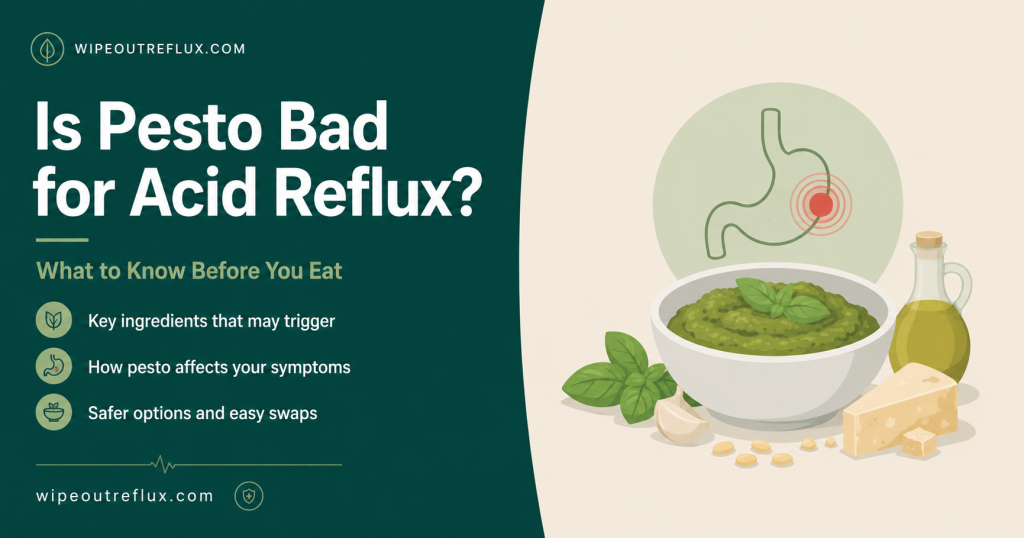
Pesto can be a reflux trigger, but not for the reason most people assume. It isn’t the basil, and it usually isn’t even the garlic that does the most damage — it’s the oil. A traditional pesto is built around a large volume of olive oil, and dietary fat is one of the most reliable ways to relax the valve at the top of your stomach and slow how quickly that stomach empties. Add garlic and aged cheese on top of that fat load, and you have a sauce that stacks three separate reflux mechanisms into a few tablespoons.
The good news is that pesto is one of the more fixable trigger foods once you understand which part is actually causing the problem. Portion size, the oil-to-everything-else ratio, and what you serve it with matter far more than whether pesto is “allowed” at all.
This guide breaks down exactly why pesto tends to aggravate reflux, which of its ingredients matters most, how classic green pesto compares to red and dairy-heavy versions, and how to build or order a version that’s genuinely gentler on both GERD and silent reflux.
Key Takeaways
- The main reflux problem with pesto is its high fat content from olive oil — dietary fat triggers cholecystokinin (CCK) release, which relaxes the lower oesophageal sphincter and slows gastric emptying.
- A typical serving of traditional basil pesto contains around 10–15g of fat, most of it from oil, before you add anything else to the plate.
- Garlic is the second issue — it’s a commonly reported personal trigger and a concentrated source of fructans (FODMAPs) that ferment and produce gas, raising stomach pressure.
- Parmesan and pecorino add a third layer: aged hard cheeses are among the highest-histamine foods, and histamine directly stimulates gastric acid secretion.
- Basil and pine nuts themselves are largely reflux-neutral — the problem is the medium they’re delivered in, not the herb.
- Red (sun-dried tomato) pesto adds acidity on top of the fat; creamy pesto pasta sauces add even more fat via cream and butter.
- Portion control is the single most effective lever — a tablespoon stirred through a larger dish behaves very differently from a thick coating.
- For LPR (silent reflux), the fat-driven sphincter relaxation and the histamine from aged cheese are the two mechanisms that matter most.
Is Pesto Bad for Acid Reflux?
For most people with reflux, pesto is a moderate trigger — not off-limits, but worth treating with respect because of how much fat it packs into a small volume. Traditional Genovese pesto is roughly half oil by weight. That concentration is the crux of the issue: you can eat a fairly small amount of pesto and still deliver a large fat load to your digestive system in one go.
Whether that tips you into symptoms depends on the same variables that govern every fatty food and reflux: how much you eat, what else is on the plate, how close to bedtime, and how competent your lower oesophageal sphincter (LES) is to begin with. Someone with a hiatal hernia or a structurally weak LES will feel a spoonful of pesto far more than someone without those issues. The mechanisms below explain why the oil matters most, and where garlic and cheese come in.
Why the Oil Load Matters Most
Dietary fat is the most consistent food-based driver of reflux, and pesto is essentially a fat-delivery system with flavour. When fat reaches the small intestine, it triggers the release of a hormone called cholecystokinin (CCK). CCK does useful things for digestion, but it also relaxes the lower oesophageal sphincter and increases the frequency of transient LES relaxations — the brief openings of the valve that let stomach contents escape upward. A controlled human study confirmed that duodenal fat, acting through CCK, both increases these transient relaxations and reduces resting LES pressure [Feinle et al., Gastroenterology, 1999].
On top of that, fat slows gastric emptying. Food sits in the stomach longer, under pressure, which extends the window during which reflux can occur — a particular problem if pesto features in an evening meal eaten close to bedtime. Population data backs the everyday impact of this: higher dietary fat intake has been associated with meaningfully greater odds of GERD [Association between Dietary Fat Intake and GERD, International Journal of Preventive Medicine, 2021].
This is why olive oil being “healthy” doesn’t exempt pesto from the reflux conversation. Olive oil is a genuinely good fat nutritionally, but the LES doesn’t distinguish between virtuous and villainous fats — it responds to the fat load itself. I cover this in more detail in my guide to whether olive oil causes acid reflux. The practical takeaway: the amount of oil is the lever, not the type.
The Garlic Problem
Garlic is the second reason pesto has a reputation as a trigger. It shows up on almost every list of common reflux offenders, and there are two plausible reasons for that. First, garlic is a frequently reported personal trigger — many people with reflux notice symptoms after concentrated raw garlic specifically, even if the exact mechanism isn’t fully pinned down. Second, garlic is one of the most concentrated dietary sources of fructans, a type of FODMAP carbohydrate that ferments in the gut and produces gas. That gas raises pressure in the stomach, which can push against the LES and provoke reflux.
Traditional pesto uses raw garlic, which tends to be harsher than cooked. If garlic is a clear trigger for you, this is one of the easier ingredients to reduce or omit without ruining the sauce. My article on whether garlic is acidic or alkaline covers the trigger question in depth, and if fructans are your issue, the low-FODMAP approach to reflux explains how to swap garlic for garlic-infused oil, which carries the flavour without the fructans.
The Cheese Layer: Parmesan and Histamine
Authentic pesto contains a substantial amount of aged hard cheese — usually Parmigiano-Reggiano, often with pecorino. These are exactly the cheeses that carry the highest biogenic amine load. Aged and ripened cheeses accumulate histamine during maturation, with levels documented up to 157 mg/kg across a range of ripening cheeses [Bodmer et al., Inflammation Research, 1999]. Histamine matters for reflux because it directly stimulates the stomach to produce more acid — more acid means a more corrosive refluxate if any escapes.
For people with silent reflux in particular, this histamine route is worth taking seriously, because LPR symptoms are often driven as much by what stimulates acid and pepsin as by the mechanical reflux itself. Parmesan also adds its own saturated fat on top of the oil. I go deeper into the cheese mechanisms in my guide to whether cheese causes acid reflux. The upshot for pesto: the cheese is a secondary but real contributor, and reducing it helps.
What About the Basil and Pine Nuts?
Here’s the reassuring part. Basil itself is not a reflux trigger — it’s a mild, non-acidic herb with no known mechanism for worsening reflux, and it’s often included in reflux-friendly recipes as a flavour builder precisely because it lets you cut back on genuine triggers. Pine nuts (and other nuts used in pesto variations) are high in fat, so they contribute to the overall fat load, but in the modest quantities used they’re a minor factor next to the oil.
This matters because it tells you where to focus. You don’t need to give up the flavour of pesto to manage reflux — basil, a little nut, and a modest amount of cheese are the parts you actually taste. It’s the oil volume, the raw garlic, and the sheer portion that drive symptoms. Rebalancing those is what makes pesto workable.
Green vs Red vs Creamy Pesto
Not all pesto is the same, and the differences matter for reflux.
- Classic green (basil) pesto: High oil, raw garlic, aged cheese. The fat load is the main issue. Manageable in small amounts.
- Red / sun-dried tomato pesto: Everything green pesto has, plus the acidity of concentrated tomato. Sun-dried tomatoes are highly acidic and can directly irritate an already-sensitive throat in LPR. This is generally the harder version for reflux.
- Creamy pesto pasta sauces: Restaurant and jarred “pesto cream” sauces blend pesto with double cream, butter, or mascarpone — dramatically increasing the total fat load. These are the most reliable triggers of the three.
If you’re choosing between them with reflux in mind, a small amount of classic green pesto is usually the safest, red pesto adds an acid problem on top, and creamy pesto sauces are the ones to be most cautious with. For the bigger picture on which sauces and condiments cause trouble, my guide to condiments to avoid with acid reflux puts pesto in context alongside the other usual suspects, and a structured plan like the Wipeout Diet Plan takes the guesswork out of where a sauce like this fits day to day.
How to Make Pesto Gentler on Reflux
You don’t have to eliminate pesto — you have to change its ratios and how you use it. These are the levers with the most impact:
- Cut the oil, add moisture another way: Replace a portion of the olive oil with a splash of the pasta cooking water, a little vegetable stock, or a spoon of plain part-skim ricotta. You keep the loose, coating texture with a fraction of the fat.
- Use garlic-infused oil instead of raw cloves: The flavour compounds are fat-soluble, so infused oil carries the garlic taste without the fructans that ferment and cause gas.
- Go light on the cheese: Use a smaller amount of Parmesan, or lean on nutritional yeast for a savoury, umami note with none of the histamine.
- Treat it as a seasoning, not a coating: A tablespoon stirred through a big bowl of pasta and vegetables delivers far less fat than a thick, glossy coating. Portion is the strongest single lever.
- Serve it with the right base: Pesto on grilled chicken and courgette is a gentler vehicle than pesto on a rich, cheese-laden pasta bake. What surrounds the sauce often matters as much as the sauce.
- Keep it away from bedtime: Because fat slows gastric emptying, a pesto-heavy meal sits longer. Eat it earlier in the day, and give yourself three hours upright before lying down. My guide to acid reflux at night explains why timing changes everything.
Frequently Asked Questions
Is pesto bad for acid reflux?
Pesto is a moderate trigger for most people with reflux, mainly because of its high fat content from olive oil. Fat relaxes the lower oesophageal sphincter and slows stomach emptying, both of which promote reflux. Garlic and aged cheese add secondary effects. It’s not off-limits, but portion size and the oil-to-everything ratio determine whether it causes symptoms.
Which part of pesto causes reflux?
The olive oil is the biggest factor, because of the fat load. Garlic is the second most common culprit, both as a reported personal trigger and as a source of gas-producing fructans. Aged cheese (Parmesan, pecorino) is third, contributing histamine that stimulates gastric acid. Basil and pine nuts themselves are largely reflux-neutral.
Is red pesto worse than green pesto for reflux?
Usually yes. Red pesto contains everything green pesto does — oil, garlic, cheese — plus concentrated sun-dried tomato, which is highly acidic and can directly irritate the throat in silent reflux. Green pesto in a small portion is generally the safer choice.
Can I eat pesto with silent reflux (LPR)?
In small, controlled amounts, often yes — but the two mechanisms that matter most for LPR are the fat-driven sphincter relaxation and the histamine from aged cheese, so reducing both the oil and the Parmesan makes a real difference. Avoid red pesto, which adds acidity that can reactivate pepsin in throat tissue.
Is homemade pesto better for reflux than jarred?
It can be, because you control the ratios. Homemade lets you cut the oil, use garlic-infused oil instead of raw garlic, and reduce the cheese — the three levers that matter most. Many jarred and especially creamy restaurant pestos are considerably higher in total fat.
What can I use instead of pesto?
A lighter basil-forward sauce built on part-skim ricotta or blended steamed courgette, loosened with pasta water and seasoned with basil and a little Parmesan, gives you the herby flavour with far less oil. Chimichurri-style herb sauces can also work if you keep the oil modest and skip the chilli.
Conclusion
Pesto earns its trigger-food reputation, but for a more specific reason than most sources give: it’s the oil load, first and foremost, that drives reflux — with raw garlic and aged cheese layering on gas and histamine effects behind it. Basil, the part that gives pesto its identity, is essentially blameless. That’s genuinely good news, because it means you can keep the flavour you actually want and simply rebalance the parts that cause the problem: less oil, garlic-infused rather than raw, a lighter hand with the Parmesan, and a portion that behaves like a seasoning rather than a coating.
If pesto is one of several foods you’re trying to place, the most reliable way to stop guessing is to work from a structured framework rather than food-by-food rules. The Wipeout Diet Plan is the more in-depth option here — it was built first and foremost around LPR, the stubborn throat-based form of reflux, but because it targets the same underlying mechanisms it works just as well for GERD and everyday heartburn, and it maps out exactly where fatty sauces, garlic and aged cheese sit so you’re not deciding in the moment. Alongside it, the Wipeout Reflux Food Reference Guide is the essential companion — it covers the pH values and reflux ratings for the foods and drinks around a dish like pesto, so you always know where you stand before you eat.
Research & References
Feinle C et al. (1999). Role of duodenal lipid and cholecystokinin A receptors in the pathophysiology of functional dyspepsia. Gastroenterology. This controlled human study showed that fat reaching the duodenum triggers endogenous CCK release, which increases transient lower oesophageal sphincter relaxations and reduces resting LES pressure — the core mechanism by which a high-fat food like pesto promotes reflux. [Feinle et al., Gastroenterology, 1999]
Nadaleti D et al. (2021). Association between Dietary Fat Intake and Odds of Gastro-esophageal Reflux Disorder (GERD) in Iranian Adults. International Journal of Preventive Medicine. This population study found that higher dietary fat intake was associated with significantly greater odds of GERD, supporting the everyday relevance of the fat-reflux mechanism beyond acute laboratory conditions. [International Journal of Preventive Medicine, 2021]
Bodmer S, Imark C, Kneubühl M. (1999). Biogenic amines in foods: histamine and food processing. Inflammation Research. Analysis of 43 samples of soft and hard ripening cheeses documented histamine levels up to 157 mg/kg and tyramine up to 575 mg/kg — the peer-reviewed basis for the high histamine load of the aged Parmesan and pecorino used in traditional pesto. [Bodmer et al., Inflammation Research, 1999]

David Gray
12 years living with LPR · Consultant & researcher
I've lived with LPR for twelve years — the misdiagnoses, the PPI courses that did nothing, the slow work of figuring out what actually helps. Wipeout Reflux is where I translate the research into plain terms for people stuck in the same place. Every claim here is sourced to peer-reviewed work, and I consult one-to-one with LPR sufferers.