
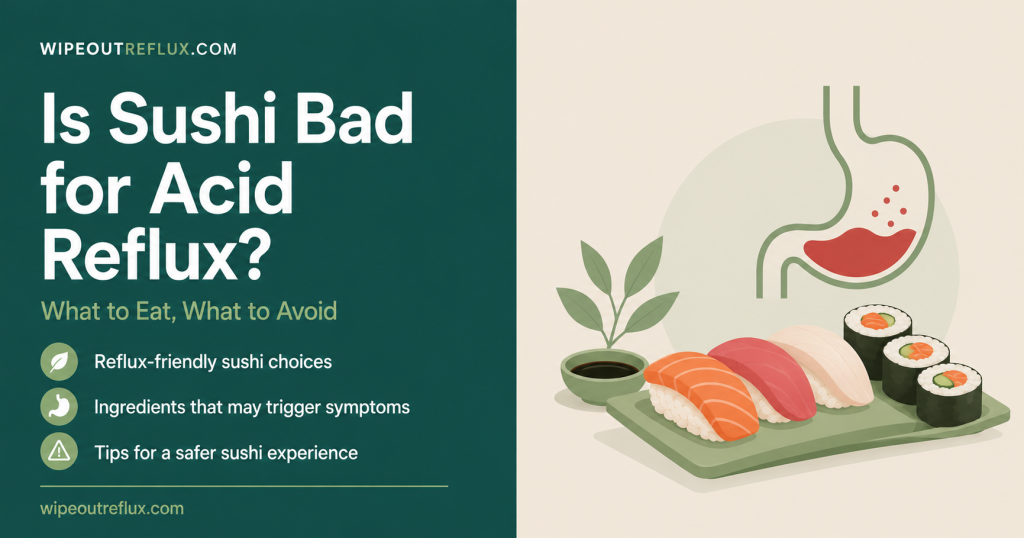
It depends on the sushi — but the part that catches people out isn’t the raw fish. It’s the rice. Sushi rice is seasoned with rice vinegar, which makes it genuinely acidic: properly made sushi rice typically sits around pH 4, well into the range that matters for reflux, and especially for the silent, throat-based kind. The fish itself is usually lean protein and one of the gentler things on the plate.
So the honest version is that plain nigiri and sashimi can be fairly reflux-friendly, while the acidity of the rice, a splash of soy, a smear of wasabi and the fried, mayo-heavy rolls are what turn a Japanese meal into a rough evening. If you’ve ever wondered why a “healthy” sushi dinner left your throat burning, the vinegar in the rice is the usual answer.
Here’s what’s actually going on, and how to order sushi that treats your reflux kindly.
Key Takeaways
- Sushi rice is seasoned with rice vinegar and sits around pH 4 — genuinely acidic, and the part of sushi most likely to bother reflux.
- Raw fish itself is lean, non-acidic protein and is usually one of the gentler elements.
- The acidity matters most for silent reflux (LPR), where dietary acid below about pH 5 can reactivate throat-bound pepsin.
- For classic heartburn (GERD), the bigger issues are often volume, soy sauce, wasabi and fried rolls rather than the rice’s pH.
- Tempura and “crunchy” rolls, and spicy-mayo rolls, add the fat and calorie load that drives most food-related reflux.
- Soy sauce is very salty, wasabi is spicy, and pickled ginger is acidic — small extras that stack up.
- Sashimi, plain nigiri and simple rolls, eaten in a sensible amount and not late at night, are the reflux-friendly way to do sushi.
Why the Rice Is the Real Problem
Sushi rice isn’t plain rice. It’s mixed while warm with a seasoning of rice vinegar, sugar and salt — that faint sweet-sour tang is the whole point of it. The vinegar is acetic acid, and it drops the pH of the rice a long way. Food-safety measurements of restaurant sushi rice consistently put it at around pH 4.1 to 4.3, which is why properly acidified sushi rice can be held safely at room temperature in the first place.
That’s a meaningful number. Plain steamed rice is close to neutral and one of the gentlest foods there is — see is rice acidic or alkaline. Turn it into sushi rice and you’ve moved it down into clearly acidic territory, on a par with a lot of the fruits people carefully avoid. The vinegar is doing exactly what vinegar does, as covered in is vinegar acid or alkaline.
The catch is that almost every piece of sushi is mostly rice. A nigiri is a small slice of fish on a fat finger of vinegared rice; a roll is a thin layer of filling wrapped around a lot of it. So when sushi bothers your reflux, you’re often reacting to the acid in the rice you barely noticed, not the fish you were worried about.
Where the Acidity Matters Most: Silent Reflux
The rice’s acidity matters far more if your reflux is the silent, throat-based kind (LPR) than if it’s classic heartburn. Here’s the difference.
In LPR, pepsin — the stomach’s protein-digesting enzyme — gets carried up into the throat and lodges in that delicate tissue. Once it’s there, acid you eat or drink can switch it back on, and the reactivated pepsin keeps irritating the throat. Human pepsin stays partly active well above the pH people assume, which is the reasoning behind strict low-acid eating [Johnston et al., The Laryngoscope, 2007]. A low-acid diet that removes everything below roughly pH 5 improved symptoms in the large majority of treatment-resistant LPR patients in one study [Koufman, Annals of Otology, Rhinology & Laryngology, 2011]. Sushi rice, at around pH 4, sits below that threshold — which is exactly why it can leave the throat raw. The mechanism is spelled out in how pepsin reactivates in the throat, and if the whole idea is new, what is pepsin is the place to start.
For classic GERD, where the burn is lower down, the rice’s pH is a smaller factor — your stomach is already far more acidic than any sushi rice, so a mildly acidic food adds little. There, the volume of the meal and the fattier, saltier extras tend to matter more. Either way, the rest of the tray is worth a closer look.
The Extras That Stack Up
Soy sauce
Soy sauce is intensely salty — a few dishes’ worth of dipping can carry a large amount of sodium. Salt isn’t a strong direct reflux trigger, but it’s easy to drown sushi in it, and low-sodium soy is worth asking for. More in is soy sauce acidic.
Wasabi
Wasabi is pungent and spicy, and spice is a common trigger for reflux symptoms — particularly the throat kind. A little is fine for most people; a lot on every piece is asking for trouble. The wider picture is in spicy food and acid reflux.
Pickled ginger
The pink ginger served alongside is pickled — usually in vinegar — so it’s acidic too. It’s a palate cleanser, not a main event, but it adds to the acid load if you work through the whole pile.
Tempura, “crunchy” and spicy-mayo rolls
This is where sushi stops being light. Tempura and crunchy rolls are deep-fried, and spicy-mayo and “dynamite” rolls are built around mayonnaise — both pile on fat. Fat and calorie density are the most consistent dietary drivers of reflux: in a controlled crossover study, oesophageal acid exposure rose after calorie-dense meals and symptoms tracked the fat percentage of the meal [Fox et al., Clinical Gastroenterology and Hepatology, 2007]. A tray of fried, mayo-laden rolls is a very different proposition from sashimi.
The Fish Is the Easy Part
Raw fish itself is lean, non-acidic protein — among the gentlest things you can eat with reflux. Even the fattier fish used in sushi, like salmon and tuna, carry the beneficial kind of fat rather than the saturated fat that’s linked to more symptoms [El-Serag et al., Gut, 2005]. If anything, plain fish is the reason to keep sushi on the menu at all. There’s more on this in what fish is good for acid reflux, is salmon good for acid reflux and is tuna good for acid reflux.
That’s the irony of the whole thing: the part everyone worries about is the safe part, and the humble rice underneath is doing most of the damage.
How to Order Reflux-Friendly Sushi
The good news is that a few simple choices strip most of the risk out of a sushi meal — the same food-by-food swap logic the Wipeout Diet Plan applies to eating out:
- Favour sashimi. Slices of raw fish with no rice at all sidestep the acidity entirely. It’s the single best choice if the rice is your problem.
- Choose plain nigiri and simple rolls over tempura, crunchy or spicy-mayo rolls. Skip the deep-fried and mayonnaise-based options.
- Go easy on the rice-heavy volume. A big tray of rolls is a lot of vinegared rice in one sitting. A smaller, fish-forward order lightens the acid load.
- Dip lightly, and ask for low-sodium soy. You control how much soy and wasabi end up on each piece — use a little, not a lot.
- Add gentle sides. Edamame, plain steamed rice, miso soup and cucumber are all easy on reflux and help fill you up without more acid.
- Mind the timing. Sushi is often a late dinner. A large, rice-heavy meal shortly before lying down is the worst combination — more on eating out sensibly in eating out with acid reflux.
Conclusion
Sushi isn’t off the table, but it pays to know where the trouble actually lives. The raw fish is lean, gentle protein; it’s the vinegared rice, at around pH 4, that carries the acid load — and for silent reflux in particular, that’s enough to leave the throat sore. Add the soy sauce, wasabi, pickled ginger and the fried, mayo-heavy rolls, and a “healthy” sushi dinner quietly becomes a stack of small triggers. Order sashimi or plain nigiri, keep the volume and the extras modest, and don’t eat it right before bed, and sushi becomes a very manageable meal.
Working out which foods are genuinely a problem and which just need ordering differently is precisely what the Wipeout Diet Plan is built around — it takes you through the real triggers, the safe swaps and how to eat out without paying for it. I designed it first and foremost for LPR and silent reflux, the stubborn throat-based form that medication so often fails to settle, but because it works on the same underlying mechanisms it applies just as well to GERD and everyday heartburn. And the Wipeout Food Reference Guide is the companion for exactly the question this article raises — which foods and drinks are safe for acid reflux and LPR, with their real pH values, so the acidity of something like sushi rice never catches you out again.
Frequently Asked Questions
Is sushi bad for acid reflux?
Not inherently — it depends what you order. The raw fish is lean, gentle protein, but the vinegared rice is genuinely acidic (around pH 4), and fried tempura or spicy-mayo rolls add fat. Sashimi and plain nigiri in a sensible amount are reflux-friendly; big trays of fried, rice-heavy rolls with lots of soy and wasabi are not.
Why does sushi give me acid reflux?
Usually the rice. Sushi rice is seasoned with rice vinegar, which makes it acidic enough to matter — especially for silent reflux, where dietary acid can reactivate throat-bound pepsin. Soy sauce, wasabi, pickled ginger and fried or mayo-based rolls add to the load, so a full sushi meal stacks several small triggers at once.
Is sashimi better than sushi for reflux?
Yes, if the rice is your issue. Sashimi is just slices of raw fish with no rice, so it avoids the vinegar acidity entirely while giving you the lean protein that makes fish gentle on reflux. It’s the single best choice for anyone whose throat reacts to sushi.
Is the raw fish in sushi a problem for acid reflux?
Rarely. Raw fish is lean, non-acidic protein and one of the gentler foods for reflux. Even fattier fish like salmon and tuna carry beneficial fats rather than the saturated fat linked to more symptoms. If sushi bothers you, the rice and the extras are the far more likely cause than the fish.
Can I eat sushi with silent reflux (LPR)?
You can, but choose carefully. The vinegared rice sits below the pH 5 threshold that matters for LPR, so favour sashimi or keep rolls small, go light on soy and wasabi, skip the pickled ginger, and avoid fried rolls. Fish-forward, low-rice choices treat the throat much more kindly.
Is soy sauce or wasabi worse for reflux?
They cause trouble in different ways. Soy sauce is very salty and easy to overuse, while wasabi is spicy, and spice is a common reflux trigger. Neither is disastrous in a small amount — the problem is dousing every piece. Use both sparingly, and ask for low-sodium soy where you can.
Research & References
- Johnston et al., The Laryngoscope, 2007 — Laboratory work on human pepsin showing it retains proteolytic activity well above pH 4. This is the basis for why an acidic food like sushi rice (around pH 4) matters in silent reflux, where it can reactivate pepsin bound in the throat tissue.
- Koufman, Annals of Otology, Rhinology & Laryngology, 2011 — Prospective study of treatment-resistant LPR patients placed on a strict low-acid diet removing everything below pH 5. Ninety-five percent improved — the pH threshold that places vinegared sushi rice firmly on the “acidic” side.
- Fox et al., Clinical Gastroenterology and Hepatology, 2007 — Randomised crossover study showing oesophageal acid exposure rose after calorie-dense meals and reflux symptoms tracked the fat percentage of the meal — the reason fried tempura and spicy-mayo rolls are the fattier, higher-risk sushi choices.
- El-Serag et al., Gut, 2005 — Cross-sectional study linking higher total and saturated fat intake with more frequent reflux symptoms, supporting the point that the lean fish in sushi is far gentler than the fried, mayonnaise-based rolls.

David Gray
12 years living with LPR · Consultant & researcher
I've lived with LPR for twelve years — the misdiagnoses, the PPI courses that did nothing, the slow work of figuring out what actually helps. Wipeout Reflux is where I translate the research into plain terms for people stuck in the same place. Every claim here is sourced to peer-reviewed work, and I consult one-to-one with LPR sufferers.